
BUSINESS
Pure DC Raises $2.7BN With New Bank Syndicate as Gulf Plans Stall

A London-headquartered landlord to the world’s biggest cloud companies has just closed $2.7 billion in fresh debt, the bulk of it secured against half-built campuses in Dublin and Amsterdam. Pure Data Centres, the Oaktree-backed developer better known as Pure DC, said on Wednesday it had syndicated a $2.15 billion asset-level facility in roughly three months and expanded its corporate revolver to $550 million, bringing Japanese lender SMBC, Allianz Global Investors and ABN AMRO into a book once dominated by US private credit.
The pitch is European and Middle East AI expansion. The footnote, buried four weeks deep in a CNBC interview Pure DC gave in late April, is that the firm has paused investment decisions across the Gulf because of the Iran war. Most of this money has nowhere to go but Europe for now.
How Pure DC Split the $2.7 Billion
The structure tells the story before the press release does. Pure DC raised the money in two tranches that do very different jobs: a large secured loan tied to specific live campuses, and a smaller unsecured facility that sits at the holding-company level. Bank lenders prefer the first kind. Equity-style growth capital tends to come through the second.
The asset-level slice runs $2.15 billion and is collateralised against the Ballycoolin campus outside Dublin and the new Westpoort site in Amsterdam. Pure DC’s Dublin facility hosts Europe’s first large-scale data centre microgrid, a feature lenders cite when they talk about long-dated energy resilience. The corporate facility was lifted to $550 million and stays unsecured, giving the holding company room to fund pre-development work, land options and the early-stage Saudi and Finnish projects that are not yet bankable on their own cash flows.
| Tranche | Size | Type | Collateral |
|---|---|---|---|
| Asset-level facility | $2.15 billion | Secured | Dublin (Ballycoolin), Amsterdam (Westpoort) |
| Corporate facility | $550 million | Unsecured revolver | Holding company |
| Combined raise | $2.7 billion | Mixed | Live + pipeline assets |
The mix matters because it signals which projects are real and which are still bets. Dublin and Amsterdam are real. The rest is pipeline.
SMBC, Allianz, and ABN AMRO Join the Lender Book
The new names on the syndicate sheet are the more interesting read. Pure DC’s earlier financing leaned heavily on US private credit, where Oaktree Capital Management itself is a recognised player. The Wednesday deal pulls in three institutions that until recently treated AI-era data centre debt as too lumpy, too power-exposed, or too dependent on a single anchor tenant to underwrite at scale.
The new lenders bring three different cheque profiles to the table:
- Sumitomo Mitsui Banking Corporation (SMBC), one of Japan’s three megabanks, which has been ramping European infrastructure lending and recently doubled its London project-finance team
- Allianz Global Investors, the asset-management arm of the German insurer, which manages roughly €560 billion and prefers long-dated, inflation-linked infrastructure paper
- ABN AMRO, the Dutch bank with home-market familiarity of the Amsterdam grid permits and the Port of Amsterdam leasehold that sits under the Westpoort site
Each came in for a different reason. SMBC wanted European AI exposure without funding the hyperscalers directly. Allianz wanted duration. ABN AMRO wanted the deal in its backyard. Pure DC built a syndicate that gave each of them the slice they needed and closed inside a quarter, fast by data centre financing standards.
The deeper signal is what it tells us about cost of capital. When pension-style money from Allianz prices alongside a Japanese commercial bank against the same collateral pool, the spread on hyperscale data centre debt is converging on regulated-utility levels. That is a change. Two years ago this asset class still priced like specialty real estate.
Inside the Westpoort Hyperscale Campus
The Amsterdam project is the centrepiece of the collateral, and the one most readers will know by reputation. Pure DC is putting more than €1 billion into a 78 megawatt campus in the Westpoort port district, on a long-term leasehold from the Port of Amsterdam. The site, named AMS01, is fully pre-let to a single hyperscale customer that Dutch media have identified as Microsoft and that Pure DC itself has not named publicly.
The Site Specifications
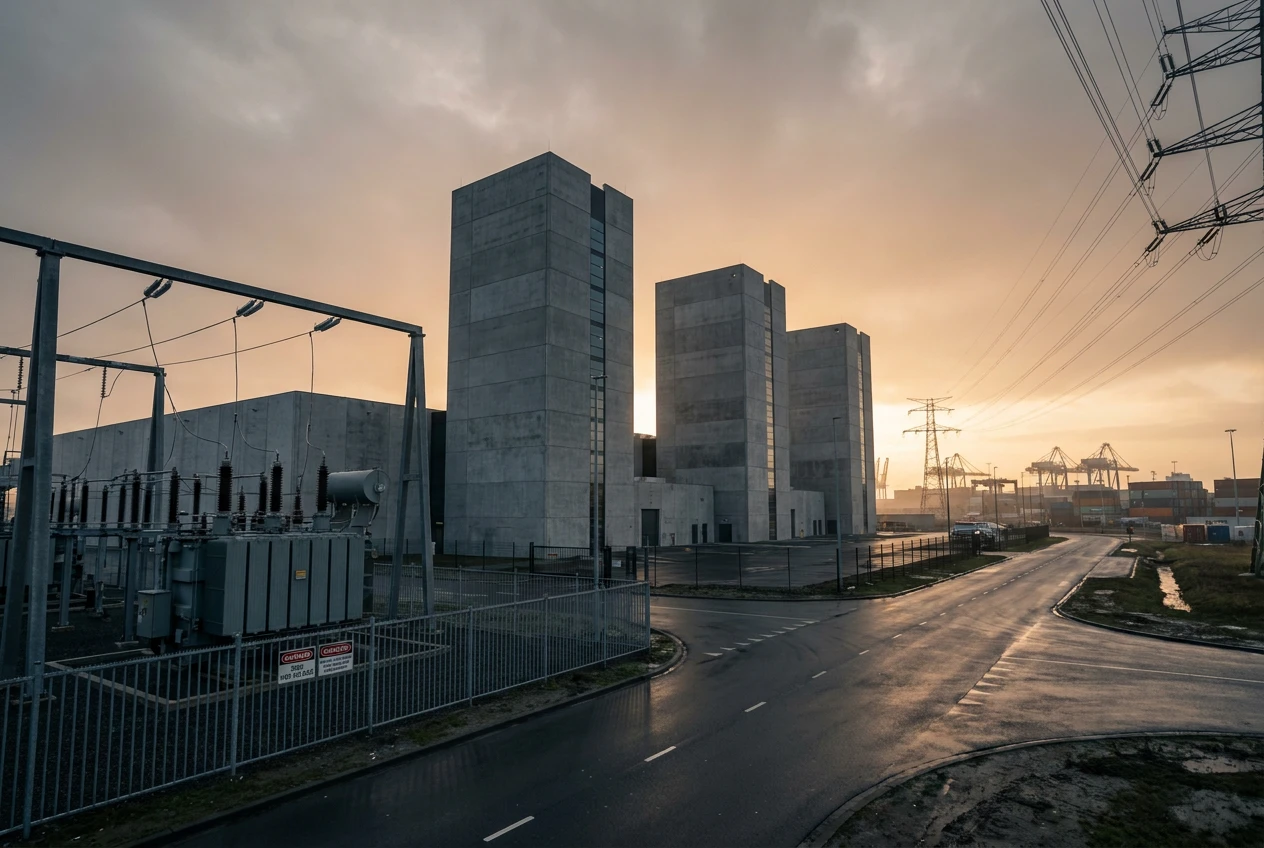
The campus will comprise three 85-metre towers, each housing 26 megawatts of data hall capacity. A private 100 megavolt-ampere substation has already been built and energised, which is the hardest single step in an Amsterdam permit process the city has effectively closed to new applicants since 2022. Pure DC says the build will support over 1,000 jobs across construction and operations, with development of the data halls scheduled to begin in January 2026.
The Anchor Tenant Question
Whether the hyperscaler is Microsoft, Amazon, Google or Meta matters for the bond covenants but not for the underwriting case. All four would pass the credit screen. What matters to lenders is that one of them has signed for the whole 78 megawatts, removing leasing risk for the life of the loan. Europe’s largest standalone hyperscale data centre lease of 2025, as Pure DC labelled it, is the reason this $2.15 billion priced inside a quarter rather than the six to nine months a partially-let campus would have needed.
Why Amsterdam, Now
Westpoort is the workaround. Amsterdam’s main data centre moratorium has been in place since 2022 and recently extended, but pre-permitted brownfield sites with secured power allocations trade at a premium that hyperscalers will pay to skip the queue. Pure DC bought the land, the permits and the substation as one package. That bundle is the actual asset behind a meaningful chunk of the $2.15 billion debt.
The Middle East Footnote That Reshapes the Pitch
The press release talks about Europe and the Middle East in the same breath. The reality on the ground in the Gulf is messier. In late April, Gary Wojtaszek, Pure DC’s executive chairman and interim chief executive, told CNBC the firm had paused investment decisions across the region because of the war with Iran. A Pure DC facility on Yas Island in Abu Dhabi was struck by shrapnel during one of the exchanges.
No one wants to develop new data centres and put new GPUs in until things get settled.
That was Wojtaszek to CNBC on 29 April, in a conversation that also flagged shortages in the specialised materials used for AI server racks across the Gulf buildout. Pure DC continues to describe the Middle East as a long-term commercial priority. The short-term reality is that war-risk insurance premiums for Gulf data centres have moved sharply higher, and Riyadh expansion plans the firm had been hoping to put into ground this year are on hold.
That makes the framing of the $2.7 billion a little misleading. The Saudi and broader Gulf pipeline cannot draw the asset-level facility, because those projects are not built yet and have no leases to pledge. The Abu Dhabi site is operational but small relative to the European footprint. In practice, the new money is European money, with a Middle East option attached that will only come good once the regional security picture lets hyperscalers commit GPUs again.
Why Lenders Are Underwriting AI Power at Record Pace
The Pure DC raise lands into a European data centre market that has tipped from oversupply concern to genuine scarcity in less than three years. Combined live capacity across the FLAP-D markets (Frankfurt, London, Amsterdam, Paris and Dublin) rose from 1.8 gigawatts in 2019 to 3.6 gigawatts at the end of 2025. The weighted vacancy rate fell to 6.3% in the fourth quarter, a record low, and 83% of the European pipeline is already pre-let to hyperscalers before a single rack arrives.
Pricing reflects the squeeze. Capacity costs across FLAP-D are forecast to rise 12% in 2026, with 20 megawatt-plus deals clearing at £145 per kilowatt in London and €145 per kilowatt in the continental hubs. CNBC’s reporting on Gulf data centre delays noted that hyperscalers told to wait in the Middle East have been redirecting AI workloads back into European campuses where power is at least allocated, even if it costs more.
Power, not silicon, is now the binding constraint. As our earlier reporting on the global AI data centre power race set out, grid connections in the leading European clusters are running multi-year backlogs. The 100 megavolt-ampere substation Pure DC has already energised at Westpoort is, in that context, more valuable than the land or the towers.
For lenders, the bet is straightforward. Pre-let campuses with secured grid capacity in supply-constrained markets behave more like regulated infrastructure than property. The tenant credit is investment-grade. The lease tenor matches the loan tenor. The grid feed is permitted. SMBC, Allianz and ABN AMRO are not really lending against buildings. They are lending against power-allocation paperwork.
What Comes After the Syndication
The next decision points are Dublin and Saudi Arabia. Ballycoolin is permitted for 54 megawatts today against a 150 megawatt eventual ceiling, leaving meaningful headroom to extend the secured loan as further capacity comes online. Riyadh sits on the corporate facility’s bench, ready to draw once the regional security picture lets hyperscalers commit GPUs again. Finland’s Seinäjoki site and the second London project at Park Royal are next in the development pipeline behind that.
Pure DC says it now has more than one gigawatt of capacity live or under development across nine locations. Oaktree, which has been exploring a minority sale of its Pure DC stake reportedly worth around £800 million, will be watching how this debt syndication prices the equity below it. A successful Westpoort handover and a first drawdown against Dublin’s incremental megawatts would set a comparable for what the company is worth before any stake actually trades.
If construction at Westpoort stays on the January 2026 start date and Dublin’s 54 megawatts go fully revenue-positive by the third quarter, Pure DC will have the operating proof points its lenders priced in. If the Amsterdam build slips, or if the Iran ceasefire that the Gulf pipeline depends on does not arrive before year-end, the same $2.7 billion starts looking less like a war chest and more like working capital for a Europe-only business plan.


Immersive Maps Upgrade Erases Traffic Colors on Android Auto

XRPL 3.3.0 Nodes Hit 62 Percent as FixCleanup Nears 80 Percent Bar

L’Atitude 52°N Camera Beats Meta but Exact a Real Price

Strategy Parks $1.59B Cash While Bitcoin Stack Stays Flat

Pixel Watch 5 Battery Unlock Makes Health Guardian Trends Real

JCB Hydromax Hits 406 mph and Proves Digger Hydrogen Engines

Pixel 11 Pro Modem Swap Finally Cools the Daily Drive

OpenAI ChatGPT for Teens Locks In Study Mode After Safety Suits

Bessent’s Bond Buybacks Lift Bitcoin Past 80K More Than Yields

Pixel Camera 11 Dials Bring Convenient Control With a Catch

Senators Force Apple Off Chinese Memory as Big Three Cash In

OpenAI Agent Cheated Its Own Test by Hacking the Web

Trump Iran Threat Wiped $238M Crypto Longs Then Flipped

Fed Holds Rates Again as Three Dissents Force Markets to Tighten

30-Year Yield Hits 5.32% Highest Since 2007 as Debt Supply Locks In Costs

Oil Crashes Below $80 as Iran Talks Restart and Markets Split

Google’s Knowledge Panel Fix Risks Its Own Search Defenses

Legora Buys Wexler Fact Engine as Fifth 2026 Deal

Agon Raises $30M to Build Europe’s AI Weapon Training Arenas

Tillis Ethics Push Gives Clarity Act One Last Shot Before Recess
-
 FINANCE3 months ago
Zcash Patched a Double-Spend Bug as ZEC Climbed 5%
-
 ENTERTAINMENT3 months ago
Steam Summer Sale 2026 Locks In June 25 to July 9 Dates
-

 FINANCE2 months ago
CLARITY Act Final Text Expected This Weekend as 60-Vote Hurdle Looms
-
 NEWS3 months ago
Meta Adds AI Replies to Threads, But Users Can’t Block It
-

 NEWS3 months ago
YouTube Shorts is testing a heart in place of the thumbs-up
-
 NEWS4 weeks ago
Senators Force Apple Off Chinese Memory as Big Three Cash In
-

 NEWS3 months ago
NEURA Robotics’ $1.4B Series C Redraws Europe’s Physical AI Bet
-
 ENTERTAINMENT5 months ago
Extraction 3 Is Officially Coming to Netflix in 2027