
GAMING
Samsung Display’s 4K 360Hz QD-OLED Goes to Monitor Brands
Samsung Display used Computex 2026 to sell a 31.5-inch 4K 360Hz QD-OLED to MSI, Odyssey and more than 10 brands.

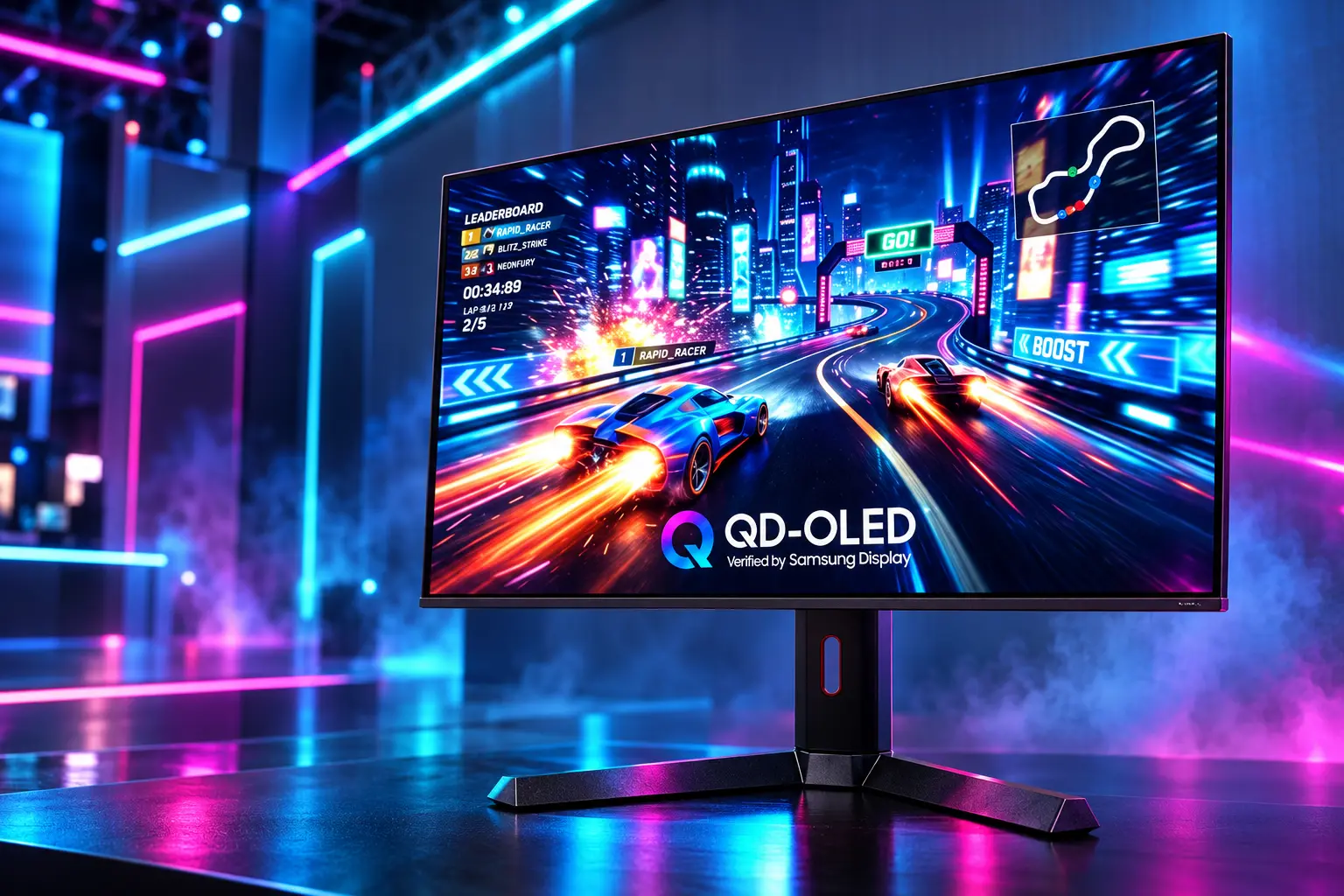
Samsung Display put a 31.5-inch 4K 360Hz QD-OLED in front of monitor makers at Computex 2026, not a single finished consumer screen. The Taipei booth ran from June 2 to June 5 at Nangang Exhibition Center and showed 16 OLED and QD-OLED products from an 8.8-inch handheld panel to a 49-inch ultrawide.
MSI already built a Triple Mode monitor on that 31.5-inch glass. In late August, Samsung Electronics put the same refresh-rate stack in its Odyssey OLED G8. The people who have to ship it are the brands, not the panel line in the press photos.
Sixteen Panels on the Taipei Show Floor
The June 1 notice from Seoul was a supplier pitch. Samsung Display said it would show laptop OLED, QD-OLED monitors, and handheld panels together, then run them against LCD in the same games. Dongil Son, executive vice president and head of the Large Display Business and IT Business Team, told visitors the high-end gaming screen market had “completely shifted from LCD to self-emissive displays.”
THE TAIPEI LINEUP
- The range: Sixteen OLED and QD-OLED parts, from an 8.8-inch handheld panel to a 49-inch Dual QHD monitor.
- The dates: Computex ran June 2-5, 2026 at Taipei Nangang Exhibition Center after a June 1 product notice.
- The games: Booth demos used PUBG: BATTLEGROUNDS, Crimson Desert, F1 25, and DJMAX RESPECT V with KRAFTON, Pearl Abyss, EA, and NEOWIZ.
- The extra kit: A 27-inch 500Hz QD-OLED, a 16-inch 2560 x 1600 laptop OLED, and a 34-inch QHD+ panel with True Black 500 sat beside the headline 31.5-inch screen.
That mix is why the show read as a Samsung monitor launch in wire copy. It was a catalog. The 49-inch screen in the F1 25 comparison ran Dual QHD at 5120 x 1440, not 4K. The 4K 360Hz claim belonged to the 31.5-inch panel Samsung Display had described on May 28.
The 31.5-Inch Panel Ends a Long Tradeoff
Until that May 28 note, a self-emissive monitor could hold 4K or a 360Hz-class refresh rate, not both. Samsung Display said brands usually dropped 4K panels to 240Hz or below, or cut resolution to QHD to go faster, because the pixel data per second left too little time to charge each pixel.
The new panel is 31.5 inches at 3840 x 2160 and 360Hz. Dual Mode drops it to Full HD and raises the refresh rate to 680Hz. It carries VESA DisplayHDR True Black 600, which requires blacks at 0.0005 nits or lower and at least 600 nits peak for white and for red, green, and blue together at 10% APL, a step above the True Black 500 grade that had been the ceiling on premium OLED monitors. A V-stripe layout puts red, green, and blue subpixels in vertical stripes so text edges stay cleaner for documents and code as well as games.
Penta Tandem, the five-layer blue OLED stack Samsung Display trademarked in February, sits under that spec sheet. The company said it moved the blue stack from four layers to five and changed the organic materials to raise efficiency, life, and luminance. Brad Jung, vice president and head of the Large Display Marketing Team, said buyers were already treating the panel as a finished idea.
Many customers have described the new 31.5-inch 4K 360Hz product as a near-perfect monitor that delivers everything consumers expect from a premium monitor, including ultra-high resolution, an ultra-high refresh rate, high brightness, and enhanced readability.
Brad Jung, Vice President, Head of the Large Display Marketing Team, Samsung Display
Those customers are the story. Samsung Display said it was in talks with more than 10 global customers on the 31.5-inch 4K 360Hz part and planned full-scale mass production in the second half of 2026. It did not name them on May 28. Two of them named themselves.
MSI Locked In First With Triple Mode
On May 29, MSI posted the MPG OLED 322URDX36 as a Computex debut. The company called it the first 31.5-inch Triple Mode 4K 360Hz monitor, using a 5th-gen QD-OLED with Penta Tandem and an RGB stripe layout. Samsung Display’s Dual Mode is 4K 360Hz or FHD 680Hz. MSI added a middle step at QHD (2560 x 1440) and 520Hz, which it labels 2K.
WHAT MSI ADDED ON TOP OF THE GLASS
- Triple Mode: 4K at 360Hz, QHD at 520Hz, and FHD at 680Hz on one 31.5-inch panel.
- DarkArmor film: MSI says it lifts black levels by 40% and scratch resistance by 2.5 times.
- Peak HDR: 1500 nits, with True Black 600 and ClearMR 18000.
- Ports: Full-bandwidth DisplayPort 2.1a UHBR20 and USB-C at 98W, plus an AI Care Sensor for burn-in protection.
MSI did not put a price or a ship week on that page. Hands-on notes from the show treated the unit as a working prototype and pointed to a late-2026 or early-2027 retail window. That gap is the OEM calendar Samsung Display sold into. The panel maker’s second-half production plan only starts the clock for whoever finishes a chassis, firmware, and a cable budget around UHBR20.
Odyssey G8, G9 and the 2027 Chassis
Samsung Electronics, the Visual Display group that sells Odyssey screens, waited until Gamescom. On August 27 in Cologne, Hun Lee, executive vice president of that business, introduced the 2027 Odyssey gaming monitor lineup as more choice across size, rate, and mode, not as a single hero SKU. The OLED G8 (G80SJ) is the 4K 360Hz cousin of MSI’s 322URDX36. Samsung markets it as a 32-inch UHD screen on fifth-generation QD-OLED with Penta Tandem and RGB stripe subpixels, with the same three modes: UHD at 360Hz, QHD at 520Hz, and FHD at 680Hz.
The G8 adds Samsung’s Glare Free film, which the company says is 54% less glossy than a conventional anti-reflection film, DisplayPort 2.1 UHBR20, two HDMI ports, USB-C at 98W, a two-port hub, and KVM. True Black 600 is listed, with the certification to be finished at launch. FreeSync Premium Pro and G-SYNC Compatible are on the same “at launch” note. Launch timing and pricing were left for later.
The 49-inch Odyssey OLED G9 (G95SJ) is the other Computex panel in a branded box. It is Dual QHD at 5120 x 1440 and 360Hz, with Dual Mode at 2560 x 720 and 720Hz, 0.03 ms GtG, and a peak of 1,300 nits on a 3% window. Samsung says the five-layer stack is up to 1.3 times more efficient and lasts up to twice as long as the previous generation. That is the ultrawide from the F1 25 booth, not a 4K 49-inch monitor.
THREE CHASSIS ON THE SAME FAMILY OF GLASS
| Monitor | Size and native mode | Extra modes | HDR claim |
|---|---|---|---|
| MSI MPG OLED 322URDX36 | 31.5-inch, 4K 360Hz | QHD 520Hz, FHD 680Hz | True Black 600, 1500 nits peak |
| Odyssey OLED G8 (G80SJ) | 32-inch, 4K 360Hz | QHD 520Hz, FHD 680Hz | True Black 600 (at launch) |
| Odyssey OLED G9 (G95SJ) | 49-inch, DQHD 360Hz | Dual HD 720Hz | 1,300 nits on a 3% window |
G8 and the MSI share the 4K 360Hz panel class. G9 is the 49-inch Dual QHD sheet from the same Computex stack. Samsung Electronics still has to announce when either OLED ships and what it will cost.
FROM PANEL TO PRODUCT
- May 28, 2026: Samsung Display says it has a 31.5-inch 4K 360Hz QD-OLED and will show it at Computex, with mass production planned for the second half of 2026.
- May 29, 2026: MSI names the MPG OLED 322URDX36 and Triple Mode on that panel.
- June 1, 2026: Samsung Display posts the 16-product Computex gaming stack, including Ultra Slim laptop OLED and the 49-inch Dual QHD monitor.
- June 2-5, 2026: The panels run in Taipei with PUBG, F1 25, Crimson Desert, and DJMAX RESPECT V.
- August 27, 2026: Samsung Electronics puts the 4K 360Hz stack in Odyssey G8 and the 49-inch Dual QHD stack in Odyssey G9 at Gamescom, with pricing still open.
By September, the argument on the hardware side had already moved. Fourth-generation Penta Tandem 4K 240Hz monitors are the units in shops. The 4K 360Hz SKU is still a show panel waiting on volume.
The Ultra Slim Laptop Screen Is Still a Prototype
The other Computex headline was thinner glass for gaming notebooks. Samsung Display called the part Ultra Slim and said it was still under development. Module outer-edge thickness falls by more than 20% against the company’s panels already in mass production, after etching both the TFT substrate glass and the encapsulation glass by more than 30% and then dealing with the warp that thin glass likes to pick up.
Picture quality is supposed to hold. Laptop OLEDs on this stack can reach DisplayHDR True Black 1000, which needs blacks below 0.0005 nits and 1,000 nits peak at 10% OPR. Refresh rates run from 165Hz to 240Hz, the top rate Samsung Display said was in mass production for laptop OLED. ClearMR 11000 is the motion grade, 110 times as many clear pixels as blurry ones on VESA’s scale.
No laptop maker attached a model name or a ship date to that ultra slim gaming laptop OLED at the show. The 20% edge cut is design room for cooling, battery, or a lower lid, which is why notebook engineers care more than monitor shoppers. It is also why this piece of the stack has moved slower than the 31.5-inch desktop panel that already has two chassis on it.
Why 4K at 360Hz Still Needs a Mode Switch
Native 4K at 360Hz asks a PC to push 3840 x 2160 pixels 360 times a second, which is why Dual Mode and Triple Mode exist on the same glass. Drop to QHD and the 31.5-inch panel can run 520Hz. Drop to Full HD and it can run 680Hz. Shooters that live on frame rate get the fast modes; story games that live on texture work can stay at 4K 360Hz if the GPU and the cable can feed it.
DisplayPort 2.1 UHBR20 is on both the MSI and the Odyssey G8 for a reason. Older ports run out of uncompressed bandwidth before the panel does. Even then, drawing a native 4K 360Hz picture in a heavy title is still a stretch for a current flagship graphics card without upscaling or frame generation. The panel ended the old 4K-or-360Hz choice. The PC in front of it did not.
That is the objection that stuck after the May spec drop. People who already own 27-inch QHD OLEDs also keep asking for V-stripe on that size, because 31.5-inch 4K is a desk and GPU problem before it is a pixel problem. MSI’s middle 520Hz QHD step is the practical answer for that group, more than the 680Hz Full HD party trick.
WHAT WE KNOW
- The panel: 31.5-inch 4K 360Hz QD-OLED with FHD 680Hz Dual Mode, True Black 600, and V-stripe, mass production planned for the second half of 2026.
- Named chassis: MSI MPG OLED 322URDX36 and Samsung Odyssey OLED G8 share the Triple Mode stack; Odyssey G9 uses the 49-inch Dual QHD 360Hz sheet.
- The laptop part: Ultra Slim was under development in June, with a 20% thinner module edge and no OEM laptop named.
WHAT IS UNCONFIRMED
- Street price: Neither MSI nor Samsung Electronics has posted a price for the 4K 360Hz monitors.
- Ship week: Odyssey OLED timing is “later”; MSI’s 322URDX36 has no firm retail date on the May 29 notice.
- The other eight-plus brands: Samsung Display has not published the rest of the customer list beyond the two that spoke.
The missing prices are not a hole in the panel story. They are the OEM step that Computex was built to start.
Handheld OLEDs Sit Beside a 49-Inch Ultrawide
At the small end, Samsung Display ran DJMAX RESPECT V on an 8.8-inch OLED handheld as well as on the 31.5-inch monitor. It did not name the handheld brand in the June 1 notice. The 8.8-inch size is already in Windows handhelds from other firms, and tying any one of those machines to this booth panel would be a guess.
At the wide end, the 49-inch Dual QHD sheet is the one people keep mixing up with 4K. It is 5120 x 1440 at 360Hz in the Odyssey G9, or 2560 x 720 at 720Hz if you give up the extra pixels. That is a different product from the 31.5-inch 4K panel, sold to a different desk, with a different GPU load.
MSI has not named a price for the 322URDX36, and Samsung Electronics has not set a launch date for the Odyssey G8. Both monitors use the 4K 360Hz QD-OLED Samsung Display said it would start making in volume in the second half of 2026.

UPI MDR Delay Hands Traders the Calendar After Paytm Falls

Google Messages Builds Nine In-Chat Games After Samsung’s Exit

Anthropic’s $100 Million Academy Trains the Firms That Bill Both Sides

Toyota’s Electric C-HR Leaves the Cheap Twin to Subaru

Markets Bet the Fed Skips October After Hawkish Minutes

The Orchard Bug Forced Zcash to Open an Empty Pool

The $5.99 Game That Won Steam’s 2026 Summer Sale

Don Lee Joins Hemsworth as Extraction 3 Starts Shooting

YouTube Shorts Retires Dislikes and Swaps Likes for Hearts

NEURA Robotics Is Spending Its $1.4B on a Machine Stack
-
 NEWS5 months ago
The Orchard Bug Forced Zcash to Open an Empty Pool
-
 GAMING5 months ago
The $5.99 Game That Won Steam’s 2026 Summer Sale
-
 ENTERTAINMENT6 months ago
Don Lee Joins Hemsworth as Extraction 3 Starts Shooting
-
 NEWS4 months ago
YouTube Shorts Retires Dislikes and Swaps Likes for Hearts
-
 NEWS4 months ago
NEURA Robotics Is Spending Its $1.4B on a Machine Stack
-

 NEWS5 months ago
Atlantic City Turned WWE’s Return Into a Civic Night
-

 AUTO6 months ago
Kawasaki Bets the New Z1100 Against Its Own Supercharger
-

 BUSINESS5 months ago
Norway’s Export Bank Backs Nscale’s $790 Million Narvik Loan