
NEWS
SpaceX Lead Turns Amazon and Blue Origin Into a Capacity Bet

SpaceX launch cadence is the measure that still separates Starlink from Amazon Leo and Blue Origin. Amazon has more than 300 broadband satellites in low Earth orbit (LEO, a close orbit used to cut internet delay) after 11 missions, but its original FCC clock asks for half of a 3,236-satellite constellation by July 30, 2026. That turns every rocket delay into a market problem.
The catch is that Amazon’s solution to not depending on one rocket has made the race more exposed to every other rocket. United Launch Alliance, Arianespace, Blue Origin and even SpaceX now sit inside Amazon’s deployment map, while Starlink keeps riding the same Falcon 9 factory line.
The Race Is a Calendar Before It Is a Rocket Test
The Federal Communications Commission (FCC, the U.S. telecom regulator) gave Kuiper Systems, Amazon’s satellite unit, authority to deploy and operate a 3,236-satellite network in the original FCC authorization. The midpoint of that approval is the number that matters now: 1,618 satellites in service by July 30, 2026, unless regulators grant relief.
Amazon Leo, formerly Project Kuiper, says it completed 11 missions and launched more than 300 satellites in its first year of operations. Its own Amazon Leo mission tracker also lists a 12th mission, LA-07, scheduled for May 29, 2026, with 29 more satellites on a United Launch Alliance Atlas V.
- 3,236 satellites are covered by Amazon’s first-generation FCC authorization.
- 300-plus satellites had been deployed after 11 Amazon Leo missions.
- 100-plus launches are secured by Amazon across Arianespace, Blue Origin, SpaceX and United Launch Alliance.
That looks like progress until the calendar is placed next to the launch count. Amazon needs volume, not a handful of milestone flights. The company can build a better antenna, buy more launch slots and sign more partners, but none of those moves change the physics of getting hundreds of satellites through a small number of launch pads.
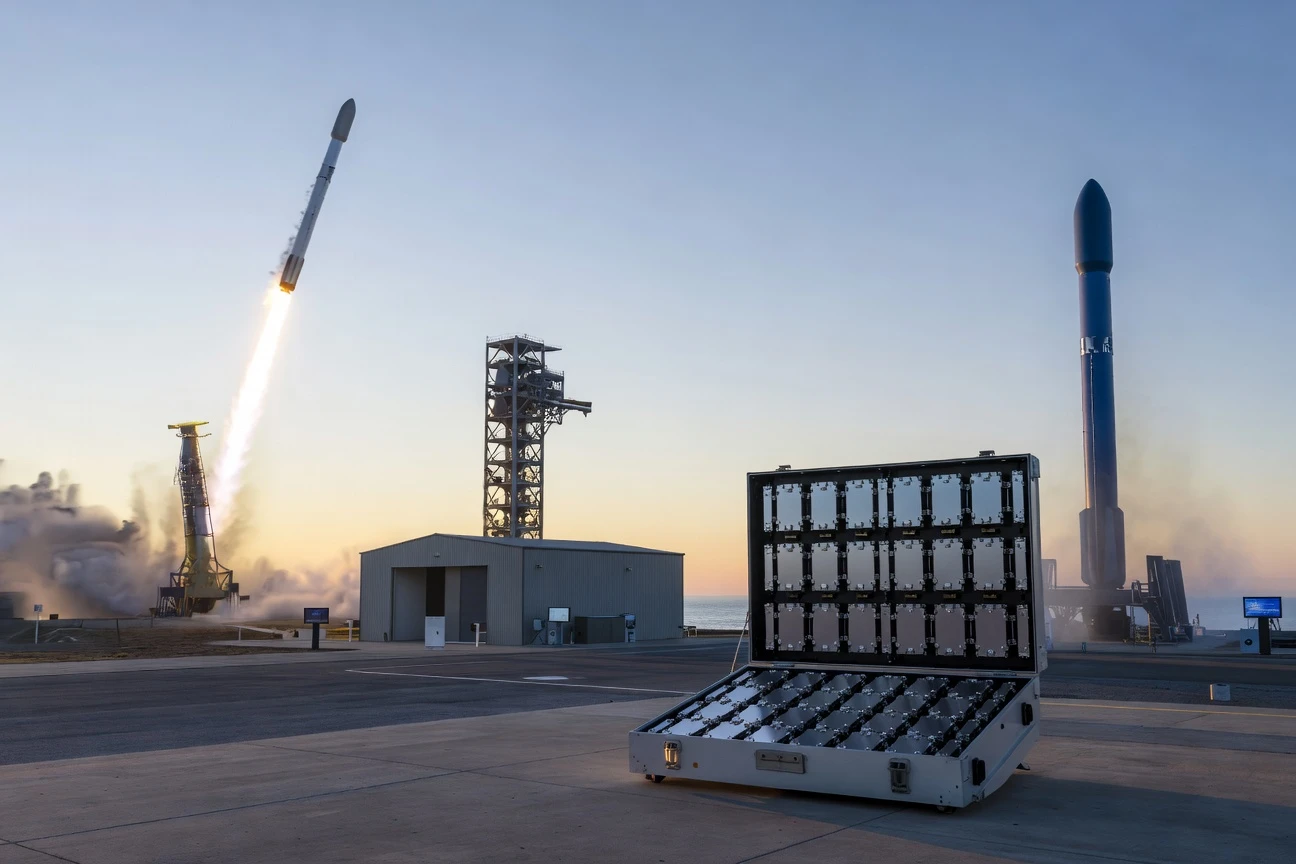
SpaceX Sells More Than a Ride to Orbit
SpaceX, Elon Musk’s launch and satellite company, is often described as cheaper because Falcon 9 boosters come back and fly again. That is true, but too narrow. The deeper edge is that cadence is the product. Customers are buying a place inside a machine that already repeats launches, payload processing, recovery and refurbishment.
The company’s Falcon 9 vehicle page lists 22,800 kilograms of payload capacity to LEO and describes the rocket as an orbital-class reusable vehicle. Those specifications matter less than the operating habit around them: Starlink gives SpaceX a permanent internal customer, which gives Falcon 9 constant work, which gives the company more data and faster turnaround.
| Player | Role in the Broadband Race | Capacity Signal | Main Constraint |
|---|---|---|---|
| SpaceX and Starlink | Launch provider and constellation operator | Routine Falcon 9 Starlink batches | Shift from Falcon 9 to Starship without slowing service growth |
| Amazon Leo | Constellation buyer and future service provider | More than 300 satellites after 11 missions | Regulatory clock and partner launch cadence |
| Blue Origin New Glenn | Heavy-lift entrant tied to Amazon’s plan | 45 metric tons to LEO in the current 7×2 version | Needs repeated orbital flights, not single demonstrations |
| ULA and Arianespace | Contracted launch lanes for Amazon | Atlas V and Ariane 64 have carried Leo satellites | Atlas retirement, Vulcan ramp and Ariane 6 production pace |
That loop also explains why Amazon buying Falcon 9 rides was more than a tactical fix. It was an admission that the most mature launch conveyor in the market belongs to the competitor whose satellite service Amazon is trying to chase.
Amazon Built a Hedge, Not a Shortcut
Amazon, the U.S. technology and retail group, did not make a foolish launch plan. It made a classic procurement hedge. The company spread work across United Launch Alliance (ULA, the Boeing-Lockheed Martin launch joint venture), Arianespace, the European launch provider, and Blue Origin, Jeff Bezos’s rocket company.
That map was supposed to reduce scheduling risk. Amazon’s large commercial launch order included 38 Vulcan Centaur launches from ULA, 18 Ariane 6 launches from Arianespace and 12 New Glenn launches from Blue Origin, with options for 15 more. Amazon already had nine Atlas V launches in place.
Spreading orders across four providers protects Amazon from one company’s factory problem. It does not protect Amazon from a whole sector moving slower than SpaceX. Vulcan Centaur, Ariane 6 and New Glenn are all important rockets, but they are still building the repeat pattern that Falcon 9 has spent years turning into habit.
The result is an awkward hedge. Amazon needs its suppliers to prove a market that SpaceX already proved, while SpaceX can use Starlink launches to keep training the system. That is why the gap is not just measured in satellites. It is measured in how quickly a missed launch can be replaced.
Blue Origin Has Hardware, But Cadence Is Still the Proof
Blue Origin has the most symbolic role in the race because it sits beside Amazon through Bezos and because New Glenn is the rocket that could change the mass equation. The company’s New Glenn rocket specifications say the vehicle can carry 45 metric tons to LEO, uses a seven-meter payload fairing and has a first stage designed for at least 25 flights.
Those are serious numbers. A larger fairing gives constellation operators more packaging room, and a reusable heavy-lift first stage could help Amazon move bigger satellite batches. Blue Origin also says seven BE-4 engines power the reusable booster, with the same engine family feeding ULA’s Vulcan first stage.
- Flight history, not stated capacity, will decide whether New Glenn becomes a reliable Amazon launch lane.
- Booster recovery must turn into quick refurbishment, not a special event that happens after a long pause.
- Second-stage performance has to satisfy insurers and customers as much as engineers.
- Factory output at Cape Canaveral needs to match the promise of the vehicle design.
Blue Origin has tried to move the story from potential to production. Its New Glenn performance update describes upgrades to engines, structures, avionics, reusability and recovery operations. That is the correct checklist. The market still needs to see it repeated on a schedule.
Europe and ULA Are Now Part of Amazon’s Clock
Arianespace has already become more than a backup lane. Its Ariane 64 placed 32 Amazon Leo satellites into orbit on February 12, 2026, the first Arianespace mission for the network in a series of 18. That flight also gave Europe a live commercial use case for the heavier Ariane 6 configuration.
ULA is carrying more of the near-term load. The company said its April 27, 2026, Atlas V mission carried 29 Amazon Leo satellites and brought ULA’s total for the constellation to 168. The ULA Amazon Leo launch statement matters because Atlas V is doing the work before Vulcan becomes the main Amazon vehicle.
Arianespace adds geographic diversity from Kourou, French Guiana. ULA adds Florida heritage and a bridge from Atlas V to Vulcan. Both help Amazon avoid a single launch choke point, but both also create handoffs, interfaces and schedule dependencies that Starlink does not face inside SpaceX.
That is the hidden advantage of vertical control. SpaceX can make a satellite plan and a rocket plan argue inside the same company. Amazon must make several suppliers, pads and vehicles converge around the same regulatory date.
The Broadband Market Rewards the First Network That Feels Boring
For consumers, the winner will not be the rocket with the best video feed. It will be the network that feels boring: equipment arrives, the dish works, speeds hold up and outages are rare. Starlink has that head start because SpaceX has already turned launch repetition into service expansion.
For investors and governments, the same fact reads differently. More demand for LEO broadband, direct-to-device service and even speculative orbital computing makes launch capacity a strategic asset. That is why the wider SpaceX valuation debate tied to Starlink keeps circling back to the same issue: the launch machine may be as valuable as the satellite service it feeds.
Amazon can still build a real competitor. It has money, manufacturing skill, customer channels and a launch book that touches nearly every major Western rocket family. Blue Origin can still become the missing heavy-lift lane if New Glenn turns specifications into repeat service. But the burden of proof sits with the challengers now.
Adjacent demand could widen the market too. If concepts such as orbital AI data centers and space infrastructure move from experiment to procurement, multiple launch providers may find enough work to grow. That would help Blue Origin and Arianespace without hurting SpaceX. Yet broadband is less patient than deep-space dreams.
If Amazon’s launch partners accelerate before the FCC clock bites, the race becomes a two-network fight. If they do not, SpaceX keeps the cleaner advantage: it can launch its own satellites while its rivals wait for room on somebody else’s rocket.


Citigroup Says ETF Outflows Drove Bitcoin’s Crash, Not Strategy’s Sale

Samsung Galaxy Z Fold 8 Ultra Confirmed by Bluetooth SIG
Game of Thrones: Dragonfire Makes Season 3 Viewing Pay Off

YouTube Music Puts Search Where Your Thumb Already Lives

Amazon’s AI Image Generator Turns Shopper Imagination Into Search

Meta’s AI Support Bot Handed Hackers Instagram Accounts

Lummis Fires Back at Dimon as the CLARITY Act Hits the Senate Calendar

CLARITY Act Floor Vote Likely Shifts to August, Lummis Says
Valve’s Steam Machine Launch Signals Point to Weeks, Not Months

Motorola’s Moto Buds 2 Arrive in the US on July 2 at $99.99

Zcash Patched a Double-Spend Bug as ZEC Climbed 5%

Steam Summer Sale 2026 Locks In June 25 to July 9 Dates

Meta Adds AI Replies to Threads, But Users Can’t Block It
Citigroup Says ETF Outflows Drove Bitcoin’s Crash, Not Strategy’s Sale

Coinbase Invests in Ethena, ENA Jumps 10% on Open-Market Buy

Gigaton Lands $26M to Replace Heavy Industry’s Control Stack

London AI Lab Inherent Raises $50m to Reinvent Science
Quobly’s €115M Bet to Scale Silicon Quantum Computing
Windows 11’s AI Uninstall Button Works on Only One Model
Telegram’s Durov Revives Gram Name the SEC Buried in 2020
-
FINANCE2 days ago
Zcash Patched a Double-Spend Bug as ZEC Climbed 5%
-
ENTERTAINMENT3 days ago
Steam Summer Sale 2026 Locks In June 25 to July 9 Dates
-
NEWS3 weeks ago
Meta Adds AI Replies to Threads, But Users Can’t Block It
-
FINANCE2 days ago
Citigroup Says ETF Outflows Drove Bitcoin’s Crash, Not Strategy’s Sale
-
FINANCE3 days ago
Coinbase Invests in Ethena, ENA Jumps 10% on Open-Market Buy
-
NEWS3 days ago
Gigaton Lands $26M to Replace Heavy Industry’s Control Stack
-
NEWS7 days ago
London AI Lab Inherent Raises $50m to Reinvent Science
-
NEWS3 days ago
Quobly’s €115M Bet to Scale Silicon Quantum Computing