
ENTERTAINMENT
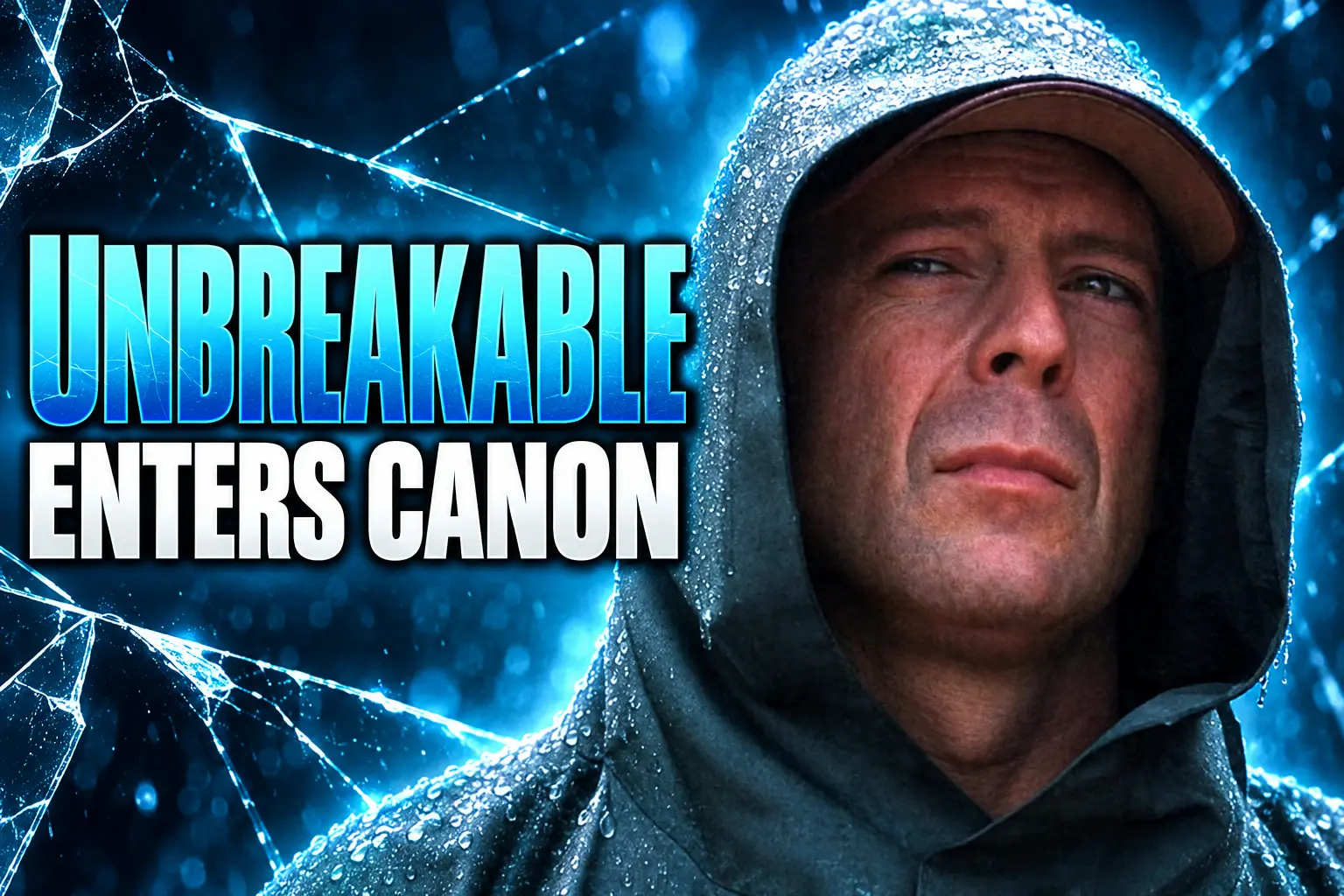
Disney Sold Unbreakable as a Thriller After X-Men
Disney released Unbreakable after X-Men hit, sold it as a thriller, and still files the $248 million film as mystery, not superhero.

Disney paid $5 million for M. Night Shyamalan’s Unbreakable script, then spent a year refusing to call it a superhero movie. It opened on November 22, 2000, as a thriller from the Sixth Sense team, and it has lived in that wrong folder ever since.
On September 27, 2026, a sold-out 35mm print leads a trilogy marathon at the Egyptian Theatre in Hollywood, with Shyamalan in the room. The audience will watch the origin story the studio would not print on a poster.
Why Disney Would Not Call Unbreakable a Comic-Book Movie
After The Sixth Sense took in $672.8 million worldwide on a $40 million budget, Walt Disney Studios bought Shyamalan’s next script at a spec-script record of $5 million and paid him another $5 million to direct. The plot he sold them was simple. A man walks away from a train crash that kills everyone else, and a stranger tells him he is a real-life superhero.
Disney, which had not yet bought Marvel, wanted a spooky cousin of the hit it already had. Shyamalan wanted a comic-book movie. In a 2018 conversation he put the studio line in plain words. Disney felt nobody would come to a comic-book film, and that the subject was for “weird people at conventions.” After The Sixth Sense, they wanted Unbreakable sold as a thriller.
He later described the same fight to GQ while walking through his own filmography. The billboards leaned on his name and Bruce Willis. They did not lean on the plot.
If you deny what it is because you’re afraid of it being different, then you’re stealing all of its strength. They were like, ‘We had one of the biggest movies of all time and the same two people are making another movie. Let’s make it look like that movie.’ As opposed to what it was, which was the beginning of an entire genre. They didn’t realize it because they were too scared to say the words ‘comic book.’
M. Night Shyamalan, director, on GQ
In his telling, the movie was always the crash, the unscratched body, and the line “You’re a real-life superhero.” “That’s the movie, but that was never said and never sold,” he said. People walked out complaining it was not scary. He asked who had promised them scary.
An oral history around Glass fills in the ad rule. Comic books were treated as a fringe beat, the domain of convention weirdos. The plan was to sell a general thriller and never mention comic books or superheroes. That ban also banned the premise. You cannot tease a real-life superhero if you are not allowed to say the words.
Four Months After X-Men, the Same Budget, a Different Pitch
The fear sat next to a counterexample already in theaters. Bryan Singer’s X-Men opened on July 14, 2000, on the same $75 million budget Disney later put into Unbreakable. Fox still soft-pedaled the comics stigma, dressing mutants in black leather instead of spandex, but it did not hide the team, the powers, or the pitch. The film’s $54.5 million domestic opening made the audience argument in cash.
Blade had already done $70.1 million domestic in 1998. Comic-book film was not an untested category in November 2000. It was a category Disney declined to join in public, even as it financed a Superman riff with no tights.
THE 2000 LEDGER
| Film | U.S. opening | Budget | Domestic opening | Worldwide gross |
|---|---|---|---|---|
| The Sixth Sense | August 6, 1999 | $40 million | $26.7 million | $672.8 million |
| X-Men | July 14, 2000 | $75 million | $54.5 million | $296.3 million |
| Unbreakable | November 22, 2000 | $75 million | $30.3 million | $248.1 million |
Shyamalan now calls Unbreakable the start of a genre. X-Men had been running for four months when his film arrived. The gap that matters is not who was first. It is that one studio put mutants on the poster and the other put “from the director of The Sixth Sense” there instead.
Audiences Handed a C to a Film Sold as a Thriller
Unbreakable opened in 2,708 theaters on the Wednesday before Thanksgiving and never reached No. 1. How the Grinch Stole Christmas held the top. The Friday-to-Sunday take was $30.3 million. The five-day holiday haul was $46 million. It finished with $95 million in the United States and a worldwide total of $248.1 million.
That is a profitable movie on a $75 million shoot. It is also about a third of The Sixth Sense’s global gross, and Disney had trained the crowd to expect the earlier film. Polling firm CinemaScore gave Unbreakable a C. That grade is the hangover of a campaign that promised the wrong genre.
THE OPENING THAT STAYED IN SECOND
- The run: 106 minutes, PG-13, Touchstone and Buena Vista, shot in Philadelphia from April 25 to July 2000.
- The rank: second on opening weekend, never No. 1, behind the Grinch.
- The grade: CinemaScore C from crowds who came for another twist thriller.
- The take: $95 million domestic, $248.1 million worldwide, on $75 million.
Quentin Tarantino has long pitched the film as a Superman story in which Superman does not know he is Superman yet. That is a clean sell. It is also the sentence Disney would not buy in 2000. The money came in anyway. The category credit did not.
Eduardo Serra Framed Heroes Like Panels
What the ads buried sits on the screen from the first shot. The movie opens on a card of comic-collector facts, then cuts to the 1961 birth of Elijah Price, a baby whose bones shatter as he enters the world. Adult Elijah, played by Samuel L. Jackson, grows into a dealer who treats comics as a record of real titans. David Dunn, played by Willis, is the security guard who should not have survived Eastrail 177.
Shyamalan built the script on a comic’s three-act shape and then kept only the origin, the part he found interesting. He and cinematographer Eduardo Serra staged scenes as panels: characters caught in doorways and glass, held in takes that last a minute or more. Shyamalan later said they shot almost no coverage. The whole film has roughly 400 cuts. A modern fight scene can spend that many in one sequence.
THE COMIC GRAMMAR THEY LEFT IN THE FRAME
- The colors: Dunn lives in green, Price in purple, a scheme Jackson asked for, down to a glass cane he wanted as a threat.
- The cape: Dunn’s wet green raincoat becomes the silhouette he patrols in, costume without spandex.
- The tell: he reads crime through touch in a crowd, then follows a janitor into a house where a family is being held.
- The weight: his son Joseph, played by Spencer Treat Clark, watches him bench 350 pounds and understands before David does.
The rescue is sloppy. Water is his weakness, and the children have to pull him out of a pool before he can finish the job. James Newton Howard’s horns still rise when he does. The scene plays like a first issue because it is one, drawn in Philadelphia row houses instead of a skyline punch-up.
The twist is the oldest superhero rule in a new coat. Price has been manufacturing disasters, including David’s train, to find his opposite number. Good, in this math, requires someone who breaks. Jackson’s voice makes the reveal feel like a thesis he has been waiting his whole brittle life to deliver. Robin Wright’s Audrey is the reason David once faked an injury to quit football. The family scenes are the secret engine. A man who will not admit what he is cannot be a husband or a father either.
That is the version of an origin that does not need a lab accident. Dunn is already the thing. He has been shrinking himself to fit a smaller life. The marketing could not say so, because saying so required the two words the studio would not print.
A Post-Credits Scene in 2017 Changed the File
For 16 years the film stood alone. Then Split, made for $9 million, ended on Willis as Dunn, sizing up James McAvoy’s Beast in a diner. The cameo turned a closed origin into the first chapter of a universe, and it did so after Marvel had already taught audiences to wait through the credits. Split went on to $278.5 million worldwide. Glass followed on January 18, 2019, with a $20 million budget and $247 million worldwide, a global haul within shouting distance of Unbreakable’s own $248.1 million, and a much colder reception.
THE EASTRAIL 177 DATES
- November 22, 2000: Unbreakable opens in 2,708 U.S. theaters as a Touchstone thriller.
- January 20, 2017: Split opens, then reveals Dunn in a final-scene cameo.
- January 18, 2019: Glass opens and binds the three films into one file.
The trilogy’s combined production cost is $104 million. The combined worldwide gross is $773.6 million. Those figures look like a win on a spreadsheet. They also refiled a complete 106-minute movie as episode one of a set whose last chapter a lot of viewers did not want. The 2000 film had to carry Glass on its back in every later argument about whether it “counts” as superhero cinema, a debate that still trails how Unbreakable changed superhero cinema even among people who love the first picture.
Shyamalan has said the original outline already contained the other antagonist, the one who became Split, and that he cut the story down because it sprawled. He also said the crowd reaction to Unbreakable hurt, and that he wished he could have told his younger self to keep going. The stealth sequel is that wish, granted 16 years late, in a market that had learned to buy universes and then learned to get tired of them.
Beyond Fest Books the Trilogy on 35mm
The correction has been happening in rooms, not in campaigns. Film at Lincoln Center ran Night at the Movies, an M. Night Shyamalan retrospective, from August 22 to September 4, 2025, and paired an Unbreakable and Pulp Fiction double bill because Willis and Jackson star in both. Shyamalan sat for a Q&A after the August 31 screening.
Beyond Fest’s Night Visions series now picks up the whole file. On September 27, 2026, at 11:00 a.m. at the Egyptian Theatre, the sold-out Eastrail 177 trilogy screening plays Unbreakable off 35mm, then Split and Glass on DCP, with Shyamalan back for questions. The listing calls the first film a radical reinvention of superhero myth. That is the sentence Disney would not spend money to test in 2000.
When a new Shyamalan trailer landed in September 2026, the older title people reached for as a standard was Unbreakable. The craft talk still circles the same bench-press crane, the raincoat, the quiet. The objection that has never really died is simpler. A movie about a man who does not know he is a hero was sold as a ghost story, and the folder stuck.
The Egyptian will show the 35mm print as a superhero film because that is what the programmers called it. The cane, the coat, and the crash were always that. The ads were the part that broke.

UPI MDR Delay Hands Traders the Calendar After Paytm Falls

Google Messages Builds Nine In-Chat Games After Samsung’s Exit

Anthropic’s $100 Million Academy Trains the Firms That Bill Both Sides

Toyota’s Electric C-HR Leaves the Cheap Twin to Subaru

Markets Bet the Fed Skips October After Hawkish Minutes

The Orchard Bug Forced Zcash to Open an Empty Pool

The $5.99 Game That Won Steam’s 2026 Summer Sale

Don Lee Joins Hemsworth as Extraction 3 Starts Shooting

YouTube Shorts Retires Dislikes and Swaps Likes for Hearts

NEURA Robotics Is Spending Its $1.4B on a Machine Stack
-
 NEWS4 months ago
The Orchard Bug Forced Zcash to Open an Empty Pool
-
 GAMING4 months ago
The $5.99 Game That Won Steam’s 2026 Summer Sale
-
 ENTERTAINMENT6 months ago
Don Lee Joins Hemsworth as Extraction 3 Starts Shooting
-
 NEWS4 months ago
YouTube Shorts Retires Dislikes and Swaps Likes for Hearts
-
 NEWS4 months ago
NEURA Robotics Is Spending Its $1.4B on a Machine Stack
-

 AUTO6 months ago
Kawasaki Bets the New Z1100 Against Its Own Supercharger
-

 BUSINESS5 months ago
Norway’s Export Bank Backs Nscale’s $790 Million Narvik Loan
-
 GAMING4 months ago
Game of Thrones Dragonfire Follows Boston’s Conquest Playbook