
BUSINESS
Shutdown Clock Ticks as Congress Leaves DC With No Deal

Lawmakers have abandoned Washington for the holidays, leaving the American public staring down the barrel of a January 31 government shutdown. With negotiations frozen and nine major spending bills still in limbo, the path to keeping federal lights on has never looked darker or more chaotic.
The looming deadline is not just a calendar date. It represents a fiscal cliff that could disrupt everything from airport security lines to paycheck delivery for active duty military personnel. Congress has left town without a map to safety.
The Stalemate Deepens Over Holiday Break
The halls of the Capitol are quiet this week, but the silence masks a brewing storm. Senate leaders attempted a last minute Hail Mary to advance a spending package before leaving for the Christmas recess. It failed miserably. Despite weeks of closed door meetings, negotiators could not persuade objectors within their own committees.
This failure effectively wasted weeks of potential progress.
Negotiations have jammed in both the House and the Senate. While leaders technically agreed on top line spending numbers weeks ago, they are fighting bitterly over the details. This is akin to a couple agreeing to buy a house but refusing to agree on which neighborhood to live in.
The current situation is precarious because:
- Nine out of twelve appropriations bills remain unfinished.
- The House and Senate remain far apart on policy riders.
- Time is the enemy, with weeks lost to holiday recess.
Republicans and Democrats have not even entered detailed negotiations on the remaining bills. This gap raises the immediate risk of either a messy temporary extension or a full blown U.S. government shutdown. The lack of dialogue is what scares seasoned observers the most.
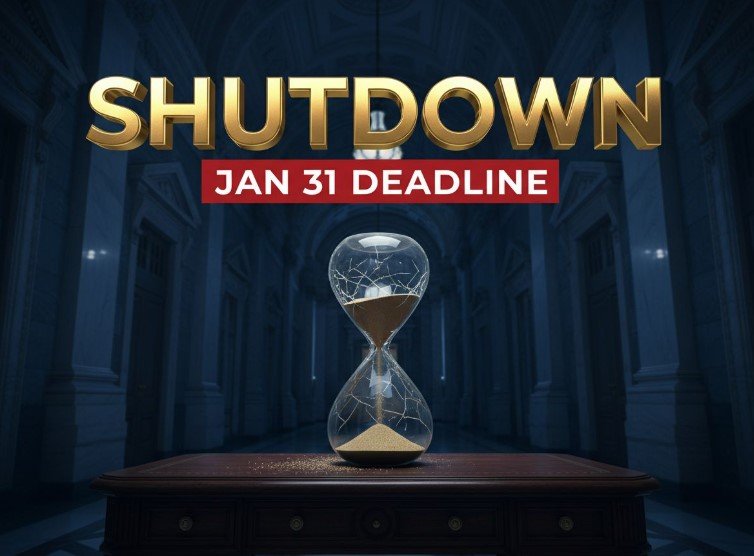
united states capitol building hourglass shutdown deadline concept
Why the January 31 Deadline Matters
This specific date puts massive pressure on party leadership. Speaker of the House Mike Johnson has publicly stated he hopes to pass all funding bills by January 30. That is a tight window. It leaves almost no room for error or political grandstanding.
Fiscal conservatives are digging in their heels and demanding flat funding across all agencies.
This demand is a non starter for many Democrats. Several lawmakers have explicitly stated they will oppose any bill that cuts spending or keeps it flat despite inflation. This fundamental disagreement is the wall that negotiations keep hitting.
Democratic appropriators have voiced extreme frustration. They argue that the past few months were wasted drafting partisan bills that had no chance of becoming law. They say they are ready to proceed under the caps both sides agreed to previously.
However, Republican divisions complicate the path forward. The Speaker faces pressure from his right flank to cut spending deep. If he compromises with Democrats to pass a bill, he risks his own leadership position. If he sides with the hardliners, a shutdown is all but guaranteed.
Political Infighting Blocks the Cash Flow
The Senate is facing its own unique set of obstacles. While usually the more stable chamber, it has been rocked by internal dissent. Conservative senators have refused to allow funding packages to move forward. Their primary objection is the inclusion of “earmarks,” or specific local spending projects.
Democrats also blocked late stage movement recently. This blockage was linked to a specific disagreement regarding a federal climate research center. These micro disputes are piling up to create a macro crisis.
Senate leaders Chuck Schumer and John Thune have tried to project confidence. They insist that staff will continue working through the recess. They claim informal negotiations will happen before lawmakers return. But history shows that without members present to make hard calls, staff can only do so much.
“If the deadline passes without a deal, we are looking at a government shutdown with little time to react. The warnings are flashing red.”
The timeline is the central constraint here. When Congress returns on January 5, the clock will already be sprinting.
The House will be out of session for one of the three weeks before the deadline.
This essentially leaves roughly 10 working days to pass complex legislation that usually takes months. It is a scheduling nightmare that makes a shutdown look less like a risk and more like a probability.
What A Shutdown Means For You
You might wonder why this political theater matters to your daily life. A shutdown is not just a beltway problem. It impacts the real economy and real families instantly.
Previous shutdowns have upended economic data releases. This leaves the Federal Reserve flying blind when trying to manage inflation. Another delay would create strain in an already fragile macro environment.
Here is what is at risk if they fail on January 31:
| Sector | Potential Impact |
|---|---|
| Travel | TSA agents work without pay, leading to sick calls and long airport lines. |
| Small Business | SBA loan processing halts completely. |
| Military | Active duty troops may not receive paychecks on time. |
| National Parks | Parks and museums close to the public. |
Federal agencies are already bracing for impact. They are dusting off contingency plans. Federal workers are once again wondering if they will be able to pay their mortgages in February.
The uncertainty alone is damaging. Agencies cannot plan for the future when they do not know their budget. Contracts get delayed. Hiring freezes. The machinery of government starts to rust.
The Narrow Path to Avoid Disaster
The coming weeks will determine the economic fate of the first quarter of the year. Congress has a history of kicking the can down the road. They often use “Continuing Resolutions” (CRs) to buy more time.
But patience is wearing thin. Many lawmakers have said they will not support another short term patch. They want a full year deal or nothing. This “all or nothing” mentality is dangerous when the deadline is so close.
The path to a deal requires compromise that neither side seems willing to give right now.
When they return on January 5, the pressure cooker will turn on. We will see late night sessions and frantic press conferences. But unless the mood changes over the holiday break, the United States is drifting toward a preventable crisis.
The shutdown is not inevitable yet. But with every day of silence during this recess, the odds get shorter. The American people are waiting to see if their elected officials can do the bare minimum: keep the government open.
We are watching closely. The clock is ticking.
In summary, Congress has left Washington without securing a budget, pushing the U.S. toward a potential government shutdown on January 31. Negotiations are stalled due to deep divides over spending allocation and policy riders, with barely three working weeks remaining once lawmakers return. The risks to the economy and federal services are real and rising.
We want to hear from you. Are you worried about how a government shutdown might impact your business or travel plans next month? Share your thoughts in the comments below. If you are discussing this on social media, use the hashtag #Shutdown2025 to join the conversation.


Replit Opens Its London Office Inside an AI Crowd

Straight Circle Trailer Lands Without a U.S. Date

Anemo Labs Bets £700,000 on an AI Sense of Smell

Nintendo Prices the Zelda 40th Switch 2 at $519

Copilot Capital Buys the Autopilot Already Running 90 GW

Ground A Raises €9.1 Million for a Pallet Laser

Gibney’s Musk Film Opens in Venice Without Its Subject

Torvalds Blames AI for a Full-Fat Linux 7.3-rc2

Dexter Returns Sharper, Older, and Stuck Between Killers

Meta’s Muse Agent Can Spend Before the Privacy Lock

Walter’s TWG Insists No Fraud as Insurer Probes Force Cleanup

30-Year Yield Hits 5.32% Highest Since 2007 as Debt Supply Locks In Costs

PCE Stays at 3.7% as Gas and Tariffs Outrun Coming Revisions

Evernorth S-4 Clears Path for Active XRP Treasury on Nasdaq

Astute’s $1.2M bet makes B2B creator deals feed AI discovery

Strategy Parks $1.59B Cash While Bitcoin Stack Stays Flat

Instinct Hits $2.5 Billion as AI Agent Access Sparks Trust Fights

CLARITY Act Cloture Opens a Door Ethics Still Blocks

Oracle’s 2.8 GW Bloom Deal Exposes the AI Power Bypass

Space Mirror Demo Revives 1993 Russian Night-Light Test
-
 FINANCE3 months ago
Zcash Patched a Double-Spend Bug as ZEC Climbed 5%
-
 ENTERTAINMENT3 months ago
Steam Summer Sale 2026 Locks In June 25 to July 9 Dates
-

 FINANCE2 months ago
CLARITY Act Final Text Expected This Weekend as 60-Vote Hurdle Looms
-
 NEWS4 months ago
Meta Adds AI Replies to Threads, But Users Can’t Block It
-
 ENTERTAINMENT5 months ago
Extraction 3 Is Officially Coming to Netflix in 2027
-

 NEWS3 months ago
YouTube Shorts is testing a heart in place of the thumbs-up
-
 NEWS1 month ago
Senators Force Apple Off Chinese Memory as Big Three Cash In
-

 NEWS3 months ago
NEURA Robotics’ $1.4B Series C Redraws Europe’s Physical AI Bet