
NEWS
The $2 Gas Map Collapsed Into a $4.27 National Average
The $1.78 Costco gallon from December 2025 is gone. AAA’s U.S. average hit $4.27 on September 10, 2026, and even Indiana averages $3.56.

Sub-$2 gas last appeared on U.S. pumps in December 2025, when a Costco in Colorado Springs sold regular for $1.78. AAA’s national average that day was $2.896.
On September 10, 2026, the same survey stood at $4.277 a gallon, and Indiana, the cheapest state, averaged $3.56. The winter bargains sat on crude in the high $50s. That oil price is gone.
Where the $1.78 Gallon Went
The December 18, 2025, survey was a four-year low at the national level, and a handful of membership pumps printed numbers that looked like a different decade. Costco in Colorado Springs led the country at $1.78. Sam’s Club in Midwest City, Oklahoma, sat at $1.84. Three Houston-area stations in Texas posted $1.89. A Phillips 66 in Indianola, Iowa, sold regular for $1.94, and a Murphy USA in Waverly, Tennessee, filled tanks at $1.99.
Just over $2, the board still looked soft: Sam’s Club in Gulfport, Mississippi, and in Alexandria, Louisiana, plus a Jumpstart in McPherson, Kansas, at $2.03, a BP in Appleton, Wisconsin, at $2.05, and a Brookshire’s in Ashdown, Arkansas, at $2.06. Oklahoma’s statewide average, then the lowest in the country, was $2.289.
That December map of sub-$2 stations was not a new American floor. It was a crude print. EIA’s monthly average for West Texas Intermediate at Cushing was a December WTI average of $57.97 a barrel. Nine months later the same agency’s path has crude in the $80s and $90s, and AAA describes the market as back in the $100 range after fresh trouble in the Strait of Hormuz.
Oklahoma’s average on September 10 is $3.87, up $1.58 from that December statewide figure. Colorado, home of the $1.78 Costco ticket, now averages $4.36 as a state. Those are different kinds of numbers, a single station versus a statewide mean, but they move in the same direction. The $1.78 gallon does not have a living cousin on AAA’s state list.
AAA Prints $4.277 After a 13-Cent Week
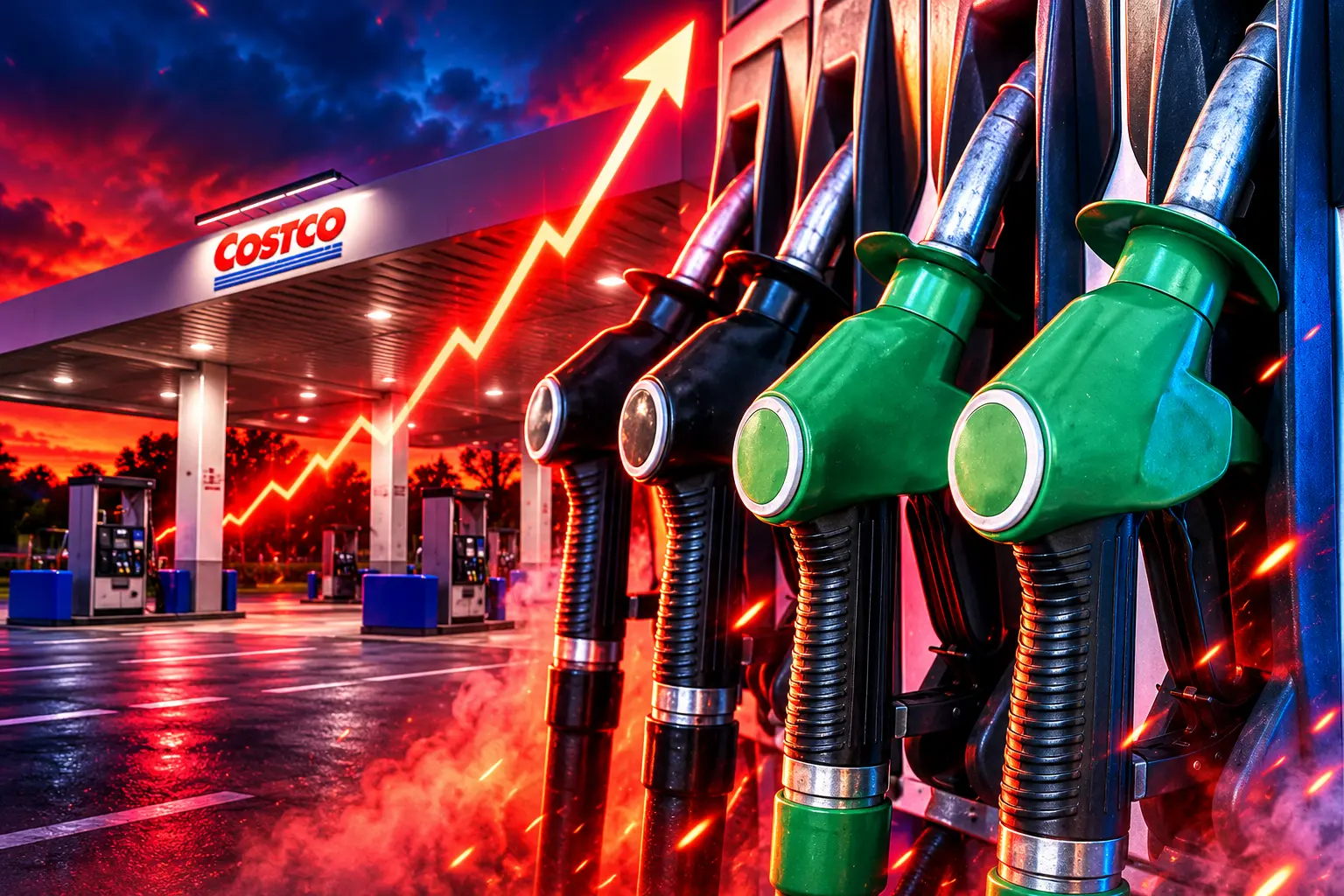
AAA posted a 13-cent rise to $4.27 in the week through September 10, with the daily print at $4.277. A week earlier the average was $4.1436. A month earlier it was $4.0091, a 27-cent climb. A year earlier it was $3.1938, which leaves September 10 about $1.08 higher than that print. Against December 18, 2025, the national average is up $1.38.
THEN AND NOW ON REGULAR GAS
| Benchmark | Dec. 18, 2025 | Sept. 10, 2026 |
|---|---|---|
| AAA U.S. regular average | $2.896 | $4.277 |
| Oklahoma state average | $2.289 | $3.87 |
| Lowest listed station | $1.78, Costco, Colorado Springs | Cheapest AAA state: Indiana, $3.56 |
| Texas marker | $1.89 at three Houston-area stations | State average $3.83 |
| California state average | Already a high-tax outlier in that winter survey | $5.89 |
The rise is happening in a season when pump prices usually ease as summer driving fades. EIA figures cited by AAA show gasoline demand falling last week from 8.92 million barrels a day to 8.55 million, even as the national average climbed. Total domestic gasoline supply ticked up from 205.7 million barrels to 206.9 million. Gasoline production slipped from 9.8 million barrels a day to 9.3 million. U.S. crude inventories fell 0.4 million barrels to 424.1 million, matching the five-year average.
West Texas Intermediate rose $3.02 to settle at $96.05 a barrel in Wednesday’s formal session, AAA said. The club also described crude as back in the $100 range for the first time since July. Pump prices, it added, look like early June, not mid-September.
The expensive end of the map is still the West Coast plus Hawaii and Alaska: California $5.89, Washington $5.53, Hawaii $5.40, Oregon $5.06, Alaska $5.05, Nevada $5.01. The cheap end is the Midwest and Gulf: Indiana $3.56, Mississippi $3.80, Texas $3.83, Kansas $3.84, Louisiana $3.85, then Alabama and Oklahoma at $3.87. The California-to-Indiana gap is $2.33 a gallon on those AAA prints.
Indiana Leads the Cheap List With a 63.1-Cent Tax
The winter story treated low state taxes as the reason Oklahoma, Texas, and Mississippi kept showing up on cheap-gas lists. That still explains part of the Gulf. It does not explain who leads the country now.
Indiana’s statewide regular average is $3.56, a full 31 cents under Mississippi and 27 cents under Texas. The Tax Foundation’s July 2026 tally puts Indiana’s gasoline tax at 63.1 cents a gallon, the third-highest in the country, after a 2026 increase of 8.6 cents. Texas and Oklahoma still levy 20.0 cents. Mississippi is at 24.4 cents.
A high-tax state sitting at the bottom of the price list means the tax table is not the whole pump. Location, crude, and the local rack still do more work than a 40-cent tax gap when the barrel itself has moved from the high $50s into the $90s. Indiana’s diesel average, $5.9551, is not cheap, so the bargain is on gasoline, not on every fuel on the island.
Oklahoma, the cheapest state in that December survey, now ties Alabama at $3.87 and sits sixth on AAA’s low list. The oil-patch discount survived as a relative gap. It did not survive as $2 gas.
Warehouse Clubs Still Shave the Street Price
The December floor was not a Shell or a BP on a corner lot. It was Costco, Sam’s Club, and a few high-volume independents. That part of the machine is still running. It no longer prints a 1-handle.
Costco’s 2025 year-end report counted 747 gas stations, with fuel about 10 percent of net sales. A Gold Star card is $65 a year, and the pumps are for members. Across 2026 tests and retailer notes, those stations still land about 10 to 30 cents under nearby name-brand pumps. Sam’s Club runs more than 500 fuel centers on the same membership logic. The card is the ticket. The crude price sets the floor the ticket can reach.
HOW WAREHOUSE CLUBS POST THE LOCAL LOW
- The fee: Annual dues, not the gallon, carry most of the profit, which lets the pump run as a traffic tool.
- The volume: Hundreds of stations and long lines buy wholesale fuel in bulk that a single corner store cannot match.
- The gap: Clubs still undercut the local street by about 10 to 30 cents, enough to matter and not enough to restore $1.78.
- The math now: Thirty cents off Indiana’s $3.56 average still leaves a member near $3.26, more than a dollar above the old Costco print.
Take 30 cents off California’s $5.89 average and the member still pays more than $5.50. The club discount is real. It is a local trim on whatever crude, tax, and blend the state already built in. It is not a national $2 policy.
California’s Tax Stack Starts at 73.6 Cents
The December write-up already flagged California, Washington, and Hawaii as states that skew the U.S. average with higher taxes and special blends. That wall did not move when crude did. It is why $2 gas was never a coastal event, even at $57.97 WTI.
The Tax Foundation’s 2026 compilation puts the 73.6 cents a gallon in California at the top of state gasoline taxes, ahead of Illinois at 70.4 cents and Indiana at 63.1 cents. Washington is 60.2 cents. Alaska sits at the bottom at 8.95 cents, which has not made Alaska cheap at the pump; isolation and shipping still print a $5.05 average. On top of every state figure sits the federal excise tax of 18.4 cents.
California’s stack does not stop at the excise line. The Tax Foundation, folding in cap-and-trade and the Low Carbon Fuel Standard, puts the state’s total policy burden near $1.156 a gallon. Add the federal 18.4 cents and a California driver is more than a dollar a gallon into taxes and climate rules before crude, refining, and freight. A $2 street price would require the remaining chain to sell at a loss.
STATE TAX VERSUS THE SEPTEMBER 10 PUMP
| State | State gasoline tax | AAA regular |
|---|---|---|
| California | 73.6 cents | $5.89 |
| Washington | 60.2 cents | $5.53 |
| Indiana | 63.1 cents | $3.56 |
| Texas | 20.0 cents | $3.83 |
| Oklahoma | 20.0 cents | $3.87 |
| Mississippi | 24.4 cents | $3.80 |
The table is the Indiana problem in one view. The third-highest tax sits on the lowest AAA average. The lowest-tax oil states are cheap, just not cheapest. Policy sets a floor in California. Logistics can still beat a tax in the Midwest. Neither column produces a 1-handle in a $90-$100 crude market.
The $2 Number Moved From Signs to Speeches
$2 gas is still in the conversation. It is not on the board. President Donald Trump said on September 9 that prices would fall after the midterms, and that gasoline should go below $2 a gallon once oil comes down.
Right after the election, oil prices are going to be tumbling downward. They’re going to be tumbling down, and we’ll get them down, I think for gasoline, we’ll get them below $2 a gallon.
Donald Trump, president, September 9, 2026
The objection writes itself, and it is fair. Asking drivers to wait until after they vote is not a pump price. Tying the current $4.277 average to the Iran fighting is closer to the EIA and AAA notes, which both put Hormuz at the center of this month’s crude spike. What the pledge skips is the recent past. Sub-$2 gas already happened, in December, at Costco and Sam’s Club in a handful of states, on WTI in the high $50s. It left when the barrel left.
A return to $2 as a national average would need crude back in that band and a collapse in the coastal tax-and-blend premium that AAA has never recorded. Even a return of isolated $1.78 tickets would need membership pumps in cheap-logistics states, not a speech. California’s $1.156 policy stack makes a 1-handle arithmetically unreachable there at any crude price that still covers refining.
EIA Sees Hormuz Constraints Into 2027
The Energy Information Administration’s Short-Term Energy Outlook, released September 9 with inputs frozen on September 3, does not bake in this week’s tanker attacks. It already had a tight market. Global inventories, the outlook says, have seen 400 million barrels drawn this year, with more draws likely through December. EIA expects some Middle East flows to rise on a mix of Hormuz traffic and other routes, and it still assumes export constraints last through year-end. Regional crude output stays below pre-conflict averages until the second quarter of 2027.
THE CRUDE PATH OUT OF $2 GAS
- December 2025: WTI averages $57.97 a barrel. AAA’s U.S. regular average is $2.896, and Costco in Colorado Springs sells a gallon for $1.78.
- March 2026: WTI’s monthly average jumps to $91.38 as Middle East fighting tightens seaborne crude.
- April 2026: WTI averages $100.32.
- May 2026: WTI averages $102.13, the high month on EIA’s 2026 table.
- June to August 2026: Monthly WTI eases to $84.81, then $80.46, then $83.90, still far above the December window.
- September 9, 2026: WTI settles at $96.05. AAA, a day later, prints $4.277 and describes crude as back in the $100 range.
EIA’s own annual path now has Brent averaging $91 in 2026, up from $69 in 2025, then $74 in 2027 as production recovers. U.S. retail gasoline, on that forecast, averages $3.84 in 2026 after $3.10 in 2025, then $3.35 in 2027. September 10’s $4.277 spot sits above the 2026 annual forecast because the cheap months are already in the books and the war months are not done. Distillate is tighter still. EIA raised its 2026 retail diesel forecast to $5.07 a gallon and warned U.S. distillate stocks could drop below 100 million barrels in September.
AAA’s September 10 note also held public EV charging at 42 cents a kilowatt-hour, unchanged on the week. That is a different product and a different bill. It does not put $1.78 gasoline back on a Costco totem.
The September outlook still has Middle East exports short of pre-conflict levels until the second quarter of 2027, with Brent near $90 through the rest of 2026. A $1.78 gallon needs crude back in the $50s, and AAA’s September 10 print is $4.277.

UPI MDR Delay Hands Traders the Calendar After Paytm Falls

Google Messages Builds Nine In-Chat Games After Samsung’s Exit

Anthropic’s $100 Million Academy Trains the Firms That Bill Both Sides

Toyota’s Electric C-HR Leaves the Cheap Twin to Subaru

Markets Bet the Fed Skips October After Hawkish Minutes

The Orchard Bug Forced Zcash to Open an Empty Pool

The $5.99 Game That Won Steam’s 2026 Summer Sale

Don Lee Joins Hemsworth as Extraction 3 Starts Shooting

YouTube Shorts Retires Dislikes and Swaps Likes for Hearts

NEURA Robotics Is Spending Its $1.4B on a Machine Stack
-
 NEWS5 months ago
The Orchard Bug Forced Zcash to Open an Empty Pool
-
 GAMING5 months ago
The $5.99 Game That Won Steam’s 2026 Summer Sale
-
 ENTERTAINMENT7 months ago
Don Lee Joins Hemsworth as Extraction 3 Starts Shooting
-
 NEWS4 months ago
YouTube Shorts Retires Dislikes and Swaps Likes for Hearts
-
 NEWS4 months ago
NEURA Robotics Is Spending Its $1.4B on a Machine Stack
-

 NEWS5 months ago
Atlantic City Turned WWE’s Return Into a Civic Night
-

 AUTO6 months ago
Kawasaki Bets the New Z1100 Against Its Own Supercharger
-
 BUSINESS5 months ago
Norway’s Export Bank Backs Nscale’s $790 Million Narvik Loan