
NEWS
Wisconsin Blackout Plates Open Behind the Iowa Forecast
Wisconsin’s blackout plates outsold the butter yellow retro about 8 to 1 in month one, at roughly half the Iowa-based pace Madison used to promise more than.

Wisconsin issued 9,493 blackout license plates in the first month they were sold, against a forecast near 17,600 a month. Another 1,201 drivers took the butter yellow retro plate.
The mix was the one Madison modeled. The volume was not. WisDOT built both designs on Iowa’s blackout boom and told lawmakers the two plates would throw more than $25 million into the transportation fund in three years.
The Iowa Sales Math Wisconsin Copied
Iowa put a white-on-black specialty plate on sale on July 1, 2019, and the thing ran away from every college-logo tag in the state. Wisconsin’s Department of Transportation told the Legislature that Iowa moved about 160,000 blackout sets a year right after launch, then cooled off once the first wave of buyers had theirs.
Scale that clip up for Wisconsin’s bigger vehicle fleet, and the department’s number was 210,000 blackout sets a year in the early years, plus 20,000 retro yellow sets. A Legislative Fiscal Bureau paper prepared by Peter Mosher put those figures in the 2025-27 budget write-up as the working demand case.
THE IOWA FIGURES WISCONSIN SCALED
- Iowa’s early clip: About 160,000 blackout sets a year after 2019, then a fade as first demand was met.
- Wisconsin blackout target: 210,000 sets a year once the fleet adjustment was applied.
- Wisconsin retro target: 20,000 butter yellow sets a year.
- Make-and-mail cost: $16 a set, against about $11 for a standard pair.
Minnesota’s own blackout launch in January 2024 moved more than 1,600 plates in two days, a figure Wisconsin lawmakers kept citing while the design sat in draft bills. Rep. Paul Melotik, a Grafton Republican, and Sen. Dan Knodl of Germantown carried standalone blackout bills after a constituent spotted Iowa’s plates. Those bills stalled in hearings. The 2025-27 budget finally created both designs and gave DMV $5.5 million in spending authority to issue them, which matches the paper’s $1,860,900 plus $3,667,400 for the two fiscal years.
Gov. Tony Evers and WisDOT Secretary Kristina Boardman unveiled the art on December 9, 2025. Sales opened on January 9, 2026, online, at most DMV counters, and at dealers and third parties that already stock state plates.
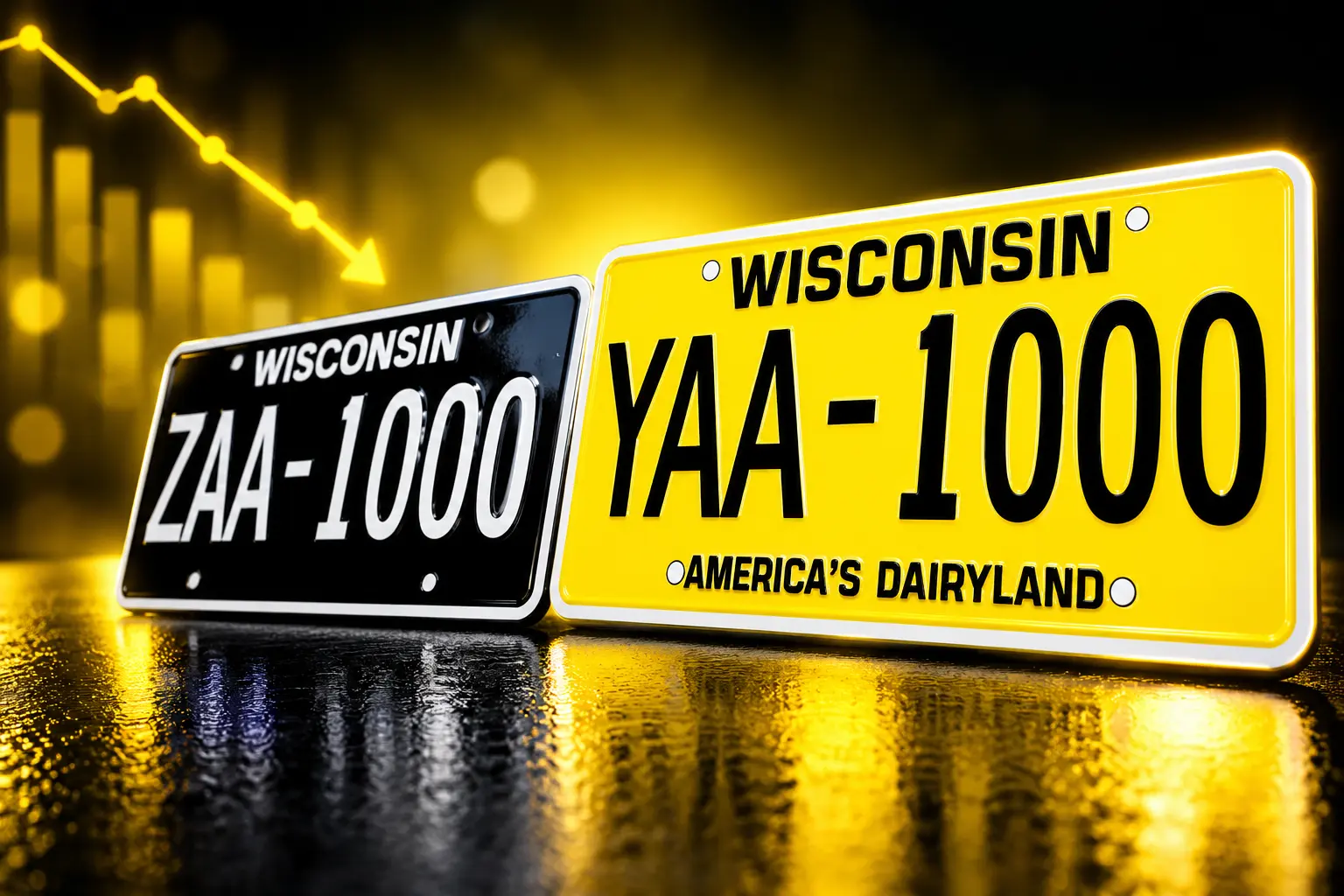
9,493 Blackout Plates and 1,201 Yellow Ones
On February 9, 2026, the DMV issued 10,694 plates in the first month, split as 9,493 blackout and 1,201 retro. Nearly half of each design carried a custom message: 4,634 blackout plates and 631 yellow ones, 5,265 in all.
The blackout plate took about 8 to 1 over butter yellow. That is close to the 210,000-to-20,000 mix the department had already baked into the budget paper. The volume test is the one that missed. The paper counted on 105,379 blackout sets in fiscal 2025-26, a short year because the plates would not exist until January, which works out to about 17,563 a month. Month one landed at 54 percent of that monthly clip. Retro ran closer to its own modest line, 1,201 against an implied 1,634 a month, about 74 percent of pace.
| Plate | First month issued | Custom messages | Fiscal 2025-26 forecast |
|---|---|---|---|
| Blackout | 9,493 | 4,634 | 105,379 |
| Retro yellow | 1,201 | 631 | 9,803 |
| Combined | 10,694 | 5,265 | 115,182 |
Most of those first plates moved through DMV’s new web app. More than 1,600 non-custom pairs also went out over the counter at DMV offices, participating dealers, and third-party vendors. Non-custom blackout stock started at ZAA 1001; by February 9 the office said ZAB and ZAC were already in circulation. Retro started at YAA 1001. Each design allows up to seven characters on a custom plate.
Iowa’s own first weeks were slower than the legend. The Iowa DOT had about 1,600 blackout plates issued by late July 2019, then opened generic stock at county treasurers after Labor Day and watched the count hit more than 46,000 by October 15. Wisconsin did not wait on a second channel. Dealers, DMV counters, and the app were live on day one, and the app still did most of the work. About 25 percent of app orders go out in the next day’s mail.
On April 1, 2026, WisDOT posted a fake all-white “Whiteout” plate it said would vanish in snow, a joke that only works if the blackout plate is already the one people talk about.
WHITEOUT LICENSE PLATE: Due to the popularity of Wisconsin DMV’s new “Blackout” license plate, plans are underway to release a “Whiteout” plate. This all-white plate with white letters, numbers and outline is nearly impossible to read and will perfectly blend in with the snow… pic.twitter.com/nV4mYkrng3
— Wisconsin DOT (@WisconsinDOT) April 1, 2026
The Butter Plate Barely Shows Up in Traffic
The yellow plate got the softer quotes and the dairy-state framing. Boardman, who used to run the DMV, talked about chasing the right shade and said she planned to order one herself.
Some call it the butter plate, others call it the Retro plate but if you had one in the 1970s, it was just the Wisconsin license plate. We put in some effort to get just the right shade of yellow. It’s nostalgic, it’s familiar to many, and I am planning to order one myself.
Kristina Boardman, WisDOT secretary, December 9, 2025 unveiling
Wisconsin’s last mass yellow era sits in living memory. A reflective yellow base from the late 1960s is the plate a lot of drivers still mean when they say butter. The state ran long-life yellow issues through the 1970s, then did its last full-fleet metal swap in 1979. Graphic plates with the barn, sailboat, and geese arrived in 1986 and became the default look people were trying to escape.
Evers sold the retro plate as heritage and the blackout plate as the contemporary look “folks have been asking for.” Month one said the asking was not evenly split. Blackout took 89 percent of the combined total. By September 2026 the yellow plate was still the one you could go a long stretch of highway without seeing, which is what an 8-to-1 opening already implied.
Boardman had previewed that outcome in a drier way. She called the blackout design simple and clean, said it complements many paint colors, and noted that neighboring states had already watched the style take off. The yellow plate was the memory. The black plate was the product.
A Rare Specialty Plate That Funds Asphalt
Wisconsin already sells more than 60 special plates, grouped by interest on the DMV site. Packers plates, veteran plates, university plates, and cause plates take a $25 annual amount that is usually a donation to the group on the sheeting. The Mosher paper’s quiet line is that none of those designs throw net money to the transportation fund.
Blackout and retro do. The $25 is deposited with road money, and a DMV application form says that unlike the rest of the special-plate menu, that annual amount is not tax-deductible. The plates are optional. The fund still gets a check that other vanity tags do not send.
HOW THESE TWO PLATES DIFFER
- Where the $25 goes: The transportation fund, not a campus, team, or charity.
- Tax treatment: The annual amount is not deductible, per DMV’s special-plate form.
- Who can order: Any Wisconsin resident; no group membership, no petition.
- Custom length: Up to seven characters, with a live duplicate and language check in the app.
That is the wager under the paint. Evers can talk about style and America’s Dairyland. The budget paper is a road-revenue instrument dressed as a choice of sheeting, priced so fees cover the extra production and still leave net cash, $2,746,400 in the first fiscal year and $8,380,700 in the second if the issuance forecasts hold. Gross fee revenue in that paper is $4,607,300 and then $12,048,100. The three-year “more than $25 million” line from the governor’s office sits on top of those two years and a third year of annual fees on a growing stock of plates.
Replies under Evers’ own February 10, 2026, pitch for the plates were not about fonts. People told him they already pay for roads. The plates are the administration’s way of collecting more from drivers who want a different look, without a general registration hike aimed at everyone.
Waupun Correctional Has Made Every Plate Since 1921
Every Wisconsin DOT plate is stamped at Waupun Correctional Institution by inmates in the Bureau of Correctional Enterprises. DOC Secretary Jared Hoy said so on launch day, and the fiscal bureau paper repeats the purchasing chain: DMV buys the metal from DOC, then pays to process and mail it.
Since 1921, all of the Wisconsin Department of Transportation’s license plates have been made at Waupun Correctional Institution. The DOC residents who make these plates take tremendous pride in their work and DOC staff are privileged to help them learn and grow through these jobs.
Jared Hoy, DOC secretary, January 9, 2026 launch release
Special sheeting costs more. The paper puts DOC’s manufacturing at about $10 a set for blackout and retro against about $5 for a standard pair, plus about $6 in postage and handling, which is how the office gets to $16 all-in. Design and data work for the two new bases was listed at $9,000 each. The plates made at Waupun Correctional Institution are the same shop as the barn plate. They just use more material and more press time.
High-contrast white on black is also easy for cameras to read. Drivers who wanted a “dark” plate as a way to get lost in traffic bought the opposite: a pair that automatic readers lock onto cleanly. The stealth pitch was never in the spec sheet. Readability was, including in older testimony that treated white-on-black as a plus for police.
What a Wisconsin Blackout Plate Costs
At launch, both plates carried a $15 issuance fee and a $25 annual fee, $40 up front, then $25 each year after, on top of ordinary registration. WisDOT kept those figures in the February 9 tally release. By late summer the department’s blackout product page listed a $27 issuance fee plus $25 a year, still on top of regular registration, with the $25 described as going to the transportation fund.
| Charge | At January 2026 launch | On the blackout plate page, August 2026 |
|---|---|---|
| Issuance (first time) | $15 | $27 |
| Annual plate amount | $25 | $25 |
| Regular registration | Still due | Still due |
| Custom message | Optional, extra review time | Optional, about four extra weeks |
If every first-month buyer paid the launch pair of $15 plus $25, those 10,694 sets put $427,760 through the two plate fees before ordinary registration. Custom messages and the later $27 issuance price sit on top of that math. The budget paper’s revenue table used the $15 issuance fee, so its $4,607,300 first-year figure is the modeled case, not a cash register dump from February.
Anyone can order from the special-plate app without waiting for renewal. The app previews a custom line as you type, checks the database for duplicates and banned words, then has a DMV staff member review it. Non-custom blackout and retro orders can land in a few days instead of several weeks by mail. DMV counters stocked both designs from the first week of January.
February Is Still the Last Official Count
FROM UNVEIL TO THE LAST SCOREBOARD
- December 9, 2025: Evers and WisDOT unveil blackout and butter yellow art in Madison.
- January 9, 2026: Both plates go on sale online, at DMV offices, and at participating dealers.
- February 9, 2026: DMV reports 10,694 issued, 9,493 of them blackout.
- April 1, 2026: WisDOT posts the fake Whiteout plate, citing blackout popularity.
- July 9, 2026: DMV staff pitch both plates at the Iola Car Show and still call them popular.
WisDOT has not put out a second sales dump since that February 9 release. The half-million blackout forecast, more than 500,000 on the road within three years, needs something much closer to 210,000 a year than 9,493 a month if the first month was a peak. If 9,493 was a floor, the Iowa-scaled case is still open. The department has not said which one it was.
The yellow plate remains the rare one in traffic, which is the result the first-month split already described. The blackout plate is the one the transportation fund actually needs, because that is the design the 210,000-a-year line was written around. Until DMV prints another number, the copied Iowa forecast is a target with one month of public evidence under it, and that month came in at 54 percent of pace.

UPI MDR Delay Hands Traders the Calendar After Paytm Falls

Google Messages Builds Nine In-Chat Games After Samsung’s Exit

Anthropic’s $100 Million Academy Trains the Firms That Bill Both Sides

Toyota’s Electric C-HR Leaves the Cheap Twin to Subaru

Markets Bet the Fed Skips October After Hawkish Minutes

The Orchard Bug Forced Zcash to Open an Empty Pool

The $5.99 Game That Won Steam’s 2026 Summer Sale

Don Lee Joins Hemsworth as Extraction 3 Starts Shooting

YouTube Shorts Retires Dislikes and Swaps Likes for Hearts

NEURA Robotics Is Spending Its $1.4B on a Machine Stack
-
 NEWS5 months ago
The Orchard Bug Forced Zcash to Open an Empty Pool
-
 GAMING5 months ago
The $5.99 Game That Won Steam’s 2026 Summer Sale
-
 ENTERTAINMENT7 months ago
Don Lee Joins Hemsworth as Extraction 3 Starts Shooting
-
 NEWS4 months ago
YouTube Shorts Retires Dislikes and Swaps Likes for Hearts
-
 NEWS4 months ago
NEURA Robotics Is Spending Its $1.4B on a Machine Stack
-

 NEWS5 months ago
Atlantic City Turned WWE’s Return Into a Civic Night
-
 AUTO6 months ago
Kawasaki Bets the New Z1100 Against Its Own Supercharger
-
 BUSINESS5 months ago
Norway’s Export Bank Backs Nscale’s $790 Million Narvik Loan