
FINANCE
Coinbase Policy Chief Rejects Warren’s CLARITY Act Security Warning
Coinbase’s Faryar Shirzad disputes Warren’s claim that the CLARITY Act eases sanctions evasion as the Senate returns with weeks left to vote.

Coinbase’s chief policy officer told Senator Elizabeth Warren on X that she has the CLARITY Act’s security risk backward, arguing that tighter compliance rules protect the country rather than expose it. The rebuttal landed hours after Warren shared an op-ed headline calling the bill a ticket to sanctions evasion. Both posts arrived as Senate Banking and Agriculture Committee staff race to merge two competing drafts into one before lawmakers leave town.
The timing matters more than the tweets themselves. At least seven Senate Democrats have to cross over for the bill to survive a filibuster, and several of them are waiting on law enforcement groups that still have not signed off.
Shirzad Turns Warren’s Own Warning Back on Her
Faryar Shirzad, Coinbase’s chief policy officer, posted on X that unclear crypto rules create the real danger because they let bad actors exploit legal gray zones. Coinbase is the largest U.S. crypto exchange and has spent more than two years lobbying for the bill, formally titled the Digital Asset Market Clarity Act and numbered H.R. 3633 in its current Senate text.
Shirzad argued the legislation would force digital asset platforms into the same anti-money laundering rules that already bind banks, while expanding the Treasury Department’s power to track and block sanctions evasion by hostile states. He pointed to added resources for the Financial Crimes Enforcement Network, known as FinCEN, to fight state-backed cybercrime, plus new authority letting platforms freeze suspicious transactions at law enforcement’s request.
His framing was simple: this is a tougher compliance regime, not a lighter one. Shirzad’s post came directly in response to Warren, who had shared an opinion piece hours earlier accusing the bill of doing the opposite.
The Iran Case Behind Warren’s Sanctions Claim
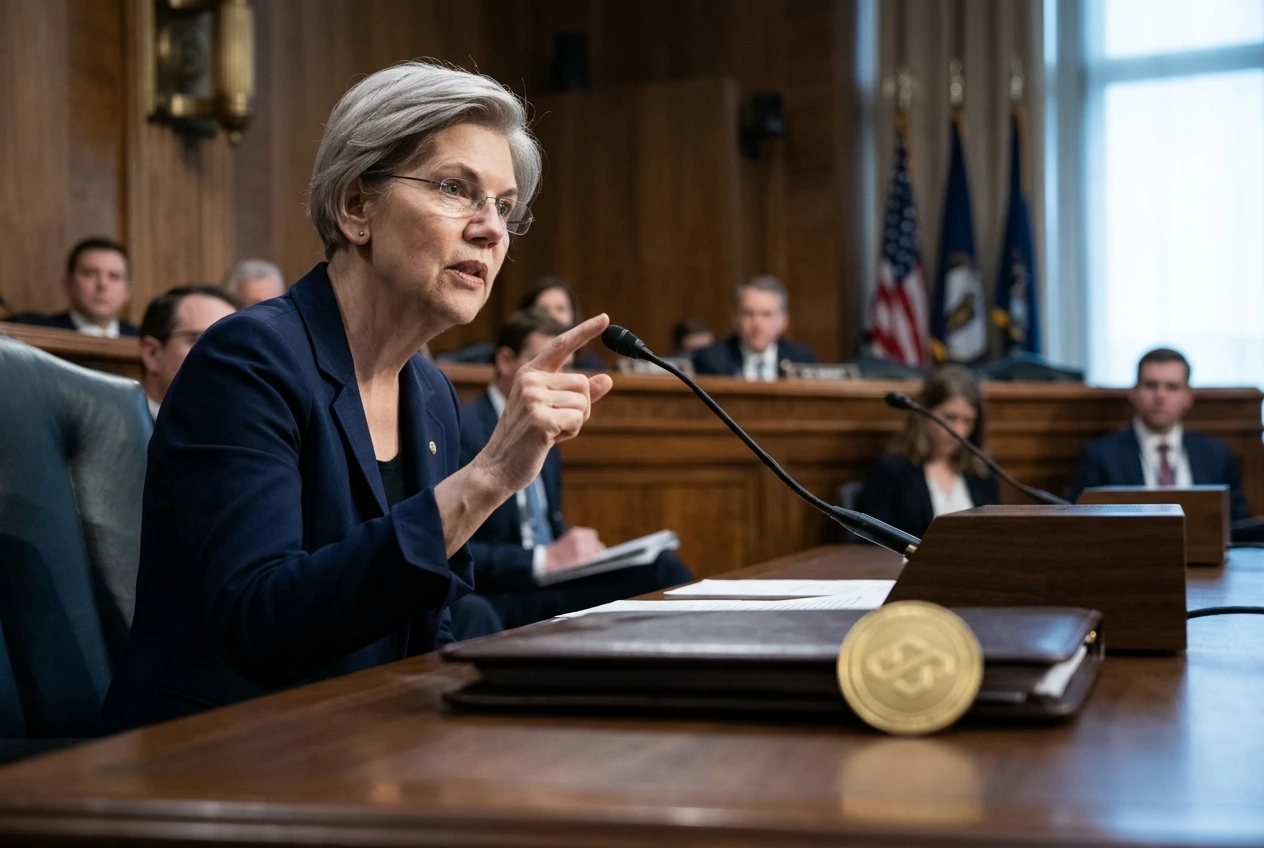
Senator Elizabeth Warren, a Massachusetts Democrat, wrote that “as currently drafted, the Clarity Act is a ticket to sanctions evasion,” repeating the headline of an op-ed she shared on X. The piece was written by Richard Nephew, a Columbia University research scholar who previously served as the State Department’s inaugural coordinator for global anticorruption and as director for Iran at the National Security Council.
Nephew argued the bill would strip away standard financial institution duties meant to protect national security, calling the resulting gaps in anti-money laundering and counter-terrorism rules for decentralized finance and certain crypto firms a design that leaves them vulnerable to terrorists, sanctions evaders and fraudsters. He named Iran, North Korea, Russia and China as adversaries positioned to exploit the weakness. Warren has made the same point before: last month she noted that Iran-affiliated groups are already channeling billions in transactions through crypto platforms.
Minority staff on the Senate Banking Committee backed up the claim with a detailed national security advisory drawing on open-source intelligence and law enforcement warnings. It argues the current draft fails to close the so-called Tornado Cash loophole, letting major crypto mixers dodge U.S. sanctions despite known ties to laundering billions for terrorists, rogue states and criminal cartels. FinCEN itself warned banks in May that Iran’s Revolutionary Guard had built a shadow banking network combining digital assets, front companies and exchange houses to launder oil proceeds and fund weapons programs.
Three camps have staked out ground on this fight, and they are not converging:
- Warren and Nephew – the bill strips away standard bank-style duties and reopens doors closed after 2001.
- Lummis, Shirzad and Senate Republicans – clear jurisdiction is itself a security tool, and the bill hands regulators sharper authority than they have today.
- Transparency International’s Scott Greytak – the deputy executive director said the bill “leaves serious illicit finance gaps” regardless of who is right about intent.
Senator Cynthia Lummis, a Wyoming Republican, dismissed the sanctions framing outright. “If you don’t like crypto, then say it,” she wrote, “but stop these baseless attacks.”
Four Sections Carrying the Whole Argument
Strip away the social media back-and-forth and the entire dispute rests on four sections of bill text. The Senate Banking Committee’s own section-by-section breakdown lays out what each provision is supposed to do; critics dispute how well it does it.
| Section | What It Does | Industry’s Case | Critics’ Rebuttal |
|---|---|---|---|
| Section 201 | Applies Bank Secrecy Act and AML rules to crypto intermediaries | Closes the regulatory gray zone bad actors exploit today | Doesn’t clearly cover every business that profits from DeFi activity |
| Section 303 | New Treasury sanctions authority targeting Iran-linked evasion | Lets Treasury sever foreign crypto firms from the U.S. financial system | Fails to close the Tornado Cash mixer loophole |
| Section 305 | Lets exchanges freeze suspected illicit funds pending a court order | Gives platforms a liability shield to act fast on law enforcement tips | Reactive by design, not preventive |
| Section 604 (BRCA) | Shields non-custodial software developers from Bank Secrecy Act treatment | Protects coders who never touch customer funds from open-ended liability | Could shield criminal activity from prosecution, police groups warn |
Section 604, the Blockchain Regulatory Certainty Act folded into the bill, draws the sharpest divide. Senator Ron Wyden has pushed to preserve it, arguing developers of non-custodial blockchain software should not be treated as financial institutions. The National District Attorneys’ Association told Senate leadership the same section would materially impair criminal investigations involving cryptocurrency, and the Fraternal Order of Police has raised nearly identical concerns.
Law Enforcement Still Hasn’t Picked a Side
That split inside law enforcement, more than anything Shirzad or Warren posts, may decide the bill’s fate. The White House Crypto Council has spent weeks trying to close the gap.
- National Organization of Black Law Enforcement Executives – became the first major law enforcement group to formally endorse the bill.
- Major County Sheriffs’ Association – moved from opposition to neutral after White House outreach.
- Fraternal Order of Police and the National District Attorneys’ Association – still warn Section 604 would hamper prosecutions.
- Senators Mark Warner and Catherine Cortez Masto – have explicitly tied their floor votes to law enforcement sign-off that neither has received.
Without that sign-off, the seven-vote math Republicans need gets harder, not easier, no matter how the sanctions argument plays out in public.
Trump’s $1.2 Billion Crypto Year Won’t Go Away
Warren isn’t fighting this alone. She, Richard Blumenthal, Gary Peters, Dick Durbin and Ron Wyden, all Senate Democrats, signed a joint statement asking for hearings into the national security implications of President Donald Trump’s crypto business interests. Ranking members from five separate Senate committees backed the request, arguing Trump’s financial disclosures raise fresh questions just as the bill nears a final text.
Those disclosures, released last week, showed Trump made about $1.2 billion in crypto-related income last year, roughly $594 million from World Liberty Financial and $635 million tied to his meme coins. The senators wrote that the numbers heighten concerns about the president pushing Congress to pass crypto legislation in favor of the very industry he’s cashing in on.
Like World Cup matches, legislation can have momentum swings, and the past week wasn’t a positive shift for the bill.
Ian Katz, managing partner at Capital Alpha, wrote that in a note to clients, calling ethics the biggest substantive obstacle left in the negotiations. One idea on the table would let state attorneys general sue federal officials over ethics violations or sue exchanges that list tokens tied to a sitting official. Neither party has agreed to it yet.
How Many Votes Does the CLARITY Act Actually Need?
The bill needs at least seven Democratic votes to clear the Senate’s 60-vote filibuster threshold, since Republicans hold 53 seats and two of their own, Josh Hawley and Rand Paul, are expected to vote no. Two Democrats, Ruben Gallego of Arizona and Angela Alsobrooks of Maryland, already backed the bill in the Senate Banking Committee’s 15-9 markup vote in May, but both warned that committee support would not automatically translate into a floor vote.
Prediction markets have soured on the odds as the deadline closes in. Polymarket now prices 2026 passage at 48%, down from 74% a month earlier. Galaxy Digital placed a $10 million institutional trade on passage this year and has separately marked its own estimate down to roughly 60%. Lummis has countered that the bill carries $150 million in dedicated funding to fight illicit crypto activity, a detail she uses to argue the legislation is an enforcement bill as much as a market structure one.
Brian Gardner, chief Washington policy strategist at Stifel, wrote that the bill probably needs to clear the Senate by the end of July, and that missing the August recess would cause its prospects to deteriorate materially. Beacon Policy Advisors put it more bluntly, describing a miss as one that could end the 2026 path entirely.
The Clock Nobody Can Stop
The Senate returned from its recess today, July 13, leaving roughly 20 working days before Congress disperses for the August 7 break. No cloture motion has been filed. Majority Leader John Thune has not yet allocated floor time, and the defense authorization bill is competing for the same calendar space.
A merged draft combining the Senate Banking and Agriculture Committee texts could surface as soon as next week, according to people following the talks who spoke to CoinDesk. That version is said to have grown by more than 70 pages, but it still has not settled the Democrats’ central demand: barring senior officials, including the president, from holding business ties to the crypto industry.
The Senate Banking Committee majority has already published its own rebuttal to the loophole claims, insisting the bill closes gaps rather than opening them. None of that changes what happens on the floor. The House Financial Services Committee holds its own CLARITY Act hearing in New York on July 17, four days after the Senate’s return and just three weeks before the recess deadline arrives.
Frequently Asked Questions
What is the CLARITY Act, exactly?
The CLARITY Act is shorthand for the Digital Asset Market Clarity Act, a bill that would split federal oversight of crypto between the Securities and Exchange Commission and the Commodity Futures Trading Commission using a three-bucket classification framework, according to SEC Commissioner Hester Peirce. It passed the House in July 2025 by a 294-134 vote and cleared the Senate Banking Committee 15-9 in May 2026, but still needs a Senate floor vote, reconciliation with the House text, and a presidential signature.
Why does Warren say Iran benefits from the bill?
Warren has pointed to Iran-affiliated groups already moving billions of dollars in transactions through crypto platforms under current rules, arguing the CLARITY Act’s DeFi carve-outs would make that easier rather than harder to police. Her source, Richard Nephew, also named North Korea, Russia and China as adversaries that could exploit the same gaps.
What happens if the Senate misses the August 7 deadline?
Analysts do not expect the bill to die outright, but Beacon Policy Advisors has said a miss could end its realistic 2026 path entirely, pushing any comprehensive crypto market structure law into 2027 or later once the midterm campaign calendar takes over the fall session.
Did Coinbase always support this version of the bill?
No. Coinbase CEO Brian Armstrong twice contributed to markup delays over a proposed ban on stablecoin rewards before reversing to publicly endorse the bill in April, after a White House Council of Economic Advisers report found a full yield ban would cost consumers roughly $800 million a year.
How much money is riding on the stablecoin yield fight?
Coinbase earns approximately $1.35 billion annually in USDC rewards revenue, and whether that survives the final text depends on language the American Bankers Association says creates a loophole around the GENIUS Act’s ban on issuer-paid interest.
Disclaimer: This article is for informational purposes only and does not constitute financial, legal or investment advice. Crypto markets and pending legislation carry significant uncertainty and risk. Figures are accurate as of publication and sourced from congressional records, Senate committee documents and reported news coverage; readers should consult a qualified professional before making financial decisions tied to legislative or market outcomes.


Space Cargo Buys Into France’s Zero-G Flight Company

The $399 Omni Walks Away, Then Asks for a Dock

TECNO’s 0mm Bezelless Phone Still Needs a Rim

The Ryobi Tools That Unblocked a Garage Workbench

Ripple’s 700 Million XRP Re-Lock Repeats a Yearlong Pattern

The 2026 Kawasaki Ninja ZX-10R Matches Honda’s Price

Chainlink Puts Official US Inflation and GDP Onchain

Google Pushes Gemini Daily Brief off the Chat Screen

The Crosshair A16 HX Outruns Its Own Power Brick

Cloover Turns a $350 Million Installer Book Into a Utility

30-Year Yield Hits 5.32% Highest Since 2007 as Debt Supply Locks In Costs

Walter’s TWG Insists No Fraud as Insurer Probes Force Cleanup

Astute’s $1.2M bet makes B2B creator deals feed AI discovery

Strategy Parks $1.59B Cash While Bitcoin Stack Stays Flat

BlackRock Turns Cash Empire Into Stablecoin Reserve Rails

The 20% Savings Ideal Meets a 2.7% Reality Check

SpaceX Stock Rebound Tests Real Demand Before Huge Unlock

Amber’s €7M locks Mittelstand knowledge inside Europe

Monzo chair Gary Hoffman exits after board revolt fallout

PCE Stays at 3.7% as Gas and Tariffs Outrun Coming Revisions
-
 FINANCE3 months ago
Zcash Patched a Double-Spend Bug as ZEC Climbed 5%
-
 ENTERTAINMENT3 months ago
Steam Summer Sale 2026 Locks In June 25 to July 9 Dates
-

 FINANCE2 months ago
CLARITY Act Final Text Expected This Weekend as 60-Vote Hurdle Looms
-
 NEWS4 months ago
Meta Adds AI Replies to Threads, But Users Can’t Block It
-

 NEWS3 months ago
YouTube Shorts is testing a heart in place of the thumbs-up
-

 NEWS1 month ago
Senators Force Apple Off Chinese Memory as Big Three Cash In
-

 NEWS3 months ago
NEURA Robotics’ $1.4B Series C Redraws Europe’s Physical AI Bet
-
 ENTERTAINMENT5 months ago
Extraction 3 Is Officially Coming to Netflix in 2027