
BUSINESS
Monumental Raises $32M as Robot Bricklayers Face Their Toughest Test Yet
Monumental raised $32 million to scale its bricklaying robots, entering a field where SAM100, Hadrian X and Katerra all struggled to reach promised scale.

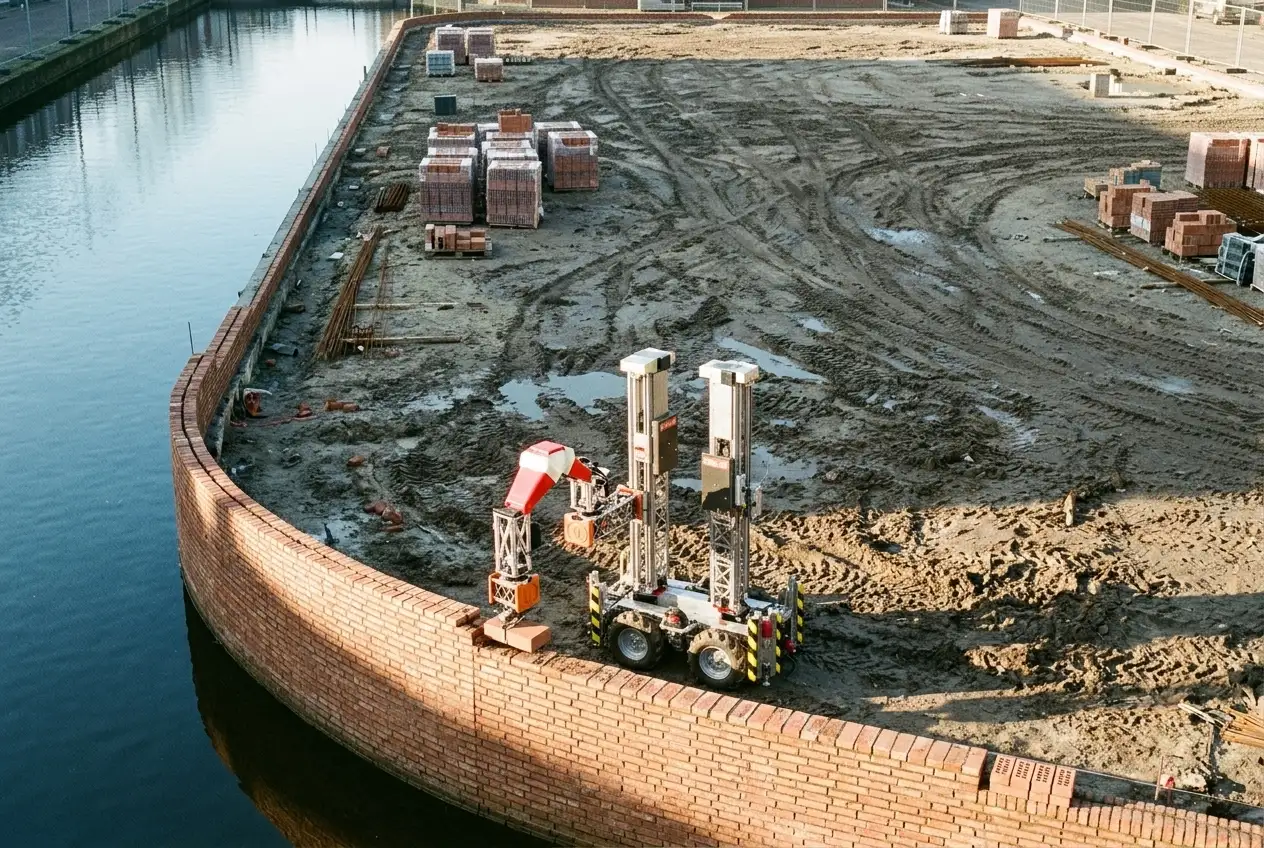
Monumental, an Amsterdam-based construction robotics startup, has raised $32 million in Series B funding led by Khosla Ventures, pushing its disclosed funding past $57 million. The money will put more autonomous bricklaying robots on European job sites and send the company’s first machines into the United States this year.
Robots that lay brick without a human mason have been pitched to investors for more than a decade. A machine called SAM100 made that promise in 2014. An Australian arm named Hadrian X made it a year later. Neither became a fixture on ordinary job sites. Monumental’s new round, and the unusually specific numbers behind it, make the strongest case yet that this attempt lands differently.
A Fleet of 150 Robots Gets Paid by the Wall
Monumental was founded in 2021 by Salar al Khafaji, now chief executive, and Sebastiaan Visser, now chief technology officer. The pair had already sold one company to data-analytics firm Palantir: their earlier startup, Silk, was acquired in 2016. They carried Palantir’s habit of putting engineers directly on a customer’s site into the new venture.
That history shows up in the business model. Contractors do not buy a robot. They hire Monumental the way they would hire a masonry subcontractor, paying per finished wall in familiar units, such as price per brick or price per square meter. The company’s electric, self-driving robots use sensors, computer vision and a small crane to place brick and mortar, coordinated by software called Atrium.
| Round | Date | Amount | Lead Investor |
|---|---|---|---|
| Series A | February 2024 | $25 million | Plural and Hummingbird |
| Series B | July 2026 | $32 million | Khosla Ventures |
| Total disclosed | Through July 2026 | $57 million | Combined investors |
Plural and Hummingbird, both backers of the 2024 round, returned for the Series B. The fresh capital arrives with a fleet already working: more than 150 robots on live job sites in the Netherlands and the United Kingdom, according to the company. Those machines have built more than 100 homes plus a school, a community center, a hotel and stretches of canal wall, with nearly half of those homes finished in the past three months alone, up from eight in the prior quarter.
Monumental’s funding announcement lays out the scale of the gap it is chasing in the US: American home builders face a monthly shortfall of 200,000 to 400,000 workers and will need to add 2.2 million more workers within three years just to keep pace with demand.
Europe Is Short Hundreds of Thousands of Bricklayers
Monumental’s home market carries its own version of the shortage. Dutch bank ABN AMRO estimates the Netherlands faces a 100,000 worker shortfall in construction through 2028, and Dutch employee insurance agency UWV ranks construction and infrastructure among the country’s five most critical shortage sectors. Employers there failed to fill 45% of vacancies in 2025, though that is actually down from 53% in prior years.
The gap widens across the continent. Germany’s construction industry needs 540,000 additional workers by 2027, and labor-market analysis points to a 2.1 million worker deficit projected across the European Union by 2026. A Euroconstruct survey from the fourth quarter of 2025 found that 58% of Dutch construction firms and 68% of German firms cited labor availability, not materials or financing, as their main constraint on filling order books.
| Country or Region | Reported Shortfall | Source |
|---|---|---|
| Netherlands | 100,000 worker gap in construction through 2028 | ABN AMRO |
| Germany | 540,000 additional workers needed by 2027 | Hauptverband der Deutschen Bauindustrie |
| United Kingdom | 6.5 million home shortfall; 20,000 more bricklayers needed against 1,990 apprenticeships completed in 2024 | Centre for Policy Studies |
| European Union overall | 2.1 million worker deficit projected by 2026 | Euroconstruct survey data |
A compilation of severe shortages of bricklayers and other manual trades from data firm Statista shows the construction vacancy rate has climbed since 2017, worsened by a wave of retirements among older tradespeople with too few younger workers trained to replace them. British think tank the Centre for Policy Studies puts the UK’s own shortfall at 6.5 million homes, with 446 dwellings per 1,000 people against a continental average of 542, second worst in Europe.
Robots Have Tried This Before
Construction accounts for 13% of global GDP and has seen almost no productivity gains in 50 years, per reporting on the round. Vinod Khosla, founder of Khosla Ventures, points to a starker version of that same stagnation: construction productivity has grown roughly 10% since 1945, while manufacturing productivity rose eightfold over the same stretch. Two companies tried to close that gap with dedicated bricklaying robots more than a decade ago, and neither became standard equipment on an ordinary job site.
Construction Robotics, a US company founded in 2007 by Nathan Podkaminer and Scott Peters, launched its SAM100 (Semi-Automated Mason) at the World of Concrete trade show in 2014. Priced around $500,000, it used a conveyor belt, a robotic arm and a concrete pump to lay 2,000 to 3,000 bricks a day, building walls the American Society of Mechanical Engineers says its makers claim run six times faster than a human mason. A year later, Australia’s Fastbrick Robotics unveiled Hadrian X, a truck-mounted robotic arm still sold today under the renamed FBR.
- 2007: Nathan Podkaminer and Scott Peters found Construction Robotics in the United States.
- 2014: Construction Robotics launches SAM100, the first commercially available bricklaying robot for job sites.
- 2015: Fastbrick Robotics unveils Hadrian X, a truck-mounted robotic bricklaying arm, in Australia.
- 2021: SoftBank-backed Katerra collapses into bankruptcy after raising more than $1 billion to overhaul construction’s supply chain.
- 2024: Monumental raises $25 million; FBR ships a next-generation Hadrian X unit to Florida through a joint venture with CRH Ventures Americas.
- 2026: Monumental raises $32 million more, led by Khosla Ventures, to fund its first US deployments.
Katerra’s collapse still shapes how investors treat this category: construction technology funding fell 33% year over year in the years since, according to reporting on the sector. FBR still sells Hadrian X, which lays up to 360 blocks an hour, but at nearly $6 million per machine it asks a contractor to make a large upfront bet before a single wall goes up. Monumental charges nothing upfront at all.
What Makes Monumental’s Approach Different?
Monumental avoids the two problems that slowed its predecessors: high upfront machine cost and regulatory friction. It charges for finished walls instead of selling hardware, and it builds with whatever brick and mortar a contractor already has approved, so regulators see nothing new to review.
- Outcome-based pricing: contractors pay per finished wall, in units like price per brick or per square meter, rather than buying or leasing a machine.
- Code-compliant materials: the robots lay whatever brick and mortar a contractor already specifies, sidestepping the building-code approval fights that slowed rivals.
- Forward-deployed engineering: engineers work on site with the robots, a habit al Khafaji and Visser carried over from building Silk before Palantir bought it.
Al Khafaji has said building-code fragmentation helped doom several predecessor attempts, and that Monumental’s workaround was deliberate.
The world simply does not have enough people to build what it needs, and that shortage will not be solved by another app or another robot doing backflips on stage.
Al Khafaji, Monumental’s co-founder and chief executive, said that when the round was announced. Khosla made a similar case for why he backed it: “construction costs have exploded while the industry itself has barely changed in decades,” he said, adding that “we know how to build, we’ve just made it too expensive and too slow.”
The Missing Numbers
The company’s own announcement, like most of the coverage around it, skips over revenue, gross margin per wall, robot uptime, cycle time against a human crew and defect rates. Those figures would show whether outcome-based pricing survives contact with an actual job site: mud, rain, a late brick delivery, a robot that needs recalibrating.
Scale is the other open question. A fleet of 150 robots is a real achievement for a five-year-old company, but it is small next to the gap it is meant to close. Al Khafaji has said as much himself: “You could have 10,000 robots a day and we would literally have just touched a few percentage points of the shortage.”
The company’s own benchmark for success is modest by design. Al Khafaji has set an 18-month target of a permanently deployed fleet in the high double to low triple digits across at least two US states, not the thousands that math would actually require.
A Crowded Field Chasing the Same Gap
Other investors are making the same bet on labor scarcity over new technology. Zurich’s Gravis Robotics raised $23 million in November to retrofit existing excavators and loaders with cameras and AI so they can run autonomously or be guided remotely by tablet. Berlin’s All3 raised $25 million in seed funding for legged robots aimed at housebuilding, and Built Robotics takes a similar retrofit approach with autonomous excavators.
Equipment giants are circling too. Caterpillar, Komatsu and Volvo are all developing autonomous construction equipment, a market valued near $10 billion in 2025 and growing at 7.9% a year. Dedicated construction robots are a smaller slice of that: industry estimates put the category near $1.4 billion in 2024, on pace for $3.66 billion by 2030 as adoption grows roughly 18% annually.
Australia’s FBR is still pushing into the same American market Monumental is now entering. Through its joint venture with CRH Ventures Americas, the venture arm of building materials supplier CRH, FBR has aimed at a phased purchase of 300 Hadrian X units tied to a demonstration program of single-story homes in Florida, one of the same states where Monumental plans its own early US deployments.
Sten Tamkivi, a partner at investor Plural, called Monumental “one of the most deployed autonomous construction operators in the world, solving a global-scale problem from the heart of Europe.” Whether that scale holds against a shortage measured in the millions will show up on job sites in Texas, Florida, Virginia and Arizona long before it shows up in any pitch deck.


Nvidia Buys Hugging Face, the Platform That Turned It Down

OpenAI Names GPT-6 Astra AGI, Then Locks It Down

Relay Q Bets a $150 Puck Can Beat Dictation Apps

Accel Backs Atira to Automate Industrial Sales Engineering

Beyerdynamic Hides a Spare Battery in the Aventho Y

Lummis Pushes the CLARITY Act to Export Wyoming’s Crypto Banks

AI Exposure Turns a Cloud Beat Into a Selloff

Citadel’s XRP ETF Filing Looks Like Dealer Inventory

Revolut’s OCC Nod Starts an 18-Month US Bank Clock

British Business Bank’s Zinc Fund Will Mint 80 Startups

Walter’s TWG Insists No Fraud as Insurer Probes Force Cleanup

30-Year Yield Hits 5.32% Highest Since 2007 as Debt Supply Locks In Costs

PCE Stays at 3.7% as Gas and Tariffs Outrun Coming Revisions

Astute’s $1.2M bet makes B2B creator deals feed AI discovery

Strategy Parks $1.59B Cash While Bitcoin Stack Stays Flat

The 20% Savings Ideal Meets a 2.7% Reality Check

Amber’s €7M locks Mittelstand knowledge inside Europe

SpaceX Stock Rebound Tests Real Demand Before Huge Unlock

Evernorth S-4 Clears Path for Active XRP Treasury on Nasdaq

Monzo chair Gary Hoffman exits after board revolt fallout
-
 FINANCE3 months ago
Zcash Patched a Double-Spend Bug as ZEC Climbed 5%
-
 ENTERTAINMENT3 months ago
Steam Summer Sale 2026 Locks In June 25 to July 9 Dates
-

 FINANCE2 months ago
CLARITY Act Final Text Expected This Weekend as 60-Vote Hurdle Looms
-
 NEWS4 months ago
Meta Adds AI Replies to Threads, But Users Can’t Block It
-

 NEWS3 months ago
YouTube Shorts is testing a heart in place of the thumbs-up
-

 NEWS1 month ago
Senators Force Apple Off Chinese Memory as Big Three Cash In
-
 ENTERTAINMENT5 months ago
Extraction 3 Is Officially Coming to Netflix in 2027
-

 NEWS3 months ago
NEURA Robotics’ $1.4B Series C Redraws Europe’s Physical AI Bet