
FINANCE
CLARITY Act Odds Sink to 31% as Europe’s Crypto Rules Take Hold
Trump’s Senate meeting produced no new CLARITY Act text, and Polymarket’s odds fell to 31% just as the EU’s MiCA regime took full legal effect.

President Trump sat down with Senate Republicans on Thursday to talk crypto ethics. He walked away with no new legislative text on the CLARITY Act, and the market that tracks the bill’s fate punished it immediately. Polymarket traders now price just a 31% chance the crypto market structure bill becomes law in 2026, a record low since the contract opened in January.
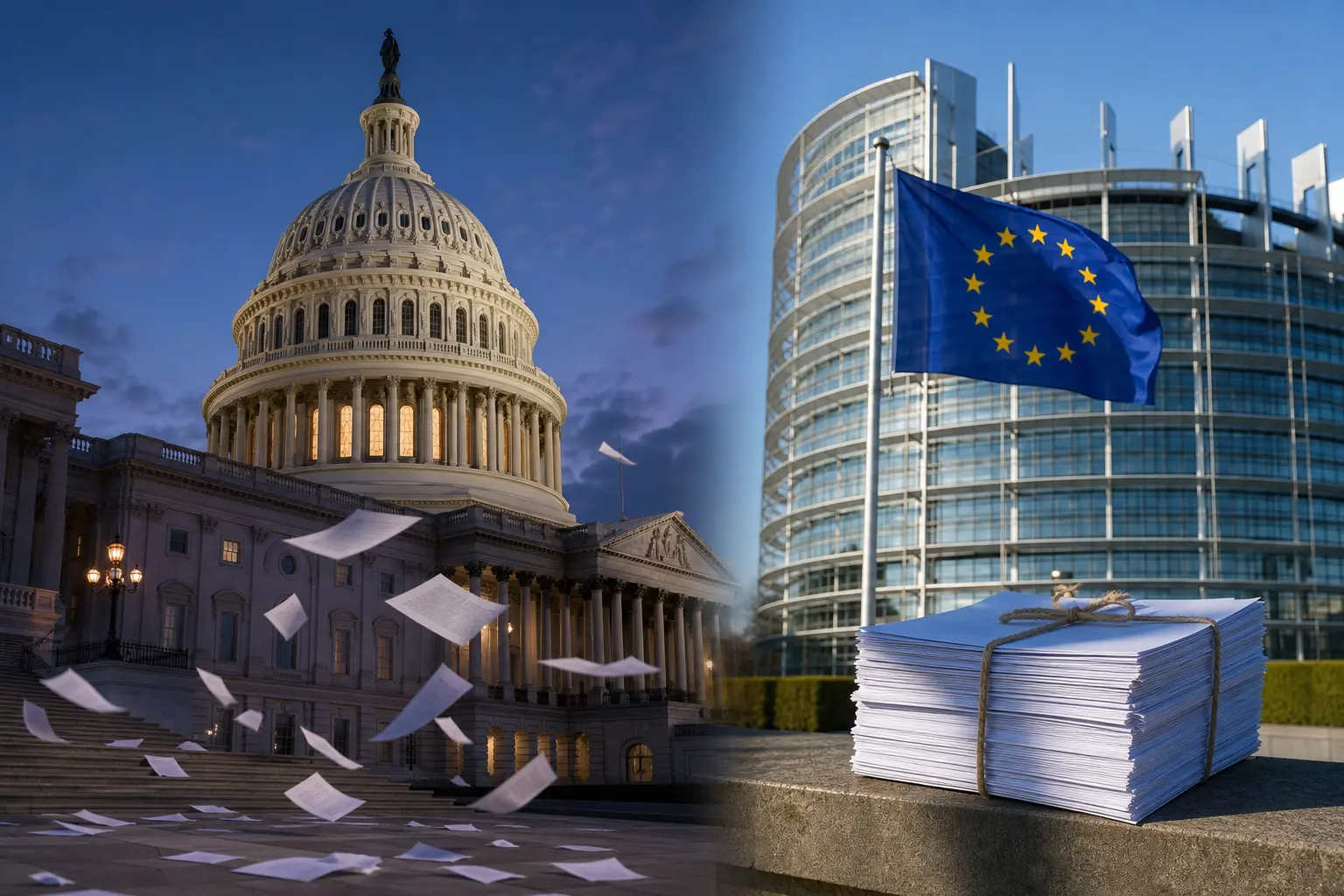
Six thousand kilometers away, the European Union has already finished the version of this fight the United States is still having. Its Markets in Crypto-Assets Regulation, known as MiCA, went into full, unforgiving enforcement on July 1. There is no grandfathering left, no White House meeting to wait on, and no ethics clause holding anything up. That contrast, not just the delay itself, is the story this week.
White House Talks Wrap Up, the Text Still Doesn’t Exist
Journalist Eleanor Terrett, who has closely tracked the bill on X, reported that updated legislative text remains elusive following Thursday’s meeting between the president and Senate Republicans. Industry contacts told her they are now bracing for the rollout to slip into next week.
Republicans had signaled otherwise beforehand. Sen. Bernie Moreno said the plan was to release text right after the sit-down, telling colleagues, “You guys have a lot of reading to do.” Moreno still wants a Senate floor vote before the August recess. Sen. Cynthia Lummis, a Wyoming Republican and one of the bill’s lead sponsors, said before the meeting that she hoped a draft would go public once talks with the president wrapped, though she gave no firm date.
Neither happened on schedule. The U.S. House Financial Services Committee held a Republican-led hearing in New York on Friday exploring how the bill could unlock digital asset innovation, but Terrett noted the session was informational and carries no weight over the Senate’s own timeline.
Odds Crash From Above 70% to 31% in Ten Weeks
The number is not an isolated data point. It is the bottom of a slide that started at genuine optimism. Galaxy Digital’s research head, Alex Thorn, pegged 2026 passage odds at 75% in May, then cut that to 60% by early June, citing a tightening Senate calendar according to reporting on the ethics objections that were already surfacing.
Here is how the market itself moved:
- January 11: Polymarket opens its “Clarity Act signed into law in 2026?” contract.
- Start of May: Odds sit near 46% ahead of a Senate Banking Committee markup.
- May 14: The committee advances the bill 15-9, with two Democrats crossing over. Odds jump toward 73 to 75%.
- June 5: Galaxy Digital trims its own estimate to 60% as ethics language hardens.
- Around July 4: A brief recovery pushes odds back above 50% on a text release.
- July 13: Trump posts on Truth Social urging senators to pass the bill in honor of the late Sen. Lindsey Graham. Odds fall toward 24% instead of rising.
- July 17 to 18: Polymarket settles near 31 to 32%, its lowest reading since launch.
Traders, in other words, treated presidential lobbying as close to irrelevant. The votes the bill needs belong to Democrats, and their objection has nothing to do with enthusiasm from the Oval Office.
Democrats Draw Their Line at One Billion Dollars
Sen. Ruben Gallego, an Arizona Democrat and one of the lead negotiators on the bill, said the ethics language Republicans offered fell far short of what his party needs.
At the end of the day, we don’t have strong ethics.
Gallego made that remark to POLITICO, adding that he didn’t care what the president said, because the Democratic votes simply were not there. He called the version of the bill he had reviewed “very weak,” arguing it gave the president broad latitude while offering thin consumer protections.
The number driving that anger is public. Financial disclosures show Trump earned more than $1 billion from crypto-related ventures in 2025. Sen. Elizabeth Warren has pushed for guardrails barring the president, senior officials and their families from profiting off the industry the bill would regulate, a fight Coinbase’s own policy chief has pushed back against in a separate dispute over her security warnings. A Democratic Senate aide said the Republican draft presented to the White House was less ambitious than what Democrats would accept, and that Democrats had neither read nor approved it during Thursday’s talks.
Not all Democrats have closed the door. Sen. Cory Booker of New Jersey said talks were still underway and argued the only route to passage runs through compromise. “The only way to get this done is a bipartisan pathway,” Booker said, adding he’d rather see the text held back than released before those talks finish.
Brussels Finishes the Job Washington Started
While the Senate argues over ethics clauses, the European Union closed its own multi-year crypto rulebook rollout on July 1, when MiCA’s grandfathering period expired for good. Any firm serving EU customers without a MiCA license is now, in the plain language of EU regulators, operating illegally.
The European Securities and Markets Authority’s grandfathering clause had let firms registered before December 30, 2024 keep operating while their applications were processed. That runway is gone. The fallout has been brutal for smaller players and clarifying for larger ones.
| Jurisdiction | Current Status | Key Number | What Comes Next |
|---|---|---|---|
| United States (CLARITY Act) | Text delayed again; needs 60 Senate votes | 31% odds of 2026 passage (Polymarket) | August 7 to 8 recess deadline |
| European Union (MiCA) | Fully enforced since July 1, 2026 | Roughly 230 of over 1,200 registered firms licensed | Consolidation and firm exits continue |
| Japan (FIEA reform) | Near a floor vote on crypto reclassification | Proposed flat 20% crypto tax | Bitcoin ETF legalization pending |
Roughly 17 to 20% of the more than 1,200 firms once registered nationally across the bloc actually secured full MiCA authorization, according to tracking of the licensing wipeout published as the deadline hit. That is not a gentle transition.
I estimate that 80% of the crypto players won’t survive after MiCA.
Erald Ghoos, chief executive of OKX Europe, gave that estimate in an interview, adding that the burden goes beyond MiCA itself once payment and e-money licensing requirements stack on top. Smaller firms have reportedly asked OKX whether it would simply acquire them rather than absorb the compliance cost.
Ripple’s Luxembourg License Versus America’s Waiting Room
The clearest single illustration of the transatlantic gap belongs to Ripple. The payments firm secured a full MiCA license in Luxembourg in early July, adding to a global tally that now exceeds 75 authorizations across markets including Singapore, Dubai and New York’s BitLicense regime, according to coverage of Ripple’s Luxembourg approval. Ripple Payments has processed more than $100 billion across over 60 markets, and the Luxembourg license lets it move both regulated euros and crypto assets under one rulebook across the entire bloc.
XRP itself is a different story. Its technical setup ahead of a possible Senate vote has drawn attention from traders, but its actual legal status in the United States still depends entirely on how the CLARITY Act defines digital commodities. Ripple’s own dollar token, RLUSD, has not yet cleared MiCA’s separate stablecoin track, a gap that Circle’s USDC does not share in Europe.
Ripple is not alone in banking regulatory certainty abroad while Washington stalls. Major licensed names now include:
- Coinbase, authorized through Ireland’s regulator, giving it passporting rights across all 27 member states.
- Kraken, licensed in both Ireland and Luxembourg.
- Revolut, which secured its license from Cyprus and now offers crypto services EU-wide through its banking app.
- Bitpanda, Bitvavo, Crypto.com, Bitstamp and OKX, all holding active MiCA authorizations as of this summer.
- Binance, the exception. It withdrew its Greek license application after setbacks and is now said to be exploring France instead.
Not every EU lawyer agrees on who benefits most from this shakeout. Joseph Borg, a Maltese lawyer and partner at WH Partners, estimated Europe could shrink from roughly 3,000 registered crypto firms to as few as 300 or 400 licensed ones, a consolidation he called a natural, positive step. Alex Fazel, chief partnership officer at SwissBorg, argued the license was never really about company size at all, saying transparency is what determines who survives.
What Breaks If the Senate Misses August 7
The calendar is doing more work here than any single senator. Lawmakers have roughly four weeks from mid-July before the chamber’s August 8 recess, a window nearly everyone involved treats as the last realistic shot this year. Miss it, and the fight moves into a fall dominated by midterm politics, the same stakes this site examined in its look at the Senate’s self-imposed recess deadline.
Lummis, who is not seeking re-election, has warned that missing this window could push comprehensive market-structure legislation as far out as 2030. She put the international stakes plainly: “Every month without clear digital asset rules is a month another country writes them for us.”
Booker’s bipartisan pathway remains the only route anyone in the Senate has publicly endorsed as workable. Whether that pathway produces text next week, or slips again, now sits entirely with negotiators who, by their own account, haven’t finished reading each other’s drafts.
Frequently Asked Questions
What would the CLARITY Act actually change for crypto markets?
The bill, formally the Digital Asset Market Clarity Act, would draw a legal line between digital assets regulated as securities by the SEC and those treated as commodities under the CFTC. The House passed its version in July 2025; the Senate Banking Committee advanced its own text in a 15-9 vote in May 2026, and the measure still needs 60 votes on the full Senate floor.
How many Democratic votes does the bill still need?
Analysts tracking the vote count put the gap at roughly seven Democratic senators short of the 60 needed, a margin that has not meaningfully closed since the ethics dispute hardened in June.
Is Europe’s MiCA the same thing as the CLARITY Act?
No. MiCA is primarily a licensing and consumer-protection regime that decides who can legally operate a crypto exchange or custody service inside the EU. The CLARITY Act is narrower and more definitional: it decides which US regulator, the SEC or the CFTC, oversees a given token. Both aim at legal certainty, but neither substitutes for the other.
What happens if the Senate misses the August recess deadline?
Momentum would likely shift toward attaching key CLARITY provisions to a must-pass spending bill later in the year, producing a narrower, watered-down version rather than the full standalone framework currently being negotiated.
How accurate are Polymarket’s odds historically?
Polymarket states a one-month accuracy score of 94% on its own platform statistics, meaning its pricing has tended to track real outcomes closely as events near resolution, though the CLARITY Act contract itself still has more than five months left before it settles.
Disclaimer: This article is for informational purposes only and does not constitute financial, legal or investment advice. Crypto assets and prediction market odds are highly volatile and can change quickly; figures cited reflect publicly reported data as of the date of publication.


British Business Bank’s Zinc Fund Will Mint 80 Startups

Philips Hue IFA Gear Opens TVs and Gates the Hub

Souk Raises $1.6 Million for Its AI Partner Manager

Anthropic Bets on Cheaper Cache for Claude Fable 5.1

Food Processors Back Backbone’s €4 Million Quality Round

Scosche Bets IFA Shoppers Will Buy Fewer Charging Bricks

ELO Bets Sentinel XR Gaming Glasses at IFA Berlin

ShiftCam SuperZoom Lenses Bet on a 350mm Phone Gap

Clooney Defends Ruffalo’s Speech While Collecting Venice’s Lion

Jungheinrich Is the Sole Backer of Uplift’s €100M Fund

30-Year Yield Hits 5.32% Highest Since 2007 as Debt Supply Locks In Costs

Walter’s TWG Insists No Fraud as Insurer Probes Force Cleanup

PCE Stays at 3.7% as Gas and Tariffs Outrun Coming Revisions

Strategy Parks $1.59B Cash While Bitcoin Stack Stays Flat

Astute’s $1.2M bet makes B2B creator deals feed AI discovery

The 20% Savings Ideal Meets a 2.7% Reality Check

SpaceX Stock Rebound Tests Real Demand Before Huge Unlock

Monzo chair Gary Hoffman exits after board revolt fallout

Amber’s €7M locks Mittelstand knowledge inside Europe

Nvidia’s $16,000 RTX Pro 6000 Turns Local AI Into a Luxury
-
 FINANCE3 months ago
Zcash Patched a Double-Spend Bug as ZEC Climbed 5%
-
 ENTERTAINMENT3 months ago
Steam Summer Sale 2026 Locks In June 25 to July 9 Dates
-

 FINANCE2 months ago
CLARITY Act Final Text Expected This Weekend as 60-Vote Hurdle Looms
-
 NEWS4 months ago
Meta Adds AI Replies to Threads, But Users Can’t Block It
-

 NEWS3 months ago
YouTube Shorts is testing a heart in place of the thumbs-up
-

 NEWS1 month ago
Senators Force Apple Off Chinese Memory as Big Three Cash In
-

 NEWS3 months ago
NEURA Robotics’ $1.4B Series C Redraws Europe’s Physical AI Bet
-
 ENTERTAINMENT5 months ago
Extraction 3 Is Officially Coming to Netflix in 2027