
NEWS
Memory Shortage Now Dictates Apple’s Two-Year Mac Roadmap
Bloomberg’s leaked Apple roadmap lists eleven new Macs through 2027, but an AI-driven memory shortage already forced Apple to cancel chips and pull a Mac Studio configuration.

Apple has mapped its Mac lineup all the way through 2027, and two of the most anticipated machines on that list still do not have a release date, because Apple does not fully control when they ship. Bloomberg’s Mark Gurman laid out the roadmap this week: eleven new Macs, an M6 MacBook Pro and fresh iMacs this fall, an OLED touchscreen MacBook Pro, and a rebuilt MacBook Air and MacBook Neo by 2027. The Mac mini and Mac Studio are on that list too, but their timing depends on something Cupertino cannot design its way around.
Gurman put it plainly: the schedule for those two desktops “depend on the state of memory-chip supplies.” That single clause is the real story sitting underneath the product list, an AI-fueled memory shortage so severe it has already forced Apple to scrap two chips and cut a Mac Studio configuration before this roadmap ever leaked.
A Two-Year Mac Lineup, Mapped Out
The near-term picture is the least complicated part. An entry-level 14-inch MacBook Pro carrying the new M6 chip arrives this fall under the internal codename J804, alongside the first new iMacs in two years, codenamed J833 and J834. The long-rumored OLED touchscreen MacBook Pro follows in 14-inch and 16-inch sizes, built on the older but still potent M5 Pro and M5 Max chips. Apple may announce it before the end of this year, with actual sales sliding into 2027.
Everything after that gets murkier. A MacBook Air update and a separately redesigned entry-level MacBook Pro are both penciled in for 2027, though Gurman himself seems unsure how a second entry-level Pro fits next to a laptop already built for budget buyers. The MacBook Neo, Apple’s cheapest laptop, is due for an A19 Pro chip (the same silicon in the iPhone 17 Pro) and a memory bump from 8GB to 16GB. That is not what should worry buyers most.
| Mac | Chip(s) Reported | Expected Window | Memory-Dependent Timing |
|---|---|---|---|
| MacBook Pro 14-inch, entry (J804) | M6 | Fall 2026 | No |
| iMac (J833, J834) | Not detailed | Fall 2026 | No |
| OLED MacBook Pro, 14/16-inch | M5 Pro, M5 Max | Announce 2026, sell 2027 | No |
| MacBook Air | Unspecified next-gen | 2027 | No |
| MacBook Neo | A19 Pro, 16GB memory | Periodic refresh | No |
| Mac mini | M5 Pro or base M6 | Undated | Yes |
| Mac Studio | M5 Max, M5 Ultra | Undated | Yes |
Mac sales are already headed for a third straight year of growth, and Gurman’s framing ties much of that to buyers who lean on Macs for demanding, agent-based AI work. Apple wants to feed that appetite with eleven machines in two years. The problem is that the ingredient those machines need most is the one currently in shortest supply anywhere in electronics.
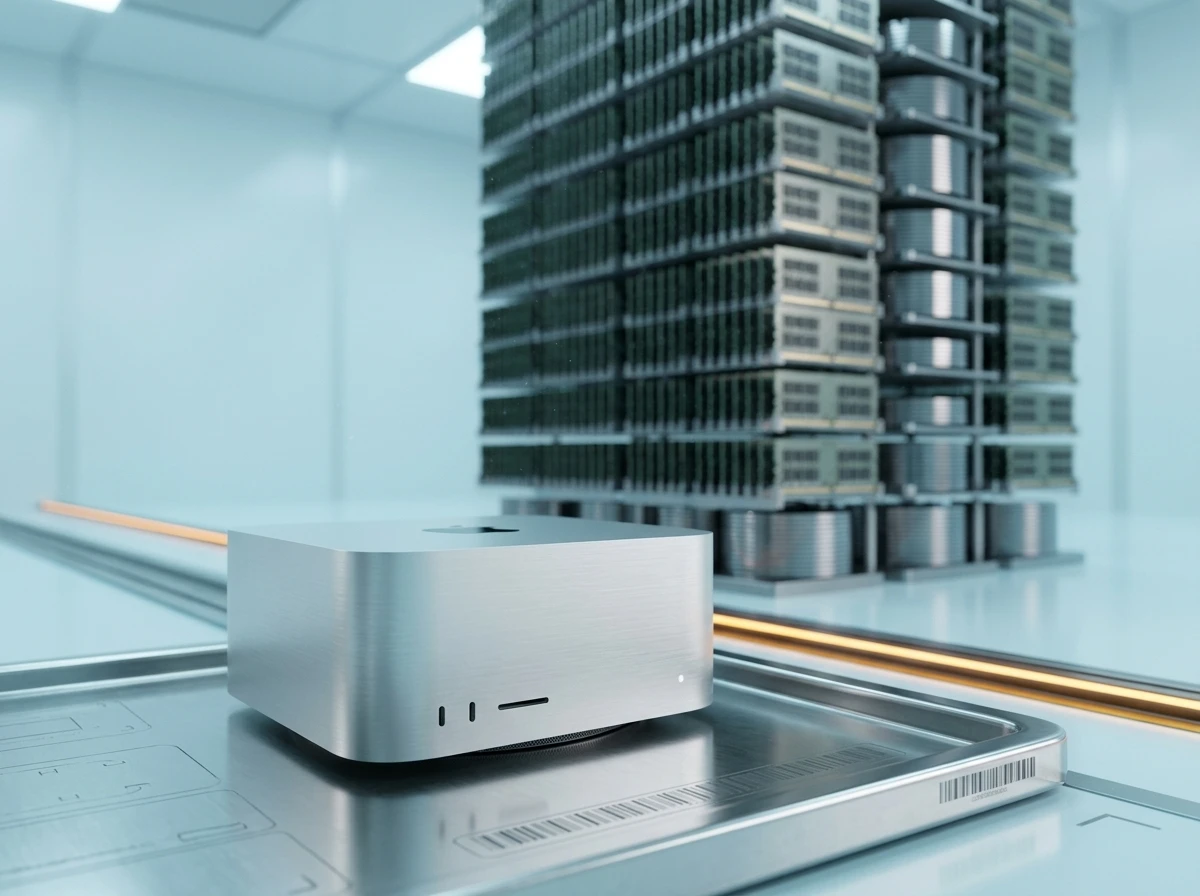
Why Two Launch Dates Come With No Date
Memory chips have not been this scarce in years. Industry researcher IDC calculates that global DRAM supply will grow just 16% year over year in 2026, with NAND close behind, both well under the 20% to 30% growth the industry used to consider normal. The reason is simple. Memory makers have shifted fabrication capacity toward the high-bandwidth memory that AI data centers need, and analysts estimate those data centers now absorb roughly 70% of high-end DRAM output worldwide.
TrendForce’s latest survey found DRAM contract prices set to climb 13% to 18% quarter over quarter in the third quarter of 2026, with NAND up 10% to 15% over the same stretch. That is actually a cooldown from the roughly 60% jump DRAM buyers absorbed in the second quarter, and TrendForce says the slowdown is coming from consumers hitting their affordability limit, not from any real improvement in supply.
Apple’s own software plans add to the squeeze. macOS 27 Golden Gate, due later this year, leans on a rebuilt Siri that pushes more processing on-device, and on-device AI is exactly what has made memory capacity a selling point on modern Macs rather than a spec buyers ignored.
Apple Already Canceled a Chip Over This
The clearest sign of how far this has already gone: Apple canceled its M6 Pro and M6 Max chips entirely to fast-track its next flagship silicon, the M7 Ultra. That chip is being engineered to support up to 1.5 terabytes of unified memory, roughly double the ceiling planned for the M5 Ultra, with Apple reportedly chasing AI performance in range of Nvidia’s Blackwell-class hardware. Whether Apple ever ships a Mac at that memory ceiling depends entirely on the shortage easing first.
It is not a hypothetical risk. Apple has already discontinued its 128GB Mac Studio configuration this year because of the same supply constraints. With no M6 Pro chip coming, Gurman expects the Mac mini to ship instead with an M5 Pro or a base M6, and the Mac Studio to fall back to this year’s M5 Max and M5 Ultra rather than anything newer, because there is nowhere else in Apple’s current lineup for it to go.
- Apple’s fiscal first-quarter 2026 earnings call: Tim Cook tells analysts memory had only a minimal effect on margins so far, but warns of a bigger hit ahead.
- June 17, 2026: Cook tells The Wall Street Journal that price increases have become unavoidable as memory and storage costs quadruple over the prior year.
- June 2026: Apple raises average prices roughly 20% across select Mac and iPad models, citing component costs directly.
- July 3, 2026: TrendForce forecasts another quarter of double-digit DRAM and NAND price gains.
- July 10, 2026: SK Hynix’s chief executive tells Reuters that 2027 will be the worst year the memory industry has ever recorded for supply.
- This week: Bloomberg’s Gurman reports Apple’s own Mac mini and Mac Studio timing now hinges on that same shortage.
From Difficult to Predict to a Hundred Year Flood
Apple’s public language on this has shifted fast. On that fiscal first-quarter call, Cook was measured about it.
We are currently constrained, and at this point, it is difficult to predict when supply and demand will balance.
Tim Cook, Apple’s chief executive, made that comment to analysts on the company’s fiscal 2026 first-quarter earnings call, discussing memory constraints tied to strong iPhone demand. By June, in a Wall Street Journal interview, his tone had hardened considerably. Cook called the pricing environment a “hundred year flood,” an unusually vivid phrase from a CEO known for measured language, and said Apple could no longer absorb the cost increases on its own.
The MacBook Neo shows the pattern in a single product. Its price has already moved from $599 to $699 as component costs climbed, and TechInsights estimates the same cost pressure could add roughly $270 to the bill of materials for the iPhone 18 Pro.
The Price Pain Spreads Past Cupertino
Apple is far from alone. Microsoft has said it is now paying two and a half times more for memory than it was at the end of last year, and Xbox Series S and Series X consoles are getting at least a $100 price increase starting in August 2026. Sony’s PS5 Pro with 2TB of storage now lists at $899, and Valve’s Steam Machine is launching around $300 above what buyers expected, at $1,049.
Apple’s own response has included a financing tweak alongside the price increases. The company recently introduced Apple Upgrade, a leasing program that spreads Mac payments over 36-month terms rather than asking buyers for the full price upfront, softening the sticker shock even as list prices climb.
Where the Chipmakers Disagree
- SK Hynix, Samsung and UBS expect 2027 to be the worst supply year in the industry’s history, with tight conditions persisting to 2030 or beyond.
- Bloomberg Intelligence analyst Shuli Ren takes the opposite view, arguing the shortage likely peaked in the second quarter of 2026 and could ease into 2028.
- Jefferies sides with the pessimists, projecting further 40% to 50% quarterly DRAM and NAND price jumps before the year is out.
SK Hynix chief executive Kwak Noh-jung told Reuters the worst year in the industry’s history is still to come, and that customer demand should keep outrunning supply capacity well past 2030. Samsung’s own executives have echoed that same 2027 warning. Bloomberg Intelligence is the lone major voice betting the crunch already crested.
What Buyers Can Actually Bank On
The fall 2026 machines are the safe bets. The M6 MacBook Pro and refreshed iMacs have real timing attached, and nothing in the reporting suggests memory supply threatens those launches. The OLED MacBook Pro sits in the middle: an announcement this year looks likely, with retail availability more probable in 2027.
The Mac Studio and Mac mini are the honest unknowns. Gurman’s own sourcing ties their release, and even their final memory configurations, to a global supply picture that Apple’s chip designers do not control and that SK Hynix’s own chief executive says will not meaningfully improve before 2030. Buyers who need a new Mac Studio soon are, in effect, waiting on a semiconductor market rebalancing out of Apple’s hands.
Frequently Asked Questions
Does the memory shortage affect the iPhone 18 lineup too?
Yes. TechInsights estimates the added memory and storage costs could push the iPhone 18 Pro’s bill of materials up by roughly $270, and Apple’s new foldable iPhone Ultra is expected to carry a price near $1,999, a premium tier that analysts say could help Apple hold mainstream iPhone pricing steadier.
What exactly is Apple Upgrade?
Apple Upgrade is a leasing program Apple introduced this summer that lets buyers pay for a Mac over 36-month terms instead of the full price at checkout, a financing option that arrived the same month Apple raised average Mac and iPad prices by about 20%.
Why does Apple’s own chip design need so much extra memory?
Apple’s unified memory architecture builds RAM directly onto the chip package, giving the GPU and Neural Engine full-speed access without the data-copy overhead of a separate memory module, which is why the upcoming M7 Ultra is being engineered toward 1.5 terabytes of unified memory for on-device AI work.


Veridue Raises $4 Million to Speed Energy Deal Diligence

Healey Adds a £150m Rung for Northern Scale-Ups

Ten Deals Took Most of Europe’s August Tech Money

Holmes Hired Fielder to Film Her Last Days

Molten Bets £100m of Plc Cash on Late-Stage Tech

Garlinghouse Cited Dutch Gold, and London Got the Bars

byFounders Bets $4.3 Million on Fluencify After $2M ARR

Alpha Gang Puts A-List Stars on a Zellner Wager

Angel Bets a Recut PG-13 Chase on Ritchson and Wilson

Flex IT and T1A Combine to Own Corporate Device Supply

Walter’s TWG Insists No Fraud as Insurer Probes Force Cleanup

30-Year Yield Hits 5.32% Highest Since 2007 as Debt Supply Locks In Costs

PCE Stays at 3.7% as Gas and Tariffs Outrun Coming Revisions

Evernorth S-4 Clears Path for Active XRP Treasury on Nasdaq

Astute’s $1.2M bet makes B2B creator deals feed AI discovery

Strategy Parks $1.59B Cash While Bitcoin Stack Stays Flat

Instinct Hits $2.5 Billion as AI Agent Access Sparks Trust Fights

Oracle’s 2.8 GW Bloom Deal Exposes the AI Power Bypass

CLARITY Act Cloture Opens a Door Ethics Still Blocks

Amber’s €7M locks Mittelstand knowledge inside Europe
-
 FINANCE3 months ago
Zcash Patched a Double-Spend Bug as ZEC Climbed 5%
-
 ENTERTAINMENT3 months ago
Steam Summer Sale 2026 Locks In June 25 to July 9 Dates
-

 FINANCE2 months ago
CLARITY Act Final Text Expected This Weekend as 60-Vote Hurdle Looms
-
 NEWS4 months ago
Meta Adds AI Replies to Threads, But Users Can’t Block It
-
 ENTERTAINMENT5 months ago
Extraction 3 Is Officially Coming to Netflix in 2027
-

 NEWS3 months ago
YouTube Shorts is testing a heart in place of the thumbs-up
-

 NEWS1 month ago
Senators Force Apple Off Chinese Memory as Big Three Cash In
-

 NEWS3 months ago
NEURA Robotics’ $1.4B Series C Redraws Europe’s Physical AI Bet