
NEWS
AIRMO Bets a 2027 Smallsat on EU Methane Rules
AIRMO is flying methane sensors now and aiming a 2027 LiDAR smallsat at EU import rules, in a market that ignores most free satellite leak alerts.

AIRMO plans to fly a methane-sensing smallsat in early 2027 and sell the data as EU import paperwork. The Berlin and Luxembourg firm, founded in 2022, already hunts leaks with drones and aircraft.
It wants orbit because moving those tools across borders is slow, and because unpaid satellite alerts rarely get a reply. The wager is that a European spectrometer-plus-laser bird can turn a leak map into a file an importer can show in Brussels.
AIRMO Is Betting Orbit Against a January Deadline
Daria Stepanova, AIRMO’s CEO and co-founder, is a space engineer who previously served as CTO of German Orbital Systems. She is building a 34-person shop that mixes people who have launched dozens of satellites with oil and gas hires who only recently entered space work.
A March seed round of €5 million (about $5.8 million), led by Ananda Impact Ventures with Unconventional Ventures, kopa ventures, Pi Labs and Antler, sat on top of a €5.2 million pre-seed in 2023 that included a €3.7 million European Space Agency contract. That is €10.2 million to get a payload onto someone else’s bus.
On 25 February 2026, AIRMO and Sofia-based EnduroSat said the first bird would be an ESPA-class FRAME-15 carrying AIRMO’s short-wave infrared pushbroom spectrometer and a micro-LiDAR, with commercial data from first light. EnduroSat’s note puts an early 2027 methane monitoring satellite on the pad and frames it as the start of a 12-plus satellite constellation. AIRMO has talked of 12 birds by 2030.
We needed a partner who could match our pace and our ambition. EnduroSat brings exactly the technical depth and mission execution experience we need to get our payload to orbit on schedule and performing to spec.
Daria Stepanova, CEO and co-founder, AIRMO
Raycho Raychev, EnduroSat’s CEO and founder, called high-quality emissions monitoring “foundational infrastructure” and said his firm would strip out the satellite complexity so AIRMO could sell intelligence. That split is the bet in miniature. AIRMO does not want to become a bus maker. It wants to sell a map.
The EU Import Rule That Turns Maps Into Paperwork
Regulation 2024/1787, in force since 4 August 2024, is the calendar AIRMO is selling against. Inside the Union, oil and gas operators must survey for leaks and repair them, in most cases within 5 or 15 working days. Venting and routine flaring are banned except in narrow safety cases.
The export punch is the part that reaches Saudi fields and Uzbek pipes. Under the Commission’s importer rules from 1 January 2027, importers must show that crude oil, natural gas or coal under contracts signed or renewed after 4 August 2024 was produced under monitoring, reporting and verification equivalent to the EU’s own rules, or at OGMP 2.0 Level 5 plus verification. Intensity reporting follows on 5 August 2028. An intensity cap is due on 5 August 2030.
THE EU IMPORTER CLOCK
- 4 August 2024: The methane regulation enters into force, and new supply contracts start to pick up future MRV duties.
- 5 May 2025: Importers file qualitative information on origin, route, and what leak detection and repair was applied.
- 20 July 2026: The Commission publishes a recommendation on importer penalties and a set of optional contract clauses.
- September 2026: The Methane Transparency Database is scheduled to launch.
- 1 January 2027: Importers must demonstrate MRV equivalence or OGMP 2.0 Level 5 plus verification for covered contracts.
- 5 August 2028: Importers report methane intensity of production under a Commission methodology.
- 5 August 2030: Importers must show intensity below a Commission limit for new and renewed contracts.
OGMP 2.0 already covers 42% of global oil and gas production, and the EU text treats Gold Standard reporting as a path through the import gate. AIRMO’s site sells that paperwork directly: kg/h, source-attributed, uncertainty-bounded, templates ready for UNEP.
Six Months to Fly a Drone Into Saudi Arabia
Stepanova has been blunt about why the company is going to space at all. Upstream oil and gas is the market it wants, with a concentration in the Middle East, Central Asia and North Africa, where the large leaks sit. Getting hardware there is the tax.
“You need to figure out the process of getting your instruments into the country. It took us six months to bring a drone into Saudi Arabia, where we’ve been doing campaigns. It’s a long, painful, experimental, and sometimes annoying process,” she said.
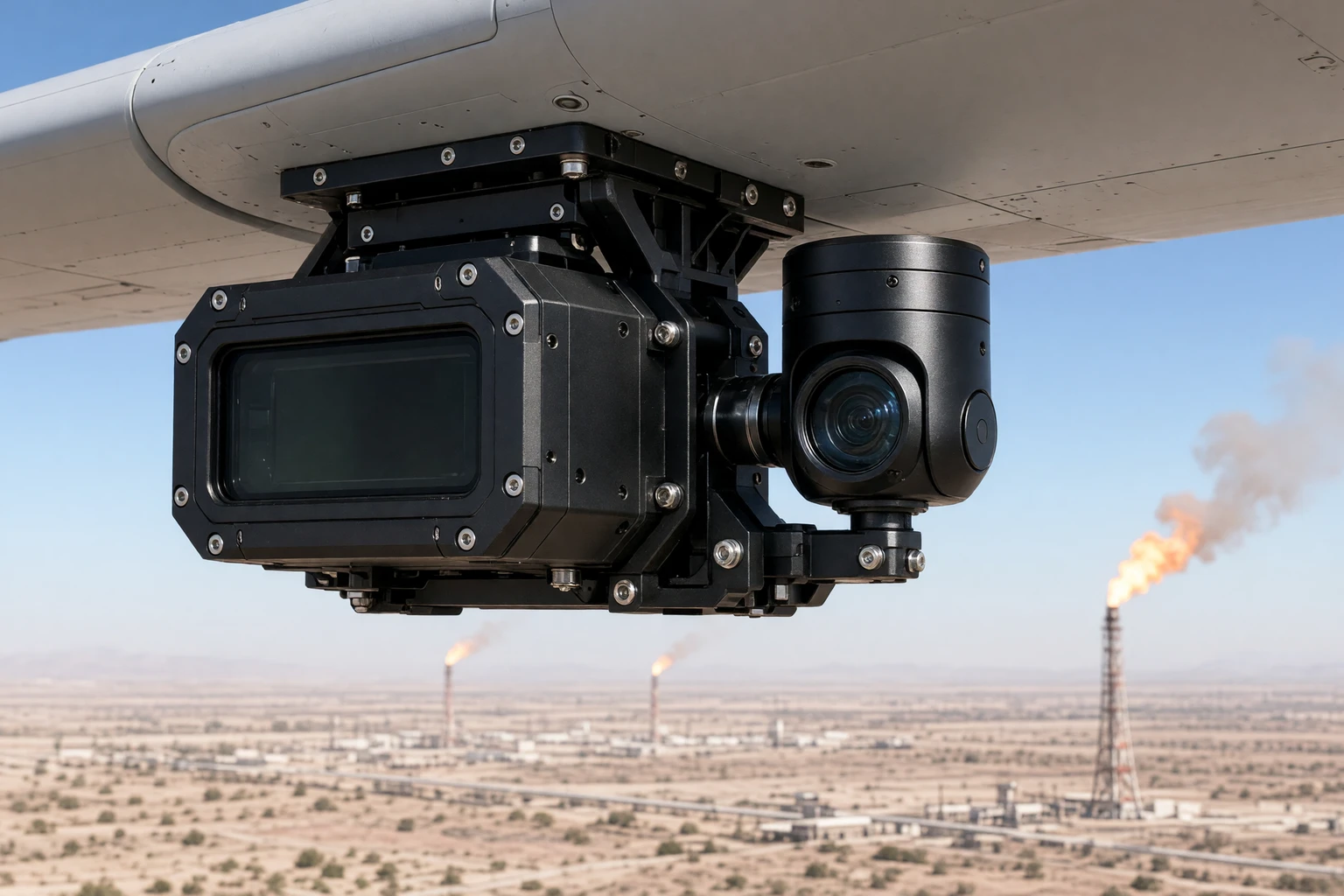
A satellite does not wait in customs. It also does not match a drone for precision, which is why AIRMO is flying the same optical package on aircraft and drones first, learning how customers actually use a leak map, then repeating the product from orbit. The map is the product. The vehicle is a delivery problem.
Ground practice is still analog. Workers walk plants that cover several square kilometres with handheld devices and old cameras. Offshore is worse. Stepanova’s line is that the work is expensive, slow and not digitised, so companies do it once a year. Satellites will not replace a sniffer on a valve. They make the year-long blind spot expensive to keep.
Free detection already exists, and that is the awkward part of the wager. The UN Environment Programme’s Methane Alert and Response System has been pinging governments since 2023 with large events spotted from public satellites. IEA analysis of 2025 traffic found only around 12% of those notifications drew a response. Seeing a plume is not the same as owning a number a compliance team will sign.
What the Micro-LiDAR Is For
AIRMO’s pitch against spectrometer-only birds is a second instrument. The SWIR pushbroom reads methane columns at about 50 m sampling from 500 km. The micro-LiDAR is there to constrain aerosols and dust, the variables that wreck a retrieval over deserts, marine haze and burn plumes. Company materials call the pair unlike anything now in orbit and claim roughly twice the accuracy of spectrometer-only systems.
Stepanova has described the lidar as compact but powerful, a box that measures atmospheric conditions and particles. The spectrometer, she said, has less novelty and is still built for size, compactness and signal. Together they are meant to quantify, not just flag. AIRMO has said the system should spot a leak the size of a car from 500 km. That is a company claim, not a flight-proven orbital result.
The site is more cautious where it counts, because OGMP Gold Standard is not a space product. Level 4 is source-level measurement. Level 5 is independent site-level measurement reconciled against that inventory. AIRMO’s own FAQ puts drones and aircraft on Level 5 and treats the satellite as the wide net that finds super-emitters and checks whether a fix held.
THE THREE SENSOR LAYERS
- Drones: Source-level work down to 1 g/h, with TDLAS, sniffers and optical gas imaging on compact sites such as compressor stations.
- Aircraft: Fast surveys over large upstream assets, using the same optical payload the company wants to fly in orbit.
- Satellites: Public feeds now, then AIRMO’s own active LiDAR bird from Q1 2027, for continuous wide-area coverage and follow-up after a repair.
Partnership guidance from OGMP 2.0 is blunter still. The satellites alone cannot meet Level 5 site-level test unless a facility is constantly above the detector’s threshold, because a non-detection is not a zero. AIRMO is not really betting that orbit replaces the drone. It is betting that orbit makes the drone campaign worth booking, and that customs will not be the bottleneck twice.
EnduroSat put the partnership on the record in February.
https://x.com/EnduroSat/status/2026671415320031550
Late August flights, described by the company on LinkedIn, put the SWIR spectrometer, the micro-LiDAR and a camera in the air together for the first time. That is the payload it still has to qualify for launch loads, temperature swings and a long enough life on station. Stepanova said that matching work is what the team is doing now.
GHGSat Is Already Overhead
AIRMO is not entering an empty sky. GHGSat has been selling facility-scale methane data from a dedicated commercial fleet for a decade, and IEA tracking treats that constellation as a live attribution engine for thousands of oil, gas and coal sites. Carbon Mapper’s Tanager-1 is already publishing persistent plumes. The Environmental Defense Fund’s MethaneSAT, an $88 million spacecraft launched in 2024, lost contact in June 2025. Its first global oil and gas assessment still came out in February 2026, with basin emissions running about 50% above official inventories.
Space is a graveyard as much as a market. A European newcomer with one unflown ESPA-class payload is asking operators to wait for first light while an incumbent is already on contract, including with large Gulf producers that run their own drone and satellite programmes.
ORBIT, AIR, AND GROUND COMPARED
| Platform | How it measures | Status now | Job it is sold for |
|---|---|---|---|
| AIRMO first satellite | SWIR spectrometer plus micro-LiDAR, about 50 m sampling from 500 km | Targeting early 2027 on an EnduroSat FRAME-15 | Facility maps for operators, regulators and banks from first light |
| AIRMO drones and aircraft | TDLAS and the same optical payload, down to 1 g/h on drones | Campaigns in Europe, the Middle East and Central Asia | OGMP Level 5 site measurements and source pinpointing |
| UN MARS alerts | Public satellite instruments on large events | Live since 2023 | Free notifications to governments; most draw no reply |
The competitive crack AIRMO is aiming at is not resolution. It is a paid, uncertainty-bounded file that lands in an OGMP template, plus a European smallsat cost base, plus the hybrid stack that still does the Level 5 flying. Whether that is enough against a fleet that already exists is the part of the bet nobody can mark to market until the first AIRMO bird is up.
The Money Inside a Methane Leak
Stepanova splits customers in two. One camp is running from regulation and decarbonisation pledges. The other is staring at a gas bill. “Some inspections are done only once a year,” she said. When a report shows how much methane left the site over that year, “the motivation changes. It becomes: ‘Oh my God, that’s so much money.’”
EnduroSat’s partnership note puts an industry estimate on that hole at over $100 billion in lost revenue a year. The IEA’s 2026 tracker is more specific about volumes, and less theatrical about dollars.
IEA METHANE TALLY 2025
- 124 million tonnes: Methane from oil, gas and coal operations, with oil at 45 Mt, coal at 43 Mt and natural gas at 36 Mt.
- 200 billion cubic metres: Nearly 100 billion cubic metres from cutting oil and gas methane, plus a further 100 bcm if non-emergency flaring stops.
- 35 million tonnes: The slice the IEA says could be avoided at no net cost at 2025 energy prices, because captured gas is worth more than the kit.
- 15 billion cubic metres: Extra supply the IEA says could reach markets quickly if exporters with spare capacity and importers cut leaks now.
The Commission, citing the same tracker, says more than 200 bcm lost through flaring, venting and leaking would cover about two-thirds of annual EU gas use. Methane is the second greenhouse gas after carbon dioxide, with a global warming potential of 82.5 over 20 years and 29.88 over 100 years, and it lasts about 10 to 12 years in the air. Cut it and the temperature effect shows up this decade. Sell it and it shows up on the same invoice.
AIRMO’s airborne loop is built for that invoice. Data from a flight is meant to land within a day, with a working goal of getting a leak mitigated within a week, depending on where the plant sits and what the local rule says. A satellite, if it works, is the cheap way to check that the repair held, because a second aircraft pass is another charter.
Brussels Told Members Not to Fine Importers Yet
The calendar that makes 2027 look like a sales year also has a hole in it. On 20 July 2026 the Commission recommended that member states not to apply importer penalties yet for the 2027, 2028 and 2029 duties, except in cases of fraud. Energy ministers had already talked through a “pragmatic” path in December 2025. Industry groups, citing Wood Mackenzie work, have warned that a hard reading of MRV equivalence could freeze a large share of crude and gas arriving in Europe.
If national authorities follow the recommendation, the stick AIRMO is selling against goes soft for three years. The reporting duties do not disappear. The May 2025 filings are already a live obligation, and the transparency database is supposed to start this month. Investors and buyers can still demand OGMP Gold Standard. A fine that may not come is a weaker closer than a cargo that cannot dock.
WHAT WE KNOW
- The partnership: AIRMO and EnduroSat announced a FRAME-15 mission with SWIR plus micro-LiDAR and commercial products from first light.
- The airborne stack: The same instruments are already flying on drones and aircraft, including campaigns that required a six-month drone import into Saudi Arabia.
- The rule: Importer MRV equivalence or OGMP 2.0 Level 5 is written into EU law from 1 January 2027 for covered contracts.
WHAT IS UNCONFIRMED
- The month: EnduroSat and AIRMO’s site say early 2027 and Q1 2027; Stepanova told an interviewer on 1 September that the first satellite offering is aimed at the end of 2027, with interface, thermal and vibration work still under way.
- The Level 5 path from orbit: Whether first-light satellite products will be treated as site-level evidence, or only as the wide-area layer on top of drone and aircraft surveys.
- The fine: Whether member states adopt the Commission’s 2027-2029 penalty pause, and how importers then treat measurement vendors.
Stepanova’s team still has to prove the payload survives launch and then runs long enough in daylight over dusty basins to beat a spectrometer that is already in orbit. The customers she wants already know they leak. They have been told from space, for free, and most of those notices have gone quiet. AIRMO is asking them to pay for a map they can file, on a bird that is not up yet, against a fine that Brussels has asked capitals not to levy.


British Business Bank’s Zinc Fund Will Mint 80 Startups

Philips Hue IFA Gear Opens TVs and Gates the Hub

Souk Raises $1.6 Million for Its AI Partner Manager

Anthropic Bets on Cheaper Cache for Claude Fable 5.1

Food Processors Back Backbone’s €4 Million Quality Round

Scosche Bets IFA Shoppers Will Buy Fewer Charging Bricks

ELO Bets Sentinel XR Gaming Glasses at IFA Berlin

ShiftCam SuperZoom Lenses Bet on a 350mm Phone Gap

Clooney Defends Ruffalo’s Speech While Collecting Venice’s Lion

Jungheinrich Is the Sole Backer of Uplift’s €100M Fund

30-Year Yield Hits 5.32% Highest Since 2007 as Debt Supply Locks In Costs

Walter’s TWG Insists No Fraud as Insurer Probes Force Cleanup

Astute’s $1.2M bet makes B2B creator deals feed AI discovery

Strategy Parks $1.59B Cash While Bitcoin Stack Stays Flat

PCE Stays at 3.7% as Gas and Tariffs Outrun Coming Revisions

SpaceX Stock Rebound Tests Real Demand Before Huge Unlock

The 20% Savings Ideal Meets a 2.7% Reality Check

Amber’s €7M locks Mittelstand knowledge inside Europe

Monzo chair Gary Hoffman exits after board revolt fallout

Nvidia’s $16,000 RTX Pro 6000 Turns Local AI Into a Luxury
-
 FINANCE3 months ago
Zcash Patched a Double-Spend Bug as ZEC Climbed 5%
-
 ENTERTAINMENT3 months ago
Steam Summer Sale 2026 Locks In June 25 to July 9 Dates
-

 FINANCE2 months ago
CLARITY Act Final Text Expected This Weekend as 60-Vote Hurdle Looms
-
 NEWS4 months ago
Meta Adds AI Replies to Threads, But Users Can’t Block It
-

 NEWS3 months ago
YouTube Shorts is testing a heart in place of the thumbs-up
-

 NEWS1 month ago
Senators Force Apple Off Chinese Memory as Big Three Cash In
-

 NEWS3 months ago
NEURA Robotics’ $1.4B Series C Redraws Europe’s Physical AI Bet
-
 ENTERTAINMENT5 months ago
Extraction 3 Is Officially Coming to Netflix in 2027