
NEWS
China’s 116 Underwater Drones Prove a Factory Can Swarm
NPU and a Xi’an defense factory ran 116 AUVs in a pool, a Guinness record that proves production scale more than open-ocean reach.

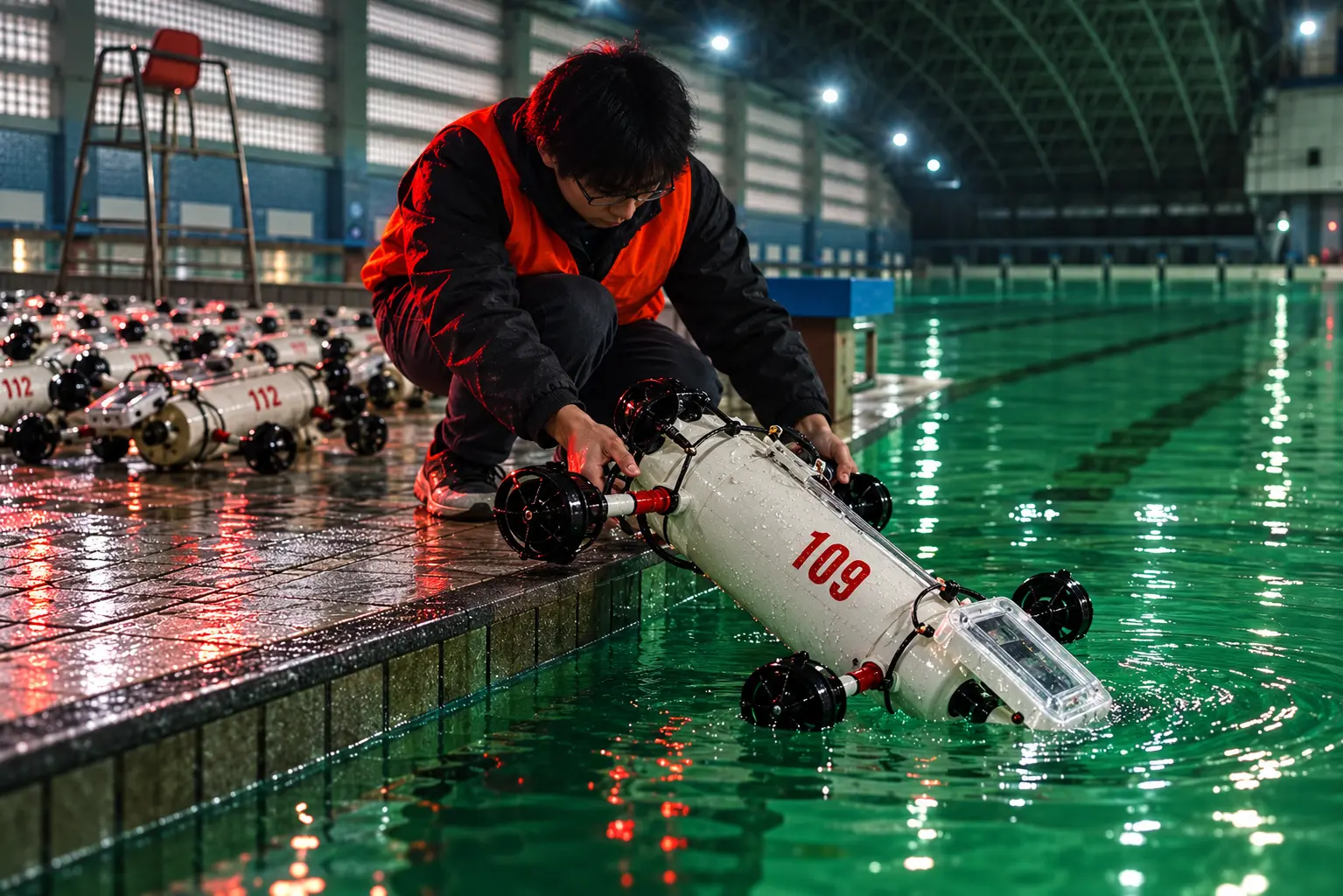
Northwestern Polytechnical University and Xi’an Tianhe Maritime Technologies ran 116 small autonomous underwater vehicles in formation on 29 August 2026. Guinness World Records certified the count as the most autonomous underwater vehicles operating simultaneously. The vehicles moved for 34 minutes along a preset route of more than 500 meters in an outdoor 50-meter by 20-meter campus pool in Xi’an, with no human control after they were put in the water one by one.
The plaque is a factory result as much as a robotics result. A defense-linked alumni shop put 116 identical hulls in the water and kept them in formation with onboard cameras, in clear pool water, which is a different problem from the open sea.
116 Vehicles, 34 Minutes, One Outdoor Pool
Guinness lists both Northwestern Polytechnical University (NPU) and Xi’an Tianhe Maritime Technologies Co., Ltd. as holders, with the attempt dated 29 August 2026 in Xi’an, Shaanxi. Officials and an expert group watched the full run, then traced the logs before the title was posted. NPU’s Chinese notice of the certification went out on 24 September 2026; the English account followed on 29 September.
Each unit is a TH-618 autonomous underwater vehicle: 61.5 centimeters long (24.2 inches), 20 centimeters wide, 28 centimeters high, and 5.14 kilograms (11.33 pounds). NPU says one person can launch it, that it can cruise up to 30 kilometers (18.6 miles), and that it can run for more than eight hours. Navigation accuracy is listed at 5 percent or less. None of that range was in play in a 1,000-square-meter pool. The endurance figure did give the team room to repeat the 34-minute pass if a hull drifted or a camera fouled.
THE ROAD TO THE PLAQUE
- 2010: Professor Chen Jianfeng’s group at NPU’s School of Marine Science and Technology begins work on underwater sensing, target detection, and unmanned vehicles.
- April 2011 to September 2014: The EU-funded CoCoRo project runs a mixed swarm of 41 underwater robots of three kinds.
- 29 August 2026: 116 TH-618 vehicles enter NPU’s outdoor pool in sequence, switch to full autonomy, and hold formation for 34 minutes.
- 24 September 2026: NPU announces that Guinness has certified the count.
NPU frames the record against more than two decades of sensing, acoustic-communications, and visual-perception work, with Chen’s named team starting in 2010. Those are two clocks, not one. The university’s longer research line and the professor’s group overlap; they are not the same span.
Why the Cameras Worked in Xi’an
Underwater grouping is hard for boring physical reasons. Radio drops out. Satellite fixes stop a few centimeters below the surface. Sound carries farther than light, but the channel is slow, narrow, and messy once many hulls share it. NPU put that problem in plain language in its own write-up of the attempt.
Enabling dozens or even hundreds of underwater vehicles to achieve fully autonomous, long-duration coordinated navigation while maintaining a stable formation has long been a major challenge in the field of intelligent underwater systems worldwide.
Northwestern Polytechnical University, School of Marine Science and Technology
This run did not solve that challenge with sound. Each TH-618 used real-time visual sensing to hold station, keep the formation, and correct when a hull drifted or took a light bump. In a 50-meter outdoor pool, the water is shallow, the light is decent, and the walls are known. Cameras can see neighbors. That is why a phone-grade vision stack can look clever here and still be blind a short way into coastal water.
A Journal of Field Robotics paper on visual formation control puts typical underwater sight at about 10 meters in sea water, cut further by silt and scatter. The European Defence Agency, closing its SABUVIS II swarm work in February 2026, restated the same bind from the naval side: satellite tracking does not work underwater, bandwidth is thin, and delay is high. NPU has spent years on acoustic links. The record attempt did not use them as the thing that kept 116 hulls in line.
WHAT WE KNOW
- The count: Guinness certified 116 TH-618 vehicles operating at the same time in Xi’an on 29 August 2026.
- The method: Sequential launch, then onboard cameras and a preset route, with no human control for 34 minutes.
- The place: An outdoor university pool 50 meters long and 20 meters wide.
WHAT IS UNCONFIRMED
- Open water: No public log shows this count holding formation in current, turbidity, or at the 30-kilometer range on the spec sheet.
- Acoustics: The certified run was visual. It does not show a hundred-vehicle acoustic net.
- Field use: Survey and inspection are named as goals. No TH-618 combat or pipeline job has been posted with this swarm.
Online recaps of the run often skip the pool and treat the number as a shock to Western navies. People who actually build underwater robots were more honest about the jump in count, and still had to square it with clear water and cameras. The formation software is the part that transfers. The lighting does not.
The Alumni Shop That Built the Hulls
NPU did not mill 116 copies in a lab. Xi’an Tianhe Maritime Technologies, an alumni company, handled overall design, precision production, process control, and quality, according to the university. The Chinese legal name, 西安天和海防智能科技有限公司, is a coastal-defense intelligent-technology firm. English materials soften that to “Maritime.”
The parent is Xi’an Tianhe Defense Technology Co., Ltd., founded in 2001. Company materials call it China’s first listed private military enterprise and count 14 subsidiaries. Its published line includes military equipment, coastal-defense systems, and an AUV family, plus sonars and expendable ocean sensors. The Guinness attempt sits on that production bench, not beside it.
NPU says the campus-industry work started on major national research projects and that this record is where Chen’s algorithms, multi-vehicle software, and large-batch manufacturing finally met. That is the load-bearing sentence. Getting 116 units to boot, dive, and hold a line is a yield problem as much as a thesis problem. Extra-large Western UUVs still travel as a handful of test articles. This team showed up with a crate count.
Phone Hardware Keeps Each Hull at 5.14 kg
NPU’s English notice is blunt about the guts. The TH-618 uses a smartphone-based visual sensing system and “the hardware of general-purpose smartphones” for an integrated perception and control stack. The point of that choice is weight, cost, and a shorter parts list, not a stunt. At 5.14 kilograms, the hull is in a class you carry to the pool deck. Multi-degree-of-freedom thrusters then give it the small-robot moves a rigid torpedo body usually lacks.
HOW THE TH-618 MOVES
- Station keeping: Vertical climb and dive, hover, and turn in place, plus depth and speed hold.
- Track follow: Terrain following and landmark recognition along a stored route.
- Recovery: On a disturbance or a light collision, an onboard correction loop is supposed to spot the fault, get free, and slot back into the formation.
Those moves were exercised in a pool with a known floor and clear sight lines. They still matter because a swarm that cannot hover or rejoin after a bump is just 116 collisions waiting on a clock. Commodity phone boards are also how you price a crate of hulls instead of a single gold-plated UUV. If the same stack is asked to read silted water at night, the camera budget becomes the limit, not the thruster layout.
The 41-Robot Swarm Europe Funded
This Guinness title is new. Large underwater groups are not. An EU account of CoCoRo, which ran from April 2011 to September 2014 on EUR 2.9 million, described the 41 robots of three different kinds as the largest autonomous underwater swarm then shown, including tank tests and harbour trials at Livorno. 116 is more than double 41. The machines are not cousins. CoCoRo’s units were mixed mini-robots that shared state with flashing LEDs. The TH-618s are 116 copies of one 5.14-kilogram AUV with a 30-kilometer range printed on the sheet, built by a defense manufacturer.
The US Navy is spending on the other end of the ruler. In July 2026 it completed a transit of more than 1,000 nautical miles in the eastern Pacific with an Orca extra-large uncrewed undersea vehicle, a Boeing-built diesel-electric craft about 26 meters long and about 85 tons. That is a truck. The TH-618 is a crate of tools. Mixing the two into a single “underwater drone race” hides the split: one program buys endurance and payload; the other buys count.
THREE UNDERWATER PROGRAMS, THREE SCALES
| Program | Who | What flew | Size | Where it was shown |
|---|---|---|---|---|
| TH-618 swarm | NPU and Xi’an Tianhe | 116 identical AUVs | 61.5 cm, 5.14 kg | Outdoor 50 m pool, 29 August 2026 |
| CoCoRo | EU project | 41 robots, three types | Mini swarm robots | Tanks and Livorno harbour, 2011-2014 |
| Orca XLUUV | US Navy / Boeing | Extra-large test vehicles | About 26 m, about 85 t | Eastern Pacific, more than 1,000 nmi, July 2026 |
SABUVIS II, a €3.7 million European Defence Agency project led by Poland with Germany, Portugal, and Slovenia, closed in early February 2026 after harbour and exercise work, including mixed swarms at REPMUS 2025. That line of effort is still arguing with acoustics, failed units, and command links across different makers. NPU’s 116-copy visual run does not replace it. It shows a different production choice: many small identical hulls, close enough for cameras to matter.
A Pool Record Leaves the Ocean Unsolved
NPU says clusters like this could support marine survey and underwater work, and that Chen’s group will keep using the small-vehicle platform to push those jobs. Pipeline inspection and seabed mapping are the civilian uses that write themselves. The parent company’s defense catalogue is why navies will read the same paragraph twice. A crate of 5.14-kilogram hulls that can be thrown in by one person is a harbour-and-littoral tool first. It is not an 85-ton Pacific truck.
The next test that would move the argument is not another Guinness number. It is the same software, in current, in water a camera cannot cross, with the acoustic links NPU has been writing papers about since 2010. Until that log is public, 116 remains a certified formation in a 50-meter outdoor pool, and a proof that Xi’an can stamp the hulls. Chen’s own next-step language already points past the deck: keep the miniaturized cluster, and take the hard problems back to the sea.
Frequently Asked Questions
Who Holds the Guinness Record for Most AUVs at Once?
Guinness World Records lists both Northwestern Polytechnical University and Xi’an Tianhe Maritime Technologies Co., Ltd., both in China, as joint holders of the title for 116 vehicles, with the attempt logged in Xi’an, Shaanxi, on 29 August 2026 in an outdoor campus pool.
How Tall Is a TH-618 and How Accurate Is Its Navigation?
NPU lists the TH-618 at 28 centimeters high on top of its 61.5-centimeter length and 20-centimeter width, and it publishes navigation accuracy of 5 percent or less, a figure separate from the 30-kilometer range and more-than-eight-hour endurance on the same spec sheet.
What Was Europe’s 41-Robot Underwater Swarm?
CoCoRo, an EU project that ran from 1 April 2011 until 30 September 2014 on EUR 2.9 million, showed 41 autonomous underwater robots of three kinds, including tank work and salt-water trials at Livorno Harbour, and described that mix in 2015 as the largest such swarm then demonstrated.
Do These Vehicles Use GPS While They Are Submerged?
They cannot. A few centimeters of water block satellite fixes and ordinary radio, which is why the certified TH-618 run used onboard cameras in a pool, and why a visual swarm of this density still has to be proven in open water where sight lines often collapse inside about 10 meters.

UPI MDR Delay Hands Traders the Calendar After Paytm Falls

Google Messages Builds Nine In-Chat Games After Samsung’s Exit

Anthropic’s $100 Million Academy Trains the Firms That Bill Both Sides

iPhone Air 2 Tries to Fix Thinness by Going Thinner

Toyota’s Electric C-HR Leaves the Cheap Twin to Subaru

The Orchard Bug Forced Zcash to Open an Empty Pool

The $5.99 Game That Won Steam’s 2026 Summer Sale

Atlantic City Turned WWE’s Return Into a Civic Night

Don Lee Joins Hemsworth as Extraction 3 Starts Shooting

YouTube Shorts Retires Dislikes and Swaps Likes for Hearts
-
 NEWS6 months ago
The Orchard Bug Forced Zcash to Open an Empty Pool
-
 GAMING6 months ago
The $5.99 Game That Won Steam’s 2026 Summer Sale
-
 NEWS6 months ago
Atlantic City Turned WWE’s Return Into a Civic Night
-
 ENTERTAINMENT7 months ago
Don Lee Joins Hemsworth as Extraction 3 Starts Shooting
-
 NEWS5 months ago
YouTube Shorts Retires Dislikes and Swaps Likes for Hearts
-
 NEWS5 months ago
NEURA Robotics Is Spending Its $1.4B on a Machine Stack
-
 BUSINESS6 months ago
Norway’s Export Bank Backs Nscale’s $790 Million Narvik Loan
-

 GAMING6 months ago
Game of Thrones Dragonfire Follows Boston’s Conquest Playbook