
NEWS
Europe’s Women Innovators Prize Winners Are Racing Real Deadlines
Brussels celebrated three women founders this year, but their space, battery and medtech ventures are each racing a separate 2027 deadline.

Three women split Europe’s top innovation prize on 4 June 2026, and each of their companies happens to sit on top of a deadline the continent cannot avoid. The European Commission named Katerina Spranger, Marta Oliveira and Ella Frances Cullen category winners of the 12th European Prize for Women Innovators, a joint award from the European Innovation Council (EIC) and European Institute of Innovation and Technology (EIT), at the EIC Summit in Brussels.
Brussels framed the ceremony around visibility for women in tech. The three winning companies also happen to plug a battery compliance deadline, a hole in Europe’s orbital return capability, and a stubborn error rate in brain surgery, each with its own clock already running.
Three Winners Take the Brussels Stage
The prize has run for twelve editions, but this was only the third time EIC and EIT judged it as one contest since merging their programmes in 2023. Ekaterina Zaharieva, the European Commissioner for Startups, Research and Innovation, said the award recognises “the bold ideas and leadership of women who are transforming innovation into real-world impact.”
Katerina Spranger, founder and CEO of Oxford Heartbeat, took the top EIC Women Innovators prize for AI software that helps surgeons plan brain aneurysm procedures. Marta Oliveira, co-founder and chief operating officer of ATMOS Space Cargo, won the EIC Rising Innovators category, reserved for founders under 35, for reusable capsules that return cargo from orbit. Ella Frances Cullen, co-founder and chief marketing officer of Minespider, took the EIT Women Leadership award for blockchain-based battery passports.
| Category | Winner | Company (Base) | Top Prize | Focus |
|---|---|---|---|---|
| EIC Women Innovators | Katerina Spranger | Oxford Heartbeat (UK) | €100,000 (roughly $108,000) | AI planning for brain aneurysm surgery |
| EIC Rising Innovators (under 35) | Marta Oliveira | ATMOS Space Cargo (Germany) | €50,000 | Reusable capsules returning cargo from orbit |
| EIT Women Leadership | Ella Frances Cullen | Minespider (Germany) | €50,000 | Blockchain battery and product passports |
Each winner’s company was already operating in the field long before the trophy arrived. What changed this year is the calendar around them.
A Battery Passport Registry Just Went Live
Cullen, who is based in Portugal, co-founded and runs marketing at Minespider, a traceability company headquartered in Berlin that uses blockchain and AI to build digital records for batteries and raw materials. Her win landed weeks before the infrastructure her product depends on actually switched on.
The EU’s central Digital Product Passport registry went live on 19 July 2026, just over two weeks after this year’s prize ceremony. From 18 February 2027, every electric vehicle, light transport and industrial battery above 2 kilowatt hours sold in the EU must carry a registered passport or it cannot legally reach the market.
Three battery categories fall under the mandate:
- Electric vehicle batteries sold or put into service anywhere in the EU
- Light means of transport batteries, covering e-bikes and similar vehicles
- Industrial batteries with a capacity greater than 2 kilowatt hours
Minespider’s platform is already used by carmakers including Renault, Ford and ABB to track battery data from raw material sourcing through recycling. Under the regulation, the legal responsibility for making sure a passport exists falls on whichever company places the battery on the EU market, whether that is a manufacturer, an importer or a distributor.
Europe’s Post-ISS Return Problem
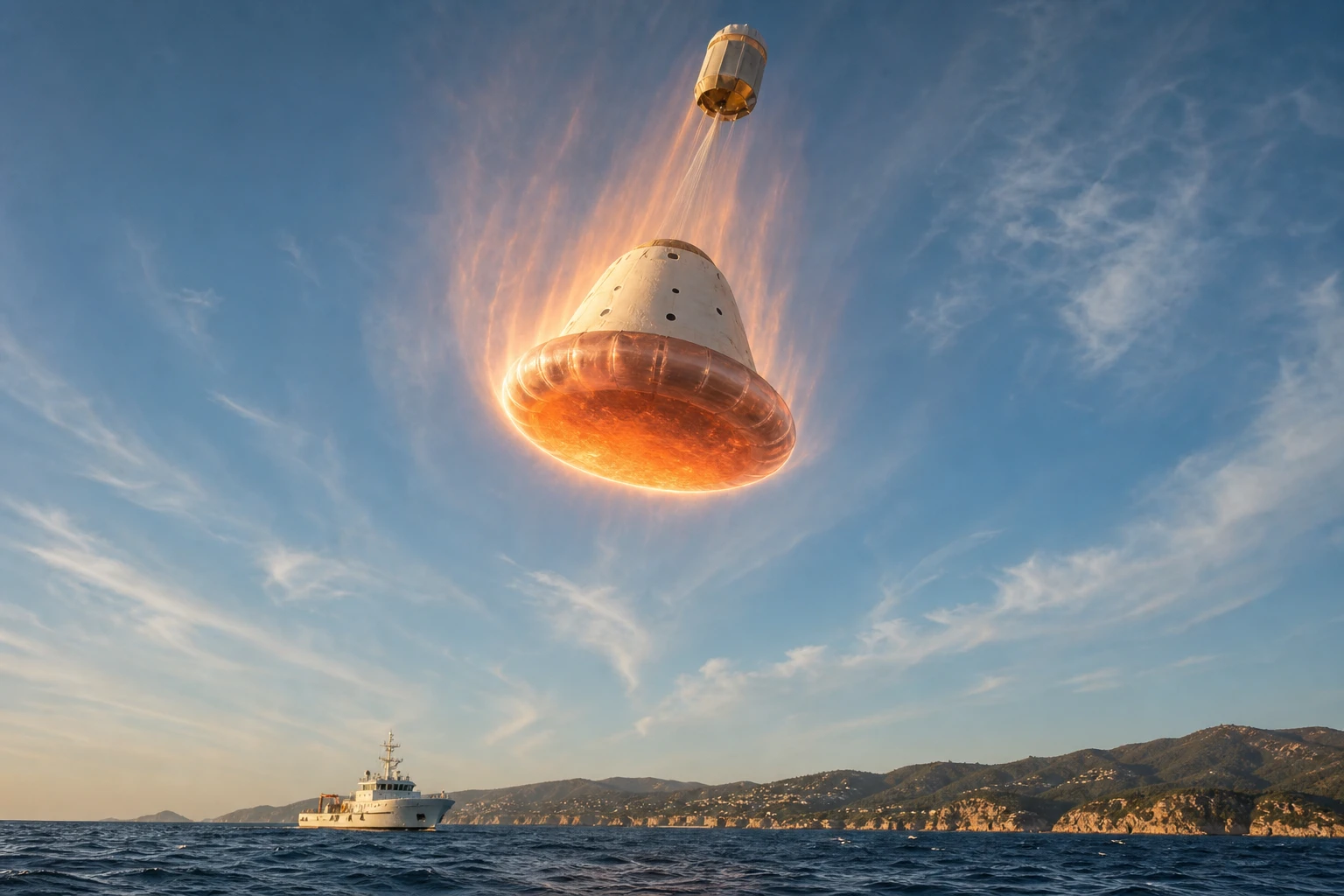
Oliveira’s company, ATMOS Space Cargo, was founded in 2021 in Lichtenau, Germany, and builds a reusable capsule called PHOENIX designed to carry payloads to low Earth orbit and bring them home again. The pitch is less about a single mission than about a repeatable service, since Europe currently has no independent way to retrieve cargo from orbit once the International Space Station winds down.
Industry coverage of the company’s most recent funding round put it plainly: with rising demand for in-orbit manufacturing and materials research, Europe faces a strategic risk from the lack of its own return infrastructure. ATMOS wants microgravity manufacturing to become as routine as production on the ground, restoring Europe’s ability to reach orbit and come back after the station era ends.
- €46 million raised to date, including a €25.7 million Series A and a €13.1 million EIC Accelerator award
- 100 kilograms is the payload capacity of the first PHOENIX capsule, with heavier models, including rocket stages, planned next
- 41 employees across Lichtenau, Germany, and a newer Strasbourg, France office
- Direct competitors include The Exploration Company, Raven Space Systems and Yuri
The company flew its first orbital test in April 2025, launching PHOENIX 1 to low Earth orbit and back to gather re-entry data. Oliveira said the flight proved the point beyond a demo.
We are enabling new industries to work in space and create benefit on Earth.
Oliveira, chief operating officer of ATMOS, made the remark after the capsule returned. Portugal followed in March 2026 by granting ATMOS its first commercial re-entry licence for splashdown near the Azores, a step Oliveira called critical to establishing independent European access to orbit. Aleksander Dobrzyniecki, a general partner at investment firm Balnord, framed the stakes even more directly, describing the company as offering “sovereign access not only to orbit, but back from orbit.”
Who Actually Buys This Technology?
Hospitals, carmakers and, increasingly, European defence planners are the real customers behind these three prizes. Oxford Heartbeat’s software is already running inside NHS trusts and continental hospitals, Minespider’s passports are embedded in car manufacturers’ supply chains, and ATMOS is pitching its capsule as dual-use infrastructure for governments.
Spranger founded Oxford Heartbeat in London in 2015 to build PreSize Neurovascular, software that simulates how a stent will behave inside a patient’s blood vessels before a surgeon ever picks one up. In head-to-head testing, the AI placed stents with roughly 95% accuracy against about 81% for experienced clinicians working alone, according to a company profile tracking its use across 375 patients in seven hospitals in England, Scotland, Germany, Finland and Ukraine. Roughly one in ten aneurysm surgeries wastes at least one stent, and about a fifth of patients face repeat operations because of complications, figures that explain why the NHS backed the company with grant funding years before this prize arrived.
“Brain aneurysms can strike out of the blue and with devastating consequences,” Spranger has said of the condition her software targets. Oxford Heartbeat’s own account of its funding history shows a £1.5 million Innovate UK grant that pushed its total funding past £4 million, money that helped extend PreSize from a research tool into CE-marked software now used in daily surgical planning.
Nine Winners, Twelve Editions, Since 2023
The prize itself predates all three winners by years. EIC and EIT have run it jointly since 2023, producing nine category winners across three tiers of recognition, and this year’s finalist pool also included founders working on reef-safe sun protection, AI-supported mental health therapy and faster molecular analysis for new medicines.
The joint prize sits inside a wider EIC and EIT effort to fund women-led ventures across Europe. The institute has separately opened a programme supporting female founders in agrifood, backed an AI femtech contest focused on women’s health in Portugal, and steered a multimillion euro urban mobility fund for city-focused startups. None of those programmes overlap with this year’s three winners directly, but they trace the same funding architecture: EIC grants and accelerator equity feeding into EIT community networks, then into prizes designed to raise the winners’ visibility with investors and buyers.
An independent expert jury drawn from investment, policy and innovation backgrounds picked this year’s nine finalists and three winners from an original pool of eighteen semi-finalists named back in February.
The Clock Running to February 2027
Each company now has a specific, dated test ahead of it rather than a vague mandate to keep innovating. ATMOS is preparing a three-vehicle PHOENIX 2 flight campaign and has launched ATMOS WORKS to serve European government and defence clients directly, with early design work already underway on a larger PHOENIX 3 vehicle.
Minespider’s compliance deadline is fixed by law. With the registry already live, battery makers have barely seven months left to get every qualifying unit registered before the 18 February 2027 cutoff turns a missing passport into a market-access problem. Oxford Heartbeat, meanwhile, keeps expanding its hospital footprint while its software runs inside a UK-wide clinical trial backed by the National Institute for Health and Care Research.
The compliance clock, the launch calendar and the hospital rollout keep running long after the applause in Brussels fades.
Frequently Asked Questions
How Much Prize Money Do the 2026 Winners Receive?
The EIC Women Innovators winner receives €100,000, with runners-up earning €70,000 and €50,000. The EIC Rising Innovators winner receives €50,000, with two runners-up earning €30,000 and €20,000. The EIT Women Leadership category has historically followed the same €50,000, €30,000 and €20,000 structure for its winner and runners-up.
Who Can Enter the European Prize for Women Innovators?
Entry is open to women who have founded or co-founded a company in an EU Member State or a country associated with Horizon Europe, the EU’s research and innovation funding programme. The Rising Innovators category adds an age limit, restricting entry to founders under 35, while the EIT Women Leadership prize is reserved for women already active in the EIT Community.
Who Is Responsible for Creating a Battery’s Digital Passport?
Under the EU Battery Regulation, the legal duty falls on whichever company places the battery on the EU market or puts it into service, a group that includes manufacturers, importers and distributors rather than software vendors like Minespider, which builds the compliance tools those companies use.
Who Were the Runners-Up in the Rising Innovators Category?
Judit Giró Benet, founder of The Blue Box in Spain, was recognised for a urine-based test aimed at earlier breast cancer detection. Carin Lightner, co-founder and CEO of Switzerland’s Enantios, was recognised for faster, more precise analysis of complex molecules used in new medicines.


Replit Opens Its London Office Inside an AI Crowd

Straight Circle Trailer Lands Without a U.S. Date

Anemo Labs Bets £700,000 on an AI Sense of Smell

Nintendo Prices the Zelda 40th Switch 2 at $519

Copilot Capital Buys the Autopilot Already Running 90 GW

Ground A Raises €9.1 Million for a Pallet Laser

Gibney’s Musk Film Opens in Venice Without Its Subject

Torvalds Blames AI for a Full-Fat Linux 7.3-rc2

Dexter Returns Sharper, Older, and Stuck Between Killers

Meta’s Muse Agent Can Spend Before the Privacy Lock

Walter’s TWG Insists No Fraud as Insurer Probes Force Cleanup

30-Year Yield Hits 5.32% Highest Since 2007 as Debt Supply Locks In Costs

PCE Stays at 3.7% as Gas and Tariffs Outrun Coming Revisions

Evernorth S-4 Clears Path for Active XRP Treasury on Nasdaq

Astute’s $1.2M bet makes B2B creator deals feed AI discovery

Strategy Parks $1.59B Cash While Bitcoin Stack Stays Flat

Instinct Hits $2.5 Billion as AI Agent Access Sparks Trust Fights

Monzo chair Gary Hoffman exits after board revolt fallout

Oracle’s 2.8 GW Bloom Deal Exposes the AI Power Bypass

CLARITY Act Cloture Opens a Door Ethics Still Blocks
-
 FINANCE3 months ago
Zcash Patched a Double-Spend Bug as ZEC Climbed 5%
-
 ENTERTAINMENT3 months ago
Steam Summer Sale 2026 Locks In June 25 to July 9 Dates
-

 FINANCE2 months ago
CLARITY Act Final Text Expected This Weekend as 60-Vote Hurdle Looms
-
 NEWS4 months ago
Meta Adds AI Replies to Threads, But Users Can’t Block It
-
 ENTERTAINMENT5 months ago
Extraction 3 Is Officially Coming to Netflix in 2027
-

 NEWS3 months ago
YouTube Shorts is testing a heart in place of the thumbs-up
-

 NEWS1 month ago
Senators Force Apple Off Chinese Memory as Big Three Cash In
-

 NEWS3 months ago
NEURA Robotics’ $1.4B Series C Redraws Europe’s Physical AI Bet