
NEWS
OnePlus’s Exit From the US and Europe Proves a 2021 Warning Right
OnePlus’s exit from the US and Europe fulfills a 2021 warning that Oppo’s slow software and R&D merger would eventually swallow the brand whole.

OnePlus will stop selling phones in the United States and Europe within days, Bloomberg reported on July 15, as parent company Oppo restructures three overlapping smartphone brands into a smaller, cheaper operation. OnePlus confirmed the retreat itself a day later, telling TechCrunch it will not launch new products in either region again.
The immediate trigger is a global memory chip shortage that has squeezed margins across Android’s lower price tiers. The deeper fault line opened five years earlier, when OnePlus agreed to merge its engineering and software with Oppo, a decision analysts warned then would eventually erase the brand’s independence.
Oppo Pulls the Plug on OnePlus in the West
Bloomberg’s report, citing a person familiar with the matter who was not authorized to discuss a private plan, said OnePlus would begin ceasing operations in the US and Europe as soon as this week. Memory prices are still climbing into Q3 2026, and Oppo is not the first phone maker to point to component costs as a reason to pull back.
The company itself confirmed the exit a day after Bloomberg’s story ran.
After careful assessment, OnePlus will no longer launch new products in Europe and North America. All users’ rights and interests, including after-sales support and software updates, will remain fully guaranteed.
OnePlus said that in a statement to TechCrunch on July 16. Oppo, whose full legal name is Guangdong Oppo Mobile Telecommunications Corporation Ltd., has not issued its own public statement or laid out a formal timeline. Bloomberg’s sourcing indicates the wind down extends to China and India too, though not until sometime in 2027, and OnePlus will keep selling in China in the meantime. Realme, a second Oppo brand built around entry-level and mid-range phones, is leaving the Chinese market entirely and shifting its sales focus to Nordic countries.
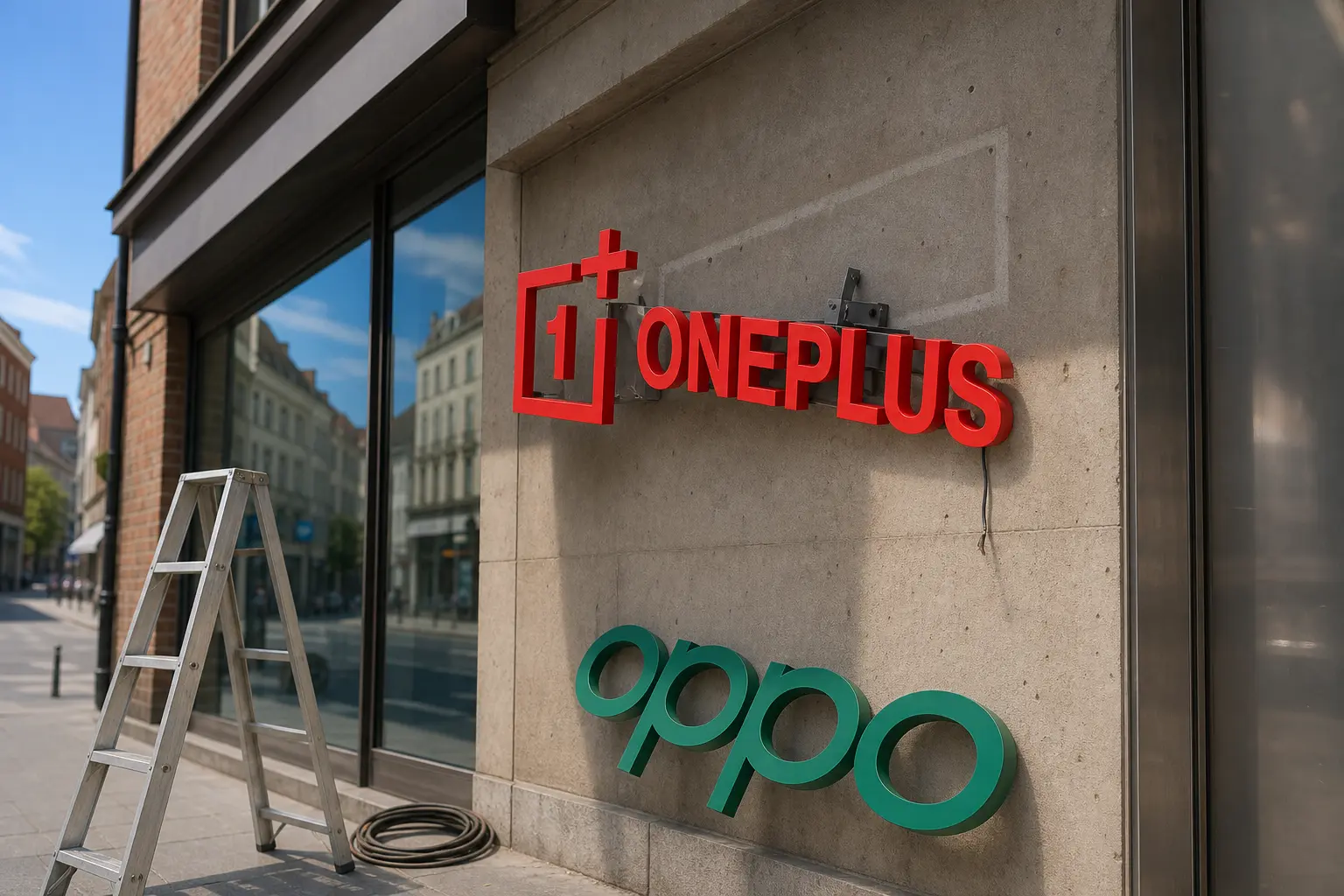
The 2021 Merger That Was Supposed to Save OnePlus
OnePlus launched in 2013 selling flagship-spec Android phones at a fraction of Samsung and Apple’s prices, earning the nickname “flagship killer” among a loyal base of enthusiasts. That independence started to fade in June 2021, when OnePlus and Oppo formally merged their product and R&D teams.
Pete Lau, OnePlus’s co-founder, who was serving as chief product officer of both companies at the time, called it “OnePlus 2.0.” He promised the newly unified operating system would keep the DNA of OxygenOS, staying clean, lightweight and friendly to the bootloader-unlocking crowd that built the brand’s early fanbase. OnePlus also pledged, separately, that its software would stay free of ads.
None of those specific promises held permanently. OxygenOS and Oppo’s ColorOS shared a technical codebase from that point on, and the visible gap between the two shrank with every release that followed.
Analysts Saw This Coming Years Ago
The prediction that OnePlus would eventually stop existing as a distinct product line is not new. An Android Authority analysis published roughly three and a half years ago found that OxygenOS 13 was already functionally equivalent to ColorOS 13, with only a handful of OnePlus-specific tweaks layered on top.
That same analysis cited Neil Shah, a Counterpoint Research analyst who tracks the smartphone industry, predicting OnePlus would become an Oppo sub-brand in the same way iQOO operates under Vivo, with its enthusiast audience deprioritized in favor of mainstream volume. By early 2026, OxygenOS and ColorOS had converged on what one technical comparison described as differences that are “primarily aesthetic.” A long-term review of the OnePlus 12 put it more bluntly: OxygenOS, in the reviewer’s words, “isn’t OxygenOS anymore.”
Paolo Pescatore, an analyst at PP Foresight, framed the exit itself in similar terms, saying OnePlus lost the clarity that made it a flagship killer as it struggled with higher prices and intensifying competition in Western markets. Apple captured a record 20% of the global smartphone market in the second quarter of 2026, with Samsung holding the top spot at 22%, according to Omdia, leaving less room than ever for a mid-tier challenger brand to stand out.
Why Memory Chips Broke the Timeline
Even without the software history, 2026 would be a brutal year to sell an affordable Android phone. Memory now accounts for 15 to 20% of a mid-range phone’s bill of materials, according to IDC research, compared with 10 to 15% on flagship devices that can absorb the cost elsewhere.
The strain is uneven across brands. Android’s NAND storage costs rose 90 to 100% quarter over quarter in the second quarter of 2026, according to Isaiah Research, a steeper climb than Apple’s 70 to 80% increase over the same stretch, since Apple’s scale and premium pricing give it more room to negotiate supply. Counterpoint Research has forecast that average smartphone selling prices will climb 6.9% globally this year, even as shipments fall 2.1%, figures reported by CNBC in December. None of that math favors a brand whose entire pitch was flagship specs at a discount.
Three Brands, One Shrinking Map
OnePlus, Realme and Oppo all sit under BBK Electronics, a private Chinese conglomerate founded by Duan Yongping that also owns Vivo and iQOO and does not disclose financial results the way a public company would. Before this restructuring, the three brands sold into overlapping regions with only loosely separated identities.
| Brand | Role Before the Restructuring | Status Now |
|---|---|---|
| OnePlus | Performance-focused flagships sold in the US, Europe, India and China | Exiting the US and Europe this week; wind down in India and China expected by 2027 |
| Realme | Entry-level and mid-range devices sold in China and overseas markets | Exiting China; shifting sales focus to Nordic countries |
| Oppo | Mainstream consumer devices, concentrated in Asia with a growing European footprint | Expanding into Europe to fill the gap left by OnePlus, prioritizing Central Europe |
Oppo’s own global market share slipped to roughly 10% in the second quarter of 2026, according to analyst estimates, which helps explain why the parent company is consolidating three sales forces into fewer, more efficient ones rather than continuing to fund three separate retail pushes into the same shrinking pool of Western buyers.
What Happens to the OnePlus Phone You Already Own?
Neither Oppo nor OnePlus has published a detailed statement covering warranty handling, repair networks, or whether existing devices will keep receiving Android security updates on their originally promised schedule once regional teams wind down. Until that changes, a few practical steps are worth taking.
- Check each device’s warranty status, purchase date and retailer, since claims processes may shift as regional support consolidates.
- Save local copies of driver files, unlock tools and firmware images tied to your specific model before regional download servers change hands or go dark.
- Back up device data to a cloud account not tied to your OnePlus login, in case support migrates onto Oppo’s infrastructure.
- Hold off on major accessory purchases for unreleased OnePlus models in the US or Europe, since no new launches are planned in either region.
Existing retail inventory will likely keep selling through normal channels until it runs out, even after OnePlus stops shipping new stock, so the practical disappearance from store shelves may lag the corporate announcement by weeks or months.
The Questions Oppo Still Hasn’t Answered
Bloomberg’s reporting and OnePlus’s own statement confirm the broad strokes. A lot of the operational detail is still missing.
What we know:
- OnePlus will stop launching new products in the US and Europe this week, confirmed both by Bloomberg’s sourcing and OnePlus’s own statement to TechCrunch.
- Realme is exiting China to focus on Nordic markets, while Oppo plans to expand its European presence to fill the space OnePlus leaves behind.
- OnePlus remains a wholly owned subsidiary of Oppo and will keep operating in China for now.
What’s unconfirmed:
- The exact date in 2027 when OnePlus’s wind down in India and China is expected to be complete.
- Whether existing US and Europe OnePlus phones will keep receiving Android updates and security patches on their original schedule.
- How warranty claims, repairs and staff roles will be handled as regional operations fold into Oppo’s structure.
Frequently Asked Questions
Will my OnePlus phone stop working after the shutdown?
No. Existing phones will keep functioning normally, and OnePlus has told TechCrunch that after-sales support and software updates will remain guaranteed. OnePlus’s recent flagships have carried commitments of around four major Android OS updates and five years of security patches, though the company has not confirmed whether that schedule holds once regional teams wind down.
Can I still buy a new OnePlus phone in Europe or the US?
Not a newly launched one. BetaNews has reported that no new OnePlus devices will arrive in either region after the exit, though existing retail inventory at carriers and stores may keep selling until stock runs out.
What is happening to OnePlus in India and China?
OnePlus plans to keep operating in China for now, with a broader wind down across China and India expected by 2027. Oppo has not confirmed a specific date, and China has historically run on its own software stack rather than the international OxygenOS build, which could make that transition look different from the one in the West.
Is Realme shutting down everywhere?
No. Realme is leaving the Chinese market specifically and redirecting its sales focus toward Nordic countries, while continuing to operate in other international markets such as India and Southeast Asia.
Does this mean Oppo is in financial trouble?
Not necessarily. Oppo sits under privately held BBK Electronics, which is not required to disclose earnings the way a public company would. Its global market share was estimated at around 10% in the second quarter of 2026, and consolidating three overlapping brands looks more like a cost and efficiency move than a sign of collapse.
Could OnePlus return to the US or Europe later?
Oppo has not ruled it out, but nothing in the current reporting suggests a timeline. Given how far OxygenOS has already merged into ColorOS, any future return would likely look more like an Oppo sub-brand than the independent flagship killer that launched in 2013.


Replit Opens Its London Office Inside an AI Crowd

Straight Circle Trailer Lands Without a U.S. Date

Anemo Labs Bets £700,000 on an AI Sense of Smell

Nintendo Prices the Zelda 40th Switch 2 at $519

Copilot Capital Buys the Autopilot Already Running 90 GW

Ground A Raises €9.1 Million for a Pallet Laser

Gibney’s Musk Film Opens in Venice Without Its Subject

Torvalds Blames AI for a Full-Fat Linux 7.3-rc2

Dexter Returns Sharper, Older, and Stuck Between Killers

Meta’s Muse Agent Can Spend Before the Privacy Lock

Walter’s TWG Insists No Fraud as Insurer Probes Force Cleanup

30-Year Yield Hits 5.32% Highest Since 2007 as Debt Supply Locks In Costs

PCE Stays at 3.7% as Gas and Tariffs Outrun Coming Revisions

Evernorth S-4 Clears Path for Active XRP Treasury on Nasdaq

Astute’s $1.2M bet makes B2B creator deals feed AI discovery

Strategy Parks $1.59B Cash While Bitcoin Stack Stays Flat

CLARITY Act Cloture Opens a Door Ethics Still Blocks

Instinct Hits $2.5 Billion as AI Agent Access Sparks Trust Fights

Oracle’s 2.8 GW Bloom Deal Exposes the AI Power Bypass

AI data centers win as RAM kits jump nearly 500 percent
-
 FINANCE3 months ago
Zcash Patched a Double-Spend Bug as ZEC Climbed 5%
-
 ENTERTAINMENT3 months ago
Steam Summer Sale 2026 Locks In June 25 to July 9 Dates
-

 FINANCE2 months ago
CLARITY Act Final Text Expected This Weekend as 60-Vote Hurdle Looms
-
 NEWS4 months ago
Meta Adds AI Replies to Threads, But Users Can’t Block It
-
 ENTERTAINMENT5 months ago
Extraction 3 Is Officially Coming to Netflix in 2027
-

 NEWS3 months ago
YouTube Shorts is testing a heart in place of the thumbs-up
-

 NEWS1 month ago
Senators Force Apple Off Chinese Memory as Big Three Cash In
-

 NEWS3 months ago
NEURA Robotics’ $1.4B Series C Redraws Europe’s Physical AI Bet