
NEWS
Focused Energy Lands Record $240M Bet on European Fusion

Focused Energy, a German laser fusion startup spun out of the Technical University of Darmstadt in 2021, has raised $240 million (about €206 million), the largest Series A on record in the global fusion industry. The round, announced on 27 May, was anchored by the energy group RWE and Germany’s federal breakthrough-innovation agency, and it values the company at close to $1 billion, making it the most valuable fusion player in Europe.
That is the headline number. The wager underneath it is whether Europe can build, fund and hold onto a frontier-energy company at scale, in the same week that a Dealroom ranking put London back on top of the continent and a separate survey found roughly a third of European founders weighing a move to the United States.
RWE Anchors the Biggest Fusion Series A on Record
The raise lands at a moment when private fusion money has mostly flowed to American and British developers. Focused Energy pursues direct-drive laser fusion, the inertial-confinement approach that uses banks of high-power lasers to compress a fuel target until it ignites. It is the only fusion route for which a scientifically verified net energy gain has been demonstrated, after the 2022 ignition shot at the US National Ignition Facility.
Who Backed the Round
The cap table reads as a mix of strategic, public and growth capital rather than pure venture. The named backers include:
- RWE, the German utility, which expanded its earlier stake by €60 million (roughly $65 million) and will free up a former plant site for the project.
- SPRIND (Germany’s Federal Agency for Breakthrough Innovation, a state vehicle that funds high-risk “moonshot” technology), joining as a new investor.
- The European Innovation Council Fund (the EU’s deeptech equity arm, the EIC Fund), also a new entrant.
- Prime Movers Lab, the existing US lead, plus further investors from Europe, Asia and the Gulf, some of them potential future buyers of fusion power.
What the Money Builds
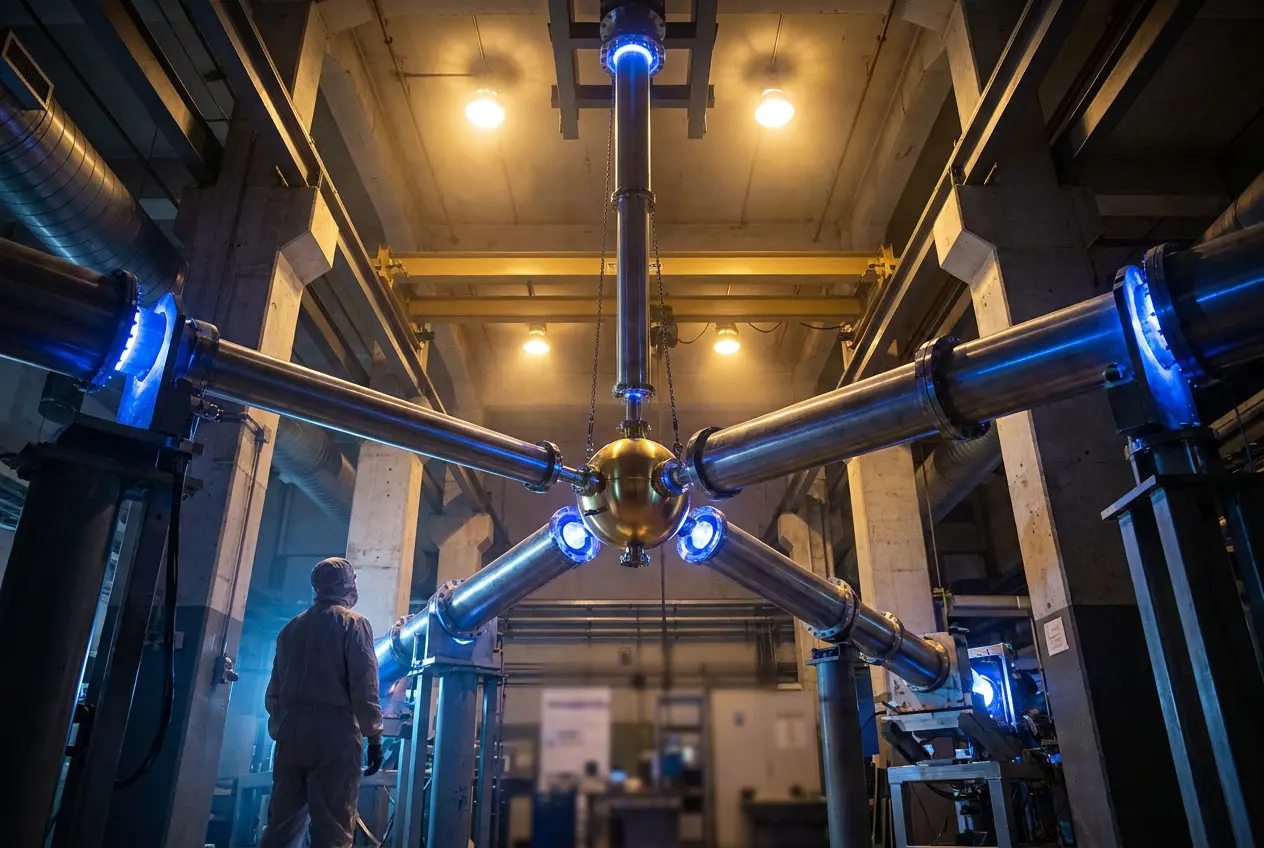
The capital goes into industrialising the technology and into a single physical anchor: the former RWE power-plant site at Biblis, in the German state of Hesse. The company wants to build what it calls the world’s first laser fusion power plant there by the mid-2030s, alongside industrial and scientific partners. You can read the company’s own framing of the milestone on the record fusion Series A announcement.
The internal timeline is concrete and slow. First laser at the site is pencilled in for 2028, with a first megawatt-hour (MWh) delivered to the grid targeted for 2037. Germany’s National Academy of Science and Engineering has separately said a working fusion reactor is achievable by 2045.
Why a Utility Reopened a Shut Nuclear Site
Biblis is not a blank field. It is a decommissioned nuclear station, switched off during Germany’s nuclear phase-out, and RWE has now agreed to speed up its decommissioning so the land, grid connection and cooling infrastructure can be handed to a fusion project. For a utility, that turns a stranded liability into an option on the next baseload technology.
The strategic logic is plain in how the company’s lead industrial backer talks about it.
Germany is well-positioned to take a leading global role in nuclear fusion. That is why we are prepared to further expand our investment.
That was Markus Krebber, chief executive of RWE, in the group’s statement on the deal; the full RWE statement on the expanded fusion stake sets out the site arrangement. The bet for the utility is cheap relative to a full plant build, and it buys a front-row seat if laser fusion ever reaches commercial output.
Laser Fusion’s Long Clock
Here is where the celebration needs a brake. A funded Series A and a verified physics result are not the same as a plant that sells electricity. The 2028 first-laser date is a lab-scale step. The 2037 grid date is the one that matters, and energy projects with eleven-year horizons rarely arrive on schedule or on budget.
Inertial confinement also carries its own engineering bill. Net energy gain at the experiment level does not account for the power needed to fire the lasers, the repetition rate required for a working plant, or the durability of targets fired many times per second. Each of those is an unsolved industrial problem, not a settled one.
So the wager is really two bets stacked together. One is that the science scales. The other is that European capital and public agencies stay patient through a decade of capital calls, when cheaper, faster clean-energy bets compete for the same euros. The structure of this round, blending a utility, a state agency and the EIC Fund, is designed to make that patience institutional rather than dependent on a single fund’s appetite.
A €3.1 Billion Week That Tilted Toward Deeptech
The fusion deal did not happen in isolation. European trackers logged more than 60 funding rounds worth over €3.1 billion in the same week, with the heavy capital clustering around hard technology and industry rather than consumer apps.
A snapshot of the larger and more telling deals shows the spread of geography and sector:
| Company | Amount | Country | Focus |
|---|---|---|---|
| Focused Energy | $240M | Germany | Laser fusion energy |
| IQE plc | £81M | UK | Compound semiconductors |
| WeRoad | $58M | Italy | Group travel experiences |
| Montis VC (fund) | €50M | Europe | Energy and AI startups |
The same week also brought new capital pools aimed squarely at the gap between research and revenue. Marvelous and the Joachim Herz Foundation launched a €20 million deeptech fund pitched explicitly at bridging Germany’s commercialisation gap, while a new energy-and-AI vehicle from Montis VC’s €50 million European fund targets the same industrial seam. On the M&A side, the fintech TrueLayer bought Dutch lender In3 to add credit at checkout, a move that fits the wider push behind pay-by-bank payment adoption.
London Back on Top as Founders Weigh the Exit
The other big release of the week measured where all this money is pooling. Dealroom’s 2026 Global Tech Ecosystem Index put London back at the top of Europe, reclaiming the spot it lost to Paris in 2024 and ranking fourth in the world behind the Bay Area, New York and Boston.
What the Dealroom Index Shows
The British capital’s numbers carried the ranking, but the European picture beneath it was broad rather than one-city deep.
- $17.7 billion raised by London tech firms in 2025, with around $7 billion of it going into AI, up from $3.9 billion the year before.
- 138 unicorns now based in the city, including Wayve, Granola and ElevenLabs.
- 45 European cities in the global top 100, ahead of North America’s 40, with Cambridge ranking third worldwide for ecosystem density.
“London reclaiming the top spot in Europe reflects the maturity and resilience of the UK’s tech ecosystem,” said Yoram Wijngaarde, founder and chief executive of Dealroom, in the firm’s 2026 Global Tech Ecosystem Index.
The Pull Across the Atlantic
The optimism sits next to a steady drain. A reading from the same week put nearly a third of European founders as actively considering a move of their headquarters to the US, and European Commission research has mapped why the urge is so persistent. The drivers are consistent across the founders surveyed:
- Easier access to growth-stage venture capital.
- Proximity to a single large market rather than 27 fragmented ones.
- Lighter, faster regulation.
- Deeper pools of experienced commercial and sales talent.
The reassurance, such as it is, comes from the actual numbers. The Commission’s work found only 3.3% to 4.3% of European venture-backed startups genuinely relocate abroad, with about three quarters of those heading stateside, and most of them moving only a legal headquarters while keeping R&D (research and development) at home. The details sit in the EU study on why innovative startups relocate from the bloc.
The Commercialisation Gap the Bet Has to Close
This is the tension the fusion round speaks to most directly. Germany has world-class fusion science and a historically cautious risk-capital market, the exact split that pushes founders toward US money and US addresses. The country’s answer has been a dual-track model: a public Fusion 2040 research programme on one side, and merged public venture vehicles plus private funds on the other.
The Darmstadt company is the test case for whether that plumbing works. By assembling a state agency, the EIC Fund and a utility into one round, it kept a frontier-energy company headquartered in Hesse rather than San Francisco, even though the firm keeps offices in both. SPRIND framed its stake in mission terms, calling a commercial fusion reactor the most important moonshot of the century and a chance to prove such breakthroughs can originate in Germany; the agency set out its reasoning in its note on joining the fusion financing.
The same gap shows up further down the funding ladder, where smaller European bets are trying to prove that adoption, not just invention, can happen at home, as with Atheni’s wager on the AI adoption gap. If the Biblis project hits its laser milestone on schedule and the public-private structure holds through the next capital calls, Europe gets a template for keeping its hardest technology onshore. If the laser timeline slips and the round proves a one-off, the brain-drain survey stops being a worry and starts being a forecast.


Veridue Raises $4 Million to Speed Energy Deal Diligence

Healey Adds a £150m Rung for Northern Scale-Ups

Ten Deals Took Most of Europe’s August Tech Money

Holmes Hired Fielder to Film Her Last Days

Molten Bets £100m of Plc Cash on Late-Stage Tech

Garlinghouse Cited Dutch Gold, and London Got the Bars

byFounders Bets $4.3 Million on Fluencify After $2M ARR

Alpha Gang Puts A-List Stars on a Zellner Wager

Angel Bets a Recut PG-13 Chase on Ritchson and Wilson

Flex IT and T1A Combine to Own Corporate Device Supply

Walter’s TWG Insists No Fraud as Insurer Probes Force Cleanup

30-Year Yield Hits 5.32% Highest Since 2007 as Debt Supply Locks In Costs

PCE Stays at 3.7% as Gas and Tariffs Outrun Coming Revisions

Evernorth S-4 Clears Path for Active XRP Treasury on Nasdaq

Astute’s $1.2M bet makes B2B creator deals feed AI discovery

Strategy Parks $1.59B Cash While Bitcoin Stack Stays Flat

Instinct Hits $2.5 Billion as AI Agent Access Sparks Trust Fights

Oracle’s 2.8 GW Bloom Deal Exposes the AI Power Bypass

Amber’s €7M locks Mittelstand knowledge inside Europe

CLARITY Act Cloture Opens a Door Ethics Still Blocks
-
 FINANCE3 months ago
Zcash Patched a Double-Spend Bug as ZEC Climbed 5%
-
 ENTERTAINMENT3 months ago
Steam Summer Sale 2026 Locks In June 25 to July 9 Dates
-

 FINANCE2 months ago
CLARITY Act Final Text Expected This Weekend as 60-Vote Hurdle Looms
-
 NEWS4 months ago
Meta Adds AI Replies to Threads, But Users Can’t Block It
-
 ENTERTAINMENT5 months ago
Extraction 3 Is Officially Coming to Netflix in 2027
-

 NEWS3 months ago
YouTube Shorts is testing a heart in place of the thumbs-up
-

 NEWS1 month ago
Senators Force Apple Off Chinese Memory as Big Three Cash In
-

 NEWS3 months ago
NEURA Robotics’ $1.4B Series C Redraws Europe’s Physical AI Bet