
FINANCE
Canada’s Commodity Boom Still Rides on a Few Fragile Chokepoints
A stuck Vancouver rail bridge, one copper smelter and a distant war are reshaping Canada’s commodity exports faster than any trade deal.

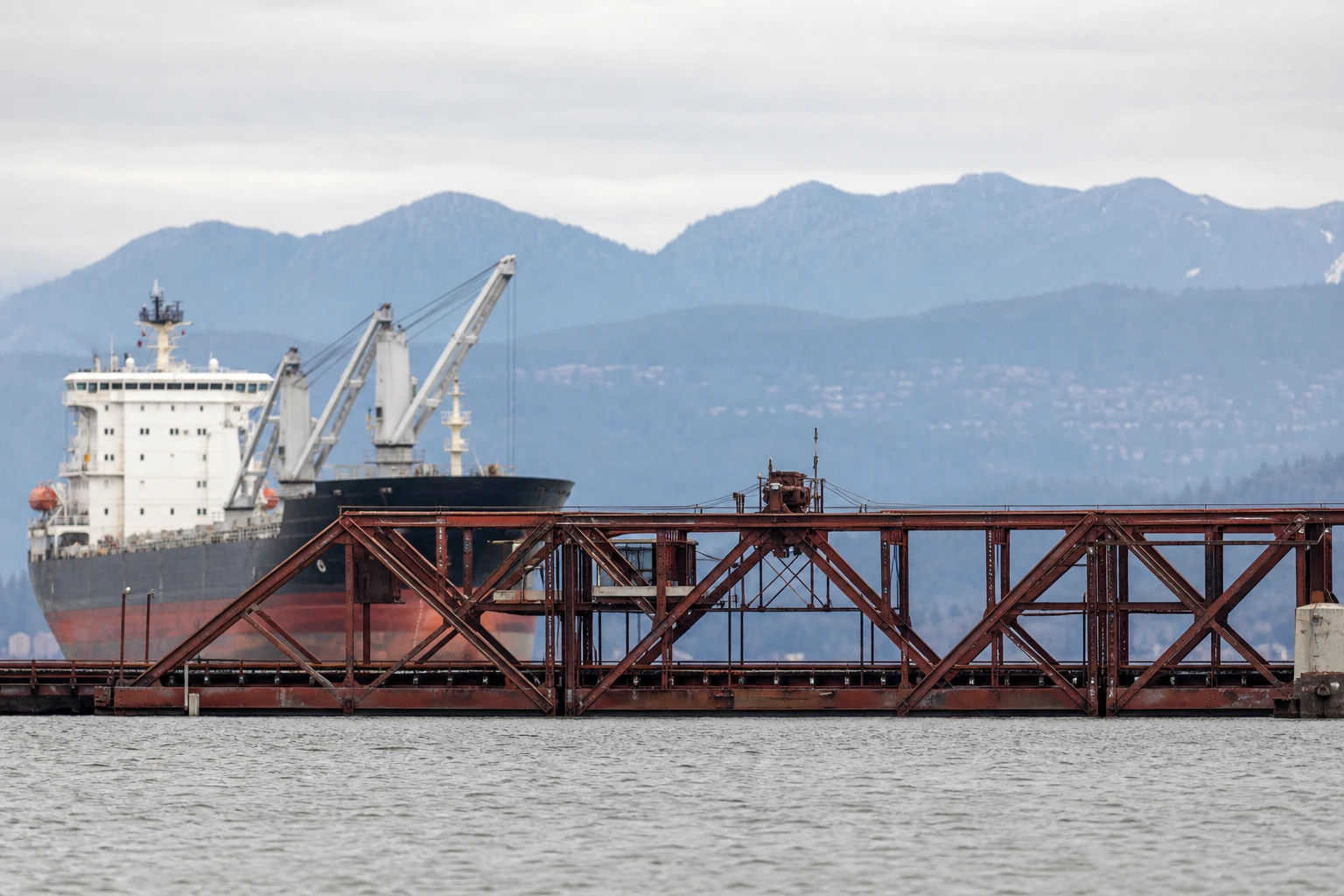
A rail bridge over Vancouver’s Burrard Inlet got stuck in the down position for four days in February, and roughly half the country’s grain shipments backed up behind it. The bridge is 57 years old. It normally carries half of Canada’s grain exports and close to a third of all cargo moving through the Port of Vancouver.
That one mechanical failure previewed the year now underway across Canadian commodities. Tariff truces, a finished pipeline expansion and a cooling trade fight with China have brought genuine relief to farmers and oil producers. But the exports that fund those wins still move through a short list of aging or singular chokepoints, and none of this year’s diplomacy actually touches them.
A Four-Day Jam on a 57-Year-Old Bridge
The bridge in question is the Second Narrows Rail Bridge, the crossing that feeds Vancouver’s North Shore grain, potash and coal terminals. In February 2026, a mechanical fault locked it in its down position and halted ship access to the inlet for four days, according to RBC Economics, the research arm of Royal Bank of Canada.
The timing mattered because export season does not pause for repairs. Economic analysis commissioned this spring by the Agriculture Transport Coalition, a group of national farm and grain organizations, found that a single week of rail or port disruption during peak export season can drain deep, mostly unrecoverable losses from the grain sector.
This was not a new problem. Prairie farmers lost buyers to Australian and Black Sea competitors during a 2018 rail backlog. In 2024, Canadian National and Canadian Pacific Kansas City both moved toward locking out workers at once, the first time Canada’s two largest railroads had threatened to idle together, and a September strike that year at the Port of Vancouver cost the grain sector an estimated $35 million a day.
Volume keeps growing anyway. The Port of Vancouver moved a record 170 million metric tons of cargo in 2025, including 30 million tons of bulk grain. Prince Rupert, the newer western corridor, handled 26 million metric tons, up 14 percent from the year before. Most of that tonnage still funnels past the same aging bridge.
Ottawa’s Canola Truce Still Runs Through Beijing
Canola tells a similar story of relief with strings attached. Prime Minister Mark Carney’s January trade mission to China produced a deal that cut combined tariffs on Canadian canola seed from as high as 84 percent to roughly 15 percent, protecting close to $4 billion a year in exports, according to Global Affairs Canada.
The relief did not come free. In exchange, Canada is cutting its own tariff on Chinese electric vehicles from 100 percent to 6.1 percent, capped at 49,000 vehicles this year, RBC Economics notes, a trade-off that leaves Canada’s protected auto sector absorbing new competition so canola exporters can breathe easier.
Even after a volatile year, exporters that adapted after 2019, by diversifying markets and adding value at home, are better positioned to respond as trade barriers ease. That resilience is becoming a competitive advantage.
Jay Albers, global trade director at Export Development Canada, the federal export credit agency, made that case in June. His own agency’s data show why the caution matters: China’s duties cut Canadian canola export volumes by 7.4 percent in 2025, even as shipments to Europe, Japan and other markets surged nearly 161 percent to fill the gap.
RBC Economics is less convinced the relief holds. It is still not clear that Chinese buyers will keep paying a 15 percent tariff on Canadian canola when tariff-free supply is available elsewhere, the bank said, and tariffs on canola oil and pork were left out of the deal entirely.
| Product | Tariff Before the 2026 Deal | Status From March 2026 |
|---|---|---|
| Canola seed | Combined duties as high as 84% | 14.9% (9% base duty plus 5.9% anti-dumping), locked in for five years |
| Canola meal | 100% additional tariff | 0% through December 31, 2026 |
| Peas | 25% retaliatory tariff | Exempt through December 31, 2026 |
| Lobster and crab | 25% retaliatory tariff | Exempt through December 31, 2026 |
| Canola oil | 100% tariff imposed in 2025 | Not addressed in the deal |
| Pork | 25% retaliatory tariff | Notably absent from the announcement |
Food producers have greeted the numbers with what one Globe and Mail report called a cautious welcome, and canola shipments were already matching year-ago levels in mid-January, weeks before Beijing’s paperwork caught up with the politics.
A War Near the Strait of Hormuz Is Setting Alberta’s Price
Energy tells a sharper version of the same lesson. Alberta’s oil patch spent years pushing for pipeline capacity to close the gap between its heavy crude and the U.S. benchmark price. The Trans Mountain expansion, which entered commercial service in May 2024, was supposed to fix that for good.
For a while, it did. The discount on Western Canadian Select against West Texas Intermediate narrowed from $18.65 a barrel in 2023 to $14.73 in 2024, then to roughly $11 in 2025, its tightest run since the pandemic, according to the Alberta Energy Regulator’s own outlook, which expected only a modest widening to about $12 a barrel in 2026 as uncertainty eased.
Actual prices this spring blew past that forecast. By April, brokerage CalRock had Western Canadian Select settling at $15.55 a barrel below WTI for May delivery, Reuters reported. By May, the discount had widened again, to $15.80 for June delivery.
Energy trade outlets tied the move to fighting between the United States and Iran and the effective closure of the Strait of Hormuz, which choked off Middle Eastern crude exports and sent buyers scrambling for substitutes. Wood Mackenzie oil market analyst Dylan White pointed to a second factor: planned releases from the U.S. strategic petroleum reserve meant to ease Iran-related supply pressure, which added competing barrels just as the Canadian discount should have kept tightening.
| Scenario | WCS Price, 2025 | WCS Price, 2034 |
|---|---|---|
| Tariff case (AER base scenario) | $45.00/bbl | $57.00/bbl |
| Low-price case | $29.00/bbl | $34.00/bbl |
| High-price case | $84.50/bbl | $106.00/bbl |
A pipeline built to insulate Alberta from exactly this kind of shock is running full. The price it was meant to protect is being set, for now, by a war it had nothing to do with.
Canada’s Copper Runs Through One Smelter
The Only Furnace Left
Glencore, the Swiss commodity trading and mining giant, operates the Horne Smelter in Rouyn-Noranda, Quebec, the only copper smelter left running in Canada. It feeds the Canadian Copper Refinery in Quebec City, the country’s sole integrated copper refining operation, meaning two facilities in one province make up the entirety of Canada’s domestic copper midstream. A 2026 KPMG socioeconomic study found the operation supported more than 2,330 direct, indirect and induced jobs and contributed $1.2 billion in direct GDP in 2024.
President Donald Trump’s tariff threats against Canada, which have at points included a vow to impose duties as high as 100 percent, have already landed narrowly on metals. A June 2026 proclamation kept a 50 percent tariff on Canadian steel, aluminum and copper at the U.S. border, double the 25 percent rate in place a year earlier, though it trimmed some derivative-product rates and set a lower rate for equipment made mostly from U.S. metal.
British Columbia’s Kitimat aluminum smelter, run by Rio Tinto and producing roughly 420,000 tonnes a year, sends more than 80 percent of that output to the United States and now absorbs the full duty. Copper miners fare better. Teck Resources’ Highland Valley Copper and Hudbay Minerals’ Copper Mountain ship concentrate through Vancouver to smelters in Japan and other Asian markets rather than refined copper to the United States, which mostly shields them from the tariff.
Ottawa answered with a C$1 billion ($734.65 million) loan program for steel, aluminum and copper exporters hit by the U.S. duties, Industry Minister Melanie Joly said in May.
Betting on a Second Smelter
Canada and British Columbia are studying whether to build a second copper smelter and refinery, this one in Western Canada, closer to the province’s own mines. A joint request for information on siting a second copper processing facility closed at the end of January, and Natural Resources Canada frames the goal as strengthening domestic supply chains rather than shipping raw concentrate abroad.
The raw material is not the constraint. Federal data show mineable or advanced deposits spread across nearly every province:
- Quebec – lithium, rare earth elements, graphite, nickel, cobalt and copper, and home to the country’s only integrated copper smelter and refinery.
- British Columbia – molybdenum, niobium, aluminum, copper, zinc and rare earth elements, mostly shipped out as concentrate rather than refined at home.
- Saskatchewan – uranium, potash, helium, copper and zinc.
- Newfoundland and Labrador – rare earth elements, nickel, cobalt, high-purity iron ore and copper.
- Manitoba – nickel, copper and cobalt.
Processing capacity has not kept pace with that geography. Corporate Knights reported that Canada’s mineral processing capacity has declined over the past decade as older mines and their attached facilities reached the end of their working lives, even as China tightened its own rare earth export licensing amid the broader trade standoff.
What Happens When the Next Link Breaks?
Three fixed dates now sit on Canada’s commodity calendar, and Ottawa controls exactly none of them. A rare earth rule tightens in November. A canola tariff exemption lapses at year’s end. A metals tariff reprieve in Washington runs out at the end of 2027. Weather and rail schedules have nothing to do with any of the three.
- November 2026: China’s expanded export-control regime takes effect, restricting any product containing at least 0.1 percent Chinese-origin rare earth content, a threshold low enough to touch manufacturers well outside the mining sector.
- December 31, 2026: Beijing’s tariff exemption on canola meal, peas, lobster and crab lapses unless both governments renew it, reopening the door to the duties that hit exporters through 2025.
- December 31, 2027: Washington’s reduced rates on certain steel and aluminum derivative products expire, and the full tariff resumes for Kitimat and other Canadian metal exporters.
For now, the bridge is repaired, the pipeline is running full and the tariff truce holds. Canada does not control the calendar underneath any of it.
Frequently Asked Questions
Why Does Canadian Crude Oil Sell for Less Than the U.S. Benchmark?
Western Canadian Select trades at a discount to West Texas Intermediate mainly because of quality and geography. It is a heavier blend that costs more to refine, and it is produced only in landlocked Western Canada, so every barrel carries added pipeline, rail or trucking costs before reaching a buyer, according to the Canadian Association of Petroleum Producers.
How Much Canadian Canola Trade Is Riding on the China Deal?
Roughly $4 billion a year in canola seed exports depend on the tariff relief Ottawa negotiated with Beijing in 2026, according to Global Affairs Canada. That figure covers seed alone and does not include canola oil, meal or pea trade, some of which remains outside the agreement entirely.
Is Canada’s Only Copper Smelter at Risk of Closing?
Industry analysts have flagged funding delays as a genuine risk. Reporting on the Horne Smelter has found that federal delays in deploying a promised environmental Strategic Response Fund have left upgrade plans in limbo, and warned that losing either the smelter or its linked refinery would end Canada’s domestic copper midstream entirely.
How Much Could a Week of Rail Disruption Cost Canadian Farmers?
Up to $540 million, according to a 2026 analysis commissioned by the Agriculture Transport Coalition covering a single week of rail or port disruption during peak export season. Most of that loss comes from export sales that cannot be rebooked once a shipment misses its window.
What Counts as a Critical Mineral in Canada?
Canada’s official list names 34 minerals and metals, from lithium and copper to niobium and rare earth elements, used in products ranging from phones and solar panels to electric vehicle batteries and defense equipment, according to Natural Resources Canada.


Veridue Raises $4 Million to Speed Energy Deal Diligence

Healey Adds a £150m Rung for Northern Scale-Ups

Ten Deals Took Most of Europe’s August Tech Money

Holmes Hired Fielder to Film Her Last Days

Molten Bets £100m of Plc Cash on Late-Stage Tech

Garlinghouse Cited Dutch Gold, and London Got the Bars

byFounders Bets $4.3 Million on Fluencify After $2M ARR

Alpha Gang Puts A-List Stars on a Zellner Wager

Angel Bets a Recut PG-13 Chase on Ritchson and Wilson

Flex IT and T1A Combine to Own Corporate Device Supply

Walter’s TWG Insists No Fraud as Insurer Probes Force Cleanup

30-Year Yield Hits 5.32% Highest Since 2007 as Debt Supply Locks In Costs

PCE Stays at 3.7% as Gas and Tariffs Outrun Coming Revisions

Evernorth S-4 Clears Path for Active XRP Treasury on Nasdaq

Astute’s $1.2M bet makes B2B creator deals feed AI discovery

Strategy Parks $1.59B Cash While Bitcoin Stack Stays Flat

Instinct Hits $2.5 Billion as AI Agent Access Sparks Trust Fights

Oracle’s 2.8 GW Bloom Deal Exposes the AI Power Bypass

CLARITY Act Cloture Opens a Door Ethics Still Blocks

Amber’s €7M locks Mittelstand knowledge inside Europe
-
 FINANCE3 months ago
Zcash Patched a Double-Spend Bug as ZEC Climbed 5%
-
 ENTERTAINMENT3 months ago
Steam Summer Sale 2026 Locks In June 25 to July 9 Dates
-

 FINANCE2 months ago
CLARITY Act Final Text Expected This Weekend as 60-Vote Hurdle Looms
-
 NEWS4 months ago
Meta Adds AI Replies to Threads, But Users Can’t Block It
-
 ENTERTAINMENT5 months ago
Extraction 3 Is Officially Coming to Netflix in 2027
-

 NEWS3 months ago
YouTube Shorts is testing a heart in place of the thumbs-up
-

 NEWS1 month ago
Senators Force Apple Off Chinese Memory as Big Three Cash In
-

 NEWS3 months ago
NEURA Robotics’ $1.4B Series C Redraws Europe’s Physical AI Bet