
NEWS
UK Startup Humanoid Hits $1.35 Billion With a Wheeled Robot Bet
Humanoid’s $152 million Series A values the London startup at $1.35 billion, betting wheeled robots beat bipedal rivals to factory floors first.

Humanoid, a two year old robotics startup based in London, closed a $152 million Series A on Tuesday at a $1.35 billion valuation, taking its total funding to $270 million. Prime Movers Lab led the round. Bosch and Schaeffler, two of Germany’s biggest industrial names, joined alongside Taiwan’s Fubon Financial Holding Venture Capital and Aglaé Ventures, the investment vehicle of LVMH’s Arnault family.
The number that matters more than the valuation is the wheels. Humanoid builds its robots to roll rather than walk, a design call that has already won it what the company calls the largest publicly announced commercial agreement any humanoid robotics maker has disclosed.
Bosch and Schaeffler Write the Checks and Place the Orders
Most Series A rounds bring in funds looking for a return years down the line. This one brought in the two companies that will actually build and buy the product.
Bosch, through its Robert Bosch Robotics unit, signed on as Humanoid’s contract manufacturer, supplying hardware design, production and supply chain support on top of its investment. Forbes reported that Bosch has lined up production capacity for as many as 100,000 units. Schaeffler went further still, signing an initial order for 1,000 robots as part of a broader deployment across its manufacturing sites.
Humanoid robotics is rapidly moving from a visionary concept to an industrial reality, and Schaeffler, as a leading motion technology company, is uniquely positioned to help shape this evolution.
Klaus Rosenfeld, chief executive of Schaeffler AG, said that in a statement announcing the funding round. He added that combining Schaeffler’s manufacturing experience with Humanoid’s “breakthrough physical AI platform” put the company inside “one of the most exciting frontiers in technology.”
Founder and chief executive Artem Sokolov framed the speed as the real story. “In just two years, we’ve gone from an idea to becoming Europe’s first pure-play humanoid robotics unicorn, partnered with some of the world’s leading industrial companies and built one of the strongest pipelines in the industry,” Sokolov said. “What we’ve accomplished in such a short time would typically take a decade.”
Zia Huque, general partner at Prime Movers Lab, put the round in a wider frame. “Humanoid robotics will be one of the defining technologies of the next decade, reshaping how commercial and industrial work gets done,” he said, adding that he expects the field to consolidate around “a handful of category leaders across the US, Europe, and China.” Fubon Financial Holding Venture Capital called its own role a long term one, saying Humanoid has “demonstrated exceptional execution in a remarkably short period of time, transforming breakthrough AI and robotics technology into real industrial deployments.”
The company counts SAP, NVIDIA, Bosch and Siemens among its industrial partners. Those names give Humanoid something rarer than capital in this market: customers who are also underwriting the balance sheet.
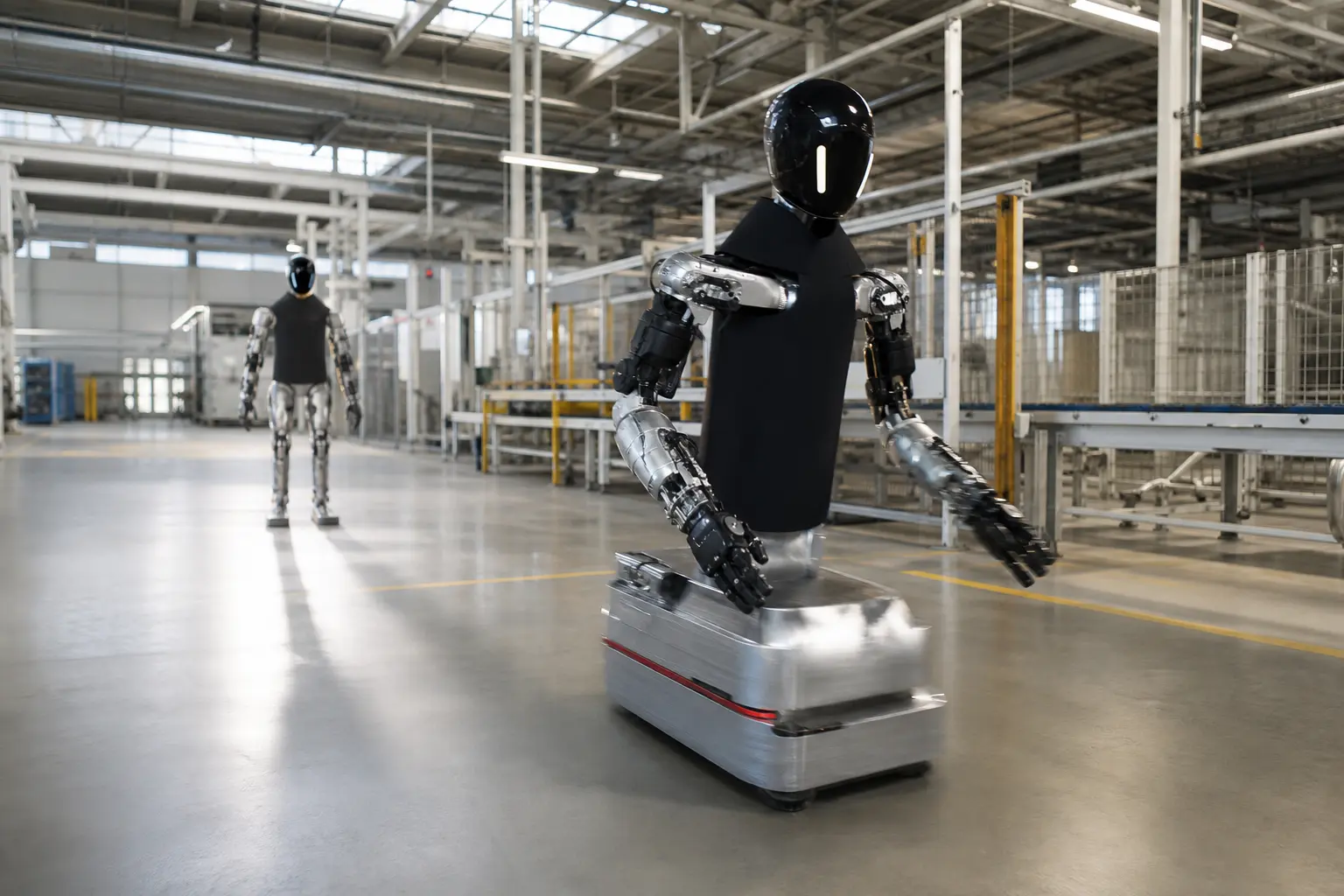
Why Did Humanoid Choose Wheels Over Legs?
Humanoid’s robots move on a wheeled base rather than walking on two legs, the chassis behind its flagship platform, HMND 01. The trade-off skips the visual drama of bipedal walking for a faster path through European safety certification and lower engineering risk, a design logic Forbes tied directly to how quickly Humanoid has moved from prototype to paying customers.
Most of the industry’s other big names walk. Figure AI, Tesla’s Optimus and Agility Robotics’ Digit all engineer for a human gait, aiming for machines that can eventually work in any space built for people. Humanoid picked the opposite bet: a platform built for flat factory and warehouse floors, where wheels are cheaper to build, easier to certify and faster to put to work than legs designed to mimic how a person walks.
BMW Already Ran This Experiment in Leipzig
The wheeled versus bipedal question already has a live test case. BMW Group’s plant in Leipzig, Germany became the automaker’s first European site to run a humanoid robot, using AEON, a wheeled-legged machine from Hexagon Robotics that made its operational debut there in December 2025. BMW scheduled a further test deployment for April 2026, with full integration into pilot production set for summer 2026.
AEON is not a pure wheeled design like Humanoid’s HMND 01. Each leg ends in a wheel instead of a foot, letting the robot roll across factory floors faster than walking while still stepping over obstacles when needed. Hexagon Robotics, the Zurich-based physical AI unit of measurement technology group Hexagon, built AEON with NVIDIA and unveiled it in June 2025.
BMW had already tested Figure’s bipedal robots at its Spartanburg, South Carolina plant before bringing AEON to Germany, a pilot that ran roughly eleven months. Toyota has taken a similar bipedal path at its Canadian RAV4 plant, where it deployed Agility Robotics’ bipedal Digit robot on the assembly line. Schaeffler, notably, shows up on both sides of this ledger: the same company that just signed a thousand-robot order with Humanoid is also named among Hexagon’s pilot partners for AEON. Industrial buyers are running parallel bets on wheels, wheeled legs and full bipedal walkers, rather than committing to one design this early.
| Company | Robot and Design | Base | Latest Milestone |
|---|---|---|---|
| Humanoid | HMND 01, wheeled | London, UK | $152M Series A at $1.35B, July 2026 |
| Figure AI | Figure 03, bipedal | San Jose, US | $39B Series C, September 2025 |
| Hexagon Robotics | AEON, wheeled legs | Zurich, Switzerland | Production pilot at BMW Leipzig since December 2025 |
| Agility Robotics | Digit, bipedal | Oregon, US | Deployed at Toyota’s Canadian RAV4 plant |
Four companies, three chassis strategies, and no consensus yet on which one wins the next decade of factory work.
Figure AI Shows Where the Valuation Ceiling Sits
Humanoid’s $1.35 billion looks modest next to the number commanded by Prime Movers Lab’s other big robotics bet. Figure AI, the bipedal humanoid maker the same firm also backs, raised a Series C above $1 billion in September 2025 at a $39 billion valuation, nearly fifteen times its $2.6 billion mark from early 2024. Figure has raised close to $2 billion in total since it was founded in 2022.
That $39 billion figure is worth holding against Goldman Sachs Research’s own forecast for the entire humanoid robot market. The bank projects a global total addressable market of $38 billion by 2035, up sixfold from an earlier $6 billion estimate, a revision it credits to component costs that fell 40% last year instead of the 15% to 20% its analysts had modeled. Figure’s valuation alone is already larger than the market Goldman expects the whole industry, every company combined, to generate nine years from now.
The people closest to this money do not read those numbers the same way.
- Prime Movers Lab expects the sector to consolidate around a small number of winners across the US, Europe and China, with Humanoid among them, according to Zia Huque.
- Goldman Sachs Research argues the optimism is earned because hardware costs are falling faster than projected, pulling forward the timeline to profitable factory use.
- Skeptics of the category point to the arithmetic itself: a paper valuation that already exceeds Goldman’s entire 2035 industry forecast, built on businesses that have yet to report meaningful revenue.
Humanoid sits on the cheaper end of that spread, but it is not exempt from the underlying problem. Its own beta robots have not yet shipped to a customer site.
Sereact and Zalando Are Betting the Other Way
European fashion retailer Zalando recently joined a $116 million bet against humanoid robots by backing Sereact, a warehouse robotics startup that skips the human silhouette entirely. The wager underneath that round is simple: for picking and sorting work, a machine built for one job can beat a general purpose one shaped like a person.
Humanoid’s bet now carries two layers of competition. One is wheels versus legs among companies that agree the humanoid shape matters. The other is the humanoid shape itself against purpose built machines like Sereact’s, which argue that shape was never the point.
Humanoid’s Beta Robots Are Due on Factory Floors by December
The new capital carries a specific list of jobs, according to the company’s own announcement:
- Development and launch of Humanoid’s next generation robotics platform.
- Long term commercial deployments across logistics, manufacturing, retail and other sectors, starting with beta robots at customer sites in the fourth quarter of 2026.
- The start of mass manufacturing of its wheel based robots.
- Continued development of KinetIQ, the AI system Humanoid describes as its path toward a general purpose industrial robot.
KinetIQ is the part of this story that does not show up in a funding table. Humanoid built the software in house alongside the hardware, rather than buying in a third party model, so the same team that designs the wheels also designs the reasoning that tells them where to go.
Schaeffler’s thousand robot rollout, still ahead of Humanoid’s own beta launch, will be the first real test of whether wheeled humanoids can do factory work at the volume this new valuation now assumes.
Frequently Asked Questions
Is Humanoid the same company as Figure AI?
No. Humanoid is a separate, London based company building wheeled robots, while Figure AI is based in San Jose, California, and builds bipedal robots valued at $39 billion after its September 2025 Series C. The two share a lead investor, Prime Movers Lab, but they build different machines with different chassis.
What problem is Humanoid trying to solve?
Humanoid says its robots target global labor shortages across manufacturing, logistics and other critical sectors, and that its goal is solving real operational problems for customers rather than demonstrating general purpose mobility for its own sake.
Who else is building humanoid robots in Europe?
Humanoid is not the continent’s only entrant. Hexagon Robotics, based in Zurich, builds the wheeled-legged AEON now on trial at BMW’s Leipzig plant. Norway’s 1X Technologies has raised funding with backing from OpenAI for its own humanoid line, and Germany’s Sereact is building warehouse robots that skip the humanoid shape altogether.
What is Humanoid’s legal company name?
Humanoid trades under that brand name, but its registered legal entity is SKL Robotics Ltd, based in London.


Veridue Raises $4 Million to Speed Energy Deal Diligence

Healey Adds a £150m Rung for Northern Scale-Ups

Ten Deals Took Most of Europe’s August Tech Money

Holmes Hired Fielder to Film Her Last Days

Molten Bets £100m of Plc Cash on Late-Stage Tech

Garlinghouse Cited Dutch Gold, and London Got the Bars

byFounders Bets $4.3 Million on Fluencify After $2M ARR

Alpha Gang Puts A-List Stars on a Zellner Wager

Angel Bets a Recut PG-13 Chase on Ritchson and Wilson

Flex IT and T1A Combine to Own Corporate Device Supply

Walter’s TWG Insists No Fraud as Insurer Probes Force Cleanup

30-Year Yield Hits 5.32% Highest Since 2007 as Debt Supply Locks In Costs

PCE Stays at 3.7% as Gas and Tariffs Outrun Coming Revisions

Evernorth S-4 Clears Path for Active XRP Treasury on Nasdaq

Astute’s $1.2M bet makes B2B creator deals feed AI discovery

Strategy Parks $1.59B Cash While Bitcoin Stack Stays Flat

Instinct Hits $2.5 Billion as AI Agent Access Sparks Trust Fights

Oracle’s 2.8 GW Bloom Deal Exposes the AI Power Bypass

Amber’s €7M locks Mittelstand knowledge inside Europe

CLARITY Act Cloture Opens a Door Ethics Still Blocks
-
 FINANCE3 months ago
Zcash Patched a Double-Spend Bug as ZEC Climbed 5%
-
 ENTERTAINMENT3 months ago
Steam Summer Sale 2026 Locks In June 25 to July 9 Dates
-

 FINANCE2 months ago
CLARITY Act Final Text Expected This Weekend as 60-Vote Hurdle Looms
-
 NEWS4 months ago
Meta Adds AI Replies to Threads, But Users Can’t Block It
-
 ENTERTAINMENT5 months ago
Extraction 3 Is Officially Coming to Netflix in 2027
-

 NEWS3 months ago
YouTube Shorts is testing a heart in place of the thumbs-up
-

 NEWS1 month ago
Senators Force Apple Off Chinese Memory as Big Three Cash In
-

 NEWS3 months ago
NEURA Robotics’ $1.4B Series C Redraws Europe’s Physical AI Bet