
FINANCE
Japan’s FSA Moves to Free Trust Stablecoins From Filings
Japan’s FSA asked to end trustee tax filings on every trust-based stablecoin transfer, the step that would finally let yen tokens settle large payments.

Japan’s Financial Services Agency asked on August 31 to drop tax filings that hit every time a trust-based stablecoin changes hands. The bid is in the agency’s fiscal 2027 tax reform request under financial innovation, and it is aimed at trustees.
Holder income tax does not move with this item. What would move, if the ruling parties accept it, is whether a yen token can circulate like money instead of like a family trust.
Japan’s FSA Wants the Trust Paperwork Gone
The agency published its Reiwa 9 (2027) tax-reform list on August 31 and listed a specified trust beneficiary rights measure among its main asks. That legal label is how Japan books a trust-type stablecoin.
Under present inheritance-tax and income-tax rules, a trustee must send papers to the tax office when a trust starts and again whenever the beneficiary changes. For a token built as specified trust beneficiary rights, the beneficiary changes with every transfer.
The FSA asked for a blanket waiver of those filings on holder changes, not a higher threshold and not a short form. It also asked for tax cleanup tied to treating some foreign-issued trust coins as electronic payment instruments.
This is still a request. The cabinet and ruling parties write the annual tax outline later in the year, and nothing in the August 31 packet writes the waiver into law.
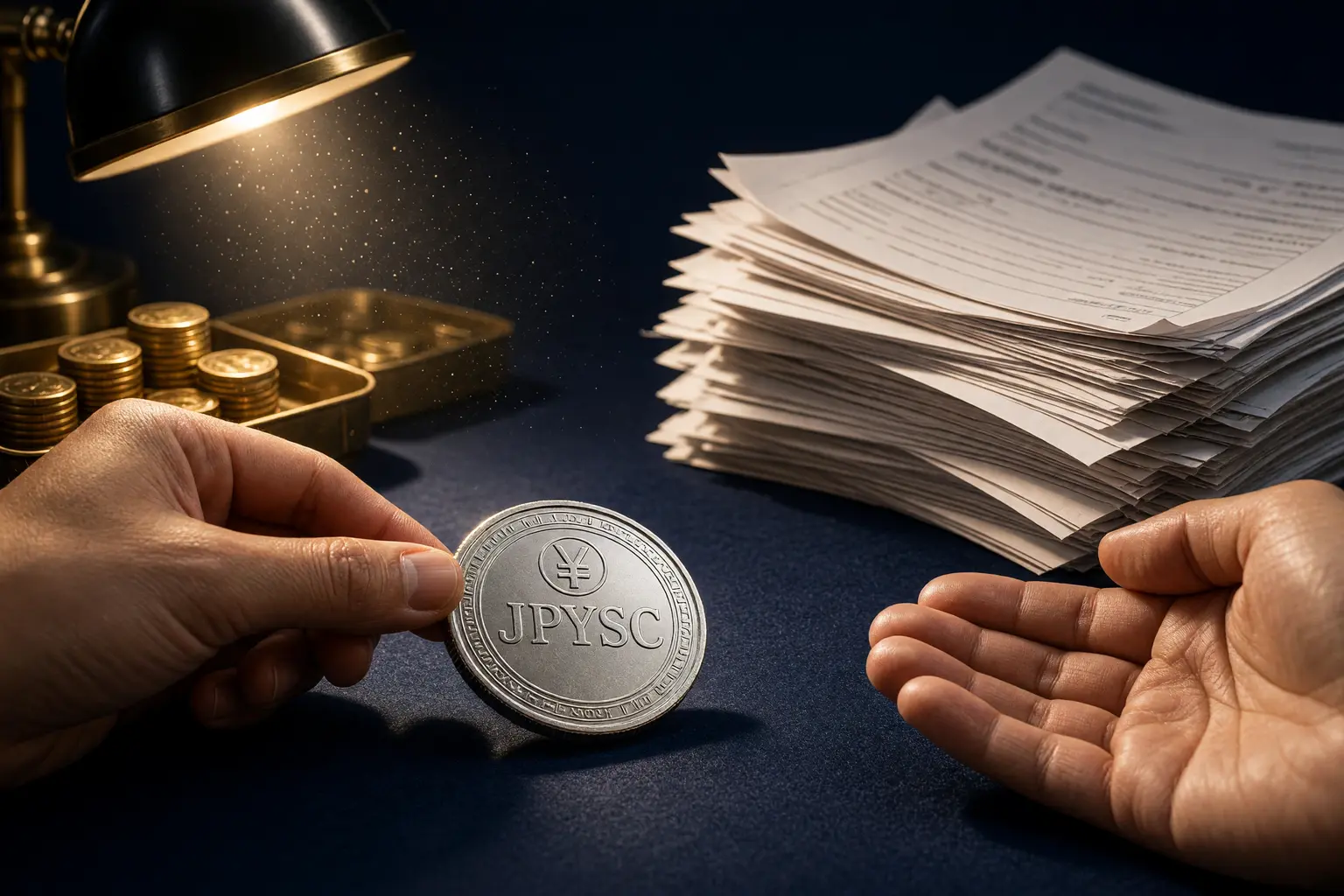
Every Transfer Counts as a New Beneficiary
A normal Japanese trust has a short list of named beneficiaries the trustee already knows. Filing when that list changes is tedious. It is possible.
A payment token inverts the model. Send the coin from one wallet to another and the beneficiary of the underlying trust moves with it, so a coin meant to pass through thousands of addresses would generate a filing on every hop. The trustee also cannot match public-chain addresses to the names the forms demand.
SBI Shinsei Trust Bank’s JPYSC is the domestic Type 3 example. Reserves sit at the trust bank. Holders own tokenised beneficiary rights in that trust, which is why the coin has strong asset segregation and why the old trust forms attach to it.
THE TWO FORMS THE FSA WANTS DROPPED
- Beneficiary ledger: The trustee now files a beneficiary-by-beneficiary trust report when holders change.
- Trust accounts: The trustee also files a trust calculation statement under income-tax rules on those same changes.
- The agency’s reason: A widely circulating payment coin is not expected to throw off income just by being held, and the trustee cannot actually see each holder.
That is a trustee problem, not a user rebate. Anyone hoping this item cuts the miscellaneous-income rate on bitcoin or ether is reading a different reform, the one still queued on a later 20 percent track for specified crypto assets.
Why the ¥1 Million Story Keeps Circulating
A week before the FSA posted the PDF, reports said the agency would use the same tax round to open individual deals above 1 million yen (about $6,300) and named cars and houses as the target ticket. That figure then got written as if the cap had already been lifted for every yen stablecoin.
The legal split is older than the headline. Funds-transfer coins such as JPYC, issued as Type 1 electronic payment instruments, still face a 1 million yen ceiling on issue and redeem under the Payment Services Act. Trust-type coins such as JPYSC never had that statutory ceiling.
What they had instead was a de facto transfer lock. If every change of holder requires named tax papers, a trustee will not let the coin roam, and high-value payments stay theoretical even when the statute says no cap.
Noritaka Okabe, chief executive of JPYC Inc., wrote on August 24 that he had not confirmed the leak, that relief on JPYC’s 1 million yen limit looked to him like a given, and that trust-type coins now face what he called a de facto transfer restriction, which is why their easing was going into the tax request. He called both moves large steps.
https://x.com/noritaka_okabe/status/2091871713537692013
GVA Law’s fintech team said on September 1 that headlines about unlocking transfers above 1 million yen skip a split already in force: Type 1 still has the cap, Type 3 already does not. Two days after the FSA posting, that mix-up was still moving.
JPYSC Holds ¥10 Billion Inside One Broker
SBI Holdings, SBI Shinsei Trust Bank, SBI VC Trade and Startale Group started JPYSC on June 24 inside SBI VC Trade accounts only. The bank’s public yen trust stablecoin design sets SBI Shinsei Trust as trustee and SBI VC Trade as settlor and initial beneficiary, with a 1-to-1 yen aim.
JPYSC ON THE BOOKS
- Issue size: Specified trust beneficiary rights outstanding were ¥10,008,294,794 as of 19:00 on June 30.
- Cash against it: The yen deposit account holding trust money showed ¥10,008,304,794 at the same stamp.
- Where it lives: First release was limited to SBI VC Trade’s own ledger, not to outside wallets.
- The gate: SBI VC Trade has said withdrawals will follow once tax and legal treatment is sorted and the supervisor confirms.
Ten billion yen is already a serious float for a coin that cannot leave the building. The August 31 filing request is the tax half of that gate. Until trustees stop owing a named form on every hop, public-chain circulation stays a promise in the product notes.
Corporate payroll in the other lane shows why volume breaks the old forms. Logistics group AZ-COM Maruwa has moved toward paying about 2,300 contractors in JPYC, a hop count no trustee could staff with paper beneficiary reports if the same flows sat inside a trust coin.
The Funds-Transfer Coin Still Hits a Wall
Japan’s Payment Services Act allows three issuer types: banks, trust companies, and registered funds-transfer firms. Each produces a different instrument, and only the trust instrument trips the beneficiary forms.
JPYC launched on October 27, 2025 as the first regulated yen coin under a funds-transfer licence. It can move on public chains. It cannot, as Type 1, legally issue or redeem above 1 million yen per turn. Okabe’s August 24 note treated a future easing of that cap as a separate rail from the trust-type tax ask.
The February JPYSC brand and logo announcement had already pitched the trust coin as a digital-yen base for larger settlement. The June issue then arrived with no statutory 1 million yen lid and with no right, yet, to walk out of one broker.
THE TWO YEN COINS IN LAW
| Lane | Live coin | Legal form | Statutory size cap | Tax-form problem |
|---|---|---|---|---|
| Type 1 funds-transfer | JPYC | Money-transfer licence | 1 million yen per issue or redeem | No trust beneficiary forms |
| Type 3 trust | JPYSC | Specified trust beneficiary rights | None by statute | A filing on every holder change |
Fair competition between those lanes is the policy subtext Okabe named. A trust coin that cannot be transferred without a tax packet is not competing with a funds-transfer coin that can move, even if the latter is stuck at 1 million yen.
Foreign Trust Coins Share the Same Ask
The same August 31 list includes tax measures for certain foreign-issued trust-type stablecoins once they are treated as electronic payment instruments. That tracks a Cabinet Office ordinance that took effect on June 1, which pulled qualifying foreign trust tokens out of the securities bucket and into the payments bucket, if they meet equivalence tests and move through a licensed Japanese intermediary.
SBI VC Trade already had a licence path for Circle’s USDC. Foreign trust beneficiary rights were the leftover problem, because they risked being read as securities. The June 1 fix created a dedicated payments category. The August tax ask is the follow-on: if those coins are payments, the tax code has to stop treating every transfer like a change in a private trust.
Details on the foreign item were thinner than the domestic waiver. The FSA bundled it as “necessary measures,” which leaves the Ministry of Finance and the ruling parties to decide how far the same paperwork relief extends offshore.
The Tax Outline Comes Late This Year
Agency wish lists are the opening bid in Japan’s annual tax cycle, not the close. The FSA can ask. The ruling parties write the outline, usually toward year-end, and the Diet then turns that outline into statute for the next fiscal year.
HOW THE WAIVER GOT ON THE LIST
- June 1, 2026: A Cabinet Office ordinance starts treating qualifying foreign trust-type stablecoins as electronic payment instruments rather than securities.
- June 24, 2026: SBI Shinsei Trust Bank issues JPYSC, limited at first to SBI VC Trade accounts, with no statutory 1 million yen transfer cap.
- June 30, 2026: The bank reports ¥10,008,294,794 of JPYSC outstanding against a matching yen deposit book.
- August 24, 2026: Reports say the FSA will use the coming tax request to make individual trust-coin payments above 1 million yen workable by cutting document filings.
- August 31, 2026: The FSA publishes the Reiwa 9 request and asks for a blanket drop of beneficiary-change filings on specified trust beneficiary rights.
If the outline accepts the item, the earliest clean start is fiscal 2027. Until then JPYSC still lives under a rule written for family trusts, and SBI VC Trade still conditions public-chain withdrawals on tax practice being sorted.
The holder’s own tax bill is a different queue. Crypto gains remain miscellaneous income stacked on salary, with combined national and local rates that can reach about 55 percent, while a separate 20 percent track for specified assets traded on licensed venues is still timed off a later Financial Instruments and Exchange Act start.
For now the live constraint on Japan’s trust yen coin is simpler than a rate debate. Ten billion yen is already on a trust bank’s books, and every public hop still looks, on paper, like a new beneficiary the trustee is supposed to name.
Disclaimer: This article is news reporting and analysis of a Japanese tax-reform request, and it is for information only. It is not tax advice, investment advice, or legal advice, and it does not tell anyone how to treat stablecoins, crypto gains, or trust filings on a return. Readers who may be affected should consult a qualified Japanese tax accountant or licensed tax attorney before acting. Figures, product balances and the status of the FSA request reflect the cited primary pages and statements as of September 2, 2026, and both the law and the outstanding amounts can change.


British Business Bank’s Zinc Fund Will Mint 80 Startups

Philips Hue IFA Gear Opens TVs and Gates the Hub

Souk Raises $1.6 Million for Its AI Partner Manager

Anthropic Bets on Cheaper Cache for Claude Fable 5.1

Food Processors Back Backbone’s €4 Million Quality Round

Scosche Bets IFA Shoppers Will Buy Fewer Charging Bricks

ELO Bets Sentinel XR Gaming Glasses at IFA Berlin

ShiftCam SuperZoom Lenses Bet on a 350mm Phone Gap

Clooney Defends Ruffalo’s Speech While Collecting Venice’s Lion

Jungheinrich Is the Sole Backer of Uplift’s €100M Fund

30-Year Yield Hits 5.32% Highest Since 2007 as Debt Supply Locks In Costs

Walter’s TWG Insists No Fraud as Insurer Probes Force Cleanup

PCE Stays at 3.7% as Gas and Tariffs Outrun Coming Revisions

Strategy Parks $1.59B Cash While Bitcoin Stack Stays Flat

Astute’s $1.2M bet makes B2B creator deals feed AI discovery

The 20% Savings Ideal Meets a 2.7% Reality Check

SpaceX Stock Rebound Tests Real Demand Before Huge Unlock

Amber’s €7M locks Mittelstand knowledge inside Europe

Monzo chair Gary Hoffman exits after board revolt fallout

Nvidia’s $16,000 RTX Pro 6000 Turns Local AI Into a Luxury
-
 FINANCE3 months ago
Zcash Patched a Double-Spend Bug as ZEC Climbed 5%
-
 ENTERTAINMENT3 months ago
Steam Summer Sale 2026 Locks In June 25 to July 9 Dates
-

 FINANCE2 months ago
CLARITY Act Final Text Expected This Weekend as 60-Vote Hurdle Looms
-
 NEWS4 months ago
Meta Adds AI Replies to Threads, But Users Can’t Block It
-

 NEWS3 months ago
YouTube Shorts is testing a heart in place of the thumbs-up
-

 NEWS1 month ago
Senators Force Apple Off Chinese Memory as Big Three Cash In
-

 NEWS3 months ago
NEURA Robotics’ $1.4B Series C Redraws Europe’s Physical AI Bet
-
 ENTERTAINMENT5 months ago
Extraction 3 Is Officially Coming to Netflix in 2027