
NEWS
Neural Concept’s $100 Million Round Meets a Larger Rival
Neural Concept closed a $100 million Goldman-led Series C and is spending it on a design copilot and India offices as PhysicsX raises $300 million.

Neural Concept opened offices in Bengaluru and Pune on September 9, 2026, after Goldman Sachs Alternatives led its $100 million Series C on December 18, 2025. The Lausanne company is spending that check on a CAD-native engineering AI pitch, and on a sales map that now reaches India.
The round was a wager that physics-aware design software, not a chat window, is the industrial AI that factories will pay for. The copilot shipped in January. The offices in Seoul and India show where the money is going.
Goldman Sachs Wrote a $100 Million Check for Geometry
Growth Equity at Goldman Sachs Alternatives led the $100 million Series C funding round, with Forestay Capital, Alven, HTGF, D. E. Shaw Ventures and Aster Capital coming back in. Neural Concept said it would use the capital to finish a generative CAD capability, hire global sales staff, and sit as an intelligence layer across tools from Nvidia, Siemens, Ansys, Microsoft and AWS.
The company claimed customers already save $50 million a year, cut late-stage redesigns by 30-50 percent, and pull product launches forward by up to two years. It also said enterprise revenue had risen fourfold over 18 months, and that more than 50 companies were on the platform, among them General Motors, GE Vernova, Leonardo Aerospace, Eaton, Safran, Renault Group and four Formula 1 teams.
Neural Concept’s technology represents a rare leap forward in enterprise engineering AI.
Lambert Diacono, Executive Director, Growth Equity at Goldman Sachs Alternatives
Christian Resch, Partner and Head of EMEA Growth Equity at Goldman Sachs Alternatives, said demand is rising for AI that changes complex industrial workflows, and that Neural Concept is coming through as one of the leaders in that market. Dr. Pierre Baqué, CEO and co-founder, said the firm was built to let teams design cars and spacecraft with AI from the first sketch, so tradeoffs are priced in before metal is cut.
NEURAL CONCEPT’S DISCLOSED ROUNDS
| Round | Date | Amount | Lead |
|---|---|---|---|
| Seed | 2020 | $2 million | Undisclosed |
| Series A | March 2022 | $9 million | Undisclosed |
| Series B | June 3, 2024 | $27 million | Forestay Capital |
| Series C | December 18, 2025 | $100 million | Goldman Sachs Alternatives |
Forestay had already underwritten the Series B, and its Forestay Capital’s Series B thesis treated 3D deep learning as a way to sell a hard product into slow industrial buyers. Goldman’s check is a different scale. It is also a different claim: that this layer can live on top of the CAD and simulation stack those buyers already run.
The Generative CAD Promise Landed at CES
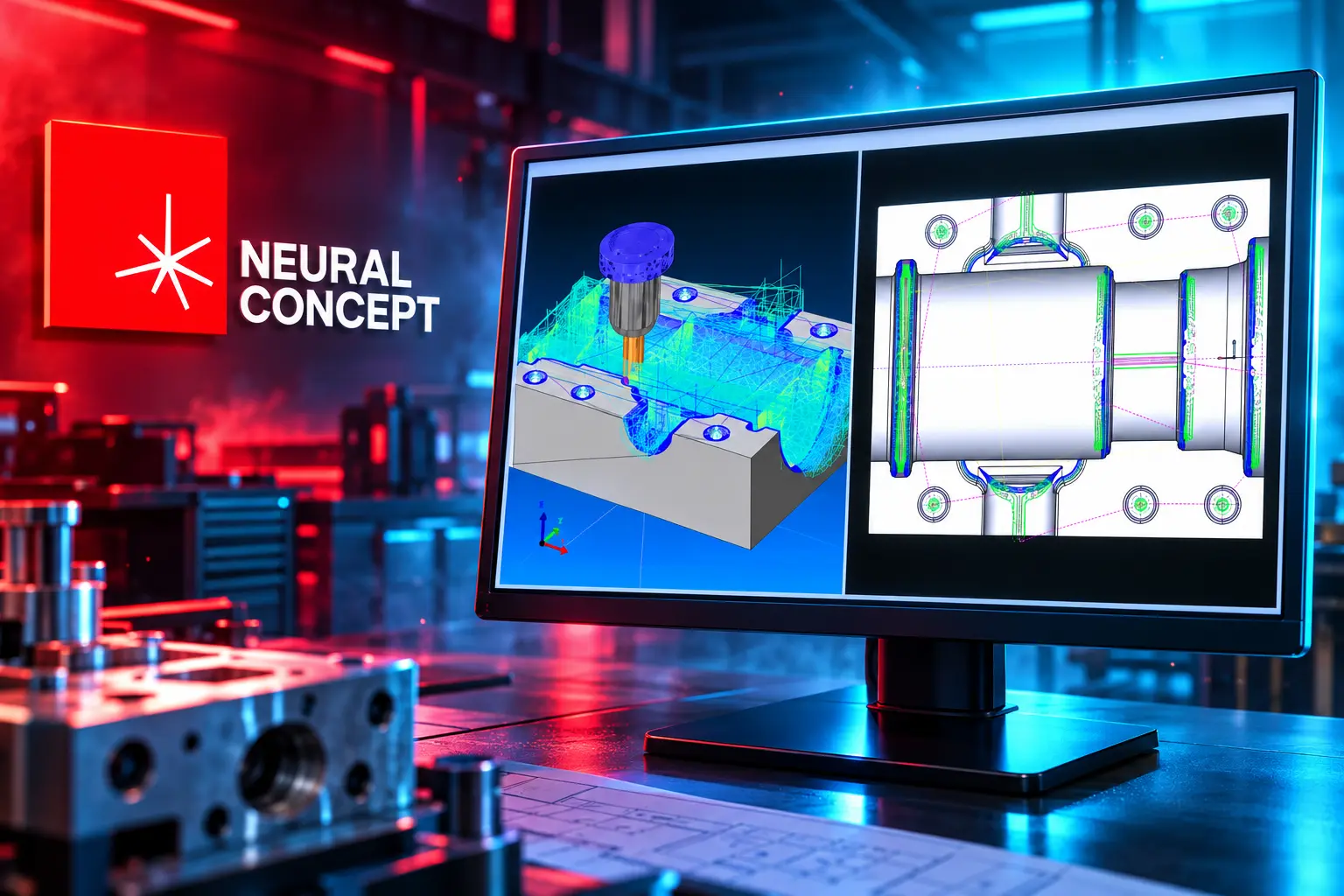
On January 7, 2026 in Las Vegas, Neural Concept launched AI Design Copilot inside the existing platform. That was the generative CAD capability flagged in the December release, now framed as a physics- and geometry-aware system that turns design intent into CAD-ready 3D options in minutes.
Baqué said generic language models fail on shape and physics, and that the copilot is built to iterate on full design sets rather than one model at a time. Subaru joined the named roster at launch, alongside General Motors, General Electric, Leonardo Aerospace and four Formula 1 teams.
Our AI Design Copilot closes the loop from concept to decision, enabling engineers to explore, test and refine designs at a scale that simply wasn’t possible before.
Dr. Pierre Baqué, CEO and co-founder, Neural Concept, CES 2026
WHAT THE DESIGN COPILOT CLAIMS
- CAD-ready geometry: High-level intent becomes manufacturing-ready models, with weeks of manual modeling compressed into minutes.
- Wider search: Engineers can look at 10 to 1,000 times more design variants in each iteration.
- Multi-physics hook: Thermal, fluids, crash and electromagnetic work sits on the same path, with manual workload cut by up to 90 percent.
The product still needs a certified solver at the end of the line. Thomas von Tschammer, co-founder and U.S. managing director, has said AI will not fully replace classical simulation, and that the job is to use solvers where they still matter and skip them where they slow the early loop. That is the Goldman bet in one line: sell the fast loop, keep the incumbents for the stamp.
MAHLE’s Blower Ran Through 30 Million Shapes
The cleanest public specimen is not a slide about time-to-market. It is a radial blower for car air conditioning that MAHLE took through Neural Concept’s copilots, using 30 million virtual blower designs against noise, packaging and efficiency targets. Engineers set the constraints. The copilot proposed geometries and predicted performance in one interface.
MAHLE’s cue was a penguin fin, a drag-cutting shape they wanted inside the tight bay of an electric vehicle. The finished part sits in front of the evaporator, runs across passenger cars and heavy trucks, and is compact enough for EV packaging.
THE MAHLE BLOWER RESULT
- Search volume: More than 30 million virtual iterations on a single component family.
- Noise: Sound output down 4 decibels versus similar systems.
- Efficiency: Energy use improved 15 percent, with a smaller footprint.
Jaguar Land Rover has been more open than most OEMs about the aero loop. Chris Johnston, a senior technical specialist at JLR, said at Nvidia GTC that jobs which used to take 4 hours now finish in 1 minute. That is the same pattern as MAHLE: the expensive hours move to the front of the week, and a human still picks the part that ships.
Four Formula 1 teams sit on the same roster, which is a loud proof point inside a quiet category. The brand still barely registers outside simulation groups, even with a Goldman-led round on the books. The people who write the checks for CAE already know the name. Everyone else is catching up through offices, not through a consumer launch.
The Round Is Paying for Seoul and Pune
Baqué’s December list was product, go-to-market, and partnerships. The 2026 calendar is mostly the middle item. Neural Concept already had Munich and New York. It opened New York on October 22, 2024, when it said 10 U.S. OEMs were on the platform. The Series C then paid for Asia.
WHERE THE SERIES C IS SHOWING UP
- December 18, 2025: Closes the $100 million Series C in Lausanne, led by Growth Equity at Goldman Sachs Alternatives.
- January 7, 2026: Unveils AI Design Copilot at CES in Las Vegas as a platform capability.
- June 9, 2026: Opens the first APAC office in Seoul and names Hanwha Ocean as a regional collaborator.
- July 1, 2026: Announces three leadership hires aimed at global expansion.
- September 9, 2026: Puts dedicated teams in Bengaluru and Pune, its first official India footprint, with MAHLE already live in the region.
Seoul came with a local bench. Jiwon Jung is Regional Sales Director for APAC. Laurent D’Alvise is VP Commercial, APAC. Dr. Eunjoo Lee, former CEO of IBM Korea and an executive vice president at Samsung, joined as a board advisor after more than two decades in enterprise AI. Dongkwon Lee, SVP of the Basic Performance Research Center at Hanwha Ocean, said the platform looked practical enough to speed design work, which is a cautious shipyard endorsement rather than a victory lap.
India is the next node on that same map. Sudhir Padaki joined as Regional Sales Director with 20 years in Indian auto and manufacturing sales. Baqué said India is becoming a powerhouse for global engineering R&D, and that the company is putting the platform next to that talent. Padaki said the local team will mix those relationships with Neural Concept’s global engineering staff so customers can get on the software without a long remote queue.
An interview with Pierre Baqué at EPFL still describes the product as a layer on top of the existing simulation stack, not a replacement for it. That is also how the sales force has to sell it in Pune and Seoul: keep CATIA, NX and Fluent, add a copilot that has already seen the last 10,000 runs.
PhysicsX Closed $300 Million at $2.4 Billion
The uncomfortable comparable landed one day before the Seoul ribbon. On June 8, 2026, London-based PhysicsX announced a $300 million Series C at $2.4 billion, led by Temasek, with Nvidia, Siemens and Applied Materials among the names on the cap table. PhysicsX said recognized revenue had doubled year over year, booked revenue had tripled, and headcount had passed 300.
Jacomo Corbo, co-founder and CEO of PhysicsX, said almost every hard problem in the physical economy comes down to how fast engineers can work through the physics, and that the new capital is for larger pre-trained physics models. Siemens is both a backer and a source of high-fidelity simulation data, which is a messier relationship than Neural Concept’s partner list, and a sign that the incumbent would rather own a piece of the new layer than ignore it.
TWO SERIES C CHECKS IN SIX MONTHS
| Company | Series C | Date | Lead | Stated valuation |
|---|---|---|---|---|
| Neural Concept | $100 million | December 18, 2025 | Goldman Sachs Alternatives | Undisclosed |
| PhysicsX | $300 million | June 8, 2026 | Temasek | About $2.4 billion |
Goldman’s check is smaller, and Neural Concept has not published a valuation. That does not make the Lausanne round a sideshow. It does mean the category now has two live wagers with different centres of gravity: a CAD-native copilot sold as an intelligence layer, and a physics-model company raising at a public $2.4 billion mark with a semiconductor and data-centre pull. Both can be right for a while. Only one of those numbers is on a term sheet the market can see.
What Incumbent CAD Vendors Are Building in Parallel
The old simulation vendors did not wait for two European startups to finish their roadmaps. Siemens closed its purchase of Altair in 2025. Synopsys closed its purchase of Ansys the same year. Autodesk has been showing Neural CAD, a geometry-aware model it says can emit editable CAD from text, sketches and voice, and it has called that a break in how designers talk to the kernel.
Ansys has been shipping more generative geometry and agent-style simulation in its 2026 releases. Neural Concept’s own answer is to partner with Siemens and Ansys rather than pick a fight in the solver bay. That is coherent if the copilot stays an early-loop tool. It gets harder if Autodesk, Siemens and Ansys make “good enough” geometry AI a checkbox inside software that is already on every seat.
World Economic Forum named Neural Concept a Technology Pioneer on June 23, 2025, which is a useful badge when a salesperson walks into a Korean shipyard or a Pune tech centre. It is not a moat. The moat, if there is one, is the customer data already inside those 50-plus deployments, including the MAHLE blower family and the F1 aero decks that never get a press release.
Neural Concept Connect 2026 is booked for the Bay Area on October 20 and Munich on November 24, with Tokyo still unlisted. The Bengaluru and Pune teams are already on the ground. That is the shape of the Goldman wager nine-odd months after the close: a copilot on the booth, a rival with a larger round, and a sales map that now includes Korea and India because that is where the next engineering seats are.
Frequently Asked Questions
Who Led Neural Concept’s $100 Million Series C?
Growth Equity at Goldman Sachs Alternatives led the round, with Lambert Diacono and Christian Resch, Partner and Head of EMEA Growth Equity, speaking for the firm. Goldman Sachs Alternatives holds over $500 billion in alternative assets, and Goldman Sachs reported about $3.5 trillion in assets under supervision as of September 30, 2025. Forestay Capital, Alven, HTGF, D. E. Shaw Ventures and Aster Capital joined as returning holders.
When Was Neural Concept Founded?
Neural Concept dates its founding to 2019 as a spinout from the Swiss Federal Institute of Technology in Lausanne (EPFL), where Baqué trained as a researcher before becoming CEO. When Forestay Capital led the $27 million Series B, it described the deal as its fourth EPFL spin-off investment, a Swiss deep-tech pattern rather than a one-off AI round.
What Does the AI Design Copilot Do?
It is a new mode inside the Neural Concept platform, not a separate product, and the company said broader customer access would follow later in the first quarter of 2026 after the January 7 launch. Engineers describe goals and constraints; the copilot proposes CAD-ready geometry and ranks options against physics, then hands editable models back to the CAD and CAE tools already on the desk.
How Much Had Neural Concept Raised Before the Series C?
Disclosed primary rounds before December 2025 add up to $38 million: a $2 million seed in 2020, a $9 million Series A in March 2022, and a $27 million Series B on June 3, 2024. Count the Goldman-led round and the disclosed total is $138 million. CNB Capital appeared on the Series B and was not listed among Series C participants.
How Do Customers Run the Software?
Neural Concept delivers the platform as SaaS or as software deployed in a customer’s private cloud, which is the path for auto, aero and defense buyers who will not put geometry and solver data on a public endpoint. That split is how a 2019 EPFL spinout sells into the same plants that still run on-premise Ansys and Siemens seats.

UPI MDR Delay Hands Traders the Calendar After Paytm Falls

Google Messages Builds Nine In-Chat Games After Samsung’s Exit

Anthropic’s $100 Million Academy Trains the Firms That Bill Both Sides

Toyota’s Electric C-HR Leaves the Cheap Twin to Subaru

Markets Bet the Fed Skips October After Hawkish Minutes

The Orchard Bug Forced Zcash to Open an Empty Pool

The $5.99 Game That Won Steam’s 2026 Summer Sale

Don Lee Joins Hemsworth as Extraction 3 Starts Shooting

YouTube Shorts Retires Dislikes and Swaps Likes for Hearts

NEURA Robotics Is Spending Its $1.4B on a Machine Stack
-
 NEWS5 months ago
The Orchard Bug Forced Zcash to Open an Empty Pool
-
 GAMING5 months ago
The $5.99 Game That Won Steam’s 2026 Summer Sale
-
 ENTERTAINMENT7 months ago
Don Lee Joins Hemsworth as Extraction 3 Starts Shooting
-
 NEWS4 months ago
YouTube Shorts Retires Dislikes and Swaps Likes for Hearts
-
 NEWS4 months ago
NEURA Robotics Is Spending Its $1.4B on a Machine Stack
-

 NEWS5 months ago
Atlantic City Turned WWE’s Return Into a Civic Night
-

 AUTO6 months ago
Kawasaki Bets the New Z1100 Against Its Own Supercharger
-

 BUSINESS5 months ago
Norway’s Export Bank Backs Nscale’s $790 Million Narvik Loan