
NEWS
Nvidia Adds $100 to Its Seven-Year-Old Shield TV Pro
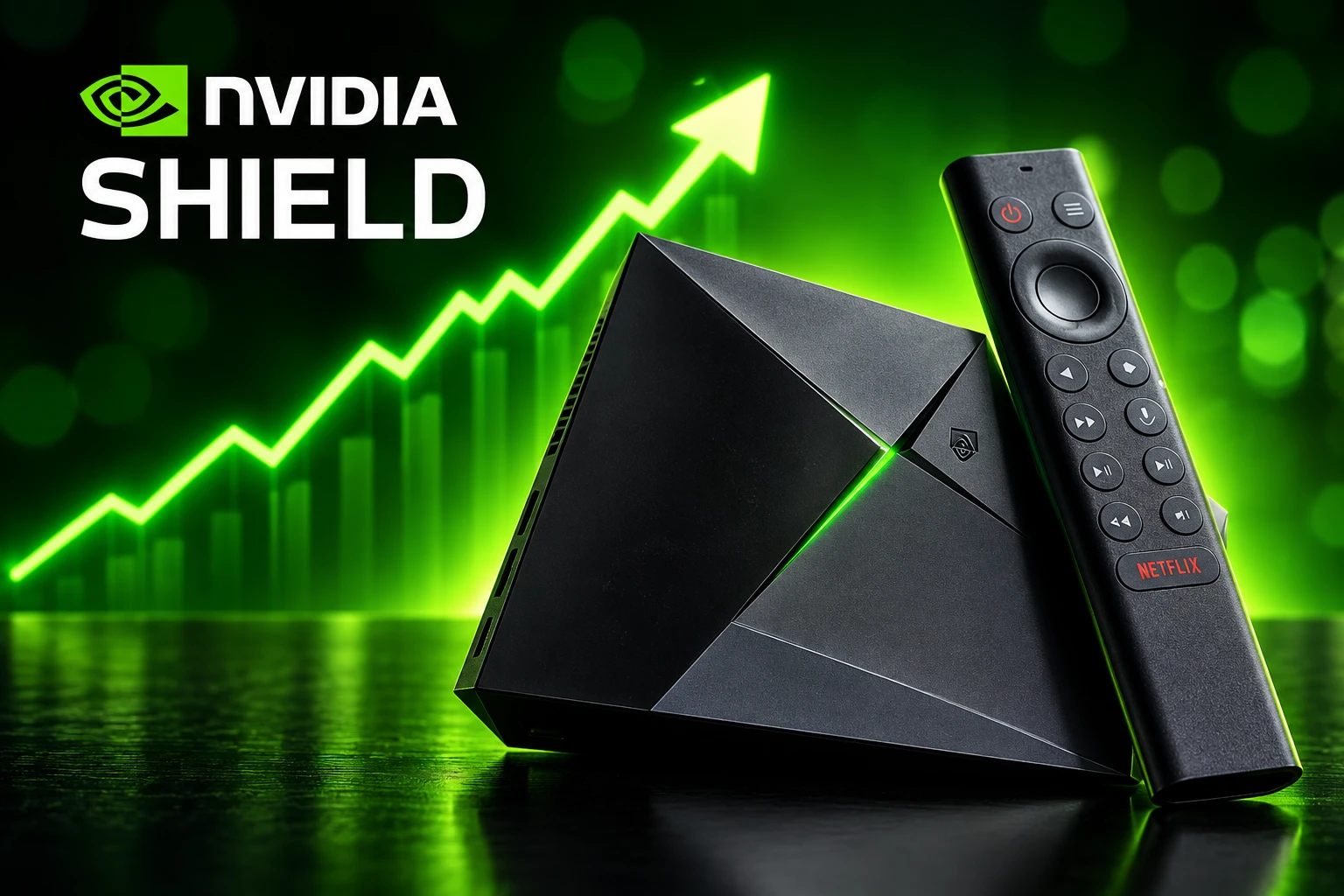
Nvidia lifted the 2019 Shield TV Pro to $299.99 on AI-era memory costs, while still building the same box with no successor.

Nvidia raised the Shield TV Pro to $299.99 on October 2, a $100 jump on a 2019 streaming box that still uses the original Tegra X1+ chip. A company spokesperson tied the new tag to parts, memory in particular, and said the change took effect that day. The hardware did not change with the price.
The same company is a prime buyer of high-bandwidth memory for AI accelerators, the demand that has pulled wafer capacity away from ordinary DRAM. New Shield units still go through that market because Nvidia builds them as it sells them, with no pile of cheaper 2019 boards left to discount.
The Same 2019 Chip, a $100 Higher Tag
Nvidia’s October 28, 2019 Shield TV launch put the Pro on sale at $199.99 with 3 GB of memory and 16 GB of storage. Nearly seven years later, those figures are the ones on the spec sheet. The new retail price is 50 percent above the old one, with no new silicon in the box.
An Nvidia spokesperson said, “Starting October 2, SHIELD Pro will be priced at $299. The cost of components, including memory, has increased substantially across the industry.” The company also said it has “stopped producing the standard SHIELD TV model as we focus on production for SHIELD TV Pro.”
The surviving model still lists a Tegra X1+ processor and 3 GB of RAM, a 256-core GPU, AI upscaling to 4K at 60 fps, Dolby Vision, HDR10, and Dolby Atmos. Gigabit Ethernet and two USB 3.0 ports are the features that let it run local media in a way cheaper sticks cannot.
LAUNCH PRICE VERSUS OCTOBER 2026
| Item | 2019 launch | October 2026 |
|---|---|---|
| U.S. price | $199.99 | $299.99 |
| Processor | Tegra X1+ | Tegra X1+ |
| Memory | 3 GB | 3 GB |
| Storage | 16 GB | 16 GB |
| Tube Shield TV | $149.99 | Production stopped |
Game consoles have already moved the same way. Sony’s PS5 Pro has gone from $699.99 at its 2024 launch to $899.99, about 29 percent higher, on much newer hardware. The Shield took a larger percentage increase on a chip from 2019.
Nvidia Helped Create the Memory Squeeze
TrendForce said on September 30 that suppliers are still steering advanced-process capacity toward high-performance server parts, which keeps the broader market short. The firm projects DRAM contract prices to rise 10-15% quarter on quarter in the fourth quarter of 2026, with NAND flash up 15 to 20 percent.
MEMORY PRICES IN LATE 2026
- Conventional DRAM: Contract prices are projected to rise 10 to 15 percent quarter on quarter in 4Q26, according to TrendForce.
- NAND flash: Overall contract prices are projected to rise 15 to 20 percent in the same quarter.
- Enterprise SSDs: Bit demand is projected to grow by more than 80 percent year on year in 2026 as cloud firms expand AI inference gear.
- Set-top boxes: TrendForce said lower-margin products such as TVs, set-top boxes, and wearables have even less room to absorb higher prices.
That last line is the Shield’s problem in one clause. A 2019 Android TV box is exactly the kind of product that cannot hide a DRAM bill inside a $1,000 PC.
Deloitte’s technology practice found that AI server DRAM roughly doubled in cost during the first quarter of 2026. Memory makers have shifted capacity toward high-bandwidth stacks and fat server DIMMs because those parts pay more. Micron chief executive Sanjay Mehrotra has said supply could be tighter in 2027 and 2028 than it is now, with HBM shipments growing faster than conventional DRAM through 2028.
Nvidia does not make the DRAM inside the Shield. It does buy huge volumes of HBM to pair with its accelerators, and that purchase list is a large reason commodity wafers are scarce. Calling the Shield hike a memory story is accurate. Calling Nvidia a bystander is not.
Why Nvidia Still Builds Every Unit
Andrew Bell, Nvidia’s senior vice president of hardware engineering, said in January 2026 that the company still makes the 2019 Shield because people still buy it. Sales volume, he said, has stayed basically unchanged for about 10 years. Promotions and price cuts barely moved the weekly number.
No matter how much we dropped the price or how much we market or don’t market it, the same number of people come out of the woodwork every week to buy Shield.
Andrew Bell, senior vice president of hardware engineering, Nvidia
That steady trickle is why there is no warehouse of pre-crisis boards. Each new Pro is built from parts bought now. Bell said that when a Shield component is pulled from the market, his group qualifies a replacement the same night. “If operations calls me and says they just ran out of this component, I’ve got engineers on it tonight looking for a new component,” he said.
The Shield began as an in-house itch. “Selfishly, a little bit, we built Shield for ourselves,” Bell said. Jensen Huang, Nvidia’s chief executive, then told the team to sell it. Early production lost money on every unit. Later refreshes in 2017 and 2019 tried to fix that while shifting the product from a living-room console toward a premium streamer.
Support was treated as a promise. Bell recalled asking Huang how long they should keep the box alive. Huang’s answer was, “For as long as we shall live.” Original 2015 units are still getting maintenance, having moved from Android 5.0 to Android 11. Bell said there are no plans to stop production or updates “any time soon.”
The $100 increase does not break that pledge. It does show the cost of keeping it. A passion-project streamer now pays 2026 memory prices for 2019 boards, and the company that helped bid those prices up is the one sending the invoice.
The Cheaper Tube Model Is Gone
The 2019 tube Shield TV launched at $149.99 as the slim model meant to vanish behind a cabinet. It had already been missing from stores for months. Nvidia’s October statement made the end official and said production would concentrate on the Pro.
Stock of the Pro has been thin as well. After the price change, Nvidia’s own store still listed the box as out of stock, while Best Buy offered it at $299.99. The higher tag is the company’s way of building more units at current parts cost rather than waiting for DRAM to cool.
THE SHIELD LINE SINCE 2015
- 2015: Nvidia ships the first Shield Android TV, built around Tegra X1, with a heavy gaming pitch.
- October 28, 2019: The Shield TV and Shield TV Pro arrive with Tegra X1+, AI upscaling, Dolby Vision, and Dolby Atmos. The Pro is $199.99.
- January 2026: Bell says Nvidia still manufactures the 2019 Pro, sells every unit, and has no plan to stop updates soon.
- October 2, 2026: The Pro moves to $299.99. Nvidia stops making the tube model and cites industry-wide component costs, including memory.
One reply to the hike treated $100 over seven years as barely a dollar a month. That math is real and it misses the product. The chip, the 3 GB of RAM, and the 16 GB of storage did not age into a new generation. Buyers are paying more for the same board because the memory market moved, and because Nvidia never replaced the board.
What $300 Still Buys in a Living Room
At $299.99 the Pro is a hard sell as a Netflix dongle. Google’s current streamer has been selling in the $100 to $150 band, and Amazon’s 4K sticks sit far lower. Those devices win if the job is apps, voice search, and 4K from the big services.
The Shield still earns the extra money only in a narrower setup. Nvidia’s own 2019 launch copy called out the Pro’s extra memory, extra storage, and dual USB ports for a Plex Media Server and large drives. That remains the gap. Most cheap streamers are clients. The Pro can be the server.
STILL WORTH $299.99 IF YOU NEED
- Local Plex: Two USB 3.0 ports, gigabit Ethernet, and a listed Plex app let the box host a library, not just play one.
- Oddball files: Container support includes MKV, M2TS, MPEG-TS, and others that living-room sticks often fumble.
- Lossless audio: Dolby TrueHD, DTS-HD, and DTS-X pass through over HDMI, which matters on a real receiver.
- AI upscaling: 720p and 1080p streams can be pushed toward 4K at 60 fps on a chip that was overbuilt for TV in 2019.
- GeForce NOW: The client is still bundled for cloud gaming on a TV, with a controller or keyboard.
Skip it if the television already runs the same apps well. Skip it if you need AV1 in hardware, HDR10+, or YouTube HDR via VP9 Profile 2. Bell named those formats as the first jobs for any new Shield, which is another way of saying the current one does not do them. Android 11 with Android TV and Chromecast 4K is also frozen in place.
The louder complaint after October 2 is that Nvidia’s AI business is a prime reason ordinary DRAM is scarce, so a $100 jump on a leftover TV box lands as the company charging living-room customers for a shortage it helped create. That reading is fair on the capacity math. It does not erase the other fact Bell put on the record: a small, stubborn group still buys this exact box every week, and Nvidia still tools up to serve them.
A New Shield Exists Only in the Lab
Bell said the hardware group is “always playing in the labs” and has tried new Shield concepts. “If we find something we’re super-excited about, we’ll probably make a go of it,” he said. He also said they talk about a successor all the time, and that he would love to build one. He did not announce one.
A new model, in his telling, would put AV1, HDR10+, newer Dolby Vision profiles, and VP9 Profile 2 ahead of cosmetic changes. He even flagged the giant Netflix key on the current remote, which he said pays Nvidia nothing and exists because Netflix’s 2019 certification rules were strict. That is not in stores. The product on sale is the 2019 Pro at $299.99.
Nvidia has not said whether the price falls if memory eases. Memory executives are not promising a quick ease. The company has not put a next Shield on a calendar. Until one of those things changes, the seven-year-old box is the line, the tube is finished, and the new number is $299.99.
Frequently Asked Questions
Does the Nvidia Shield TV Pro Decode AV1 Video?
No. The 2019 Tegra X1+ does not offer hardware AV1, and it also lacks VP9 Profile 2, which is what YouTube uses for HDR. Bell said any new Shield would put AV1, HDR10+, and newer Dolby Vision profiles first, which is the cleanest confirmation that the current Pro does not cover those formats.
Can You Expand Storage on the Shield TV Pro?
Yes. Nvidia rates onboard storage at 16 GB, with a portion taken by system software, and says the box can expand through USB flash drives or hard drives. The two USB 3.0 Type-A ports are the path for that, and the 2019 launch specifically sold the Pro as the model for a Plex server and high-capacity drives.
How Much Power Does the Shield TV Pro Use?
Nvidia ships a 40 W adapter and lists typical consumption at 5 to 10 W. The box is an 8.8 oz (250 g) slab, 6.26 inches wide and just over an inch thick, with HDMI 2.0b, HDCP 2.2, and gigabit Ethernet on the back.
Does Nvidia Still Send Software Updates to Older Shield Boxes?
Yes. Bell said 2015 units are still maintained, having moved from Android 5.0 to Android 11, and that the company has no plan to stop updates soon. After a quiet stretch in 2023 and 2024, Nvidia shipped a 2025 patch that added a security fix for 4K DRM playback on the older Tegra X1 boards, the same family of chip that had a public exploit on the original Nintendo Switch.

UPI MDR Delay Hands Traders the Calendar After Paytm Falls

Google Messages Builds Nine In-Chat Games After Samsung’s Exit

Anthropic’s $100 Million Academy Trains the Firms That Bill Both Sides

iPhone Air 2 Tries to Fix Thinness by Going Thinner

Toyota’s Electric C-HR Leaves the Cheap Twin to Subaru

The Orchard Bug Forced Zcash to Open an Empty Pool

The $5.99 Game That Won Steam’s 2026 Summer Sale

Atlantic City Turned WWE’s Return Into a Civic Night

Don Lee Joins Hemsworth as Extraction 3 Starts Shooting

YouTube Shorts Retires Dislikes and Swaps Likes for Hearts
-
 NEWS6 months ago
The Orchard Bug Forced Zcash to Open an Empty Pool
-
 GAMING6 months ago
The $5.99 Game That Won Steam’s 2026 Summer Sale
-
 NEWS6 months ago
Atlantic City Turned WWE’s Return Into a Civic Night
-
 ENTERTAINMENT7 months ago
Don Lee Joins Hemsworth as Extraction 3 Starts Shooting
-
 NEWS5 months ago
YouTube Shorts Retires Dislikes and Swaps Likes for Hearts
-

 NEWS5 months ago
NEURA Robotics Is Spending Its $1.4B on a Machine Stack
-
 BUSINESS6 months ago
Norway’s Export Bank Backs Nscale’s $790 Million Narvik Loan
-

 GAMING6 months ago
Game of Thrones Dragonfire Follows Boston’s Conquest Playbook