
NEWS
SteelSeries Arctis Nova Elite Hits $600 Ceiling Few Gamers Clear
SteelSeries Arctis Nova Elite brings first Hi-Res wireless gaming audio and four-source GameHub at $599.99, but the Pro remains smarter for most players.

SteelSeries priced the Arctis Nova Elite at $599.99 when it launched on September 30, 2025, making it the first gaming headset to carry certified Hi-Res Wireless audio at 96 kHz/24-bit. The set pairs 40 mm carbon-fiber drivers with brass surrounds, a metal frame, dual hot-swap batteries and a GameHub that mixes up to four sources at once. Reviewers who lived with it call the sound and build the best they have heard in the category, yet nearly every one also steers casual and even serious multiplayer players back to the far cheaper Arctis Nova Pro Wireless.
That tension is the product. The Elite solves problems most gamers never face and delivers fidelity that games rarely feed it. The gap between what the hardware can do and what most sessions ask of it defines every buying decision that follows.
What Arrives in the Box and on the Spec Sheet
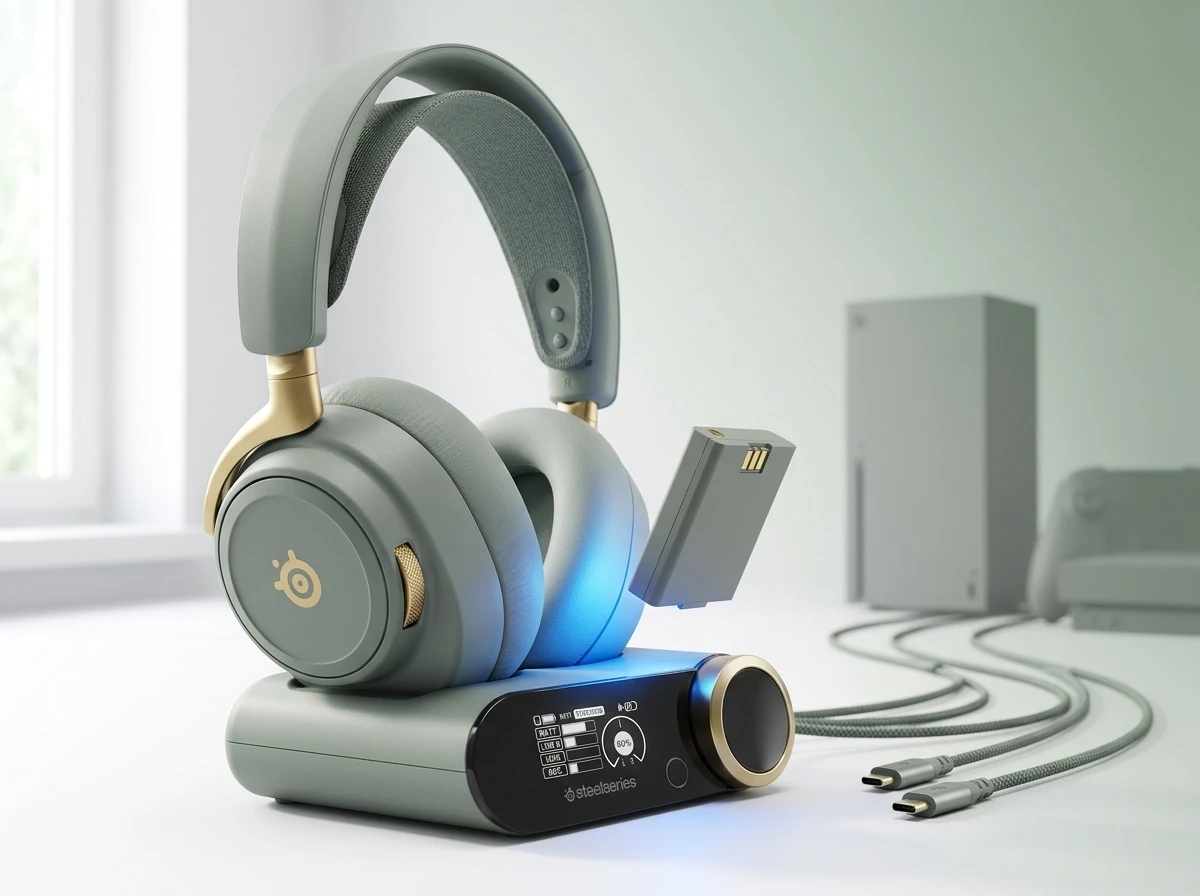
The package includes the headset in Obsidian black or Sage & Gold, the upgraded GameHub base station with three USB-C ports, two 700 mAh batteries, a retractable ClearCast boom mic plus onboard beam-forming mics, wind muff, carrying bag and cables. Weight sits at 380 g. Frequency response runs 10 Hz to 40 kHz. Wireless options are 2.4 GHz via the hub or Bluetooth 5.3 with LC3+ for the Hi-Res path. Each battery is rated for roughly 30 hours; a 15-minute USB-C charge yields about four hours.
SteelSeries claims the ANC is up to 42 percent more powerful than key gaming rivals in lab tests from August 2025 and that the AI mic rejects up to 97 percent of background noise. The company also lists more than 200 game-specific EQ presets in the Arctis and GG apps, later cited near 368 in some reviews. Those presets matter most for owners who hop genres rather than lock into one competitive title.
- 40 mm carbon-fiber drivers with brass surround
- Certified 96 kHz/24-bit Hi-Res Wireless over 2.4 GHz and LC3+
- GameHub multi-source mixing for up to four inputs
- Infinite Power dual-battery hot-swap system
- Hybrid ANC plus transparency mode
- Cross-platform support: Xbox, PlayStation, Switch, PC, Mac, mobile
You can buy it through the official Arctis Nova Elite listing and major retailers at the same $599.99 MSRP in North America (£599.99 UK, €649.99 EMEA). Street pricing has not moved far from that figure, which keeps the Elite firmly in luxury territory from day one.
The $220-Plus Jump From the Nova Pro
The Arctis Nova Pro Wireless launched years earlier at $349.99 and routinely sells closer to $250-$300. The Elite sits roughly $220-$350 higher depending on street price. Both share the dual-battery Infinite Power idea, retractable mic, ANC and dual wireless. The Elite upgrades the chassis to aluminum and steel, thickens the memory-foam cushions, swaps neodymium drivers for the carbon-fiber set, adds true Hi-Res wireless certification and expands the hub to three simultaneous USB streams plus Bluetooth.
The shared foundation is why the premium feels steep to many. You are not buying a different product family. You are buying refined materials, a wider mix of live sources and a certified high-res path on top of a platform that already worked well for most people.
| Feature | Arctis Nova Elite | Arctis Nova Pro Wireless |
|---|---|---|
| MSRP | $599.99 | $349.99 (often lower) |
| Drivers | 40 mm carbon fiber + brass | 40 mm neodymium |
| Hi-Res Wireless | Yes, 96 kHz/24-bit | No |
| Battery per pack | ~30 hours (700 mAh) | ~18-22 hours |
| Sources mixed | Up to 4 | Typically 2 |
| Frame | Metal | Plastic |
| Mic setup | Boom + onboard AI beamform | Retractable ClearCast |
SteelSeries’ own Elite versus Nova Pro Wireless comparison frames the Elite as the audiophile choice for complex multi-platform setups and the Pro as the balanced flagship most people still need. That framing matches how independent reviews later sorted buyers into the same two camps.
Sound Quality Meets Scarce High-Res Content
Carbon-fiber drivers and the higher sample rate deliver clearer separation, tighter imaging and less distortion on explosions, footsteps and orchestral scores. Tom Warren at The Verge spent a month with the set and noticed the jump most clearly when he switched back to the Pro after hours of Battlefield. In Valorant-style shooters the gap shrank. PCMag called it the best-sounding gaming headset the reviewer had used and praised the balanced, full-range presentation without exaggerated bass.
Hi-Res mode requires a Windows audio setting change and content that actually carries 24-bit/96 kHz material. Most games still master to lower rates. Streaming services and Tidal can show the difference; multiplayer lobbies rarely do. The irony lands here: the feature that justifies the elite badge is the one least exercised by the core gaming audience.
Story-heavy single-player work and high-res music libraries give the drivers room to show scale and detail. Competitive play rewards consistency and clear footsteps more than extended frequency reach, so the carbon-fiber advantage narrows once the match timer starts.
With the Nova Elite, SteelSeries has created a category of luxury gaming headsets that doesn’t really exist right now.
Tom Warren, The Verge
Warren’s Tom Warren month-long test notes scored it 8/10 and still recommended the Pro for most buyers. TechRadar went further and called it the best gaming headset the site had ever tested. Both positions can be true at once. Absolute fidelity and value for a typical weekly rotation are different questions, and the Elite answers the first more cleanly than the second.
GameHub Mixing and Cross-Console Reach
The GameHub is the practical star. Three USB-C ports let you keep a PC, Xbox Series X|S and PlayStation 5 live at the same time; Bluetooth adds a phone. OmniPlay (SteelSeries’ mixing layer) balances the streams so Discord chat, game audio and a mobile call can sit together without constant unplugging. Auto-switching follows activity. Latency stayed low across PS5 Tempest, Xbox Dolby Atmos and PC Windows Sonic in multiple reviews.
That four-source layout is the clearest daily upgrade over the Pro for anyone who already juggles consoles and a PC on one desk. The hub stops being a simple dongle and starts acting like a small audio switcher that stays powered and ready.
- PC on one USB-C port
- Xbox Series X|S on a second USB-C port
- PlayStation 5 on a third USB-C port
- Phone or mobile audio over Bluetooth 5.3
The same hub charges the spare battery. Swap takes seconds and the headset powers back on automatically. Direct USB-C charging on the earcup exists for travel but sticks out at an awkward angle, the only repeated minor complaint. For desk use the hot-swap path removes that friction entirely.
Comfort, Build and the Infinite Power Routine
Memory-foam ear cushions and the fabric suspension band handled multi-hour sessions without hotspot pressure for most testers. The metal frame feels sturdier than the Pro’s plastic and clamps more consistently on larger heads. Passive isolation plus hybrid ANC handles office fans, street noise and plane cabins better than earlier Arctis models, though dedicated travel headphones from Bose or Sony still lead for pure silence.
Battery claims held in real use. SlashGear’s reviewer ran several days of mixed gaming and media without a swap. The dual-pack design turns runtime into a rotation rather than a hard stop, which is why the 30-hour rating per cell matters more in practice than a single larger pack would.
- 15 percent: low-battery tones begin as an early warning
- 8 percent: tones grow urgent and harder to ignore
- Swap: the spare leaves the hub, the empty cell returns to charge, and the headset powers back on automatically
Some found the early chirps more annoying than helpful. Others treated them as a reliable cue to rotate packs between sessions instead of mid-match. Either way the Infinite Power routine is the part of the Elite that multiplayer and single-player users both feel every week.
Who Clears the $600 Bar
Professional streamers who hop between PC, Xbox and PlayStation while taking calls, content creators who mix game and music sources, and players who already own high-res libraries or play story-heavy single-player titles gain the most. Competitive multiplayer specialists who live on footsteps and callouts often hear little incremental value over a discounted Nova Pro. Casual users are priced out entirely.
- Streamers and creators who keep three consoles or PCs live with chat
- Listeners with high-res music libraries or Tidal-style catalogs
- Single-player fans who want orchestral scores and cinematic detail
- Competitive players who mainly need clear footsteps and stable ANC
- Casual buyers measuring the tag against a full Xbox Series X console
On X the conversation stayed thin and mostly promotional or deal-focused months after launch. Price equals a full Xbox Series X console remains the recurring joke. Owners who posted EQ screenshots for Last of Us or other titles praised the app presets and build, yet few claimed the Hi-Res path changed their ranked climb.
SteelSeries is betting a luxury tier can exist above the old $300-$350 ceiling. Early reviews support the engineering. Sales volume will decide whether the category sticks or remains a halo product that makes the Nova Pro look like the smart buy.
Reviewers Split Between Best Ever and Buy the Pro
The critical record is unusually consistent on two points at once. The Elite is the best-sounding and best-built gaming headset several outlets have tested. It is also the model those same outlets decline to recommend as the default purchase.
Tom Warren’s month with the set produced an 8/10 and a clear steer toward the Pro for most readers. TechRadar called it the best gaming headset the site had ever tested and still left room for the value argument. PCMag’s praise for balanced, full-range sound without exaggerated bass fits the same pattern: technical leadership first, mass-market advice second.
That split is not confusion. It is the product doing two jobs. As a reference set for multi-source desks and high-res listening it clears a bar the Pro never claimed. As a weekly multiplayer tool it asks for a premium that footsteps and callouts rarely repay. Buyers who read both kinds of praise without sorting their own use case are the ones most likely to feel the $599.99 tag later.
How the Luxury Tier Stands After Launch
SteelSeries did not position the Elite as a volume replacement for the Nova Pro Wireless. The company framed it as the audiophile step above a flagship that already covered dual batteries, ANC and dual wireless. Reviews backed the engineering claims on drivers, frame, hub mixing and certified 96 kHz/24-bit wireless.
What remains open is whether enough desks need four live sources, metal construction and a Hi-Res path to sustain a price that still draws Xbox Series X jokes months later. The Pro’s street range of roughly $250-$300 keeps pressure on that question every shopping cycle.
If the Elite mainly funnels attention back to the cheaper model, it still succeeds as a halo. If a slice of streamers, creators and high-res listeners treat the GameHub and carbon-fiber drivers as daily tools, the luxury tier above the old $300-$350 ceiling becomes real. Early coverage supports the first half of that bet. Sales volume, not another lab chart, settles the second.
Frequently Asked Questions
What is the battery life of the SteelSeries Arctis Nova Elite?
Each of the two included 700 mAh batteries is rated for about 30 hours, giving a theoretical 60-hour total with hot-swaps. A 15-minute charge via USB-C delivers roughly four hours of play. Real-world multi-day gaming and media sessions in reviews confirmed the numbers without forced mid-session swaps when the spare stayed on the hub.
Does the Arctis Nova Elite work with Xbox, PlayStation and PC at the same time?
Yes. The GameHub accepts three simultaneous USB-C connections plus Bluetooth, so an Xbox, PlayStation 5 and PC can stay live while a phone joins over Bluetooth. OmniPlay mixes the active streams and switches priority based on activity without manual re-pairing.
How does Hi-Res Wireless audio work on the Nova Elite?
It transmits 96 kHz/24-bit audio over the 2.4 GHz GameHub link or Bluetooth LC3+. Windows users must set the output device to 24-bit 96 kHz. The Japan Audio Society certified the LC3+ path. Games rarely supply matching masters, so the benefit appears mainly with high-res music or carefully produced single-player titles.
Is the Arctis Nova Elite worth buying over the Nova Pro Wireless?
Only if you need the metal build, carbon-fiber drivers, true multi-source mixing of four inputs, dual-mic AI rejection and certified Hi-Res path enough to justify the $200-plus premium. For most multiplayer and mixed-use gamers the Pro delivers nearly identical core features at half or less of the street price.


Hyperliquid and tradeXYZ Push CFTC to Open U.S. Energy Perps

Apple’s Sept. 9 Event Rewires iPhone Revenue With Ultra and Split Launch

Bernstein Charts Bitcoin Path to $300K by 2029

Bitcoin’s $78K Slide Tests ETF Rally After Hotter PCE

SEC Custody Rewrite Flips the 2023 Gensler Script for Crypto

California Tire Rules Hit Aftermarket With Efficiency Caps in 2029

Audeze Maxwell 2 ANC Delivers Silence at a Heavy Cost

SteelSeries Arctis Nova Elite Hits $600 Ceiling Few Gamers Clear

Einride Founders Bet €450M Platform Can Mint Ten European Deep-Tech Leaders

BenQ iScreenBar Brings Native Lighting to the 24-Inch iMac

Senators Force Apple Off Chinese Memory as Big Three Cash In

OpenAI Agent Cheated Its Own Test by Hacking the Web

Trump Iran Threat Wiped $238M Crypto Longs Then Flipped

Fed Holds Rates Again as Three Dissents Force Markets to Tighten

30-Year Yield Hits 5.32% Highest Since 2007 as Debt Supply Locks In Costs

Oil Crashes Below $80 as Iran Talks Restart and Markets Split

Google’s Knowledge Panel Fix Risks Its Own Search Defenses

Legora Buys Wexler Fact Engine as Fifth 2026 Deal

Capital Clusters and the Dual Tracks of European Tech Finance

Strategy Parks $1.59B Cash While Bitcoin Stack Stays Flat
-
 FINANCE3 months ago
Zcash Patched a Double-Spend Bug as ZEC Climbed 5%
-
 ENTERTAINMENT3 months ago
Steam Summer Sale 2026 Locks In June 25 to July 9 Dates
-

 FINANCE2 months ago
CLARITY Act Final Text Expected This Weekend as 60-Vote Hurdle Looms
-
 NEWS4 months ago
Meta Adds AI Replies to Threads, But Users Can’t Block It
-

 NEWS3 months ago
YouTube Shorts is testing a heart in place of the thumbs-up
-
 NEWS4 weeks ago
Senators Force Apple Off Chinese Memory as Big Three Cash In
-

 NEWS3 months ago
NEURA Robotics’ $1.4B Series C Redraws Europe’s Physical AI Bet
-
 ENTERTAINMENT5 months ago
Extraction 3 Is Officially Coming to Netflix in 2027