
NEWS
Apple’s Foldable iPhone Ultra Faces Indefinite Delay

Apple’s most anticipated phone in years may not make it to store shelves this September. A fresh supply chain leak from a well-known Chinese tech insider claims the iPhone Ultra’s hinge mechanism is failing quality control tests. Apple refuses to ship a broken product at any price, and with a new CEO stepping into the spotlight the same month, the stakes could not be any higher.
What the Supply Chain Leak Actually Reveals
The warning came through Weibo, the Chinese social network where some of the most reliable Apple supply chain leaks have surfaced over the years. Tech tipster Instant Digital posted that trial production for the foldable iPhone Ultra has stalled due to durability concerns. The issue is not the display. It is the hinge. The mechanical hinge is currently failing to meet Apple’s stringent quality standards after high-frequency folding tests. While the screen holds up, the physical wear and tear on the internal moving parts are deemed unacceptable for a retail device. Apple is reportedly hunting for what the leaker described as a “perfect solution.” Until that solution arrives, the launch could be pushed back with no set date in sight. If these mechanical issues persist, a slip into 2027 is likely as Apple refuses to compromise. **That single word, “indefinitely,” is what has the entire tech world holding its breath right now.**
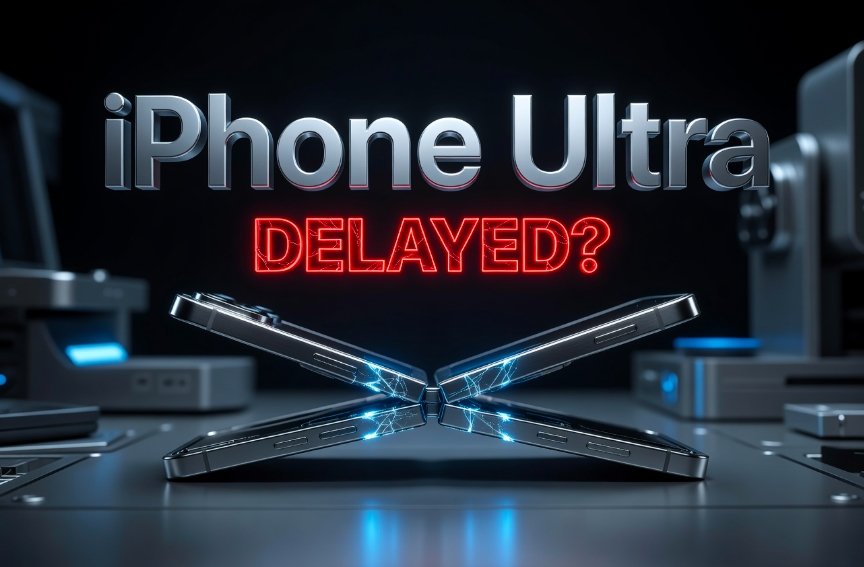
Apple iPhone Ultra foldable hinge reliability delay 2026
The Hinge Problem Runs Deeper Than Expected
The trouble traces back to a manufacturing decision Apple made to keep production costs in check. The mechanical issue reportedly stems from a revised manufacturing method Apple adopted for the folding mechanism. To manage production costs and keep the retail price below initial projection figures, Apple utilized a 3D-printed hinge design. This specific technique relies on integrated filler material to smooth over minor surface dents and structural irregularities during the fabrication process. The problem only shows up under repeated use. Under the stress of repeated use, the internal alignment of the components appears to degrade. The tolerance misalignment leads to the rattling sound, which raises serious durability concerns inside Apple’s product development pipeline. Here is what the latest supply chain reports reveal about the hinge situation:
- The hinge fails after high-frequency repeated folding tests
- A 3D-printed manufacturing method using filler material is linked to the flaw
- Internal component alignment degrades over time, causing an audible rattling noise
- Apple is weighing liquid metal against 3D-printed titanium alloy as a possible fix
- The device is currently stuck in the production verification phase, step four of six before mass production
The issue has drawn attention across the tech industry because Apple is known for extremely tight hardware tolerances. Even minor inconsistencies in movement or sound are typically treated as critical engineering flaws inside the company’s product development pipeline. A rattling hinge on a phone that costs close to $2,000 is not just a product problem. It is a brand problem.
Apple Actually Cracked the Display Crease
Not everything is going wrong. While the hinge remains the main roadblock, Apple has reportedly scored a major win on the display front. According to the leak, Apple has actually made significant progress in one of the industry’s toughest areas, the display crease. Internal testing results reportedly show a screen that maintains a “visually creaseless” look with long-term use. Other foldable phones do tend to have visible screen creases, although they have gotten smaller in recent years, and this was long believed to be unacceptable to Apple, which is perhaps why a foldable iPhone has taken so long. Getting this right is genuinely impressive. **The inner display is expected to measure 7.8 inches when unfolded, offering an experience closer to an iPad mini than a standard smartphone.** In March 2026, reports suggested that Samsung Display, Apple’s primary screen supplier, had developed a near-creaseless OLED panel, showcased at CES 2026 specifically to meet Apple’s standards. Advances in optically clear adhesive technology are also believed to be a key factor in achieving that result. Here is a quick look at what the iPhone Ultra is expected to offer, based on supply chain reporting and analyst forecasts:
| Feature | Expected Details |
|---|---|
| Inner Display | 7.8 inches, near-creaseless OLED |
| Outer Display | 5.5 inches |
| Chip | A20 Pro, 2nm process |
| RAM | 12GB LPDDR5 |
| Battery | 5,400 to 5,800 mAh |
| Biometrics | Touch ID in power button, no Face ID |
| Starting Price | Around $1,999 |
| Launch Target | September 2026 alongside iPhone 18 Pro |
New CEO John Ternus Has Everything Riding on This
The timing of this delay risk could not be more complicated from a leadership standpoint. Ternus, Apple’s current Senior Vice President of Hardware Engineering, will officially take over from Tim Cook on September 1, 2026. Apple’s new CEO, John Ternus, officially takes the helm on September 1. Less than two weeks later, he is set to unveil what is expected to be the company’s biggest new product in a decade: the first foldable iPhone. This launch is not just about a product. It is about first impressions. According to Bloomberg News’ Mark Gurman, Apple deliberately planned the leadership transition so that its new chief executive would be the one onstage introducing the device, positioning Ternus as the public face of what the company believes will launch a major new product category. Ternus, who previously headed Apple’s hardware engineering division, is being positioned to showcase the foldable iPhone as a culmination of his career at Apple, particularly due to his role in developing the original iPad. **Walking onto that stage to announce a delay, rather than a revolutionary new device, would be a rough start by any measure.** If the foldable iPhone flops, whether from high pricing, durability concerns, or simply arriving too late, it sets a negative tone for his entire tenure. First impressions matter, and September 2026 will make or break Ternus’s credibility.
September or 2027? What Comes Next for Apple
Apple now has two roads ahead, and both come with serious consequences. If Apple solves the hardware challenges on time, the first foldable iPhone should be announced alongside the iPhone 18 Pro series in September, powered by the 2nm A20 Pro chip and Apple Intelligence. Bloomberg’s Mark Gurman has said the device remains on track for that September window, though he acknowledged the timing is not final. Apple had targeted production of 7 to 8 million foldable units, which would represent less than 10% of its total planned iPhone production for 2026. Supply will be tight regardless of when it ships. If the hinge problem is not resolved, the picture changes significantly. Rather than jeopardize its reputation by introducing a structurally compromised first-generation flagship, Apple is anticipated to push the commercial rollout from late 2026 to 2027. This delay would mark a substantial setback for the technology titan, which is under increasing market pressure to compete in the evolving foldable phone landscape. **Samsung is already preparing its counter-move. The company is reportedly developing a Galaxy Z Fold 8 Wide with a similar 4:3 aspect ratio, timed specifically to compete with Apple’s expected fall launch.** Adding a hinge to an iPhone introduces significant engineering challenges that Apple has spent years trying to resolve. While competitors have released multiple generations of foldables, Apple’s slower entry to the market is widely attributed to its focus on refining the hinge and delivering a more seamless user experience. Coming in this late only raises the expectation bar even higher. There have been strong and reliable rumors of a foldable iPhone being just two years away, dating as far back as 2018, at least. Back then, reliable reports said Apple was going to have a folding iPhone on the market in 2020. That became 2021, 2022, 2024, 2025, and now it is expected to land in 2026. Another delay would extend one of the longest-running waiting games in tech history. Apple has always bet on patience over rushing. The company sat out the early foldable race for years while Samsung fumbled through dust-clogged hinges and fragile displays. The world expected Apple to walk in and get it perfect on the first try. Right now, a small mechanical component stands between that expectation and reality. Whether Apple’s engineers can solve it in the next few weeks will determine not just the fate of one phone, but the opening chapter of a new era for the company. For the millions of Apple fans who have been waiting years for this moment, the next few weeks matter more than any product launch in recent memory. What do you think? Will Apple crack the hinge problem in time for September, or is 2027 the more realistic outcome? Share your thoughts in the comments below.


Dolly Parton’s $450 Million Fortune Keeps Working After Her Death

SpaceX’s $60B Cursor Buy Immediately Costs It OpenAI Models

Rays Forever Home Wins County Vote as College and Taxpayers Carry the Load

Apple TV Hits $14.99 as Sports and Hits Bill Comes Due

Swift Telescopes Restart as Orbit Drop Accelerates

Oracle’s 2.8 GW Bloom Deal Exposes the AI Power Bypass

Galaxy S26 Beta 7 Ports Fold 8 AI as Stable Nears

Walmart Pays $50 Million to Close Federal Opioid Pharmacy Case

Space Mirror Demo Revives 1993 Russian Night-Light Test

Measles Death Dispute Deepens Distrust in Pennsylvania Outbreak

Trump Iran Threat Wiped $238M Crypto Longs Then Flipped

30-Year Yield Hits 5.32% Highest Since 2007 as Debt Supply Locks In Costs

Oil Crashes Below $80 as Iran Talks Restart and Markets Split

Strategy Parks $1.59B Cash While Bitcoin Stack Stays Flat

Astute’s $1.2M bet makes B2B creator deals feed AI discovery

SpaceX Stock Rebound Tests Real Demand Before Huge Unlock

BlackRock Turns Cash Empire Into Stablecoin Reserve Rails

The 20% Savings Ideal Meets a 2.7% Reality Check

Amber’s €7M locks Mittelstand knowledge inside Europe

Walter’s TWG Insists No Fraud as Insurer Probes Force Cleanup
-
 FINANCE3 months ago
Zcash Patched a Double-Spend Bug as ZEC Climbed 5%
-
 ENTERTAINMENT3 months ago
Steam Summer Sale 2026 Locks In June 25 to July 9 Dates
-

 FINANCE2 months ago
CLARITY Act Final Text Expected This Weekend as 60-Vote Hurdle Looms
-
 NEWS4 months ago
Meta Adds AI Replies to Threads, But Users Can’t Block It
-

 NEWS3 months ago
YouTube Shorts is testing a heart in place of the thumbs-up
-

 NEWS1 month ago
Senators Force Apple Off Chinese Memory as Big Three Cash In
-

 NEWS3 months ago
NEURA Robotics’ $1.4B Series C Redraws Europe’s Physical AI Bet
-
 ENTERTAINMENT5 months ago
Extraction 3 Is Officially Coming to Netflix in 2027