
NEWS
Valve’s Steam Machine Launch Signals Point to Weeks, Not Months
Valve’s Steam Machine welcome tour appeared in 12+ languages on GitHub. The same pattern preceded the Steam Controller by 25 days. But the RAM crisis means price uncertainty.

Valve’s Steam Machine has shown its clearest launch signal yet. A “Welcome to Steam Machine” onboarding guide turned up in Steam’s backend on May 29, spotted by hardware analyst Brad Lynch, and by June 4 community researchers had confirmed the same guide localized into more than a dozen languages on GitHub. Valve hasn’t announced a price or a release date for the living room PC, but multilingual onboarding files at this stage of a product cycle typically arrive weeks before a retail announcement.
That read draws on Valve’s own recent record. The Steam Controller, one of three products Valve unveiled in November 2025, followed the same pre-launch sequence: backend welcome tour, multilingual expansion, retail announcement, hardware shipped. It’s the only one of those three that has actually reached buyers. The Steam Machine’s tour surfaced May 29, and the community is doing the same arithmetic.
The 25-Day Countdown That Preceded the Controller
Hardware analyst Brad Lynch was also the person who flagged the Steam Controller’s equivalent welcome tour when Valve added it to the backend on April 2. Pricing and availability were announced exactly 25 days later. The controller launched on May 4 at $99 in the US and €99 in Europe, confirming that Valve could still ship consumer hardware on a compressed timeline even as the component shortages delaying the Machine continued to worsen.
The pattern the Steam Machine community is now mapping against:
| Signal | Steam Controller | Steam Machine |
|---|---|---|
| Backend welcome tour added | April 2, 2026 | May 29, 2026 |
| Multilingual localization confirmed | Sequential rollout | June 2, 2026 (GitHub) |
| Days to pricing announcement | 25 days | Pending |
| Retail launch | May 4, 2026 ($99 US / €99 EU) | Pending |
Community researchers tracked the multilingual addition in the r/steammachine thread on the multilingual Welcome Tour additions, flagging it as the stronger signal the English-only backend entry didn’t carry on its own. The tour now appears in German, Spanish, Portuguese, French, Italian, Dutch, Polish, Turkish, Russian, Hungarian, Chinese, and Swedish, among others. For the Steam Controller, English came first with other languages following progressively. The Machine’s tour appears to have gone wide all at once.
This is Valve’s second attempt at a Steam Machine. The first, in 2015, collapsed under loose OEM hardware specifications and Linux’s thin game library at the time. Every manufacturer shipped a different box with different internals, leaving buyers no consistent experience and developers no consistent target. This version is built entirely in-house, hardware and software together, running the same SteamOS that has since proved itself on millions of Steam Decks. Valve is betting the platform problem is solved.
What the Welcome Tour Reveals
The tour itself is sparse, but its structure carries meaning. Lynch shared a screenshot of minified JavaScript code showing Valve has built two versions: one designed for first-time hardware setup, and a second that returning users can manually relaunch. That dual architecture is a consumer-hardware decision. Internal test builds don’t typically ship with a re-accessible onboarding tutorial.
The content of the first-time setup version specifically mentions the Steam Machine’s microSD card slot, with step-by-step instructions for inserting, ejecting, and formatting supported cards. The slot’s presence in the shipping unit had not been explicitly confirmed by Valve before the tour appeared, resolving one open question from the original November announcement.
AllKeyShop’s analysis of Steam database entries reports four distinct launch configurations. Valve confirmed during its November 2025 hardware reveal that it would offer the Steam Controller bundled with the Machine at launch while keeping both products available separately. The database structure lines up with that plan:
- 512GB standalone Steam Machine
- 2TB standalone Steam Machine
- 512GB Steam Machine bundled with Steam Controller
- 2TB Steam Machine bundled with Steam Controller
An earlier signal appeared weeks before the welcome tour discovery. A Steam Machine reference surfaced in the Vulkan Conformance Database, the Khronos Group registry that GPU vendors and system manufacturers must enter to certify graphics API compliance. That certification step happens after hardware has passed early development and is approaching production-ready status, and its appearance set off the first wave of launch speculation in the community.
Memory Costs and the Missing Price Tag
There’s still no announced price, and the reason is legible in every Valve hardware announcement since late 2025. On May 27, Valve raised Steam Deck OLED prices by $300 on the 1TB model, from $649 to $949, a 46% jump. The 512GB model went from $549 to $789. Per Valve’s official Steam Deck OLED price update, the hardware itself was unchanged. Components had simply become that much more expensive to source. The AI memory crunch behind Valve’s Steam Deck price hike covers those supply dynamics in full.
The Steam Machine uses newer, desktop-class DDR5 memory alongside GDDR6 video memory. DDR5 has roughly quadrupled in price since Valve announced the Machine in November 2025, with industry analysts attributing the shortage to AI hyperscalers absorbing the supply consumer hardware manufacturers would otherwise access. Framework Desktop, the modular PC maker, raised its base desktop configuration from $1,099 to $1,139 in January and saw its 128GB RAM configuration climb to $2,459 over the same period. That’s a non-gaming product showing how quickly desktop RAM costs have shifted even for workstation-class machines.
Valve addressed the Machine’s situation directly in its update FAQ:
The limited availability and growing prices of these critical components mean we must revisit our exact shipping schedule and pricing, especially around Steam Machine and Steam Frame.
Valve designer Pierre-Loup Griffais told The Verge that the Machine’s price would be “comparable to a PC with similar specs” and “very competitive with what you could build yourself from parts.” In a market where pre-built gaming PCs with comparable specifications run $900 to $1,200, that framing no longer points to budget hardware. Lawrence Yang, a Valve hardware developer, told PC Gamer the team was doing their “best” to reach a competitive price amid “RAM shortages, memory shortages, price hikes.” Trusted Reviews cites a leaked listing placing the base model at roughly $950 for the 512GB version and $1,070 for the 2TB. Valve has not confirmed either number.
Inside the Steam Machine’s Build
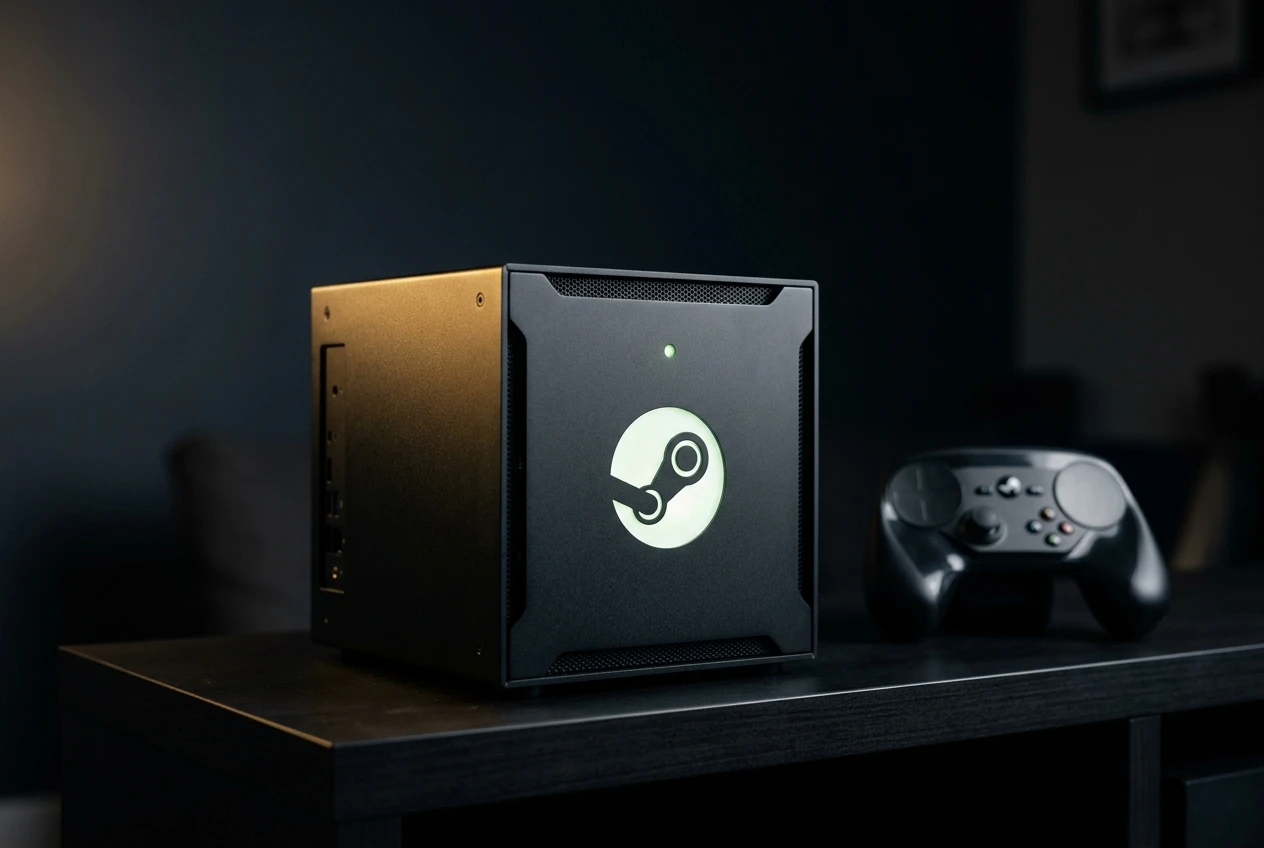
What you’d be buying is a compact cube-shaped Linux PC, roughly 6 inches on each side, running desktop-class AMD silicon. The CPU is a semi-custom AMD Zen 4 chip with six cores, twelve threads, and a boost clock of 4.8GHz, running at a low 30W TDP that keeps thermals manageable in the small chassis. The GPU is a semi-custom AMD RDNA 3 unit with 28 compute units, a 2.45GHz boost clock, and 8GB of GDDR6 video memory, with a 110W TDP. Valve says the combination delivers more than six times the performance of the Steam Deck, targeting 4K gaming at 60fps with AMD FSR (FidelityFX Super Resolution) upscaling handling the heavy lifting at higher resolutions.
The operating system is SteamOS 3, built on Arch Linux with KDE Plasma as the desktop environment. Windows games run via Proton, the compatibility layer Valve and CodeWeavers developed that translates Windows API calls into Linux equivalents. On Steam Deck it has worked well enough that most owners rarely notice the absence of Windows. The confirmed hardware specification list from Valve’s announcement and subsequent database analysis:
- Semi-custom AMD Zen 4 CPU, 6 cores / 12 threads, up to 4.8GHz, 30W TDP
- Semi-custom AMD RDNA 3 GPU, 28 CUs, 8GB GDDR6, up to 2.45GHz, 110W TDP
- 16GB DDR5 SODIMM RAM (Valve has indicated upgradability)
- 512GB and 2TB NVMe SSD options, with user-accessible storage replacement
- MicroSD card slot for expanded storage
- Wi-Fi 6E, Bluetooth 5.3, Gigabit Ethernet
- DisplayPort 1.4 for 4K at high refresh rates; HDMI 2.0 for standard 4K/60Hz
- Dedicated 2.4GHz wireless receiver for up to four Steam Controllers simultaneously
The display output situation is worth flagging for anyone planning a TV setup. The Machine includes HDMI 2.0, not HDMI 2.1, so maximum HDMI output is 4K at 60Hz. Valve’s open-source driver commitment blocks compliant HDMI 2.1 implementation because the HDMI Forum doesn’t publish open documentation. The DisplayPort 1.4 port handles 4K at 120Hz and above, but most living room televisions still carry HDMI inputs only. Anyone wanting high-refresh 4K on a TV will need a model with DisplayPort, or to run the Machine to a monitor.
The Announcement Valve Still Hasn’t Made
If the Steam Controller’s 25-day gap repeats from the May 29 backend discovery, the window for a pricing and availability announcement falls around June 23. Summer Game Fest, which opens June 5, has circulated in speculation as a potential venue. Lawrence Yang told PC Gamer that the team was doing their best on pricing, and Valve said in its February statement that it still planned to ship all three products in 2026. The company has historically preferred its own storefront for hardware reveals over third-party showcases, but the timing puts June 5 inside the outer range of the pattern.
The Steam Summer Sale runs June 25 to July 9, per Valve’s own published 2026 sales calendar, a window that aligns with the pattern-derived announcement timeline. A hardware launch sitting alongside the biggest software sale of the year would give the storefront peak traffic heading into new-product momentum. Valve hasn’t indicated any such coordination, but the dates stack neatly.
The Machine was originally slated for Q1 2026, then H1 2026, and is now simply “2026.” Every slip came from the same RAM shortage that just raised the Steam Deck’s price by $300 on a handheld running older components. The multilingual welcome tour, visible to anyone reading Steam’s backend, says the announcement is close. When Valve finally posts a price, that number will settle everything the GitHub data left open.


Replit Opens Its London Office Inside an AI Crowd

Straight Circle Trailer Lands Without a U.S. Date

Anemo Labs Bets £700,000 on an AI Sense of Smell

Nintendo Prices the Zelda 40th Switch 2 at $519

Copilot Capital Buys the Autopilot Already Running 90 GW

Ground A Raises €9.1 Million for a Pallet Laser

Gibney’s Musk Film Opens in Venice Without Its Subject

Torvalds Blames AI for a Full-Fat Linux 7.3-rc2

Dexter Returns Sharper, Older, and Stuck Between Killers

Meta’s Muse Agent Can Spend Before the Privacy Lock

Walter’s TWG Insists No Fraud as Insurer Probes Force Cleanup

30-Year Yield Hits 5.32% Highest Since 2007 as Debt Supply Locks In Costs

PCE Stays at 3.7% as Gas and Tariffs Outrun Coming Revisions

Evernorth S-4 Clears Path for Active XRP Treasury on Nasdaq

Astute’s $1.2M bet makes B2B creator deals feed AI discovery

Strategy Parks $1.59B Cash While Bitcoin Stack Stays Flat

Instinct Hits $2.5 Billion as AI Agent Access Sparks Trust Fights

CLARITY Act Cloture Opens a Door Ethics Still Blocks

Oracle’s 2.8 GW Bloom Deal Exposes the AI Power Bypass

Space Mirror Demo Revives 1993 Russian Night-Light Test
-
 FINANCE3 months ago
Zcash Patched a Double-Spend Bug as ZEC Climbed 5%
-
 ENTERTAINMENT3 months ago
Steam Summer Sale 2026 Locks In June 25 to July 9 Dates
-

 FINANCE2 months ago
CLARITY Act Final Text Expected This Weekend as 60-Vote Hurdle Looms
-
 NEWS4 months ago
Meta Adds AI Replies to Threads, But Users Can’t Block It
-
 ENTERTAINMENT5 months ago
Extraction 3 Is Officially Coming to Netflix in 2027
-

 NEWS3 months ago
YouTube Shorts is testing a heart in place of the thumbs-up
-

 NEWS1 month ago
Senators Force Apple Off Chinese Memory as Big Three Cash In
-

 NEWS3 months ago
NEURA Robotics’ $1.4B Series C Redraws Europe’s Physical AI Bet