
NEWS
Google AI Mode Now Runs Five Live Ad Formats Inside Gemini Answers
Google’s AI Mode embeds five live ad formats inside Gemini-generated answers, with no manual targeting. Here’s what advertisers and searchers actually see.

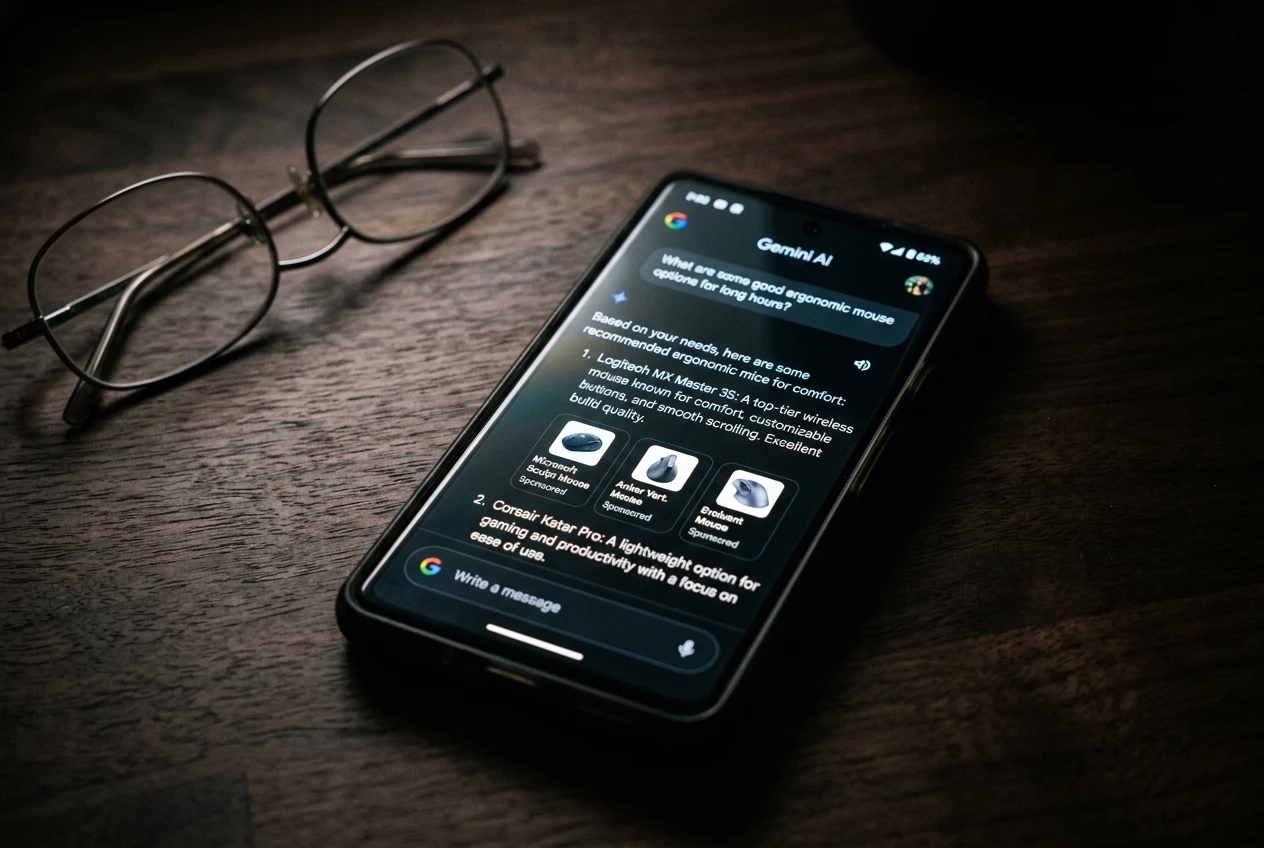
Google has quietly deployed five distinct advertising formats inside its Gemini-powered AI Mode, the conversational search experience that began ramping up in late 2025. The placements sit inside the AI-generated answer itself, not at the margins of a results page, and they range from stacked text units to sponsored rows perched above free product listings.
Searchers now see “Sponsored” labels tucked between product cards, formatted to look like the rest of the generative answer. Brands have no manual way to opt in, no segmented reporting that separates AI Mode clicks from the rest of search, and no toggle to block ads from appearing. The full inventory has been catalogued by the SerpLens catalog of five live AI Mode formats, the most detailed public accounting to date.
The Five Live Formats in AI Mode
Ads began surfacing inside AI Mode around November 19, 2025, when their presence ramped up significantly, according to SerpLens. Five distinct formats are now live in user-facing search, each differing in placement, design, and the kind of URL it serves.
| Format | Position | URL type | What it shows |
|---|---|---|---|
| Bottom Text-Based Ads (Stacked) | End of AI answer | Non-product | Descriptive titles in a shaded box |
| Bottom Shopping Carousel | End of AI answer | Product (e-commerce) | Image, title, price, site name, reviews |
| In-Line Shopping Singular | Middle of product list | Product | Sponsored label, redirects to storefront |
| In-Line Shopping (Non-Rich) | Top of AI answer | Product | Favicon, site name, price, shipping |
| Sponsored Product Grid | Top of product grid | Product | Up to 4 sponsored stores above free listings |
The bottom text-based ad is the most common of the five. It appears as a stack of links at the end of the AI Mode response, inside a shaded box that mimics the look of organic citations on desktop. The titles are written in highly descriptive language tied to the user’s query, and the format serves non-product URLs: typical websites and services rather than retail SKUs.
The bottom Shopping carousel is built for e-commerce. It also sits at the end of the answer, paired with a contextual headline, but it shows product cards or a horizontal row of products with images, prices, site names, and review snippets. SerpLens describes the unit as “far more vibrant and engaging” than the text-only formats.
The in-line Shopping singular ad is the format most likely to confuse a reader. It appears inside a list of organic-looking products in the middle of the answer, carries a “Sponsored” label, and uses a 302 redirect to send the click straight to the storefront, bypassing the standard overlay panel used for free listings. The format matches the surrounding organic content closely enough that what advertisers must accept under AI Mode formats flags it as a forced trade.
The non-rich in-line Shopping ad is the understated cousin. It shows only a favicon, site name, price, and shipping policies, often toward the top of the AI Mode output. SerpLens has observed up to two of these ads grouped inside a single shaded box to keep the layout from overpowering the answer.
The sponsored product grid ad lives above what used to be a strictly organic surface. Up to four sponsored results can appear above the free “all stores” listings in a grid, with one common pattern labeling the ad as a “sponsored store” and applying a “trending brand” tag. If a retailer ranks organically for a product and also runs a Shopping campaign, Google’s algorithm often serves that retailer’s ad as the top result.
How the Ads Blend Into the Answer
The blending is deliberate, and it follows a small set of design choices SerpLens has mapped. The moves stack on top of each other to make sponsored and organic content hard to separate at a glance.
- Placement inside the answer, not alongside it. The bottom text-based ad and the bottom Shopping carousel anchor the response. The in-line Shopping singular and the non-rich Shopping ads sit higher up, sometimes within the AI’s prose. The product grid ad sits at the top of the grid that has historically been free.
- Visual mimicry. The bottom text-based unit is wrapped in a shaded box that recalls organic citations. The in-line Shopping singular matches the formatting of the free listings above and below it. The non-rich version trims visuals to a favicon, price, and shipping line, trading graphics for restraint.
- A direct redirect. The in-line Shopping singular uses a 302 redirect with ad parameters, sending the searcher straight to the product URL. Free listings in the same grid route through the standard overlay panel where users can pick from multiple stores.
- Consistent labelling. The “Sponsored” tag shows on the in-line singular and grid formats in SerpLens’s catalogue. The bottom text-based and non-rich formats lean on design restraint instead.
These formats will also continue to be clearly labeled as “Sponsored.”
That line comes from a Google Blog post titled “A new generation of ads for the AI era of Search,” dated May 20, 2026. The post introduced Conversational Discovery ads and Highlighted Answers, two Gemini-built formats that the May 20, 2026 announcement of new AI Mode ad formats says will follow the same labelling rule when they roll out.
The Backend Reality: No Manual Targeting, No Segmented Reporting
For advertisers used to choosing keywords, audiences, and placements, AI Mode removes most of the levers.
There is no opt-in. Per SerpLens, “At this time, you can’t directly place ads within Google’s AI-related surfaces, with it being an automatic placement based on Google’s advertising models.” That covers both AI Overviews in the main search results and AI Mode. The placements pull from existing asset pools and Merchant Center feeds, with Google’s algorithms deciding when each format appears.
There is no segmented reporting. SerpLens states plainly that “there is no segmentation for ads within AI Mode for reporting purposes.” Advertisers cannot separate AI Mode clicks from standard search clicks today.
There is one escape hatch. AI Max for Search campaigns, surfaced through the AI Max for Search campaigns documentation page, gives advertisers specific reporting for “conversational queries.” The catch is that brands must opt into AI Max or Performance Max to access it; standard Search campaigns will not surface inside AI Mode by default.
The Conversational Bet Driving the Rollout
Google’s broader strategy landed on May 20, 2026, in a Google Blog post titled “A new generation of ads for the AI era of Search.” It bundles two Gemini-built formats, Conversational Discovery ads and Highlighted Answers, with a planned expansion of AI-powered Shopping ads, a Business Agent for Leads feature, and an upgrade to the Direct Offers pilot that launched in January 2026 with brands including Chewy, Gap, and L’Oreal.
Conversational Discovery ads use Gemini to build creative tailored to a specific query, paired with an independent AI explainer that synthesizes information about the product or service. Highlighted Answers insert highly relevant ads into the lists of recommendations AI Mode already produces. Both keep the “Sponsored” label Google committed to in the same post.
Google’s own framing leans on one statistic: 75% of people report making faster, more confident decisions using AI Mode in Search. The number comes from an Ipsos Global Consumer Journeys survey Google commissioned, fielded in December 2025 with 13,189 online shoppers who had made a considered consumer-good purchase in the past week.
For deals, the Direct Offers pilot is now expanding. Promotion bundling lets brands upload discounts, giveaways, and local coupons, then use AI Brief to target the right audiences. Native checkout is being added for merchants on the Universal Commerce Protocol. Travel partners including Booking and Expedia will surface special offers inside AI-assisted trip planning.
What Changes for Brands and Searchers Now
The new format inventory reshapes what a brand controls inside a Google search.
Ad Age, covering the same Google announcements, summed up the trade in one line: the formats “could force brands to surrender short-term control of messaging in order to build long-term trust with consumers who are skeptical of ads in AI environments.” The agency-side critique is that Gemini-generated explainers and ad copy arrive at the reader with no creative approval from the advertiser, while the “Sponsored” label has to do all the work of signalling what is paid.
Searchers get a more conversational answer with embedded shopping choices, but they also get a tighter fuse between organic content and sponsored content. The in-line singular format mirrors free listings, and the product grid ad sits where only organic results used to live. Google’s promise is that “Sponsored” stays visible; SerpLens notes that the five formats observed today are a running list, “and I expect this to expand further over the coming months.”
For publishers, the shift also touches the News AI pilot, where Showcase payouts now depend on granting AI training rights for the data that feeds the Gemini model behind AI Mode’s answers.
Frequently Asked Questions
When did ads first start appearing in Google AI Mode?
Ads began surfacing inside AI Mode around November 19, 2025, according to SerpLens, which uses that date as the milestone for when AI Mode ads ramped up significantly. Google formally previewed several of the formats at Google Marketing Live in May 2026.
How many ad formats does AI Mode currently show?
Five distinct formats are live as of mid-2026, per SerpLens: bottom text-based stacked ads, bottom Shopping carousel ads, in-line Shopping singular ads, in-line non-rich Shopping ads, and sponsored product grid ads. The list is updated as new formats appear in the wild.
Can advertisers target AI Mode directly?
No. Per SerpLens, placements are automatic and pull from existing Google Ads assets and Merchant Center feeds. Brands cannot directly place or block ads inside AI Mode or AI Overviews today, though Google is starting to add blocking controls inside Search Console for organic results.
Will Google provide separate reporting for AI Mode clicks?
Not yet. SerpLens reports that there is no segmentation for ads within AI Mode for reporting purposes. AI Max for Search campaigns, which Google rolled out in 2025, surfaces reporting for conversational queries, but brands must opt into AI Max or Performance Max to access it.
What is the difference between AI Max and Performance Max?
Performance Max is Google’s goal-based campaign type that runs across Search, Display, YouTube, Gmail, Discover, and Maps from a single campaign. AI Max is a newer AI-powered suite layered on top of Search campaigns, with specific reporting for conversational queries and tighter Gemini integration. Both are the routes advertisers use to surface inside AI Mode today.


NFL Preseason Week 2 Quietly Tests the Schemes That Matter

Alonso’s Towering Drive Stands Foul and Flips Orioles Momentum

US Debt Crosses $40 Trillion as Interest Crowds the Budget

Trevon Diggs Joins Seahawks on One-Year Deal After Cowboys Exit

Pixel Watch 5 Turns Passive Trends Into Early Health Alerts

Pixel 11 Pro Fold Sleek Build Undercuts Its Own Unfolding Appeal

Tugboat Wilkinson’s Scoreless Debut Pays Off Giants’ Bailey Trade

Brown Shines for Pats as Love for Eagles Meets Trade Reality

Pixel Watch 5 Turns Wrist Data Into Early Metabolic Alerts

Resistance Stars Pay the Price in Democratic Primaries

Senators Force Apple Off Chinese Memory as Big Three Cash In

OpenAI Agent Cheated Its Own Test by Hacking the Web

Trump Iran Threat Wiped $238M Crypto Longs Then Flipped

30-Year Yield Hits 5.32% Highest Since 2007 as Debt Supply Locks In Costs

Fed Holds Rates Again as Three Dissents Force Markets to Tighten

Oil Crashes Below $80 as Iran Talks Restart and Markets Split

Google’s Knowledge Panel Fix Risks Its Own Search Defenses

Agon Raises $30M to Build Europe’s AI Weapon Training Arenas

Legora Buys Wexler Fact Engine as Fifth 2026 Deal

Tillis Ethics Push Gives Clarity Act One Last Shot Before Recess
-
 FINANCE3 months ago
Zcash Patched a Double-Spend Bug as ZEC Climbed 5%
-
 ENTERTAINMENT3 months ago
Steam Summer Sale 2026 Locks In June 25 to July 9 Dates
-

 FINANCE2 months ago
CLARITY Act Final Text Expected This Weekend as 60-Vote Hurdle Looms
-
 NEWS3 months ago
Meta Adds AI Replies to Threads, But Users Can’t Block It
-

 NEWS3 months ago
YouTube Shorts is testing a heart in place of the thumbs-up
-
 NEWS3 weeks ago
Senators Force Apple Off Chinese Memory as Big Three Cash In
-

 NEWS2 months ago
NEURA Robotics’ $1.4B Series C Redraws Europe’s Physical AI Bet
-

 FINANCE2 months ago
Kalshi Loses Major NY Prediction Markets Ruling to Judge Torres