
NEWS
MacBook Air Delays Reveal AI Memory Crunch Repricing Laptops
AI data-center demand has diverted memory from consumer laptops, pushing MacBook Air deliveries into September and locking in higher prices industry-wide.

Base M5 MacBook Air configurations now carry delivery estimates stretching into late August and early September, an unusual lag for Apple’s highest-volume laptop just five months after its March refresh. Bloomberg’s Mark Gurman reported the squeeze in his Power On newsletter, citing retail sources who call current shipment levels more constrained than anything they can recall.
The root sits far from any Apple store floor. AI data-center buildouts have pulled wafer capacity toward high-bandwidth memory, leaving ordinary DRAM and NAND short for consumer machines. That second-order pressure is now rewriting laptop pricing and product mix across the industry.
The lag is not a brief launch hiccup. It arrives mid-cycle, after the usual post-refresh inventory build should already have filled channels. That timing turns a component shortage into a visible retail problem for the machine Apple counts on for volume.
Ship Dates Slide Into September for the Air
Online orders for standard and custom Air models show 2-to-6-week waits in the U.S., with higher-RAM builds pushed farthest. Specific screen-size, color and memory combinations land in early September. Physical stores face the same drought.
Gurman noted Apple delayed its usual June back-to-school promotion to manage the crunch. The machine remains Apple’s volume driver, so the visibility of empty shelves carries weight far beyond the Mac mini and Mac Studio, which felt the shortage earlier.
- Base M5 Air: deliveries into late August or early September
- Higher RAM configs: longest delays reported
- Retail assessment: tightest stock levels staff can recall
- Refresh timing: March 2026 M5 update already under pressure
Shoppers on X have posted September pickup confirmations for 24 GB units, matching the public estimates.
The pattern across channels is consistent. Configurations that once shipped in days now stretch across the full 2-to-6-week window, and the longest waits cluster on the memory-heavy builds students and professionals tend to choose. Retail staff are not describing a soft patch. They are describing the tightest Air inventory they can recall at any point in the current cycle.
- March: M5 MacBook Air refresh lands and begins the normal sell-in window
- June: price increases roll across Macs and iPads; the usual back-to-school promo is delayed
- Late August to early September: base and higher-RAM Air configs carry the longest public delivery estimates
- Fall: anticipated M6 refresh inherits the same constrained memory substrate
AI Servers Ate the Laptop Memory
Three suppliers (Samsung, SK Hynix and Micron) control roughly 95 percent of global DRAM. They have redirected cleanroom space and capital expenditure to HBM stacks for Nvidia and other AI accelerators. Every wafer allocated to HBM is one denied to LPDDR or conventional DDR used in notebooks.
IDC expects 2026 DRAM and NAND supply growth of just 16 percent and 17 percent year-on-year, below historical norms. Memory already makes up 15-20 percent of a mid-range laptop’s bill of materials; HP recently put the share near 35 percent after the spike. Counterpoint Research tracked memory and storage prices quadrupling across three recent quarters. Spot DRAM has climbed hundreds of percent over the past year in some tallies.
| Metric | Reading | Source context |
|---|---|---|
| PC market downside | 4.9% to 8.9% contraction | IDC scenarios for 2026 |
| PC ASP rise | 4% to 8% | IDC moderate to pessimistic |
| Laptop memory BOM share | 15-20% (up to ~35%) | Industry / HP disclosure |
| Memory price move | Quad in ~3 quarters | Counterpoint via reporting |
The IDC downside scenarios for the PC market also flag longer replacement cycles and pressure on the AI PC narrative that needs more on-device RAM just as supply tightens.
The mechanism is straightforward. HBM stacks consume more wafer area and more advanced packaging capacity per bit than the LPDDR used in thin laptops. When the three dominant suppliers shift cleanroom time and capital toward those stacks, the leftover output for notebook memory shrinks even if headline bit growth still posts mid-teens percentages. Notebooks then compete for a smaller pool at higher prices, and the BOM share climbs from the old 15-20 percent range toward the levels HP has already disclosed.
That is why a shortage that began in server halls now shows up as September ship dates on a consumer Air. The wafer decision was made upstream; the retail delay is the downstream receipt.
Apple Steers Buyers to the Base Pro
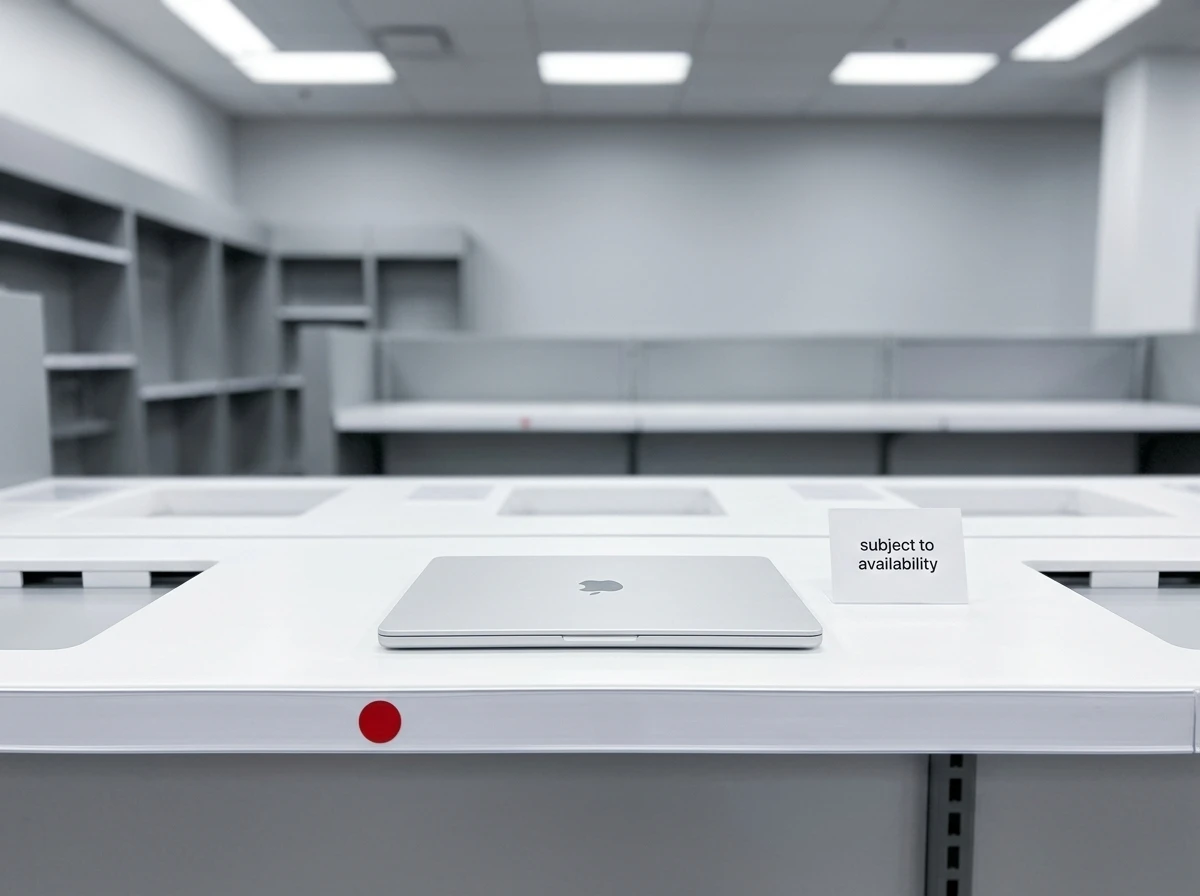
Apple’s response goes beyond waiting for more chips. Across its site and stores the company is prominently pointing shoppers to the entry-level 14-inch MacBook Pro. Marketing materials now carry a rare line: “MacBook Air is subject to availability.”
That pivot is something Apple has rarely if ever done at this scale. It frees manufacturing capacity while protecting higher-margin units. One sharp X reply called the disclaimer “Apple’s classy corporate way of saying please buy the expensive one.” Buyers are already following the nudge, with some choosing refurbished base Pros for the better screen and speakers before the June price moves locked in.
- Delayed annual back-to-school promotion from its usual June window
- Prominent website and store steering toward entry 14-inch MacBook Pro
- Explicit “subject to availability” language in materials
- Prior line of price increases across Macs and iPads
The same memory math applies to Apple’s newer budget MacBook Neo option, which itself saw a $100 entry jump earlier in the cycle.
Steering demand toward the entry Pro does two jobs at once. It keeps revenue on higher-margin hardware that is still in stock, and it reduces pressure on the Air line while wafer allocations remain tilted toward HBM. The “subject to availability” language makes the constraint public instead of leaving shoppers to discover empty shelves on their own. Refurbished base Pros become a practical bridge for buyers who want the better screen and speakers without waiting into September.
Back-to-School Shoppers Hit the Wall
August is peak laptop season for students and parents. Month-long waits collide with the start of term. Apple’s delayed promo removes one traditional discount lever just when families are comparing options.
Higher configurations that once felt like easy upgrades now carry both premium pricing and the longest waits. The result is a quieter form of rationing: buy the available Pro now, or wait and risk missing the school calendar.
Retail staff descriptions of “more constrained than they can ever recall” land hardest here. Previous Air shortages were shorter or confined to launch windows. This one arrives mid-cycle on the current M5.
Families comparing a base Air against a higher-RAM build now face a three-way tradeoff of price, ship date, and school deadlines. The delayed June promotion means the usual seasonal discount is missing from that comparison. Some households will take the entry Pro that is on the shelf. Others will stretch for a 24 GB Air and accept a September pickup. A third group will simply defer, which is how longer replacement cycles begin at the household level.
The China Memory Request and Fall M6 Bet
Apple has already lifted prices by a couple of hundred dollars across much of the lineup. The MacBook Air 512 GB model moved from $1,099 to $1,299 in the June round. Other Macs and iPads rose in lockstep. CEO Tim Cook described the component spike to the Wall Street Journal as a “hundred-year flood” unlike anything he had seen in more than 40 years.
This is a hundred-year flood. I’ve never seen anything like it in any area in over 40 years.
Cook’s assessment matches Apple’s own public statement at the time of the hikes: the industry faces an unprecedented challenge from AI data-center demand for memory and storage, and the company reached the point where price rises became necessary.
Separately, Apple has sought U.S. permission to buy memory from blacklisted Chinese suppliers such as CXMT for units sold inside China. That path remains under discussion. At the same time, prioritizing the current entry Pro helps clear lines for an anticipated M6 chip refresh expected this fall. The Air shortage is therefore both a symptom and a deliberate capacity choice.
Those supply-chain pressures sit alongside Apple’s broader chip supply moves as the company works multiple fronts at once.
The China request and the M6 prioritization are parallel hedges. One seeks incremental DRAM supply inside a single large market. The other protects the next hardware wave by keeping assembly lines fed with the chips Apple already controls. Neither erases the HBM pull on global wafers, but together they show how Apple is treating the crunch as a multi-quarter planning problem rather than a one-month stockout.
Windows Offers No Way Out
Switching brands brings no relief. The same three memory makers feed Dell, HP, Lenovo, ASUS and the rest. Vendors have already warned of 15-20 percent cost hikes and contract resets. White-box and smaller assemblers face the sharpest squeeze.
DIY upgraders and gamers who once relied on plentiful DDR modules now meet allocation and elevated spot prices. The shortage is industry-wide because the wafer decision is industry-wide. Consumer electronics simply sit lower in the priority queue than hyperscaler contracts already locked for 2026 HBM.
Secondary coverage in the same Gurman newsletter noted Apple’s Vision Products Group exploring health and fitness tracking for future smart glasses, adapting body-sensing work originally planned for Vision Pro. That long-horizon wearable bet continues even as laptop supply teams fight fires. It also puts Apple on a different path from rival smart glasses landing this fall.
- Dell, HP, Lenovo, ASUS and peers draw from the same three DRAM suppliers
- Vendors have warned of 15-20 percent cost hikes and contract resets
- White-box and smaller assemblers absorb the sharpest allocation cuts
- DIY and gamer DDR markets face the same elevated spot pricing
Brand switching only changes the logo on the chassis. It does not change the supplier concentration or the hyperscaler contracts that already claim priority HBM output through 2026. That is why the Air delay is a consumer-facing symptom of an industry queue, not an Apple-only miscalculation.
Longer Cycles Squeeze the AI PC Story
IDC’s downside cases already link the memory crunch to longer PC replacement cycles and to pressure on the AI PC pitch. Those two effects reinforce each other. AI-oriented laptops need more on-device RAM to deliver local features. The same RAM is the component in shortest supply and the fastest-rising line on the bill of materials.
When memory moves from a 15-20 percent BOM share toward the higher levels HP has flagged, vendors either raise street prices or strip configurations. Either path makes the upgrade decision harder for households and IT buyers who were already stretching refresh budgets. Longer cycles then follow: machines stay in service another year, and the installed base ages just as software vendors push features that assume more local memory.
Apple’s own mix shift illustrates the bind. Steering shoppers to the entry 14-inch Pro keeps revenue intact and avoids promising Air configs that cannot ship before term starts. It also means some buyers who wanted a light, lower-cost Air leave with a different product, or leave empty-handed. Across the wider market the same math applies. The AI PC narrative needs abundant mid-range memory at stable prices. The wafer allocation now favors HBM stacks instead.
Record Margins Keep HBM Wafers Priority
Memory makers enjoy record margins; Micron’s recent quarter showed gross margin near 85 percent after revenue more than quadrupled. That incentive structure does not reverse quickly. Capacity expansions take years, and HBM demand shows no sign of cooling.
From the supplier side the choice is rational. A wafer turned into HBM for AI accelerators returns far more profit than the same wafer turned into LPDDR for notebooks. Until new cleanroom space comes online, every incremental tool hour has a clear highest bidder. Consumer PC lines, white-box assemblers, and DIY module buyers sit further down that queue.
Apple’s price lifts, the delayed back-to-school window, and the public steer to the base Pro are all ways of managing that queue from the OEM side. None of them add wafer starts. They only reallocate finished goods and reset customer expectations while the underlying margin gap between HBM and commodity DRAM remains wide.
Prices That Will Not Snap Back
Memory makers enjoy record margins; Micron’s recent quarter showed gross margin near 85 percent after revenue more than quadrupled. That incentive structure does not reverse quickly. Capacity expansions take years, and HBM demand shows no sign of cooling.
For buyers the practical picture is simpler. Expect longer lead times on popular Air configs through the remainder of summer, continued steering toward available Pros, and list prices that hold even if spot memory eventually eases. The M6 wave later this year will inherit the same constrained substrate.
The Air delays are the most visible consumer face of a structural shift: AI infrastructure now sets the price and the availability of ordinary laptops. That is the part that outlasts any single September ship date.
Shoppers watching a single product page will see only a ship-date string and a “subject to availability” note. Behind those lines sit the three-supplier DRAM concentration, the HBM wafer pull, the mid-teens supply growth outlook, and the margin structure that keeps new capacity pointed at AI servers. Until that stack changes, September estimates and firmer laptop prices remain the baseline rather than the exception.


Howard the Duck at 40 Still Owns Marvel’s First Flop

Valve Skin Ban Hits BLAST and Forces CS2 Teams Toward Betting Cash

Oil Crashes Below $80 as Iran Talks Restart and Markets Split

Netflix Screening Erases Fortitude Exclusivity in $105M Cage Suit

Bitget BGBTC Upgrade Turns Idle Bitcoin Into Daily Yield

FFXIV Switch 2 Port Brings Portability With a Second Bill

MacBook Air Delays Reveal AI Memory Crunch Repricing Laptops

Bitcoin BIP-110 Soft Fork Dies on Tiny Miner Support

CXMT LPDDR6 Push Locks In Mobile DRAM Split

Snapchat Hands Spotlight Priority to Human Creators Over AI Farms

Kalshi Loses Major NY Prediction Markets Ruling to Judge Torres

Fed Minutes Cite AI Demand as Inflation Risk, Put a 2026 Hike Back on the Map

Marker AI Writing Startup Lands $13M Seed Led by Index Ventures

Dota 2 Esports World Cup 2026: Spirit Defends $2M Title In Paris

Meta’s Muse Spark 1.1 Beats Rivals on Price, Trails on Coding

ARC Intelligence Closes €4M Seed Round in Roughly a Week

CS2 Premier Season 5 Lands With Cache and a C4 Damage Rework

Finto Picks Munich Over Silicon Valley After YC, Raises $3.4M

Backrooms Returns to Theaters as the Everything Must Go Edition

Trump Calls Iran ‘Islamic Republic of Japan’ as Ceasefire Ends
-
 FINANCE2 months ago
Zcash Patched a Double-Spend Bug as ZEC Climbed 5%
-
 ENTERTAINMENT2 months ago
Steam Summer Sale 2026 Locks In June 25 to July 9 Dates
-

 FINANCE1 month ago
CLARITY Act Final Text Expected This Weekend as 60-Vote Hurdle Looms
-
 NEWS3 months ago
Meta Adds AI Replies to Threads, But Users Can’t Block It
-
 ENTERTAINMENT3 months ago
‘Widow’s Bay’ Review: Apple TV’s Sleeper Horror-Comedy Earns Its Fog
-
 NEWS5 months ago
U.S. Navy Deploys Solar-Powered Lightfish Drone to Patrol Oceans
-
 NEWS8 months ago
FolderFresh Review: This Free Tool Automates Windows File Organizing
-
 FINANCE4 weeks ago
Kalshi Loses Major NY Prediction Markets Ruling to Judge Torres