
NEWS
Bacterial Membrane Hybrid Cracks Centralized Peroxide Production
Purple membrane on BiOCl nanosheets yields over five times more hydrogen peroxide under ambient light while upgrading ethylene glycol.

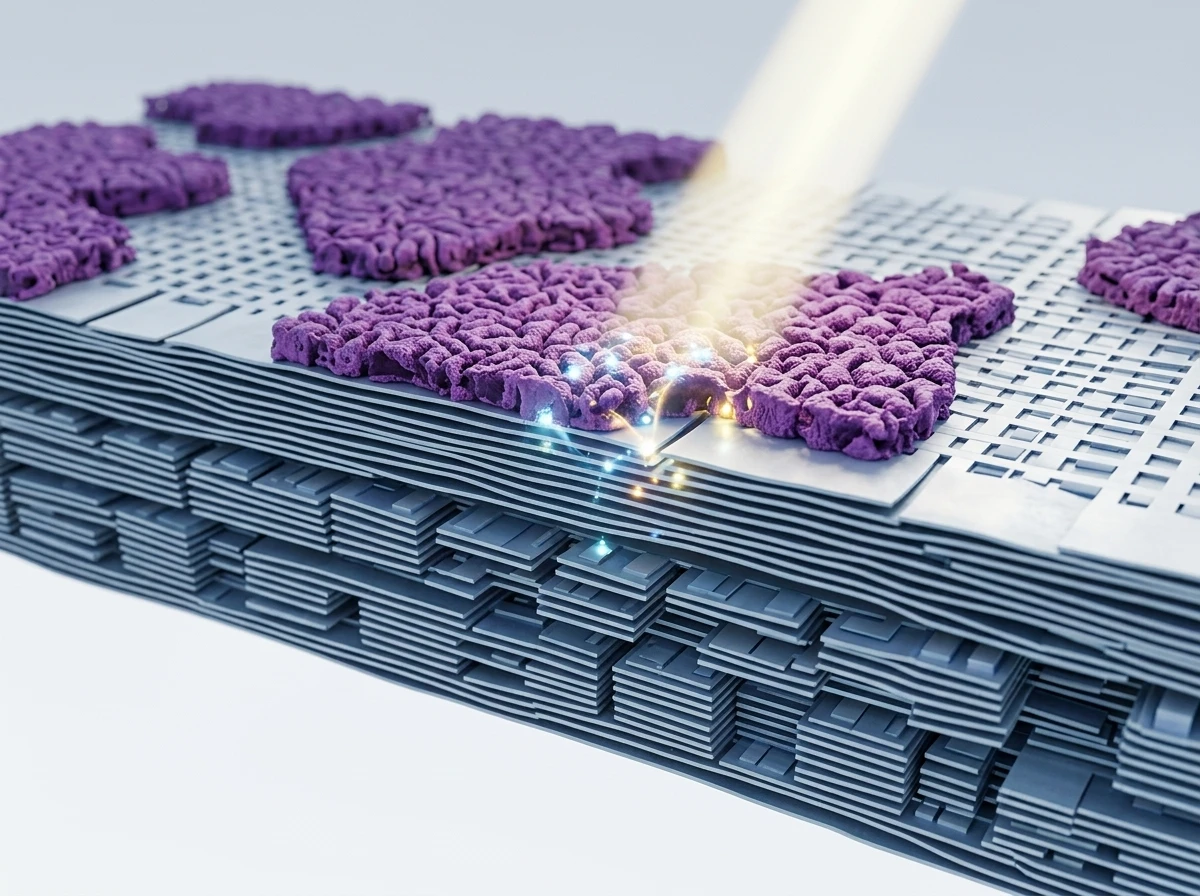
Researchers at Argonne National Laboratory have built a 200-nanometer hybrid sheet that turns sunlight, air and water into hydrogen peroxide while upgrading a cheap industrial chemical at the same time. The purple-membrane patches on bismuth oxychloride deliver more than five times the peroxide of the semiconductor alone under ordinary laboratory light.
The result, published in the Journal of the American Chemical Society and featured on its cover, sits at room temperature and atmospheric pressure. It points past the high-temperature, high-pressure anthraquinone plants that still make nearly all of the world’s supply.
Inside the 200-nanometer biohybrid sheet
The foundation is a layered bismuth oxychloride (BiOCl) nanosheet roughly 200 nm thick, about 500 times thinner than a human hair. Patches of purple membrane sit on top. That membrane comes from the salt-loving archaeon Halobacterium salinarum and is packed with bacteriorhodopsin, a light-driven proton pump discovered in the early 1970s.
When light hits the hybrid, the membrane absorbs energy and starts proton and electron transfer. At the interface those charges reshape the semiconductor’s electronic states so oxygen undergoes the two-electron reduction to hydrogen peroxide instead of competing side reactions. On the hole side, ethylene glycol is oxidized to glycolaldehyde, glyoxal and formic acid.
Elena Rozhkova, a scientist at Argonne’s Center for Nanoscale Materials, put the design principle plainly: simply combining the parts does not create the catalysis. The key is designing the interface so charge moves in the right direction and drives a chosen reaction.
Fivefold yield and a second product stream
Under identical test conditions the purple-membrane-BiOCl hybrid produced over five times more hydrogen peroxide than bare BiOCl. Absolute rates in mmol per gram per hour remain inside the full paper, but the relative jump is the headline laboratory number.
The same light-driven cycle upgrades ethylene glycol, a low-cost feedstock, into higher-value chemicals. That dual output is deliberate. One photon stream pays two chemical bills.
- Reduction side: O2 + 2e- + 2H+ → H2O2
- Oxidation side: ethylene glycol → glycolaldehyde, glyoxal, formic acid
- Conditions: ambient temperature and pressure, aqueous medium, no added high-pressure H2
- Multiplier: >5× H2O2 versus semiconductor alone
Lead author Jinhyeong Jang, an Argonne postdoctoral appointee, called nanoarchitectonics “on par with artificial intelligence and quantum information science as one of the most important technologies of the 21st century.” The work shows living-system components can be tuned for industrial chemistry.
The anthraquinone lock the hybrid aims to break
More than 95 percent of industrial hydrogen peroxide still comes from the anthraquinone process invented in the 1940s. Alkylanthraquinone is hydrogenated over palladium, then oxidized with air; the organic solvent cycle is regenerated. Hydrogen usually arrives from natural-gas steam reforming.
A SINTEF review places the European global-warming potential near 1.79 kg CO2-equivalent per kg of H2O2; coal-based hydrogen pushes it to roughly 2.5 kg. The process runs as a multistep batch operation inside large centralized plants. High-concentration peroxide is an explosion hazard in transport, so small on-site units near users have stayed rare.
Global consumption hit about 9.1 million tons in 2024 while the global market reached 5.2 billion dollars, according to IndexBox figures. Production sat near 8.3 million tons. The clean image of the finished chemical therefore sits on a carbon-heavy, logistics-constrained foundation.
| Attribute | Anthraquinone process | PM-BiOCl hybrid (lab) |
|---|---|---|
| Conditions | High T/P, Pd catalyst, organic solvent | Room temperature, atmospheric pressure, aqueous |
| Feedstocks | H2 (mostly natural-gas), anthraquinone | Sunlight, air O2, water, ethylene glycol |
| Scale today | Tens of thousands of tons per plant | Nanosheet laboratory demonstration |
| Side products | Waste streams needing treatment | Glycolaldehyde, glyoxal, formic acid |
| Direct CO2 | ~1.6-2.5 kg per kg H2O2 | Zero (solar-driven) |
The hybrid does not yet replace a commercial plant. It shows that ambient, sunlight-only synthesis with useful co-products is chemically feasible.
A decade of building bio-semiconductor interfaces
Rozhkova’s group has worked this interface for years. In 2013 they non-covalently assembled bacteriorhodopsin with TiO2 nanoparticles and generated hydrogen under visible light (Nano Letters). In 2017 they moved to cell-free synthetic bacteriorhodopsin on the same oxide (ACS Nano).
Three changes mark the new paper. The semiconductor is now two-dimensional BiOCl nanosheets with planar interface geometry. The target product shifted from hydrogen to hydrogen peroxide, where oxygen-reduction selectivity is harder. And the oxidation half-reaction was deliberately engineered to upgrade ethylene glycol instead of wasting holes.
Fabrication and electron-microscopy characterization happened at the Center for Nanoscale Materials, one of the DOE nanoscale science research centers. The team confirmed a vertical heterostructure verified by electron microscopy, plus reduced recombination through photocurrent and transient-absorption measurements.
- 2013, Bacteriorhodopsin + TiO2 nanoparticles produce hydrogen (Nano Letters).
- 2017, Cell-free synthetic bacteriorhodopsin on TiO2 (ACS Nano).
- 2026, Purple membrane patches on BiOCl nanosheets produce H2O2 + upgraded organics (JACS cover).
Nanoarchitectonics itself dates to Masakazu Aono’s 2000 proposal and the later MANA center at NIMS in Japan. The Argonne work is a concrete chemical application of that assembly philosophy.
What still has to be proven outdoors
Long-term stability of the isolated purple membrane under continuous illumination has not been reported. Bacteriorhodopsin is rugged inside living cells; hundreds or thousands of hours of dry or wet photocatalysis is another test. No industrial route yet exists to manufacture the 200 nm sheets at reactor scale or to pack them efficiently. Performance under real sunlight, with its changing intensity and spectrum, also remains unquantified.
What we know
- Hybrid gives >5× H2O2 versus BiOCl alone under controlled lab light.
- Simultaneous upgrade of ethylene glycol to three value-added products.
- Operates at ambient temperature and pressure with abundant materials.
- Interface design, not mere mixing, controls selectivity.
What’s unconfirmed
- Absolute production rates outside the paywalled paper details.
- Membrane lifetime under continuous or outdoor illumination.
- Scalable fabrication and reactor packing methods.
- Retained multiplier under fluctuating natural sunlight.
Jang noted the same nanoarchitectonic approach could reach fertilizer or fuel-component chemistry. Follow-up groups will decide how much of the laboratory advantage survives engineering.
Point-of-use peroxide becomes chemically plausible
The structural constraint that forced giant centralized plants was safety and economics of shipping concentrated peroxide. An ambient, solar-driven sheet that also makes saleable co-products changes the arithmetic for semiconductor fabs, water-treatment plants and remote disinfection needs. Whether the biology holds up long enough and whether the sheets can be made cheaply enough are now engineering questions, not fundamental ones.
The next round of experiments will measure durability, outdoor yield and first scale-up attempts. Until those numbers arrive, the hybrid remains a laboratory proof that the old lock can be picked.


NFL Preseason Week 2 Quietly Tests the Schemes That Matter

Alonso’s Towering Drive Stands Foul and Flips Orioles Momentum

US Debt Crosses $40 Trillion as Interest Crowds the Budget

Trevon Diggs Joins Seahawks on One-Year Deal After Cowboys Exit

Pixel Watch 5 Turns Passive Trends Into Early Health Alerts

Pixel 11 Pro Fold Sleek Build Undercuts Its Own Unfolding Appeal

Tugboat Wilkinson’s Scoreless Debut Pays Off Giants’ Bailey Trade

Brown Shines for Pats as Love for Eagles Meets Trade Reality

Pixel Watch 5 Turns Wrist Data Into Early Metabolic Alerts

Resistance Stars Pay the Price in Democratic Primaries

Senators Force Apple Off Chinese Memory as Big Three Cash In

Revolut Hits $115 Billion While Storonsky’s Stake Keeps Growing

OpenAI Agent Cheated Its Own Test by Hacking the Web

Trump Iran Threat Wiped $238M Crypto Longs Then Flipped

CLARITY Act Odds Crash as Democrats Reject DOJ Ethics Plan

30-Year Yield Hits 5.32% Highest Since 2007 as Debt Supply Locks In Costs

Fed Holds Rates Again as Three Dissents Force Markets to Tighten

Memory Shortage Now Dictates Apple’s Two-Year Mac Roadmap

Oil Crashes Below $80 as Iran Talks Restart and Markets Split

Google’s Knowledge Panel Fix Risks Its Own Search Defenses
-
 FINANCE3 months ago
Zcash Patched a Double-Spend Bug as ZEC Climbed 5%
-
 ENTERTAINMENT3 months ago
Steam Summer Sale 2026 Locks In June 25 to July 9 Dates
-

 FINANCE2 months ago
CLARITY Act Final Text Expected This Weekend as 60-Vote Hurdle Looms
-
 NEWS3 months ago
Meta Adds AI Replies to Threads, But Users Can’t Block It
-

 NEWS2 months ago
NEURA Robotics’ $1.4B Series C Redraws Europe’s Physical AI Bet
-

 NEWS2 months ago
YouTube Shorts is testing a heart in place of the thumbs-up
-
 ENTERTAINMENT3 months ago
‘Widow’s Bay’ Review: Apple TV’s Sleeper Horror-Comedy Earns Its Fog
-

 FINANCE1 month ago
Kalshi Loses Major NY Prediction Markets Ruling to Judge Torres