
NEWS
Apple M6 Mini and M5 Ultra Studio Lock In Local AI Desktops
New M6 and M5 Ultra chips bring 2nm, dual Neural Engines and up to 512GB memory so Mac mini and Studio run large models privately.

Apple opened preorders on August 25 for refreshed Mac mini and Mac Studio models that put new M6 and M5 Ultra silicon at the center of on-device AI. The Mac mini with M6 starts at $899; the M5 Pro version at $1,699. Mac Studio with M5 Max opens at $2,499 and M5 Ultra at $5,499. Both keep their familiar aluminum shells and ship starting September 22.
The chips bring Neural Accelerators into every GPU core, dual Neural Engines on M6, and up to 512 GB of unified memory on the Ultra Studio. That combination turns the smallest Macs into private inference boxes that can run large language models without sending data to the cloud.
The pitch is continuity of form with a sharp jump in local compute. Buyers who already treat a desk-side Mac as an always-on agent host get more headroom without changing cables, displays, or workflow habits.
M6 Brings 2 nm and Dual Neural Engines
Apple’s first 2-nanometer M-series chip, the M6, powers the base Mac mini. It packs a 12-core CPU with two super cores, four performance cores and six efficiency cores, plus a 12-core GPU. Each GPU core now carries a Neural Accelerator. A Dual 16-core Neural Engine doubles peak Neural Engine compute over prior generations.
Unified memory tops out at 32 GB with 170 GB/s bandwidth. Apple says the package delivers the world’s fastest single-threaded CPU core, up to 1.2x multithreaded performance versus M5, and more than 8x GPU AI compute versus M1.
- Up to 4x faster AI performance than the M4 Mac mini on agentic and LLM tasks
- Up to 2x faster graphics with ray tracing in titles such as Cyberpunk 2077
- Up to 40 percent faster CPU overall versus the previous Mac mini generation
- 2x faster storage reads and writes on the new SSD controller
Sri Santhanam, Apple’s vice president of Silicon Engineering Group, said the M6 “combines a new CPU complex, two additional CPU and GPU cores, a Dual 16-core Neural Engine, and more unified memory bandwidth to power through workloads with amazing energy efficiency.” The full M6 first 2 nm chip and M5 Ultra specs sit in Apple’s silicon announcement.
Putting a Neural Accelerator in every GPU core spreads AI math across the same silicon that already handles graphics and compute shaders. The dual Neural Engines then absorb sustained model work that would otherwise stall a single engine. Together they explain the agentic and LLM speed claims without requiring a discrete accelerator card.
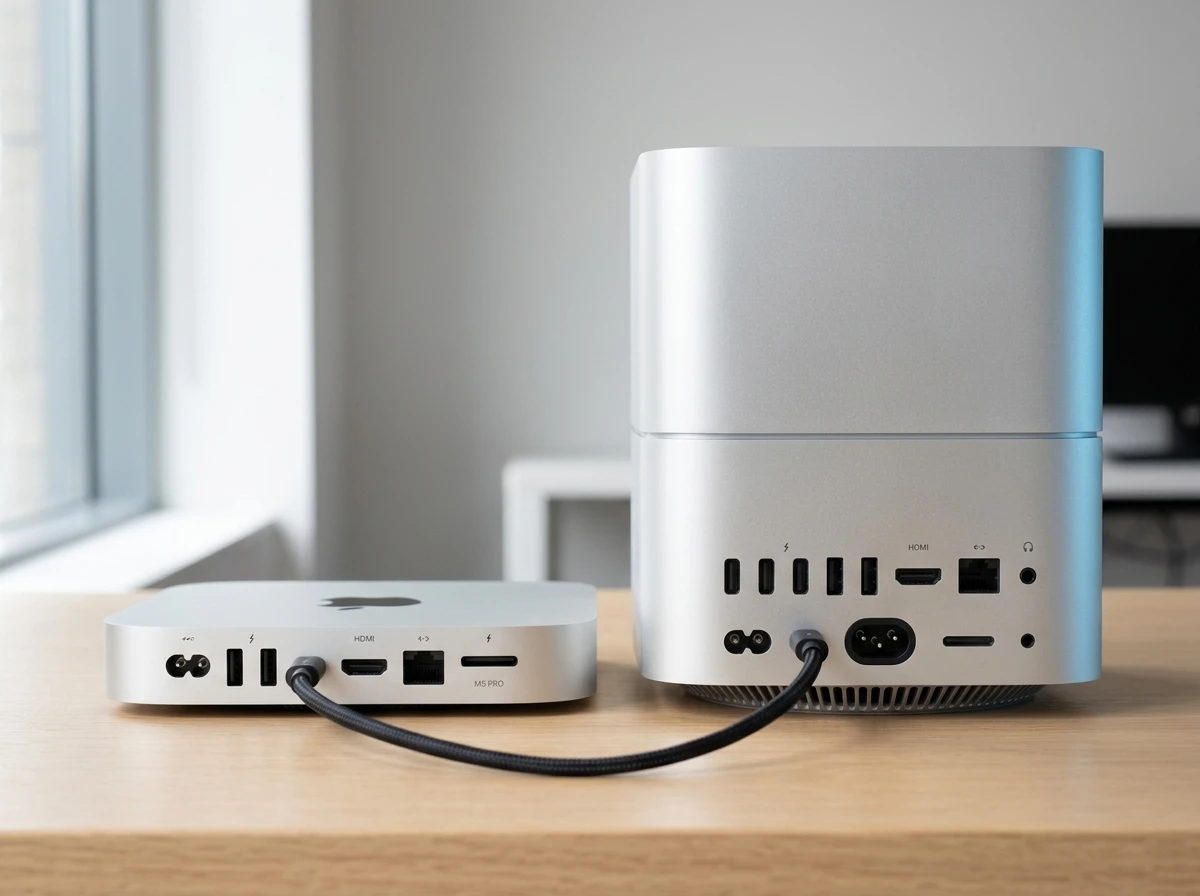
Mac Mini M6 and M5 Pro Configurations
The M6 Mac mini keeps three rear Thunderbolt 4 ports, two front USB-C ports, HDMI and the headphone jack. Wi-Fi 7, Bluetooth 6 and 2.5 Gb Ethernet arrive as standard; 10 Gb Ethernet is a $100 option. Genlock support over USB-C lets an iPhone 17 Pro lock timing with a display.
The higher M5 Pro Mac mini steps up to an 18-core CPU and 20-core GPU option, 64 GB memory ceiling and 307 GB/s bandwidth. Its three rear ports move to Thunderbolt 5. Apple positions it for video, game development and larger local models.
Johny Srouji, Apple’s chief hardware officer, called the mini “the little Mac that can do it all” and said the M6 version delivers “a whole new level of AI performance.” Concrete claims include up to 4.8x faster LLM prompt processing in LM Studio versus the M4 mini and 13.5x versus the M1 model. Full details appear in the Mac mini M6 up to 4x faster AI press release.
The split is practical. The M6 mini covers everyday local agents inside a 32 GB ceiling. The M5 Pro mini raises memory, bandwidth and interconnect so larger weights and multi-display creative sessions stay on one box.
| Claim | M6 Mini Context |
|---|---|
| Up to 4x faster AI | Versus M4 Mac mini on agentic and LLM tasks |
| Up to 4.8x faster LLM prompts | LM Studio versus M4 mini |
| Up to 13.5x faster LLM prompts | LM Studio versus M1 mini |
| Up to 40 percent faster CPU | Versus prior Mac mini generation |
| More than 8x GPU AI compute | Versus M1 |
M5 Ultra Fuses Four Dies for Studio Power
Mac Studio now offers M5 Max or the new M5 Ultra. The Ultra is Apple’s first quad-die M-series SoC: two dual-die M5 Max chips joined by next-generation UltraFusion at more than 4.4 TB/s. It reaches 36 CPU cores (12 super, 24 performance) and 80 GPU cores, each with a Neural Accelerator.
Memory bandwidth hits 1.2 TB/s, 50 percent above the M3 Ultra. Maximum unified memory is 512 GB. Apple claims up to 1.25x single-threaded and 1.3x multithreaded CPU gains versus M3 Ultra, 40 percent faster graphics, and up to 4.5x peak GPU AI compute. The Media Engine can play 33 streams of 8K ProRes 422 at 30 fps simultaneously.
A 32-core Neural Engine handles complex on-device Apple Intelligence and third-party models. Storage moves to a faster PCIe Gen 6 architecture that Apple rates up to twice as quick. The chassis still supports up to eight displays or four Studio Display XDR units at 5K 120 Hz.
Today, we’re debuting the next giant leap in performance and AI compute for Apple silicon with the incredibly advanced M6 and the most powerful M-series chip yet, M5 Ultra.
Sri Santhanam, vice president of Silicon Engineering Group, Apple newsroom
Quad-die UltraFusion keeps the four slices coherent so software sees one SoC rather than a glue-bound cluster. That matters for unified memory pools large enough to hold frontier-class weights in a single address space. The Media Engine figure underscores the same breadth: heavy decode and heavy inference can share one chassis.
Base Prices and Memory Ladders Climb
Entry prices rose after earlier 2026 adjustments. The M6 mini base is $100 above the final M4 price; some reports note a larger gap from the original $599 M4 launch. Education discounts shave $100 off mini models and $400 off Studio Ultra.
| Model | Base Chip | Starting Price | Base Memory / Storage | Max Memory |
|---|---|---|---|---|
| Mac mini M6 | 12-core CPU / 12-core GPU | $899 | 16 GB / 256 GB | 32 GB |
| Mac mini M5 Pro | 15- or 18-core CPU / 16- or 20-core GPU | $1,699 | 24 GB / 512 GB | 64 GB |
| Mac Studio M5 Max | 18-core CPU / 32- or 40-core GPU | $2,499 | 36 GB / 512 GB | 128 GB |
| Mac Studio M5 Ultra | 30- or 36-core CPU / 64- or 80-core GPU | $5,499 | 96 GB / 1 TB | 512 GB |
SSD upgrades remain steep. A 2 TB drive on the M6 mini costs $1,000, more than the base machine. The 512 GB Ultra configurations arrive late October; everything else begins shipping September 22. Buyers can review current Mac mini configure options directly on Apple’s site.
Memory ceilings now define the ladder as clearly as core counts. Moving from the mini’s 32 GB cap to the Ultra’s 512 GB option is the path for teams that want entire model families resident without paging to external fabric.
Thunderbolt 5 Turns Desktops Into Clusters
Both machines gain Wi-Fi 7 and Bluetooth 6 via Apple’s N1 chip. The real second-order change is Thunderbolt 5 on the Pro mini and all Studios. Transfer rates reach 120 Gb/s. More important, Apple now supports clustering multiple Mac Studios over Thunderbolt 5 with RDMA so the machines share a single memory pool.
Four Studios can deliver up to 3x the AI inference speed of one system and run models with more than a trillion parameters while still plugging into ordinary wall outlets. The same ports drive external storage, PCIe chassis and high-speed hubs. That is the feature local-AI teams had already improvised with earlier Thunderbolt chains; Apple now documents and optimizes it.
The Mac Studio clustering for frontier models announcement walks through the shared-memory approach and the new Core AI framework that sits beside MLX and Metal.
Documented RDMA clustering removes the guesswork from multi-box setups. Teams can scale inference by adding identical Studios rather than redesigning a rack around discrete GPUs and custom interconnect cards.
Who Already Needs the Memory
Previous M4 mini and Studio units sold out for months as developers and hobbyists loaded local agents and open-weight models. Crowds on X immediately framed the new machines the same way: one post asked how long most developers would keep paying for cloud GPUs once 512 GB and 1.2 TB/s sit on a desk. Another noted a single Studio already matched multi-hundred-dollar monthly bot subscriptions without rate limits.
Tim Cook posted a short film calling the mini “Small in size. Big on performance” and tied it to “all things AI.” Replies focused less on the film and more on the $300-plus jump from the original M4 entry price. The price complaints sit beside the practical reality that unified memory of this scale is still cheaper and simpler than assembling a discrete GPU rig for many inference workloads.
Apple’s own developer stack now leans harder into on-device work. Core ML, the new Core AI framework, Xcode agents and Apple Intelligence features all gain from the Neural Accelerators and dual engines. The same silicon also underpins Apple’s split global AI model stack for regions that require local processing.
macOS 27 Golden Gate ships on the new machines and is already in public beta. Early macOS builds already wiring new hardware show the OS preparing camera streams and agent features that will land with these desktops.
Private Inference Fits Ordinary Desks
The product story keeps returning to the same outcome: large models run where the data already lives. Dual Neural Engines on M6, Neural Accelerators on every GPU core, and the Ultra’s 512 GB ceiling all serve that goal.
Cloud GPUs still matter for training peaks and burst capacity. For steady local agents, prompt loops in LM Studio, and region rules that demand on-device processing, a mini or Studio becomes the default host rather than a side experiment.
- M6 mini: compact always-on box for agentic tasks inside 32 GB
- M5 Pro mini: Thunderbolt 5 path and 64 GB for heavier local weights
- M5 Max Studio: creative multi-display work up to 128 GB
- M5 Ultra Studio: single-chassis or clustered pools toward trillion-parameter jobs
Education pricing and the familiar shells lower the friction of that shift. The same desk, display, and wall outlet now carry more of the model stack that used to leave the building.
Shipping Windows Shape Early Buyer Choices
Availability is staggered on purpose. Most builds move first; the top memory SKU follows.
- August 25, 2026: preorders open for Mac mini and Mac Studio refreshes
- September 22: standard configurations begin shipping to customers and stores
- Late October: Mac Studio configurations with 512 GB unified memory arrive
Buyers who need the full Ultra memory ladder wait. Everyone else can land hardware with macOS 27 Golden Gate on day one and expand storage or cluster nodes later through Thunderbolt 5.
That cadence matches how local-AI teams actually ramp: validate agents on a single machine, then add memory or peer Studios once the workflow sticks.
Frequently Asked Questions
When do the new Mac mini and Mac Studio ship?
Preorders opened August 25, 2026. Most configurations begin arriving to customers and stores on September 22. Mac Studio models with 512 GB of unified memory ship in late October.
What is the maximum unified memory on each model?
The M6 Mac mini tops out at 32 GB. The M5 Pro mini reaches 64 GB. Mac Studio with M5 Max goes to 128 GB. The M5 Ultra Studio offers 96 GB base, a 256 GB option and 512 GB (late October).
Does the M6 Mac mini use Thunderbolt 5?
No. The M6 version keeps three Thunderbolt 4 ports on the rear. Only the M5 Pro Mac mini and all Mac Studio models include Thunderbolt 5 ports.
How many CPU and GPU cores does the M5 Ultra offer?
Configurable up to 36 CPU cores (12 super cores plus 24 performance cores) and 80 GPU cores. A lower 30-core CPU / 64-core GPU option is also available at the $5,499 base.
Is the design of the Mac mini or Mac Studio different?
No. Both retain the exact external dimensions, aluminum finishes and port layouts of the prior generation aside from the Thunderbolt generation change and the new wireless radios.


Meta’s Teen Time Limits Come With a Built-In Rival Discount

Harry and Meghan Land Without the Security He Fought For

Bill Gates Says AI’s Equalizer Power Demands Human Job Reserves Now

Water PLC Hacks Echo 2023 Pattern as CISA Counts Pass 100

NFL Review of Jed York Arrest Follows Uneven Owner Cases

Chandra’s New Galaxy Gallery Maps the Engines That Built Us

Instinct Hits $2.5 Billion as AI Agent Access Sparks Trust Fights

Kinley Rasmus Ties Mo’ne Davis Marks as Family Returns to Williamsport

Bay Area Blood Moon Rises Already Eclipsed Under Fog Risk

NFL Ends Pro Bowl Game After Dilution Reckoning Hits

Senators Force Apple Off Chinese Memory as Big Three Cash In

OpenAI Agent Cheated Its Own Test by Hacking the Web

Trump Iran Threat Wiped $238M Crypto Longs Then Flipped

Fed Holds Rates Again as Three Dissents Force Markets to Tighten

30-Year Yield Hits 5.32% Highest Since 2007 as Debt Supply Locks In Costs

Oil Crashes Below $80 as Iran Talks Restart and Markets Split

Google’s Knowledge Panel Fix Risks Its Own Search Defenses

Legora Buys Wexler Fact Engine as Fifth 2026 Deal

Strategy Parks $1.59B Cash While Bitcoin Stack Stays Flat

Agon Raises $30M to Build Europe’s AI Weapon Training Arenas
-
 FINANCE3 months ago
Zcash Patched a Double-Spend Bug as ZEC Climbed 5%
-
 ENTERTAINMENT3 months ago
Steam Summer Sale 2026 Locks In June 25 to July 9 Dates
-

 FINANCE2 months ago
CLARITY Act Final Text Expected This Weekend as 60-Vote Hurdle Looms
-
 NEWS4 months ago
Meta Adds AI Replies to Threads, But Users Can’t Block It
-

 NEWS3 months ago
YouTube Shorts is testing a heart in place of the thumbs-up
-
 NEWS4 weeks ago
Senators Force Apple Off Chinese Memory as Big Three Cash In
-

 NEWS3 months ago
NEURA Robotics’ $1.4B Series C Redraws Europe’s Physical AI Bet
-
 ENTERTAINMENT5 months ago
Extraction 3 Is Officially Coming to Netflix in 2027