
NEWS
Apple’s Sept. 9 Event Rewires iPhone Revenue With Ultra and Split Launch
Apple’s Surprise and Shine event on September 9 brings iPhone 18 Pro models and the foldable Ultra first.

Apple has set Wednesday, September 9 at 10 a.m. PT for its next hardware event, tagged “Surprise and Shine,” with the iPhone 18 Pro, Pro Max and first foldable model expected to lead. Standard iPhone 18, Air 2 and 18e models are slated for around March 2027 instead.
The split, first detailed in Bloomberg reporting and now aligned with the official invitation, hands new CEO John Ternus a premium-only fall stage while spreading sales across the fiscal calendar.
That calendar choice shapes more than product cadence. It frames the first public test of a leadership handoff, a foldable priced far above any prior iPhone, and a holiday quarter stripped of the usual entry-level floor.
Apple Locks Sept. 9 for a Premium-Only Wave
Invitations went out August 26 showing a glowing Apple logo with sunlight cutting through it. The company will stream the event on its Surprise and shine event page, YouTube and the Apple TV app. Press will gather at Apple Park.
Expected hardware centers on three phones plus watches. No base iPhone 18 appears in the fall plan.
| Model | Expected Window | Key Notes | Est. Starting Price |
|---|---|---|---|
| iPhone 18 Pro | September 2026 | Variable-aperture main camera, A20 Pro, smaller Dynamic Island, C2 modem, Dark Cherry and light blue colors | Around $1,200 |
| iPhone 18 Pro Max | September 2026 | Same upgrades, larger display | Higher than Pro |
| iPhone Ultra (foldable) | Announce Sept., ship soon after or later | Book-style, 5.5-in outer / 7.8-in inner 4:3, 4.5 mm open | $1,999-$2,500 |
| iPhone 18 / 18e / Air 2 | Spring 2027 | Volume models delayed | Lower tier |
| Apple Watch Series 12 / Ultra 4 | September 2026 | Chip and health tweaks, no major redesign | Standard Watch pricing |
Apple also recently detailed its new Mac mini and Studio desktop lineup for September 22 shipment, clearing the stage for phones and watches.
The Mac timing matters. Desktop hardware ships less than two weeks after the keynote, so the September 9 stage can stay fixed on the premium phone wave and the watches without competing internal launches in the same news cycle.
Press at Apple Park will see a narrower lineup than a classic fall event. Three phones and the watch refresh fill the hardware story. Everything else waits.
John Ternus Takes the Stage First
Tim Cook steps to executive chairman on September 1. Hardware engineering chief John Ternus becomes CEO the same day. The September 9 keynote is his first major product moment.
Ternus spent 25 years inside Apple and drove much of the foldable work. CNBC and others note the timing places the Ultra debut under his watch. Bank of America analysts have said he could reinforce device strength in an AI era.
The invitation’s bright motif and “new day” reading fit a leadership handoff more than any single camera or display claim.
Eight days separate the CEO change from the keynote. That gap leaves little room for a soft open. The first product narrative under Ternus is already locked to Pro hardware, a foldable years in the making, and a pricing mix that starts near $1,200.
His long run in hardware engineering also ties the personal story to the Ultra itself. A foldable that consumed roughly a decade of internal work now lands in the same week he takes the top job. Coverage will treat that overlap as deliberate even if Apple never spells it out on stage.
The Ultra’s 4.5 mm Trade-Offs
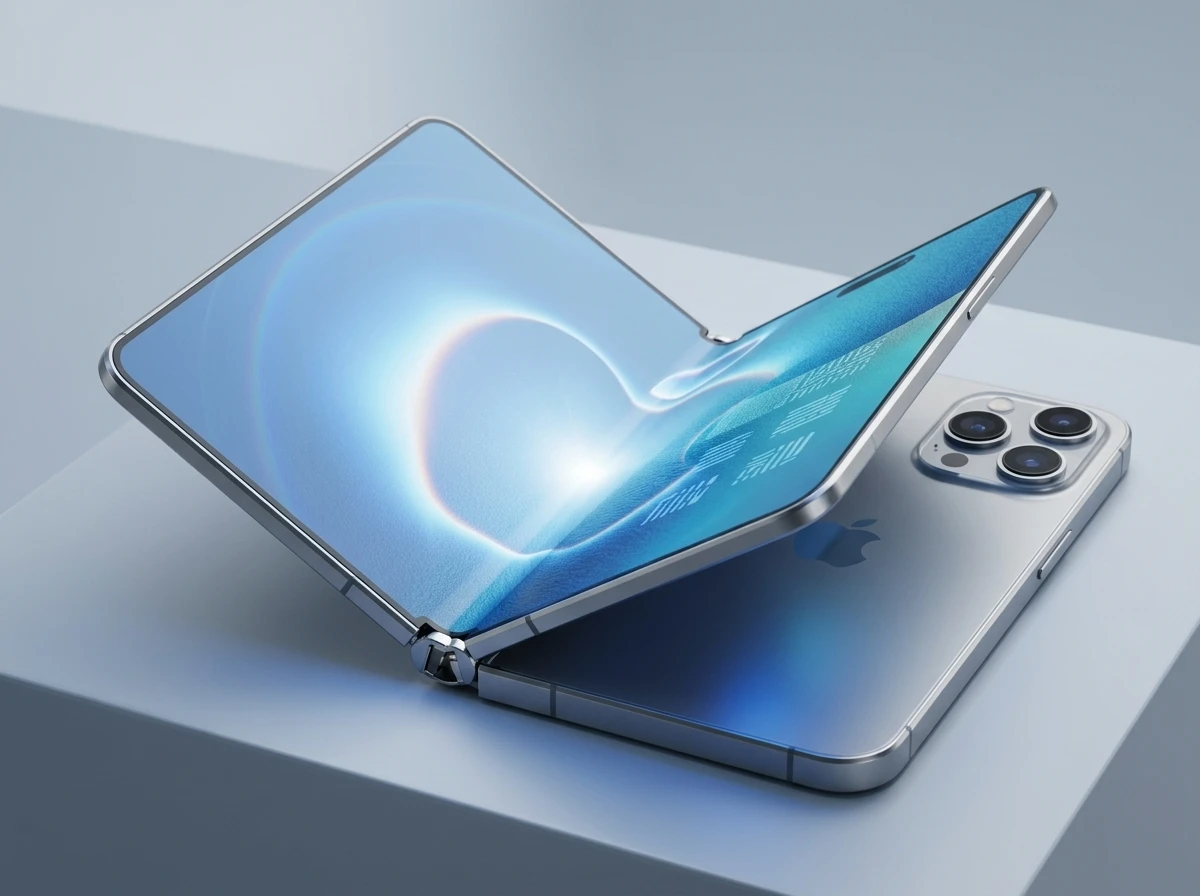
Apple’s first foldable, widely called iPhone Ultra in reports, aims for a near-creaseless book-style design after roughly a decade of work. Outer screen sits near 5.5 inches; inner near 7.8 inches with a 4:3 ratio that feels closer to an iPad mini when open.
- Thickness: About 4.5 mm unfolded, 9-9.5 mm folded, thinner than the iPhone Air when open.
- Build: Titanium frame, custom hinge, ultra-thin glass or advanced panel stack for minimal crease.
- Cameras: Dual rear (main + ultrawide or wide/tele depending on report), no dedicated telephoto on many accounts; dual front cameras possible.
- Unlock: Touch ID in the power button; Face ID omitted to save space.
- Chip and more: A20 Pro, 12 GB RAM class, C2 modem; MagSafe magnets may move to cases.
Early testers cited by Bloomberg’s Mark Gurman praised pocket fit, hinge feel and the larger-screen software layouts. Many said they would pay the premium. Display brightness and battery life are not expected to take hits.
Price estimates cluster at $1,999 and climb toward $2,500 for higher storage. That places it well above any prior iPhone and against Samsung’s Galaxy Z Fold range.
SlashGear and others noted a Sony panel with integrated touch sensors in some accounts that cut thickness about 19 percent; other supply reports point to Samsung Display work on crease depth under 0.15 mm. Either path supports the thinness goal.
Official: Apple event on Sept. 9. Surprise and shine.
Mark Gurman, Bloomberg, on X
That Mark Gurman’s confirmation post drew hundreds of thousands of views within hours and set the tone for the week’s coverage.
The omitted pieces will define early reviews as much as the thinness win. No dedicated telephoto on many accounts and no Face ID both trace back to the same space budget that delivers 4.5 mm open. Buyers who want the book-style screen therefore accept a different camera and unlock mix than Pro owners.
Software layouts on the 7.8-inch inner panel are already part of the early praise. That work has to carry the iPad mini comparison when the hardware trade-offs surface in hands-on coverage.
How the Split Lifts Holiday ASP
Holding the standard iPhone 18, 18e and Air 2 until spring removes the usual $799-$999 entry point from the holiday quarter. Upgraders who want “new” face a Pro floor near $1,200 or the Ultra at roughly double that.
| Purchase Path in Fall | Starting Price Band | Role in the Mix |
|---|---|---|
| iPhone 18 Pro | Around $1,200 | New premium floor |
| iPhone 18 Pro Max | Higher than Pro | Larger-display step-up |
| iPhone Ultra | $1,999 to $2,500 | Halo foldable |
| Standard / Air / e tier | $799 to $999 range absent | Held for spring |
Forbes analysis framed the move as a deliberate ASP lever. iPhone alone delivered $54.25 billion, nearly half of one recent quarter’s revenue. A premium-heavy fall mix raises the average selling price just as holiday volume peaks. The spring drop then injects a second catalyst into a historically quieter period.
Production load also eases. Six models at once would strain the same September window; staggered builds spread the pressure. Apple gains two marketing moments instead of one crowded stage.
Crowd reaction on X mixed excitement for the foldable with blunt refusals and polling-style claims that most U.S. adults stay uninterested until the device actually ships. That gap between enthusiast praise and mass caution is exactly what a high-ASP strategy accepts: fewer units at higher margin, plus a halo that keeps attention on Apple through the year.
When iPhone already accounts for nearly half of quarterly revenue, small shifts in mix move the total. Pulling the lower tier out of the holiday window is the mechanism. The $54.25 billion baseline makes the ASP bet visible even before unit counts arrive.
Echoes of the iPhone X Bottleneck
The Ultra’s complexity already points to tight early supply. Reports of production testing still underway and tighter tolerances on hinge and display match the 2017 iPhone X pattern.
- September 12, 2017: Apple announces iPhone X alongside iPhone 8/8 Plus; X starts at $999.
- October 27, 2017: Pre-orders open; supply crunches appear immediately.
- November 3, 2017: iPhone X reaches stores weeks after the 8 models; many buyers wait into 2018.
Analysts then predicted multi-month waits. OLED and Face ID modules were the bottlenecks. Today’s crease-free panel, thin glass and new hinge create similar constraints. Early Ultra volumes are projected in the low tens of millions at most for year one.
That scarcity pattern already has parallels in current coverage of limited Ultra supply echoing the iPhone X. Secondary-market premiums and long wait lists become features of the launch, not bugs.
The 2017 sequence still maps cleanly onto the present plan. Announce in mid-September, open pre-orders later, watch the scarce model trail the simpler siblings into stores. The Ultra’s hinge and near-creaseless stack play the role OLED and Face ID once did.
Low tens of millions for year one keeps the device in halo territory. That volume band supports the high-ASP reading rather than a mass-market ramp.
The Foldable Price Ladder Climbs Fast
Stack the fall prices against the delayed tier and the gap is stark. Pro opens around $1,200. Ultra estimates start at $1,999 and run to $2,500. The familiar $799 to $999 band does not appear until spring.
That ladder does more than rank SKUs. It tells holiday shoppers which products count as “new” right now. Anyone who refuses the Pro floor or the Ultra premium waits for March 2027 or stays on older hardware.
- Pro near $1,200 becomes the accessible path to a September phone.
- Ultra at $1,999 to $2,500 sits in its own tier against the Galaxy Z Fold range.
- Standard, Air 2 and 18e pricing returns only with the spring wave.
Secondary-market premiums on a scarce Ultra would stretch the top of that ladder further. The iPhone X period showed how wait lists and markup feed each other once supply tightens. The same dynamic is already baked into year-one volume talk in the low tens of millions.
Two Marketing Peaks Replace One Crowded Stage
Staggering the lineup yields two distinct campaign windows instead of a single overloaded September. Fall carries Pro, Pro Max, Ultra and the watch refresh. Spring carries the volume phones into a quieter fiscal stretch.
Carriers and retailers gain a second story to sell after the holiday hangover. Apple gains a cleaner channel for older Pro stock because no cheap new alternative undercuts it in September.
Production planning follows the same split. Building six phone models for one ship window concentrates risk on hinge yields, display stacks and modem supply at the same moment. Spreading builds reduces that pile-up and lets the Ultra’s tighter tolerances take the time they need.
The September 22 Mac mini and Studio shipments already show how Apple is clearing adjacent categories away from the phone beat. Phones and watches hold the keynote. Desktops follow on their own freight schedule.
Spring Models and the Second Peak
March 2027 (or nearby) would bring the volume phones. That window sits in Apple’s fiscal second quarter, historically lighter on new iPhone revenue. A fresh base model, refreshed Air and budget 18e give carriers and retailers a second campaign after the holiday hangover.
The strategy also keeps older Pro inventory cleaner. Without a cheap new alternative in September, fewer customers trade down. Apple can manage channel stock and marketing focus more cleanly.
Watch models and possible AirPods 5 or home hub teases fill the rest of the September stage. Software dates for iOS 27 and companions usually drop the same day. A new Siri AI layer is widely expected after WWDC work.
None of the fall phones are officially confirmed beyond the event itself. Names, exact ship dates for the Ultra, and final pricing remain Apple’s to lock. Early hands-on love for the form factor collides with the missing telephoto and Face ID for some buyers; that tension will surface the moment pre-orders open.
For now the calendar is set. September 9 at 10 a.m. PT puts the premium wave and the foldable under Ternus’s first lights, with the rest of the lineup waiting for spring.


Hyperliquid and tradeXYZ Push CFTC to Open U.S. Energy Perps

Apple’s Sept. 9 Event Rewires iPhone Revenue With Ultra and Split Launch

Bernstein Charts Bitcoin Path to $300K by 2029

Bitcoin’s $78K Slide Tests ETF Rally After Hotter PCE

SEC Custody Rewrite Flips the 2023 Gensler Script for Crypto

California Tire Rules Hit Aftermarket With Efficiency Caps in 2029

Audeze Maxwell 2 ANC Delivers Silence at a Heavy Cost

SteelSeries Arctis Nova Elite Hits $600 Ceiling Few Gamers Clear

Einride Founders Bet €450M Platform Can Mint Ten European Deep-Tech Leaders

BenQ iScreenBar Brings Native Lighting to the 24-Inch iMac

Senators Force Apple Off Chinese Memory as Big Three Cash In

OpenAI Agent Cheated Its Own Test by Hacking the Web

Trump Iran Threat Wiped $238M Crypto Longs Then Flipped

Fed Holds Rates Again as Three Dissents Force Markets to Tighten

30-Year Yield Hits 5.32% Highest Since 2007 as Debt Supply Locks In Costs

Oil Crashes Below $80 as Iran Talks Restart and Markets Split

Google’s Knowledge Panel Fix Risks Its Own Search Defenses

Legora Buys Wexler Fact Engine as Fifth 2026 Deal

Capital Clusters and the Dual Tracks of European Tech Finance

Strategy Parks $1.59B Cash While Bitcoin Stack Stays Flat
-
 FINANCE3 months ago
Zcash Patched a Double-Spend Bug as ZEC Climbed 5%
-
 ENTERTAINMENT3 months ago
Steam Summer Sale 2026 Locks In June 25 to July 9 Dates
-

 FINANCE2 months ago
CLARITY Act Final Text Expected This Weekend as 60-Vote Hurdle Looms
-
 NEWS4 months ago
Meta Adds AI Replies to Threads, But Users Can’t Block It
-

 NEWS3 months ago
YouTube Shorts is testing a heart in place of the thumbs-up
-
 NEWS4 weeks ago
Senators Force Apple Off Chinese Memory as Big Three Cash In
-

 NEWS3 months ago
NEURA Robotics’ $1.4B Series C Redraws Europe’s Physical AI Bet
-
 ENTERTAINMENT5 months ago
Extraction 3 Is Officially Coming to Netflix in 2027