
NEWS
Mars Southern Mantle Runs Hundreds of Degrees Hotter
Tidal tomography of three NASA orbiters finds a lasting southern mantle heat anomaly that tracks the crustal dichotomy and limits Mars habitability recycling.

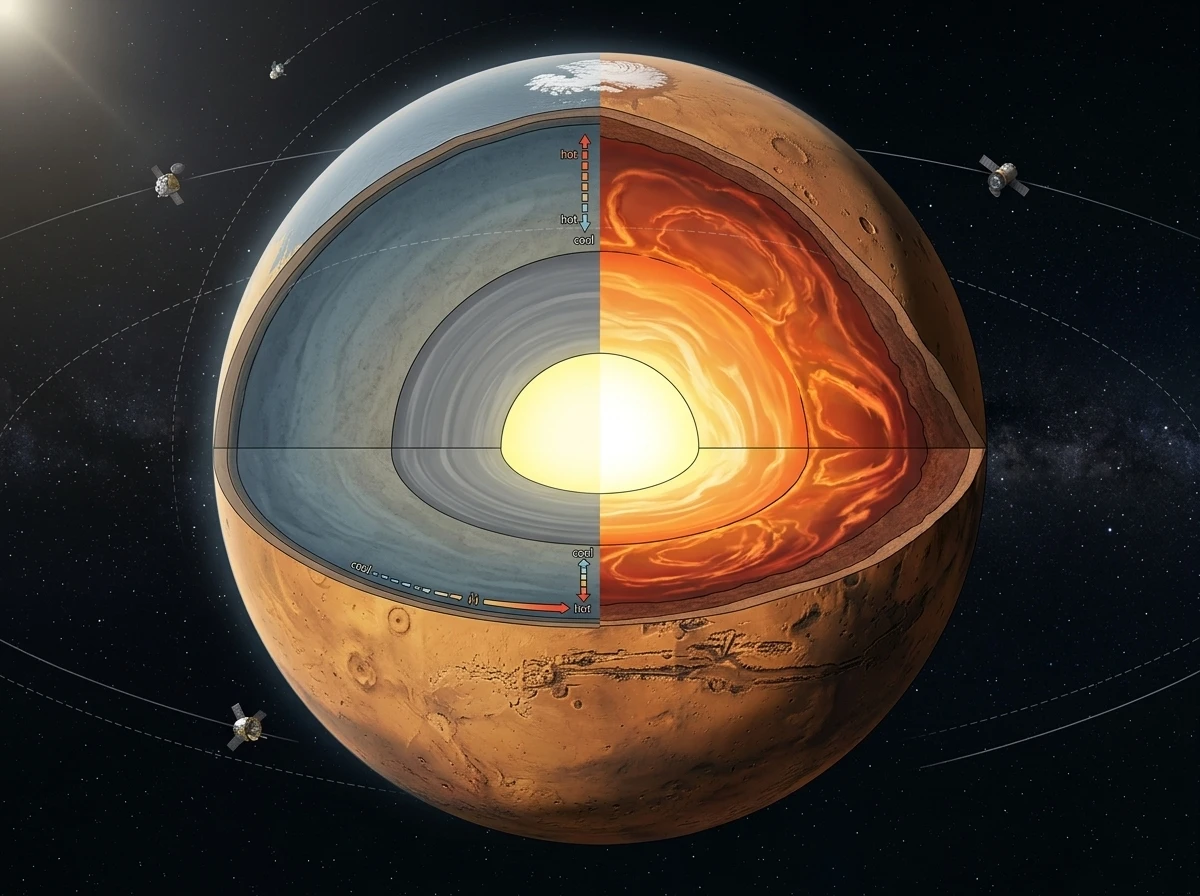
A team of planetary scientists has mapped a lasting heat imbalance deep inside Mars: the mantle under the southern highlands runs 200 to 400 degrees Celsius hotter than the material beneath the northern lowlands. The finding, published in Nature, comes from tidal tomography applied for the first time to the Red Planet and directly tracks the planet’s famous crustal dichotomy.
The temperature contrast helps explain why the southern half stands kilometers higher and more cratered while the north sits as smooth, low plains that may once have held an ocean. It also sharpens a harder question about why Mars never developed the surface-interior recycling that keeps Earth’s climate and chemistry in long-term balance.
Heat That Tracks the Surface Divide
Alexander Berne of the University of Arizona’s Lunar and Planetary Laboratory led the work with Nicholas Wagner of Brown University and colleagues. Their models show the effective shear modulus of the Martian mantle varies by more than 20 percent between hemispheres. Softer rock sits under the south; stiffer rock under the north.
That stiffness difference is the measurable signature of the heat. At the long seasonal tidal period of a Martian year, olivine’s shear modulus becomes highly sensitive to temperature, turning a few hundred degrees of contrast into the observed gravity signal.
- Southern mantle: 200-400 °C warmer, lower shear modulus, possible partial melt pockets
- Northern mantle: cooler and more rigid
- Alignment: the zero-contrast line follows the surface dichotomy even where the boundary wanders
- Confidence: degree-3 gravity coefficients deviate up to 300 percent from a symmetric planet after atmosphere correction
Berne told Scientific American the match between deep heat and surface elevation “was a happy surprise.” The pattern is not a simple polar hotspot; it is a hemispheric feature that mirrors the topography and crustal thickness difference of roughly 25 kilometers.
How Three Orbiters Caught the Seasonal Flex
Mars follows an eccentric path and has a tilted axis, so the Sun’s gravitational pull flexes the planet slightly over its 687-Earth-day year. Those tiny shape changes rearrange the gravity field enough to nudge orbiting spacecraft.
The team reprocessed 16 years of radio tracking data from Mars Global Surveyor, Mars Odyssey and Mars Reconnaissance Orbiter. Earth-based Deep Space Network Doppler measurements supplied the raw velocities. After removing atmospheric loading effects, the leftover non-zonal degree-3 signals stood out sharply.
For a perfectly layered, spherical Mars the seasonal tide would produce almost no degree-3 gravity change. The large observed residuals require lateral structure in the mantle, the layer between crust and core that is most sensitive at these periods.
Tidal tomography had already mapped interiors of Earth and the Moon. This is its first application to Mars. The method needs no new lander; it mines existing orbital archives.
- 1999-2015+ data span: continuous X-band tracking across solar cycles
- Atmosphere correction: Mars general circulation models subtracted CO2 and dust loading
- Bayesian inversion: Markov-chain Monte Carlo tests of shear-modulus variations in crust and mantle layers
- Result: north-south pattern that aligns with the dichotomy surface expression
Why the Dichotomy Still Divides Theories
Scientists have argued for half a century over how Mars became two-faced. One camp favors a giant ancient impact that excavated the northern lowlands or thickened the south. Another favors early mantle convection that piled crust on one side. A third notes that thick southern crust itself can act as a thermal blanket, trapping radiogenic heat for billions of years.
The new heat map does not crown a single winner. An impact alone would have dissipated its thermal signature long ago. “We would not expect to have it in the mantle today if an impact was the only thing that happened,” Berne said. Some combination of impact, lingering convection and long-term insulation is required to keep the south hot into the present.
- 1970s Mariner 9: first clear images of the elevation contrast
- Impact models: Borealis basin excavation of the north, or southern thickening
- Endogenic models: degree-1 convection plumes or magma-ocean overturn
- 2026 tidal result: present-day thermal anomaly that any successful model must preserve
Amir Khan of ETH Zurich, not involved in the study, called the observations the strongest part of the paper and cautioned that the thermal interpretation rests on modeling assumptions. Paul Byrne of Washington University noted that Tharsis, Mars’s largest volcanic province, sits along the dichotomy margin rather than squarely over the hottest southern mantle, an unresolved detail.
What the Heat Means for Past Water and Life
Four billion years ago Mars had rivers, lakes and possibly a northern ocean. NASA’s Perseverance rover has found organic compounds in a dried lakebed that could be biological or geological. Reconstructing the full planetary engine is required to decide which.
Habitability depends on more than surface water. It needs a way to cycle carbon, nitrogen and other volatiles between crust and interior over geologic time. Earth does that with plate tectonics. Mars appears never to have done so. It operates in a stagnant-lid regime in which the outer shell stays locked and heat escapes mainly by conduction and limited volcanism.
Habitability is a complicated thing. There’s a lot of different things that feed into it: heat, chemistry, water. Earth is special for a lot of reasons, habitability included, but I think what gets undersold, potentially, is the geodynamics of it. And what I mean by that is [Earth has] plate tectonics-a way for the surface of Earth to transfer material with its interior and regulate its carbon, regulate its nitrogen and its oxygen. As far as we know, Mars doesn’t have plate tectonics, and it never did.
Nicholas Wagner, planetary scientist, Brown University, 404 Media interview
Wagner added that he is now asking how the anomaly fits the possibility that Mars once had, or never had, the capacity for plate-like motion. A persistently hotter southern mantle could have helped drive early volcanism and magnetic field generation in the south, yet the same heat may have helped lock the lithosphere against the wholesale recycling Earth enjoys. The anomaly is therefore both a clue to early conditions and a constraint on why those conditions did not last.
A Method Built for Worlds Without Landers
Berne described the paper partly as an advertisement for the technique. Tidal tomography works entirely from orbit. It can be applied to Mercury, Enceladus, Pluto or any body with accurate radio tracking and a measurable seasonal or orbital tide.
“We always complain about the huge budgets of space agencies. This is a way to make it a lot cheaper and get 80 percent of the result that you want,” Berne said. Future missions that already plan long-term orbiters can harvest interior structure as a free byproduct of navigation data.
The same approach that yielded the 200-400 °C thermal anomaly can test whether other worlds keep deep heat reservoirs, molten layers or compositional gradients without a single seismometer on the ground.
The Open Interior Questions
The Mars interior remains poorly known. InSight’s single seismic station sat in the north and could not distinguish hemispheres. The new gravity result supplies the missing lateral view but still rests on assumptions about grain size, water content and the exact reference 1-D model.
| Question | Status after this study |
|---|---|
| Is the anomaly purely thermal or partly compositional? | Open; iron enrichment up to 5 percent still allowed |
| Does partial melt exist today under the south? | Possible but not required |
| How much did an early impact contribute? | Compatible as a trigger, not sole cause |
| Will future landers confirm the heat? | Desired; orbital method already generalizable |
The static and time-variable gravity field of Mars continues to improve with every year of tracking. The next datasets will test whether the southern softness is still evolving or has been frozen in place for most of solar-system history.
For now the Red Planet’s two faces run all the way down. The heat that keeps the south elevated also helps explain why Mars never became a long-lived, tectonically active world like Earth, and why its window for surface life closed early.
Frequently Asked Questions
What temperature difference did the study find in the Martian mantle?
The southern highlands mantle is 200 to 400 degrees Celsius hotter than the northern lowlands mantle at present. That range accounts for the observed greater-than-20-percent variation in effective shear modulus once the long tidal period is taken into account; a naïve short-period conversion would have implied an impossible thousand-degree contrast.
What is tidal tomography and why was it new for Mars?
Tidal tomography recovers three-dimensional interior structure by measuring how a planet’s gravity field changes under known tidal forces from the Sun or a moon. It had been used on Earth and the Moon; the 2026 study is the first successful application to Mars, using existing orbiter tracking rather than new surface instruments.
What is the Martian crustal dichotomy?
It is the planet’s largest topographic feature: southern highlands average several kilometers higher, thicker-crusted and more heavily cratered than the northern lowlands. Average crustal thickness differs by about 25 kilometers, and the boundary has been visible since Mariner 9 in the early 1970s.
Which spacecraft supplied the data?
Sixteen years of Deep Space Network radio tracking from Mars Global Surveyor, Mars Odyssey and Mars Reconnaissance Orbiter provided the Doppler residuals that revealed the degree-3 seasonal gravity signals after atmospheric corrections.
Does the anomaly prove Mars never had plate tectonics?
It does not prove the negative by itself, but a long-lived hemispheric heat contrast is consistent with a stagnant-lid regime that never achieved the widespread lithospheric failure and recycling seen on Earth. Wagner noted the finding is another piece in the puzzle of whether early Mars ever had that capacity.


Meta’s Teen Time Limits Come With a Built-In Rival Discount

Harry and Meghan Land Without the Security He Fought For

Bill Gates Says AI’s Equalizer Power Demands Human Job Reserves Now

Water PLC Hacks Echo 2023 Pattern as CISA Counts Pass 100

NFL Review of Jed York Arrest Follows Uneven Owner Cases

Chandra’s New Galaxy Gallery Maps the Engines That Built Us

Instinct Hits $2.5 Billion as AI Agent Access Sparks Trust Fights

Kinley Rasmus Ties Mo’ne Davis Marks as Family Returns to Williamsport

Bay Area Blood Moon Rises Already Eclipsed Under Fog Risk

NFL Ends Pro Bowl Game After Dilution Reckoning Hits

Senators Force Apple Off Chinese Memory as Big Three Cash In

OpenAI Agent Cheated Its Own Test by Hacking the Web

Trump Iran Threat Wiped $238M Crypto Longs Then Flipped

Fed Holds Rates Again as Three Dissents Force Markets to Tighten

30-Year Yield Hits 5.32% Highest Since 2007 as Debt Supply Locks In Costs

Oil Crashes Below $80 as Iran Talks Restart and Markets Split

Google’s Knowledge Panel Fix Risks Its Own Search Defenses

Legora Buys Wexler Fact Engine as Fifth 2026 Deal

Strategy Parks $1.59B Cash While Bitcoin Stack Stays Flat

Agon Raises $30M to Build Europe’s AI Weapon Training Arenas
-
 FINANCE3 months ago
Zcash Patched a Double-Spend Bug as ZEC Climbed 5%
-
 ENTERTAINMENT3 months ago
Steam Summer Sale 2026 Locks In June 25 to July 9 Dates
-

 FINANCE2 months ago
CLARITY Act Final Text Expected This Weekend as 60-Vote Hurdle Looms
-
 NEWS4 months ago
Meta Adds AI Replies to Threads, But Users Can’t Block It
-

 NEWS3 months ago
YouTube Shorts is testing a heart in place of the thumbs-up
-
 NEWS4 weeks ago
Senators Force Apple Off Chinese Memory as Big Three Cash In
-

 NEWS3 months ago
NEURA Robotics’ $1.4B Series C Redraws Europe’s Physical AI Bet
-
 ENTERTAINMENT5 months ago
Extraction 3 Is Officially Coming to Netflix in 2027