
NEWS
Space Mirror Demo Revives 1993 Russian Night-Light Test
Eärendil-1 will test an 18-meter reflector to beam sunlight at night, echoing Znamya while drawing astronomy and wildlife pushback over a 50,000-satellite vision.

The Federal Communications Commission on July 9 authorized Reflect Orbital of Hawthorne, California, to launch Eärendil-1, a 142-kilogram test satellite carrying an 18-by-18-meter thin-film reflector that will bounce sunlight onto a roughly 5-kilometer patch of nighttime ground. Launch is targeted for later this year on a SpaceX rideshare into a near-polar orbit near 625 kilometers.
The single-satellite demo is the first commercial step toward what the company calls sunlight on demand. If it works, Reflect Orbital has sketched a path to dozens of mirrors next year, 5,000 by 2030 and as many as 50,000 by 2035. The idea is not new. Russia flew a working version in 1993.
The FCC Cleared One Demo Satellite
In its July 9 order granting the license, the Space Bureau said the application served the public interest by letting an American firm test innovative space technology. The grant covers radio frequencies in UHF, S-band and X-band for two years. It is limited to this one spacecraft, call sign S00711.
Ben Nowack, co-founder and CEO, said the company was grateful the agency recognized the value of testing novel systems. “This license is the first step toward rigorously testing our technology’s efficacy and the safeguards we have developed,” he said in the firm’s statement.
- Orbit: 625 km altitude, 88-degree inclination
- Reflector: 18 × 18 m aluminized Mylar, about 324 square meters
- Beam: ~5 km diameter, several minutes per pass, near full-moon brightness at center
- Mass: roughly 142 kg; design life about one year before deorbit
The FCC received more than 1,800 public comments, most critical, plus a petition to deny from the American Astronomical Society. The bureau denied the petition and said optical-astronomy impacts fell outside its review of the space station.
The two-year radio license therefore functions as a narrow gate. Controllers may talk to the spacecraft. They may not yet claim a permanent right to light the ground at scale.
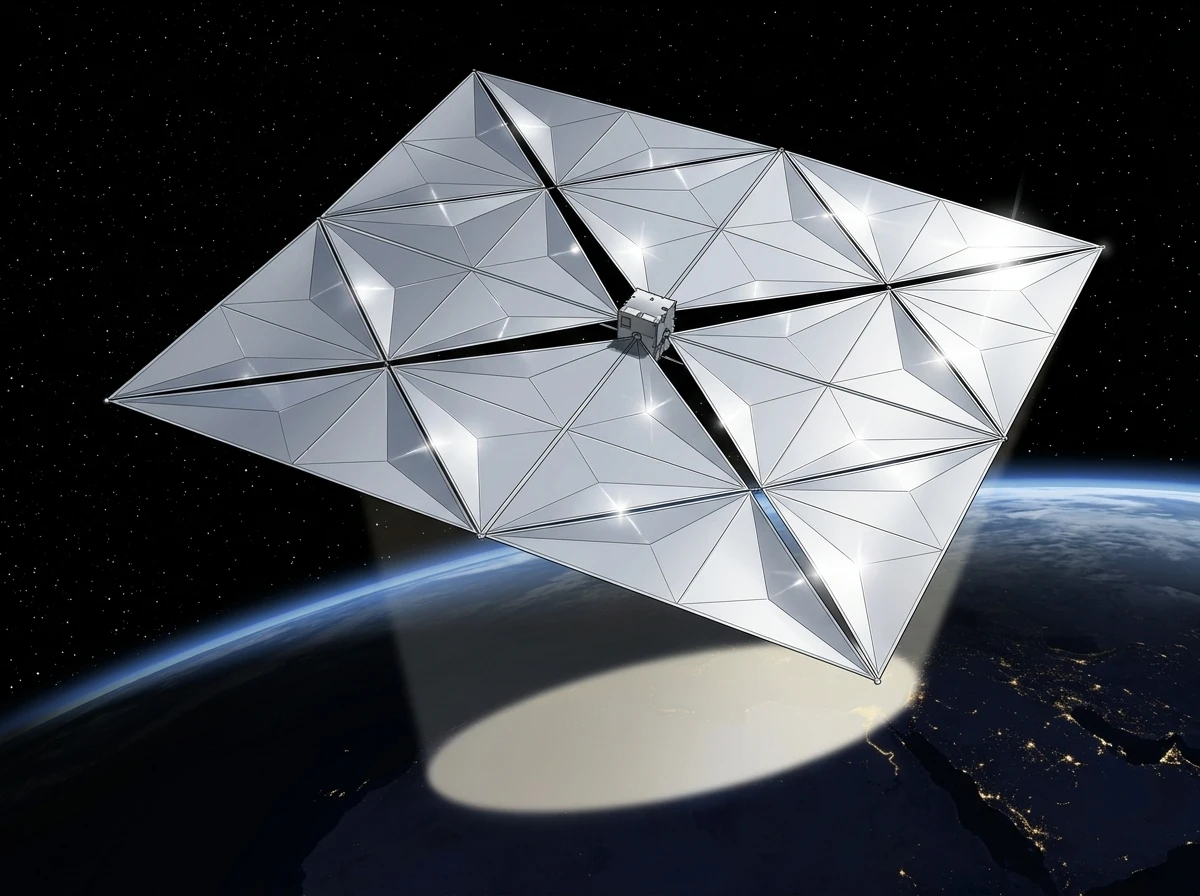
An 18-Meter Mylar Sail Aims a 5 km Beam
Once on orbit the satellite will deploy four triangular panels into a square sail. Ground controllers will steer it to paint a moving spot of reflected sunlight on chosen sites for construction work after dark, search-and-rescue lighting, or extra hours on solar farms. Peak brightness along the ground track is estimated at magnitude -4, comparable to Venus at its brightest for distant observers.
Company materials list a target price of about $5,000 per hour for customers who commit to 1,000 hours a year. Military uses have also been floated; the firm already holds a $1.25 million Air Force SBIR Phase II award for force-protection and base lighting concepts.
| Parameter | Eärendil-1 (2026 demo) | Znamya-2 (1993) |
|---|---|---|
| Reflector size | 18 × 18 m square | 20 m diameter circular |
| Beam footprint | ~5 km | ~5 km |
| Brightness in beam | ~full Moon | ~full Moon (2-5× in some reports) |
| Duration | minutes per pass, multi-pass planned | hours total, single pass sweep |
| Operator | Private U.S. startup | Russian space agency / Mir |
The demo will also stress-test safeguards: exclusion zones, brightness limits, coordination with NASA and the National Science Foundation, and public data release. Larger future mirrors are described as 54 × 54 m.
At 625 km and 88-degree inclination the ground track moves quickly. Each illuminated patch lasts only minutes unless later satellites hand off the same site. That geometry is why the commercial model sells hours rather than permanent spots, and why a single 18-meter sail cannot alone deliver continuous service.
Russia Already Tried This in 1993
On 4 February 1993 the Progress M-15 craft undocked from Mir and spun out Znamya-2, a 20-meter aluminized plastic reflector weighing under 4 kg. Centrifugal force held the film taut. The beam, roughly full-moon bright and 5 km wide, raced across southern France, Switzerland, Germany, Poland and into Belarus at 8 km/s before dawn. Clouds hid most of the track, yet a few ground observers saw a brief silvery flash and cosmonauts watched the spot from orbit.
- 4 February 1993: Znamya-2 deploys successfully from Progress near Mir; 5 km beam crosses Europe.
- 1999: Znamya-2.5 (25 m) snags on an antenna during deployment and fails; program ends.
- 2018: Chengdu “artificial moon” concepts surface in China but produce no hardware.
- October 2021: Reflect Orbital founded by Ben Nowack (ex-SpaceX) and Tristan Semmelhack.
- July 9, 2026: FCC grants Eärendil-1 license; first commercial orbital mirror since the Russian tests.
Znamya proved the physics work for a brief, low-intensity pass. It never scaled. Reflect Orbital’s pitch is continuous commercial service and eventually multi-mirror stacks that could deliver far higher illumination.
The mass gap is stark. Znamya-2 weighed under 4 kg; Eärendil-1 weighs about 142 kg and carries radios, steering hardware and a year-long design life before deorbit. The Russian film was a one-shot experiment. The California craft is built to be commanded, measured and sold by the hour.
Astronomers Call the Full Fleet Existential
The European Southern Observatory warned that a full constellation could raise night-sky brightness over its Chile sites by a factor of three to four. A August 2026 analysis by Miroslav Kocifaj and colleagues, accepted by Astrophysical Journal Letters, calculated that a single Eärendil-class beam would appear about 40 times brighter than the full Moon at its center. Even 14 km away the satellite would still match the Moon; a 400-satellite stack aimed at one site would reach 10,000 full Moons inside the 5 km core and leave a visible glow on the horizon 80 km out.
Samantha Lawler of the University of Regina said the concept is incompatible with astronomy: “There is no way you can do this and preserve dark skies.” The American Astronomical Society told the FCC the project “cannot be considered to serve the public interest” and would waste taxpayer money by degrading federally funded observatories. DarkSky International and the American Bird Conservancy petitioned in August for the agency to reverse the order and require a full National Environmental Policy Act review, citing aviation flash risks, wildlife circadian disruption and human sleep cycles.
Deploying these mirrors would be seriously damaging for astronomy and for the nighttime environment. The damage extends far beyond the target area.
Miroslav Kocifaj, Slovak Academy of Sciences, MIT Technology Review
Reflect Orbital disputes the scatter models. Nowack said some assumptions are inaccurate and that exclusion zones already account for scattering. The company has not released its own quantitative models or raw data for independent check.
On X, reaction mixed sarcasm with alarm: one widely shared thread called the plan a “subscription service for sunlight” after “billions of years evolving under a dark sky.” Others noted the same regulatory gap that let mega-constellations proliferate without optical rules now applies to intentional beams. Crowd commentary keeps returning to the point that night is not empty infrastructure; it is the baseline for navigation, migration and sleep.
The Agency Says Light Falls Outside Its Remit
The FCC’s order is explicit. Concerns about optical astronomy “fall outside our review and authorization of the space station and are not a basis for denial.” The commission’s authority covers radio stations and spectrum. It does not license the reflector itself. Space lawyer Michelle Hanlon of the University of Mississippi noted real potential benefits for solar capacity factor and disaster lighting, yet “the legal basis is less clear than the technology.” Beams that scatter across borders could require multi-jurisdiction ground permits the company has not yet secured.
That gap is the live second-order problem. Spectrum licensing was written when launches were rare and payloads did not deliberately light the ground. A 1980s-era framework now green-lights a technology whose main effect is optical. Future applications will face the same split: radio yes, light no, unless Congress or a new international body rewrites the rules.
In practice the license grants a radio voice to a craft whose product is photons on soil. Astronomy groups, bird advocates and dark-sky petitioners must therefore seek relief elsewhere, through NEPA claims or later legislation, while the demo proceeds under spectrum rules alone.
Funding Hits $35 Million With Air Force Backing
According to verified mission specs and funding rounds, Reflect Orbital has raised $35.2 million. Sequoia led a $6.5 million seed in 2024; Lux Capital led a $20 million Series A in May 2025 with Sequoia and Starship Ventures. The Air Force SBIR added $1.25 million. Prototype cost is cited near $2 million; production units are projected near $300,000 each.
| Round or source | Amount |
|---|---|
| Seed, Sequoia (2024) | $6.5 million |
| Series A, Lux Capital lead (May 2025) | $20 million |
| Air Force SBIR Phase II | $1.25 million |
| Total raised | $35.2 million |
Uses listed by the company and in its company post on clean-energy goals include:
- Extending solar-farm generation after sunset
- Night construction and emergency lighting
- Search-and-rescue illumination
- Military force protection and forward-base lighting
- Possible agricultural yield boosts via longer photoperiods
Tristan Semmelhack wrote that the firm is “earning the right to operate and to scale” by proving precise control, limited brightness and duration, and willingness to change course if evidence demands it. The night sky, wildlife and cultural heritage “matter,” the post states.
At the stated $5,000 hourly rate and a 1,000-hour annual commitment, a single dedicated customer would represent multi-million-dollar revenue against hardware projected near $300,000 in production. That arithmetic explains investor interest even before the demo flies. It also explains why astronomers treat the capital stack as a signal that the company intends to move past a one-off test.
Scale Plans Jump From One To Fifty Thousand
The license covers one spacecraft. The public roadmap does not stop there. Company materials already sketch a stepped build-out that turns a single 142-kilogram demo into a commercial constellation.
| Target window | Mirror count |
|---|---|
| 2026 demo | 1 (Eärendil-1) |
| Next year after demo | dozens |
| By 2030 | 5,000 |
| By 2035 | up to 50,000 |
Each step multiplies both service hours and sky-glow risk. Dozens of mirrors could hand off a site for longer night coverage. Five thousand begin to look like infrastructure. Fifty thousand would make intentional illumination a standing feature of low Earth orbit.
Future individual mirrors are described at 54 × 54 m, nine times the area of the demo sail. Stacked beams aimed at one 5 km core are the pathway Kocifaj modeled to 10,000 full Moons. The same growth curve that makes the $5,000 hourly product viable is the curve astronomers call existential.
Brightness Models Clash Over The Same Beam
Company materials describe the demo beam as near full-moon brightness at center, with distant observers seeing roughly magnitude -4, akin to Venus. The Kocifaj analysis accepted by Astrophysical Journal Letters reaches a different peak: about 40 times the full Moon inside the core, still Moon-bright 14 km out, and a horizon glow 80 km away.
- Company framing: ~full Moon in beam; magnitude -4 for distant viewers
- Kocifaj single-beam peak: ~40× full Moon at center
- Kocifaj off-axis: full-Moon equivalent at 14 km
- Kocifaj 400-satellite stack: 10,000 full Moons in the 5 km core
- ESO constellation warning: three to four times brighter night sky over Chile sites
Reflect Orbital says scatter assumptions in the critical models are inaccurate and that exclusion zones already address the problem. Independent raw data from the company have not been released. Eärendil-1’s year of telemetry is therefore the first chance to replace dueling paper estimates with measured ground brightness.
Until those numbers exist, regulators face a one-satellite radio license while the public debate runs on constellation-scale optics. The demo cannot settle the 50,000-mirror case. It can show whether the company’s full-moon claim or the 40-times claim better matches a real 18-meter sail.
Safeguards Face Their First Real Test
Eärendil-1 is scheduled to fly later in 2026. The satellite will spend roughly a year testing aiming accuracy, beam duration and the promised exclusion zones before controlled deorbit. Only after real telemetry and independent brightness measurements will the larger claims be testable. DarkSky’s reverse petition remains pending. Astronomers continue modeling cumulative sky glow. Solar developers and rescue agencies watch the energy and lighting numbers.
The 1993 Znamya beam lasted hours and vanished. This one is built to return, multiply and sell. Whether the safeguards hold, and whether any regulator eventually claims the light itself, will decide if the night stays mostly dark or becomes another scheduled utility.


Dolly Parton’s $450 Million Fortune Keeps Working After Her Death

SpaceX’s $60B Cursor Buy Immediately Costs It OpenAI Models

Rays Forever Home Wins County Vote as College and Taxpayers Carry the Load

Apple TV Hits $14.99 as Sports and Hits Bill Comes Due

Swift Telescopes Restart as Orbit Drop Accelerates

Oracle’s 2.8 GW Bloom Deal Exposes the AI Power Bypass

Galaxy S26 Beta 7 Ports Fold 8 AI as Stable Nears

Walmart Pays $50 Million to Close Federal Opioid Pharmacy Case

Space Mirror Demo Revives 1993 Russian Night-Light Test

Measles Death Dispute Deepens Distrust in Pennsylvania Outbreak

Senators Force Apple Off Chinese Memory as Big Three Cash In

OpenAI Agent Cheated Its Own Test by Hacking the Web

Trump Iran Threat Wiped $238M Crypto Longs Then Flipped

30-Year Yield Hits 5.32% Highest Since 2007 as Debt Supply Locks In Costs

Oil Crashes Below $80 as Iran Talks Restart and Markets Split

Strategy Parks $1.59B Cash While Bitcoin Stack Stays Flat

Capital Clusters and the Dual Tracks of European Tech Finance

Astute’s $1.2M bet makes B2B creator deals feed AI discovery

SpaceX Stock Rebound Tests Real Demand Before Huge Unlock

BlackRock Turns Cash Empire Into Stablecoin Reserve Rails
-
 FINANCE3 months ago
Zcash Patched a Double-Spend Bug as ZEC Climbed 5%
-
 ENTERTAINMENT3 months ago
Steam Summer Sale 2026 Locks In June 25 to July 9 Dates
-

 FINANCE2 months ago
CLARITY Act Final Text Expected This Weekend as 60-Vote Hurdle Looms
-
 NEWS4 months ago
Meta Adds AI Replies to Threads, But Users Can’t Block It
-

 NEWS3 months ago
YouTube Shorts is testing a heart in place of the thumbs-up
-
 NEWS4 weeks ago
Senators Force Apple Off Chinese Memory as Big Three Cash In
-

 NEWS3 months ago
NEURA Robotics’ $1.4B Series C Redraws Europe’s Physical AI Bet
-
 ENTERTAINMENT5 months ago
Extraction 3 Is Officially Coming to Netflix in 2027