
FINANCE
Larry Fink Turns Bullish on Bitcoin as ETF Inflows Stage a Comeback
Bitcoin ETF inflows are rebounding after Larry Fink called crypto markets more stable, even as BlackRock’s own crypto funds bled billions this quarter.

Larry Fink says Bitcoin looks more stable than it has in years, and he is “very bullish on the markets over the next 12 months.” His own crypto funds just shed $3.1 billion in three months, reversing a year of net buying.
The BlackRock chief executive made the comments in an interview with CNBC this week, tying Bitcoin’s calmer price action to a washout of excessive leverage. The remarks landed just as spot Bitcoin exchange-traded funds (ETFs), which let ordinary investors hold Bitcoin exposure through a regular brokerage account, show tentative signs of a comeback after their roughest stretch of outflows on record.
BlackRock’s Crypto Funds Just Had Their Worst Quarter
BlackRock’s second-quarter results, released this week, hit a record for the firm overall. Assets reached $15.3 trillion. Net inflows totaled $192 billion, and revenue rose 31% year over year to $7.1 billion.
The digital asset business did not share in that momentum. BlackRock’s crypto funds bled $3.1 billion in the second quarter alone, on top of falling prices that eroded another $8.7 billion in value. Year to date, net outflows from those funds total $2.2 billion.
Digital assets now generate about $40 million in quarterly base fees, roughly 1% of the firm’s total fee revenue, and round down to zero as a share of total assets under management, or AUM. “I’ve never been more optimistic about the growth ahead,” Fink said in the earnings release, referring to the firm’s overall business.
| Metric | BlackRock Overall | Digital Asset Funds |
|---|---|---|
| Second-quarter flows | +$192 billion net inflows | -$3.1 billion net outflows |
| Year-over-year revenue | +31%, to $7.1 billion | About 1% of quarterly base fees |
| Total assets | Record $15.3 trillion | Rounds to roughly 0% of AUM |
| Year-to-date flows | Record inflows overall | -$2.2 billion net outflows |
Fink’s public comments this week did not reference either column.
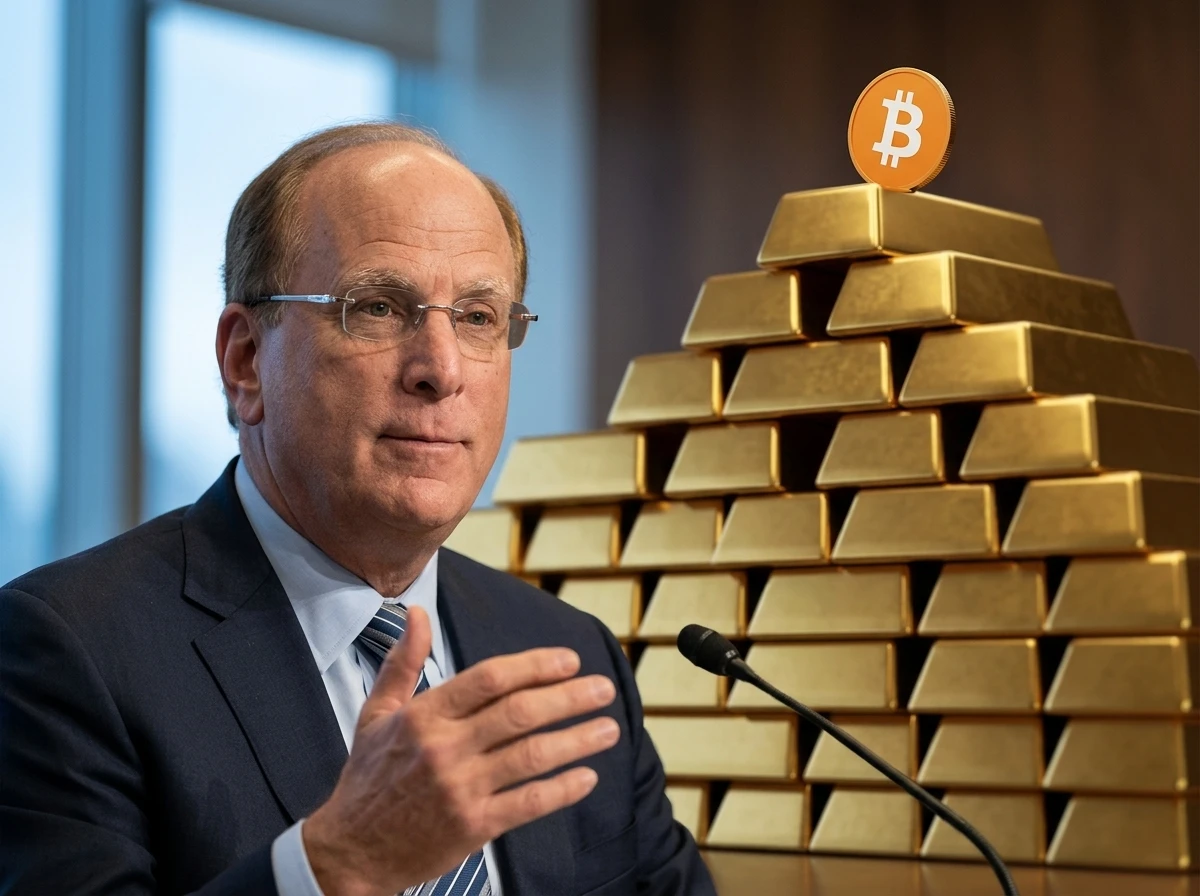
What Fink Told CNBC This Week
Fink told CNBC he is no longer worried about excessive borrowing in Bitcoin and the broader crypto market. “I was always worried about the leverage in bitcoin and crypto. There were too many leveraged players in it. That’s why we had to wash out, and I think there’s more stability at these levels,” he said.
Fink’s tone has shifted before. He called Bitcoin an “index of money laundering” in 2017. He changed course in 2023, when BlackRock filed for what became the industry’s largest spot Bitcoin ETF, and later described Bitcoin as an “international asset” that could hedge against currency debasement.
Much of the CNBC interview covered artificial intelligence. Fink pointed to BlackRock’s own numbers as evidence that technology is already reshaping margins: the firm added $1 trillion in assets over the past year without adding headcount, and margins rose 260 basis points in that span. “A lot of it is using more and more technology,” he said.
Fink pointed to several forces behind his broader confidence, beyond Bitcoin’s price chart alone:
- Leverage washout: repeated liquidation events forced exchanges to close overextended long positions, cutting futures open interest and pushing traders toward options instead of high-leverage perpetual contracts.
- Technology-driven margins: BlackRock’s own 260 basis point margin gain over 12 months, credited to AI-assisted operations and faster code production.
- Compute infrastructure: investment in data centers, chips, and computing capacity, which Fink has called the next major shift in finance.
- Tokenization: the growing need to represent physical and traditional holdings digitally on blockchain rails, a shift pushed forward by real-world asset (RWA) issuers, firms that link treasuries and capital markets to crypto infrastructure.
Is the ETF Inflow Comeback Real?
Partly, and cautiously. Spot Bitcoin ETFs pulled in $107.7 million on Wednesday, extending a rebound that traces back to early July. The gain follows an eight-week stretch that drained more than $8 billion, and on-chain data shows broader demand still lagging behind the fund flows themselves.
The improving mood tracks a softer inflation picture. The Consumer Price Index (CPI), the government’s broadest inflation gauge, cooled to 3.5%, and Wednesday’s session followed a similarly cooling Producer Price Index (PPI) report. BlackRock’s iShares Bitcoin Trust (IBIT) led that day with $80.8 million, followed by Fidelity’s FBTC at $16.9 million and the Grayscale Bitcoin Mini Trust at $10 million. No other spot Bitcoin ETF reported an outflow.
Bitcoin traded near $65,000 that day, a $1.29 trillion market capitalization, inside an intraday range of $64,361 to $65,507, with roughly $28 billion changing hands.
That single green day sits inside a longer pattern. BlackRock’s IBIT had already logged its first inflow in weeks on July 7, part of a $265.7 million session for the whole ETF complex, its largest daily haul in over a month. Reaction spread quickly online too, including a widely shared post reacting to Fink’s comments within hours of the interview airing.
The Crypto Fear and Greed Index had been stuck at 28, in “fear” territory, for days. It ticked up slightly on the news, though it has not left fear territory.
A Year Bitcoin Won’t Miss
Context helps explain why one green week counts as news. Bitcoin hit an all-time high near $126,000 in October 2025. It closed the first half of 2026 down roughly 37%, sliding from near $95,000 in January to below $59,000 by the end of June, more than 53% below that peak.
Spot Bitcoin ETFs absorbed much of that pain. A 10-day, $2.73 billion outflow streak broke on July 2 with a $221.7 million inflow session, led by Fidelity’s FBTC at nearly $166 million. Weeks earlier, industry-wide, US-listed spot Bitcoin ETFs had posted their worst month of withdrawals since launching in January 2024, with more than $4.1 billion pulled from the 13 funds in June, according to Bloomberg. IBIT alone accounted for roughly $3 billion of that figure, its own flagship fund driving the industry’s worst month.
Geopolitics added extra turbulence. When US and Iranian forces exchanged strikes on July 8, oil prices jumped and Bitcoin, which trades around the clock, fell back toward $62,000 within hours, a reminder that crypto prices geopolitical risk in real time, without waiting for equity markets to open.
An eight-week outflow streak that began in mid-May finally broke the week ending July 10, when the ETF complex posted a $197.4 million net inflow. BlackRock’s IBIT brought in $209.4 million in a single July 6 session and finished the week with $291.9 million, even as the broader streak had drained $8.26 billion since May 11.
Some of that selling had a specific trigger beyond macro nerves. Strategy, the corporate Bitcoin holder led by Michael Saylor, sold 32 BTC that spring, its first disclosed sale in nearly four years, rattling sentiment even though the trade was tiny next to its treasury. Citigroup’s analysis afterward pointed to ETF redemptions as the primary driver of the crash.
Do Analysts Agree With Fink’s Bullish Call?
Not entirely. Fink’s stability argument holds up on leverage and liquidations, but Bloomberg’s own ETF analyst warned in late June that outflows were accelerating, and on-chain researchers still see spot demand lagging behind the fund flows that make headlines.
- Larry Fink, BlackRock CEO: argues the leverage washout has left Bitcoin on steadier footing, without naming a specific price target.
- James Seyffart, senior ETF analyst at Bloomberg Intelligence: said on the Milk Road Show, just before the streak broke, that the outflow pace was “not slowing down,” adding, “if anything it’s kind of accelerating.”
- Glassnode, the blockchain analytics firm: found spot trading volume fell 21.5% even as ETF inflows returned, with net market buying turning negative, a sign that broader demand still lags behind institutional flows.
- Jeff Park, chief investment officer at ProCap and an adviser to Bitwise: clarified earlier this year that ETF inflow figures do not translate one-for-one into same-day Bitcoin purchases, since authorized participants can draw on coins they already hold.
Fink’s Tokenization Bet Looms Larger Than Bitcoin’s Price
Fink’s CNBC comments spent as much time on tokenization as on Bitcoin’s chart. He has argued that representing real-world holdings, treasuries, funds, and other traditional assets, digitally on blockchain rails is the more durable opportunity. BlackRock already runs BUIDL, a tokenized Treasury fund that sits alongside similar projects from Franklin Templeton and JPMorgan, part of a push Binance chief executive Richard Teng has called a coming turning point for tokenized finance.
Fink offered no specific Bitcoin price target, which puts him at odds with banks that have. Citigroup has set a 12-month base case of $143,000, with a bullish extension to $189,000, anchored partly to expected US legislative action on digital assets. Fidelity’s Jurrien Timmer has argued 2026 fits the pattern of a historical post-halving slow year, with support expected between $65,000 and $75,000, a far more measured read than Citigroup’s six-figure target. Other forecasts range wider still, from bearish calls near $25,000 to Fundstrat’s $250,000 year-end target, a sign of how unsettled the outlook remains even among people paid to have a view.
Analysts have already flagged the next macro test, noting that crash risk has shifted from options expiry toward central bank policy in recent weeks.
The Federal Reserve meets July 28 and 29, its first decision since cooling inflation data helped fuel this week’s rally. That is the next test for a bullish call that arrived weeks after BlackRock’s own crypto funds shed $3.1 billion in a single quarter.
Disclaimer: This article is for informational purposes only and does not constitute investment advice. Cryptocurrency markets are highly volatile and carry significant risk. Consult a qualified financial advisor before making investment decisions. Figures are accurate as of publication on July 16, 2026.


The House Cancels September Votes and Strands the CLARITY Act

Ascentiz Recruits Developers Around Its Modular Exoskeleton at IFA

Saylor’s Bitcoin Speech Claim Needs a Statute

Zeit AI Raises €5 Million for the Mid-Market Data Layer

Onwards and Sideways Turns Five Good Years Into a Joke

The Galaxy Watch 9 Splits Samsung’s Watch Update Path

Rightcharge Raises £500,000 as Fleets Drift Onto Public Chargers

Early Payment Discounts Hand Buyers a 37 Percent Return

AI Score Raises $5.4 Million as Security Alumni Watch Agents

Sony’s PlayStation Settlement Pays Users in Store Credit

Walter’s TWG Insists No Fraud as Insurer Probes Force Cleanup

30-Year Yield Hits 5.32% Highest Since 2007 as Debt Supply Locks In Costs

PCE Stays at 3.7% as Gas and Tariffs Outrun Coming Revisions

Evernorth S-4 Clears Path for Active XRP Treasury on Nasdaq

Astute’s $1.2M bet makes B2B creator deals feed AI discovery

Strategy Parks $1.59B Cash While Bitcoin Stack Stays Flat

Amber’s €7M locks Mittelstand knowledge inside Europe

SpaceX Stock Rebound Tests Real Demand Before Huge Unlock

The 20% Savings Ideal Meets a 2.7% Reality Check

CLARITY Act Cloture Opens a Door Ethics Still Blocks
-
 FINANCE3 months ago
Zcash Patched a Double-Spend Bug as ZEC Climbed 5%
-
 ENTERTAINMENT3 months ago
Steam Summer Sale 2026 Locks In June 25 to July 9 Dates
-

 FINANCE2 months ago
CLARITY Act Final Text Expected This Weekend as 60-Vote Hurdle Looms
-
 NEWS4 months ago
Meta Adds AI Replies to Threads, But Users Can’t Block It
-

 NEWS3 months ago
YouTube Shorts is testing a heart in place of the thumbs-up
-
 ENTERTAINMENT5 months ago
Extraction 3 Is Officially Coming to Netflix in 2027
-

 NEWS1 month ago
Senators Force Apple Off Chinese Memory as Big Three Cash In
-

 NEWS3 months ago
NEURA Robotics’ $1.4B Series C Redraws Europe’s Physical AI Bet