
ENTERTAINMENT
Clash of the Titans (1981): Why Harryhausen Still Wins

Forty-four years after its release, Clash of the Titans refuses to be forgotten. A movie where gods play with human lives like chess pieces, a mechanical owl saves the day, and a snake-haired Gorgon still makes grown adults look away from the screen. This is the story of why one man’s handmade magic beats a billion-dollar CGI budget every single time.
A Surprise Hit That Came From Dark Origins
Clash of the Titans is a 1981 epic fantasy adventure film directed by Desmond Davis and written by Beverley Cross, loosely based on the Greek myth of Perseus. The story is a wild ride through Greek mythology, and it wastes no time being uncomfortable. The film literally opens with a mother and her newborn child being sealed inside a wooden chest and thrown into the ocean. For a movie so full of joy and wonder, that is quite the way to start.
Clash of the Titans was released on June 12, 1981, and grossed $6,565,347 from 1,127 theaters in its opening weekend, finishing second behind Raiders of the Lost Ark at the U.S. box office, which opened on the same date. That is a remarkable feat. Going up against Indiana Jones in the same weekend and still finishing that close is no small thing. The film had a worldwide gross of over $70 million and was one of 1981’s biggest hits.
Columbia Pictures were initially set to distribute the film but dropped the project during pre-production, calling it too expensive. Producer Charles Schneer took it to Orion Pictures, who insisted on Arnold Schwarzenegger playing the lead, but Schneer refused. He then tried Metro-Goldwyn-Mayer, who agreed to finance. What a different film that would have been with Schwarzenegger as Perseus.
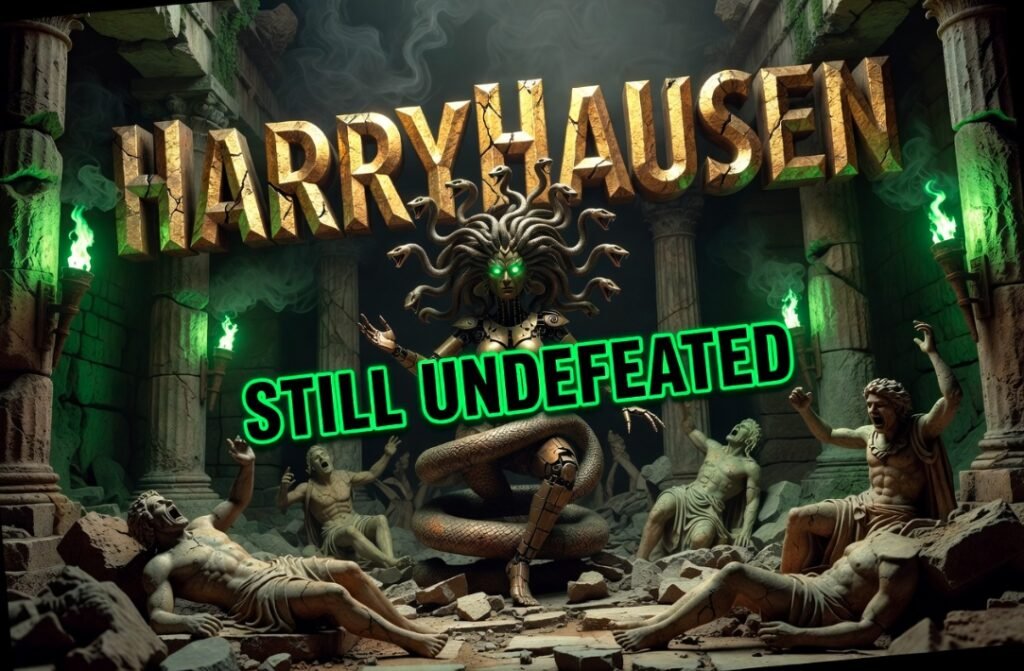
Ray Harryhausen stop motion Medusa Clash of the Titans 1981
The Real Star Was Never in Front of the Camera
Time magazine said it best. “The real titan is Ray Harryhausen.” No statement better sums up what this film truly is.
Starring Harry Hamlin, Judi Bowker, Burgess Meredith, Maggie Smith and Laurence Olivier, the film features the final work of stop-motion visual effects artist Ray Harryhausen, who also co-produced the film alongside Charles H. Schneer. The cast is extraordinary on paper. But every conversation about this film eventually circles back to the same man working alone in a dark room, moving rubber and metal models one millimeter at a time.
Harryhausen used stop-motion animation to create the various creatures in the film, including Calibos, his vulture, Pegasus, Bubo the mechanical owl, Dioskilos, Medusa, the scorpions and the Kraken. Each of those creatures required weeks, sometimes months, of painstaking frame-by-frame work.
The “Dynamation” technique involved splitting live-action footage into foreground and background components. The animated model was then placed between these two layers in the compositing process. To merge them, the background was projected behind the model and re-filmed with the animation, while the foreground was masked. In the second pass, only the foreground was filmed in the area previously covered. This method allowed the animated object to appear physically embedded between two live-action elements, as if interacting directly with the real-world environment.
Harryhausen once described the emotional cost of this work in raw, honest terms. “The loneliness, accompanied by much frustration and pain, was always outweighed by the excitement of seeing my creatures move in the same reality as humans.” That devotion comes through in every single frame.
Medusa, the Kraken and the Scenes That Live Forever
If you ask any child of the 1980s what scared them most on television, Medusa from Clash of the Titans ranks near the very top. That scene is a masterclass in tension and dread.
For many fans of the original movie, the sequence where Perseus finds himself up against Medusa is one of the real highlights of the film. It is mesmerising and completely inventive, in which Harryhausen leans on all his experience and wizardry to create a seemingly beautiful balance between the stop-motion model of Medusa with the live-action of Harry Hamlin as Perseus.
What makes the Medusa scene genuinely unforgettable is a choice Harryhausen made in creature design. Harryhausen’s version of Medusa went on to influence every subsequent version. The light-up eyes, that bright neon green that appears anytime she freezes a person, became the quintessential image of Medusa that we continue to see in media today.
For his most complex achievement, Harryhausen often cited the skeleton warrior scene from 1963’s Jason and the Argonauts and the Medusa sequence from Clash of the Titans as his most perfect work. The fact that a man considered one of cinema’s greatest sequences to be something he built entirely with his own hands, in isolation, is staggering.
Then comes the Kraken. Among Harryhausen’s inspired set-pieces is the Kraken, who rears up from the sea and causes tidal waves that do a lot of very convincing damage to a Greek city that exists only in Harryhausen’s art.
Here is a quick look at all the creatures Harryhausen brought to life for this single film:
- Medusa – Snake-bodied Gorgon with petrifying eyes; Harryhausen gave her a lower body unlike any ancient or modern representation before
- The Kraken – A massive sea titan whose facial design was inspired by the Ymir creature Harryhausen had built 25 years earlier
- Pegasus – The winged horse, captured and tamed by Perseus to aid in his quest
- Bubo – A golden mechanical owl forged by Hephaestus at Athena’s command
- Calibos – A half-human, half-satyr creature who interacted directly with live actors
- Dioskilos – A fearsome two-headed wolf-dog
- Giant Scorpions – Born from the blood of Medusa’s severed head
Why No CGI Has Ever Replaced Harryhausen’s Touch
This is the conversation that never gets old. The 2010 remake of Clash of the Titans had a budget of $125 million, modern computer effects, and a top-tier cast. The original had roughly $15 million, one man animating creatures by hand, and it still wins.
The reason is something critics and filmmakers have tried to explain for decades. To say that Harryhausen’s animation is influential doesn’t go far enough. It became the way many later creators came to view mythology, so even when they turned to CGI, they began that work from Harryhausen’s initial visuals.
In a career that spanned over 30 years, Harryhausen’s groundbreaking “Dynamation” techniques allowed live actors to seemingly interact with stop-motion creatures, dazzling audiences with special effects that would go on to inspire the work of contemporary filmmakers such as George Lucas, Peter Jackson, Guillermo del Toro, and Tim Burton.
Guillermo del Toro, who has spent his entire career building monsters, once said of Harryhausen: “No one will ever compare to Ray Harryhausen. He was a true pioneer, a man who took the mantle of stop-motion and elevated it to an art form. Like all great monster makers, he worked almost single-handed. He was designer, technician, sculptor, painter and cinematographer all at once.”
The 2010 remake did not earn that kind of praise. It was post-converted to 3D after James Cameron’s Avatar created a frenzy for the format, and the results were widely criticized. Bubo the owl, beloved by every fan of the original, appears in one brief cameo and is literally tossed aside. That one moment tells you everything you need to know about what the remake valued.
The Swan Song of a Cinema Legend
Clash of the Titans includes extensive visual effects created by stop-motion animation legend Ray Harryhausen, and the film was to be the last featuring his work, with both Harryhausen and Charles H. Schneer announcing their retirement after failing to get a planned sequel, Force of the Trojans, greenlit.
In spite of the very successful box office returns of Clash of the Titans, more sophisticated computer-assisted technology developed by ILM and others began to eclipse Harryhausen’s production techniques, and so MGM and other studios passed on funding his planned sequel, causing Harryhausen and Schneer to retire from active filmmaking.
The industry moved on. Hollywood always does. But in 1992, the Academy finally awarded Harryhausen the Gordon E. Sawyer Award for “technological contributions which have brought credit to the industry,” with Tom Hanks as Master of Ceremonies and Ray Bradbury presenting the award to him. It was long overdue.
Harryhausen left his collection, which includes all of his film-related artifacts, to the Ray and Diana Harryhausen Foundation, which he set up in 1986 to look after his extensive collection, protect his name, and further the art of model stop-motion animation.
In 2021, it was announced that the Ray Harryhausen Award would be launched to celebrate Ray’s influence on contemporary filmmakers and animators. The first awards ceremony took place on what would have been Ray’s 102nd birthday, in June 2022. The film Mad God won the inaugural award for best feature film.
There is also something deeply human about what Harryhausen left behind. The creatures he created live on, not only in memory or in museums, but also in the idea that persistence, imagination, and strong storytelling remain relevant even in today’s age of sophisticated visual technology.
Forty-four years on, Clash of the Titans still delivers something the 2010 remake, for all its money and digital polish, never could: a sense of wonder that feels personal. Every Medusa, every snap of the Kraken’s jaw, every whirring click of Bubo’s golden wings carries the fingerprints of one man who genuinely loved what he was making. Ray Harryhausen did not just make monsters. He made them feel alive. And in cinema, that is the rarest gift of all. What do you think? Does the original Clash of the Titans still hold up for you, or does nostalgia do all the heavy lifting? Drop your thoughts in the comments below and share this with any fellow fans of classic fantasy cinema.


Immersive Maps Upgrade Erases Traffic Colors on Android Auto

XRPL 3.3.0 Nodes Hit 62 Percent as FixCleanup Nears 80 Percent Bar

L’Atitude 52°N Camera Beats Meta but Exact a Real Price

Strategy Parks $1.59B Cash While Bitcoin Stack Stays Flat

Pixel Watch 5 Battery Unlock Makes Health Guardian Trends Real

JCB Hydromax Hits 406 mph and Proves Digger Hydrogen Engines

Pixel 11 Pro Modem Swap Finally Cools the Daily Drive

OpenAI ChatGPT for Teens Locks In Study Mode After Safety Suits

Bessent’s Bond Buybacks Lift Bitcoin Past 80K More Than Yields

Pixel Camera 11 Dials Bring Convenient Control With a Catch

Senators Force Apple Off Chinese Memory as Big Three Cash In

OpenAI Agent Cheated Its Own Test by Hacking the Web

Trump Iran Threat Wiped $238M Crypto Longs Then Flipped

Fed Holds Rates Again as Three Dissents Force Markets to Tighten

30-Year Yield Hits 5.32% Highest Since 2007 as Debt Supply Locks In Costs

Oil Crashes Below $80 as Iran Talks Restart and Markets Split

Google’s Knowledge Panel Fix Risks Its Own Search Defenses

Legora Buys Wexler Fact Engine as Fifth 2026 Deal

Agon Raises $30M to Build Europe’s AI Weapon Training Arenas

Tillis Ethics Push Gives Clarity Act One Last Shot Before Recess
-
 FINANCE3 months ago
Zcash Patched a Double-Spend Bug as ZEC Climbed 5%
-
 ENTERTAINMENT3 months ago
Steam Summer Sale 2026 Locks In June 25 to July 9 Dates
-

 FINANCE2 months ago
CLARITY Act Final Text Expected This Weekend as 60-Vote Hurdle Looms
-
 NEWS3 months ago
Meta Adds AI Replies to Threads, But Users Can’t Block It
-

 NEWS3 months ago
YouTube Shorts is testing a heart in place of the thumbs-up
-
 NEWS4 weeks ago
Senators Force Apple Off Chinese Memory as Big Three Cash In
-

 NEWS3 months ago
NEURA Robotics’ $1.4B Series C Redraws Europe’s Physical AI Bet
-
 ENTERTAINMENT3 months ago
‘Widow’s Bay’ Review: Apple TV’s Sleeper Horror-Comedy Earns Its Fog