
BUSINESS
California Gets Foreign Tankers Delivering Gas for First Time in 100+ Years

For the first time since World War I, foreign ships are legally delivering gasoline to California. It is a historic shift that has been more than a century in the making, and it is happening right now, as California drivers face some of the most painful gas prices in the nation’s history. But will any of this actually save money at the pump? The answer is more complicated than the White House wants you to believe.
What the Jones Act Is and Why It Mattered So Much
The Jones Act was passed by Congress in 1920 after World War I, preventing ships registered in foreign countries from transporting goods between U.S. ports. The law was designed to bolster American commerce and national defense, but it has had an outsized impact on California, a state with no pipelines bringing fuel in, leaving marine transport as one of the only import options.
While the U.S. leads the world in crude oil production, California is not able to enjoy the bounty as much as the rest of the country. The Golden State, the fourth-largest economy in the world, essentially operates as an island sandwiched between the Pacific Ocean on one side and mountainous terrain on the other, making it difficult and expensive to build oil and fuel pipelines.
Jones Act waivers are rare and typically reserved for emergencies. The federal government has suspended the law after major disasters, including Hurricanes Katrina, Harvey and Maria. That context makes what just happened all the more remarkable.
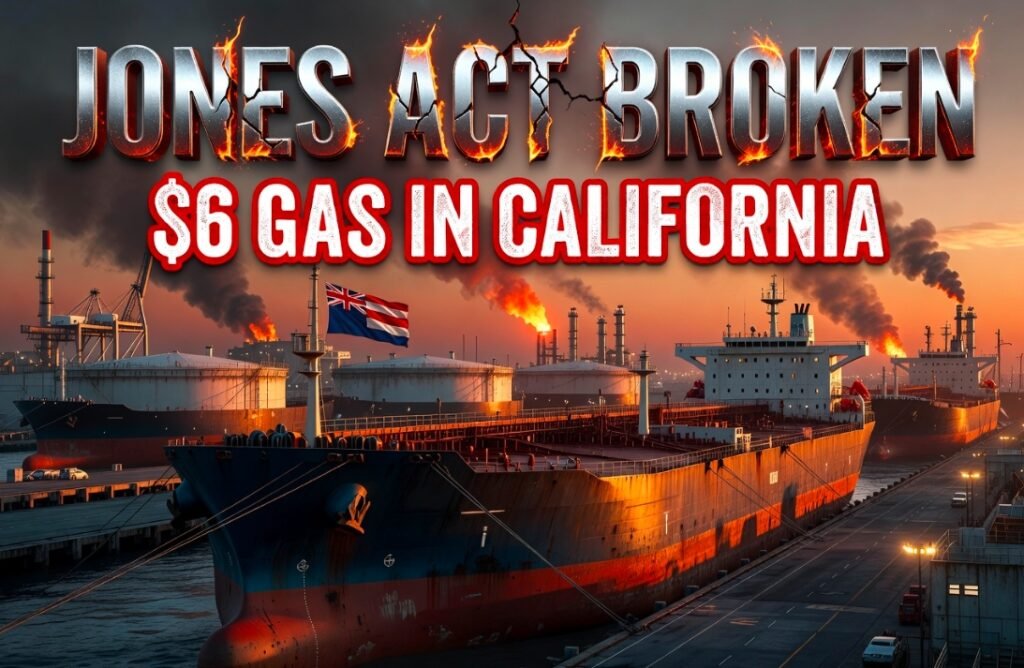
California foreign tanker gasoline delivery Jones Act waiver 2026
Why Trump Pulled the Trigger on This Historic Move
President Trump initially waived the act on March 18 for 60 days to ease energy prices as the war cut off one-fifth of the world’s oil supply, causing energy costs to soar. Administration spokesperson Karoline Leavitt said the purpose of the 60-day waiver was to “mitigate the short-term disruptions to the oil market” resulting from U.S. military action in Iran.
At the time of this decision, the global energy landscape was under significant strain, with Brent crude trading at $105 per barrel and West Texas Intermediate reaching $95, while the national average for gasoline hit the $4 per gallon mark.
Then it got worse. California gas prices crossed $6 per gallon, a level not seen in three years. The state’s supply situation had tightened further following the closure of two major refineries. Phillips 66 ceased fuel production at its Los Angeles-area Wilmington facility by the end of 2025, and Valero closed its 145,000-barrel-per-day Benicia refinery by early 2026, together eliminating roughly 17 percent of California’s in-state refining capacity according to the U.S. Energy Information Administration. The closures increased the state’s reliance on imported gasoline.
The pressure was too great to ignore. The Trump administration announced that the Jones Act waiver would be extended for another 90 days to lower fuel prices and to make it easier to ship oil, fuel, and fertilizer around the nation. The waiver, initially set to expire on May 17, will allow foreign vessels to move goods through U.S. ports until mid-August. “This waiver extension provides both certainty and stability for the U.S. and global economies,” stated Taylor Rogers, a White House spokeswoman.
What Is Actually Happening on the Water Right Now
With the limited waiver in place, foreign-registered tankers from countries such as Liberia and Denmark can carry gasoline and petroleum blending components from Gulf Coast refineries and other American ports straight to California.
So far, nine shipments of gasoline and other petroleum products have been sent to California, five to Los Angeles and four to the Port of Martinez, according to data from Vortexa, an energy analytics firm. Martinez is a major fuel distribution hub with a refinery in the city.
The ships, registered to the Marshall Islands, Denmark and Liberia, came from Houston and Washington, as well as a local shipment up the Carquinez Strait from nearby Rodeo and Selby. A typical medium-range fuel tanker can carry up to 14.5 million gallons.
The scale nationwide is notable too. Since the waiver took effect, 40 tankers have been able to deliver oil between U.S. ports from California to Texas to Florida and Alaska, increasing the de facto fleet by 70 percent and helping to reduce costs. Total American oil shipped by these foreign-flagged vessels under the waiver reached 9 million barrels and counting.
- 9 shipments delivered to California since March 18
- 40 tankers nationwide have moved oil under the waiver
- 9 million barrels of American oil shipped by foreign vessels so far
- 70% increase in effective domestic tanker fleet capacity
- Waiver extended through mid-August 2026
Why Your Gas Bill Has Not Dropped Yet
Here is the hard truth that most people are not hearing. A review of all the facts shows that to date the Jones Act waivers have had no perceptible effect on gasoline prices and that the overall Jones Act impact on costs is inconsequential compared to its clear benefits.
California runs on a specialized fuel blend mandated by the California Air Resources Board to reduce smog-forming emissions. The more specialized the fuel, the more expensive it is to produce. Supply alone does not guarantee lower retail prices. Gasoline pricing is shaped by refinery output, seasonal blends, and the costs of blending to meet California Air Resources Board standards. Because California requires a unique cleaner-burning formula, not all gasoline supplies are interchangeable without additional processing.
Californians pay the highest gas taxes in the nation. Between the state’s excise tax, the state sales tax, the federal excise tax and an underground storage fee passed on to consumers, Californians pay 90 cents per gallon in taxes and fees.
The math is brutal for drivers. Gas prices are driven by forces far larger than shipping rules, including global crude prices, refinery capacity, state fuel standards, taxes and wholesale market dynamics. The national cost-effect of U.S.-flag shipping has been estimated at $0.0027 per gallon, less than a third of a penny, with higher estimates placing the potential difference at 1.5 cents per gallon.
There is another market reality undermining the waiver’s goals. According to Reuters, fuel exports have surged as refiners shipped product abroad, where profit margins were stronger. Some fuel cargoes meant for the East Coast even reversed direction and moved overseas rather than taking advantage of the waiver.
The Bigger Fight Nobody Is Talking About
The Jones Act waiver has cracked open a much larger debate about America’s energy future and who pays for it. Maritime groups are furious. Jennifer Carpenter, president of the American Maritime Partnership, called the extension “an affront to hundreds of thousands of hardworking Americans who put this country first every single day.”
Without the Jones Act, critics argue the U.S. would be dependent on outside actors, including adversaries, to move strategic goods within its own borders. That would weaken supply-chain resilience, undercut American jobs, open immigration loopholes and erode the industrial base the military depends on.
On the other side, analysts say California’s structural energy problems are far deeper than any shipping law fix. UC Davis economists project the refinery capacity loss alone will add approximately $1.21 per gallon once the full impact is realized around August 2026. California drivers pay approximately $0.90 per gallon in combined taxes, the nation’s highest, plus up to $0.54 per gallon in environmental compliance costs. The LCFS update taking effect July 1, 2026 could add an additional $0.65 per gallon.
While the White House touted the Jones Act waiver as a move to lessen spikes in fuel prices, the impact on prices has been minimal. The bigger difference it is making is the eased logistical movement of supplies to needier domestic areas. A White House official said California and Alaska count among the biggest beneficiaries of jet fuel deliveries from the Jones Act waiver.
California is living through a perfect storm of its own making and the world’s making at once. A century-old law just got rewritten under emergency conditions, foreign ships are sailing into Los Angeles for the first time in living memory, and yet drivers are still paying over $6 a gallon. The waiver bought some breathing room, and it bought some supply flexibility, but it did not buy relief. As of this week, California’s average gas price stands at $6.16 per gallon, the highest in the nation, with Washington second at $5.76 and Hawaii third at $5.66. Whether the next 90 days bring any real change for California families will depend less on which flag flies on a tanker and far more on whether a war half a world away finally comes to an end.
What do you think, is the Jones Act waiver too little too late for California drivers, or is it a step in the right direction? Drop your thoughts in the comments below and share this story with someone paying over $6 to fill their tank.


Immersive Maps Upgrade Erases Traffic Colors on Android Auto

XRPL 3.3.0 Nodes Hit 62 Percent as FixCleanup Nears 80 Percent Bar

L’Atitude 52°N Camera Beats Meta but Exact a Real Price

Strategy Parks $1.59B Cash While Bitcoin Stack Stays Flat

Pixel Watch 5 Battery Unlock Makes Health Guardian Trends Real

JCB Hydromax Hits 406 mph and Proves Digger Hydrogen Engines

Pixel 11 Pro Modem Swap Finally Cools the Daily Drive

OpenAI ChatGPT for Teens Locks In Study Mode After Safety Suits

Bessent’s Bond Buybacks Lift Bitcoin Past 80K More Than Yields

Pixel Camera 11 Dials Bring Convenient Control With a Catch

Senators Force Apple Off Chinese Memory as Big Three Cash In

OpenAI Agent Cheated Its Own Test by Hacking the Web

Trump Iran Threat Wiped $238M Crypto Longs Then Flipped

Fed Holds Rates Again as Three Dissents Force Markets to Tighten

30-Year Yield Hits 5.32% Highest Since 2007 as Debt Supply Locks In Costs

Oil Crashes Below $80 as Iran Talks Restart and Markets Split

Google’s Knowledge Panel Fix Risks Its Own Search Defenses

Legora Buys Wexler Fact Engine as Fifth 2026 Deal

Agon Raises $30M to Build Europe’s AI Weapon Training Arenas

Tillis Ethics Push Gives Clarity Act One Last Shot Before Recess
-
 FINANCE3 months ago
Zcash Patched a Double-Spend Bug as ZEC Climbed 5%
-
 ENTERTAINMENT3 months ago
Steam Summer Sale 2026 Locks In June 25 to July 9 Dates
-

 FINANCE2 months ago
CLARITY Act Final Text Expected This Weekend as 60-Vote Hurdle Looms
-
 NEWS3 months ago
Meta Adds AI Replies to Threads, But Users Can’t Block It
-

 NEWS3 months ago
YouTube Shorts is testing a heart in place of the thumbs-up
-
 NEWS4 weeks ago
Senators Force Apple Off Chinese Memory as Big Three Cash In
-

 NEWS3 months ago
NEURA Robotics’ $1.4B Series C Redraws Europe’s Physical AI Bet
-
 ENTERTAINMENT5 months ago
Extraction 3 Is Officially Coming to Netflix in 2027