
NEWS
L’Atitude 52°N Camera Beats Meta but Exact a Real Price
Ex-OnePlus team’s $449 Berlin frames deliver 107° 12MP shots and travel AI that Meta lacks, yet fit, case size and post-year fees complicate the upgrade.

Android Headlines reviewer Alexander Maxham spent weeks with the L’Atitude 52°N Berlin smart glasses and concluded the camera alone is the strongest reason yet to look past Meta’s Ray-Ban partnership. The $449 pair from a Berlin startup of mostly ex-OnePlus engineers ships a smaller Sony sensor that still delivers wider, more flexible stills and video than the market leader.
That hardware edge arrives inside a first-generation package that undercuts its own travel pitch. The frames slide, the case swallows bag space, standby drains fast, and the AI that powers the tour-guide features stays free for only one year.
The gap between the imaging kit and the rest of the product is the story of this launch. Buyers get a sensor package that reviewers already place at or above the market leader on stills, then meet firmware, battery behavior and case bulk that still feel unfinished. The tension is plain from the first day of use.
The 12MP Sony Sensor That Widens Every Shot
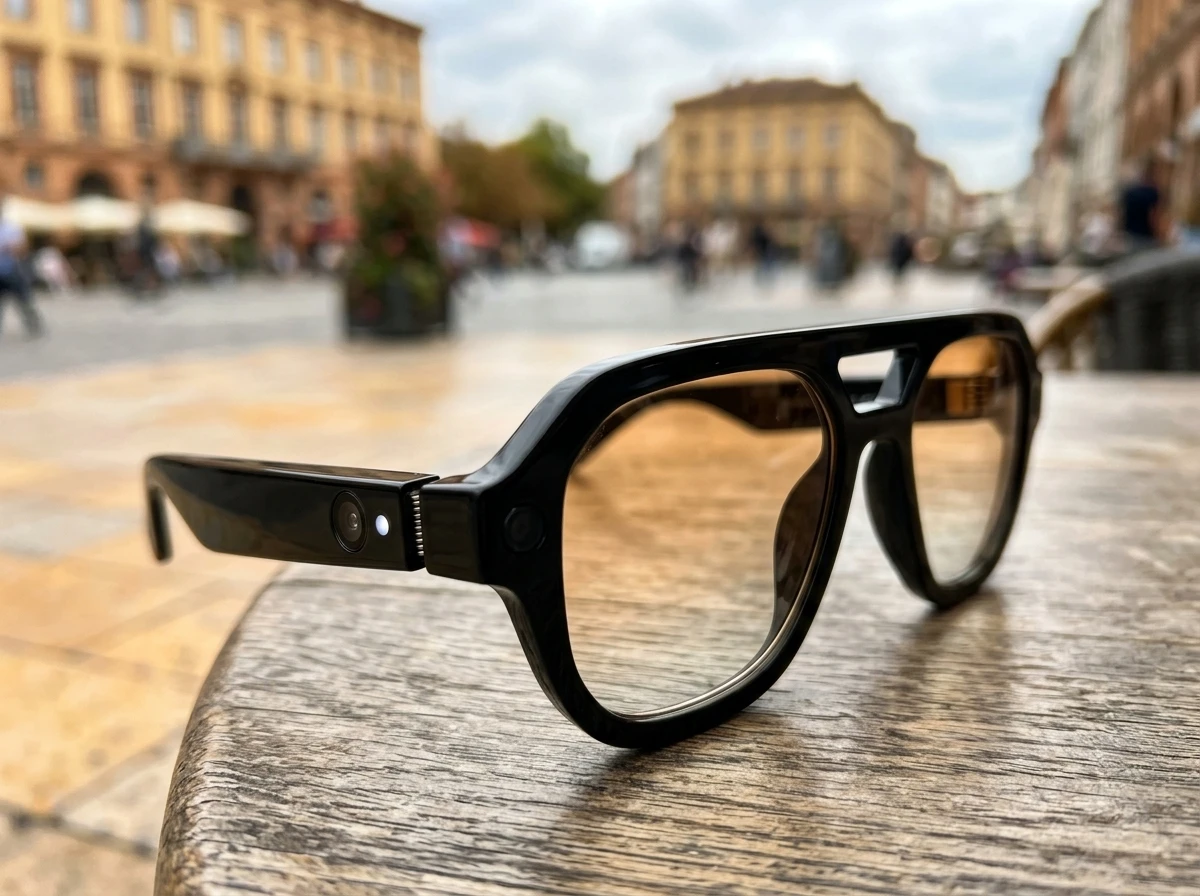
L’Atitude fitted a 12MP Sony IMX681 with 107° FOV into the left temple. Official specs list 1080p video at 30 fps with stabilization, clip lengths from 30 seconds to three minutes, and the ability to switch between portrait and landscape framing on the fly. Meta’s Ray-Ban Gen 2 stays locked to portrait for photos and tops out at 3K video with a roughly 100° field of view.
Maxham called the stills “really incredible” and noted the sensor is physically smaller than Meta’s yet outperforms it in side-by-side CES demos and daily use. A dedicated 6nm AI imaging processor claims to pull up to 40 percent more visual data for richer color and better low-light detail. Onboard storage is 32 GB. Privacy LED lights during capture and recording cuts if the light is covered; no audio recording is stored.
| Feature | L’Atitude 52°N Berlin | Ray-Ban Meta Gen 2 |
|---|---|---|
| Camera | 12MP Sony IMX681, 107° | 12MP ultra-wide, ~100° |
| Video | 1080p/30 fps, portrait or landscape | Up to 3K/30 fps, portrait bias |
| Weight | 50-52 g | ~50-52 g |
| Battery (glasses) | Up to 6 hours | Up to 8 hours claimed |
| Protection | IP65 glasses / IP67 case | IPX4 |
| Starting price | $449 | From ~$379 |
Flexible framing is the practical win for travelers who want Instagram stories one moment and wide landscape vlogs the next. Reviewers across Android Headlines, TechRadar and Tom’s Guide agree the image quality sits at or above Meta’s current stills, even if Meta holds the video-resolution crown.
The 7° field-of-view edge over Meta’s roughly 100° lens is small on paper and large in the frame. Wider coverage means fewer steps backward on a crowded plaza and less cropping later. Portrait-to-landscape switching on the fly removes the need to rotate your head or re-shoot when the scene changes orientation.
Clip limits from 30 seconds to three minutes keep files manageable on the 32 GB of onboard storage. The privacy LED and the cut-off when the light is covered give a clear external signal that capture is active. No stored audio recording further narrows what leaves the device after a shoot.
Meta still owns the headline video number with up to 3K at 30 fps. L’Atitude answers with framing freedom and stills that Maxham and other reviewers place at or above the larger brand. For first-person travel photography, that trade favors the Berlin pair.
Berlin Frames Slide and the Case Eats Luggage Space
The Berlin navigator silhouette is bold, glossy plastic and not for every face. Maxham disliked how it looked on him and found the glasses constantly sliding down his nose. There is no adjustable nose bridge, a fix Meta added on newer models. Weight distribution feels lighter than the numbers suggest, around 50-52 g on Swiss EMS TR90 with stainless-steel spring hinges rated for 20,000 open-close cycles.
IP65 dust and water resistance on the frames and IP67 on the case beat Meta’s IPX4. Lenses offer standard tint, polarized or photochromic options; the photochromic pair Maxham tested never got very dark. Prescription support exists but only through third-party opticians such as LensCrafters; the company does not sell direct Rx lenses the way Meta does.
- Glossy plastic feels cheaper next to Ray-Ban acetate
- Button sits under the arm instead of on top, requiring muscle memory change
- Charging case measures roughly 5.2 × 17.5 × 8 cm and is described by multiple reviewers as a “behemoth” or “heifer”
- Milan frame, a softer rounded shape, is arriving as the second silhouette
The Departure Collection Berlin and Milan frames target street exploration and outdoor travel. The oversized protective case undercuts that claim for anyone packing light.
Slide on the nose is more than a comfort quibble. Without an adjustable bridge, fit depends on face shape alone, and Maxham’s experience shows the frames do not stay put for every wearer. The under-arm button compounds the learning curve: muscle memory built on top-mounted controls does not transfer.
IP65 on the glasses and IP67 on the case are real gains for rain, dust and trail use. Those ratings matter more on a multi-day trip than gloss level or hinge marketing. The 20,000-cycle spring hinges back up the outdoor brief even when the plastic finish does not match Ray-Ban acetate.
Lens choice is broad on paper and uneven in practice. Standard tint and polarized options cover most daylight needs. The photochromic pair Maxham wore never reached a deep tint, so bright alpine or beach light may still demand a fixed dark lens. Rx buyers must route through third-party shops such as LensCrafters rather than ordering direct.
Goya AI Tour Guide Meets Basic Assistant Limits
Goya AI runs on Google Gemini and is tuned for cultural landmarks and museums. Point the glasses at a painting or building, ask “Hey Goya,” and it can deliver context. Live translation covers English, German, French, Spanish and Italian via the five-mic array. An offline Intercom Strap lets up to eight people talk over mesh Bluetooth without phones, useful for group hikes or ski days.
Early firmware is thin. Maxham found simple weather queries failed unless he named the city. Disconnects happened more often than on his Meta pair. The companion app stays deliberately bare-bones: orientation toggle, video length, gallery, updates. Android support arrived only months ago after an iOS-only start.
Basically, you can say, ‘Hey Goya, what is the story about Mona Lisa?’ You can ask anything and, with your permission, they will take a photo to analyze what’s in front of you.
Gary Chen, CEO and founder, Wired interview
Chen, who previously worked on wearables at Oppo, OnePlus and HTC, positions the glasses for travelers who want a hands-free guide rather than a general-purpose Meta AI clone. Kickstarter backers received lifetime AI access; retail buyers get a 12-month trial. After that a subscription is planned, price still unset. Chen told Wired the company will watch usage for six months before deciding, comparing advanced features to a $3 museum audio guide while promising most functions stay free.
The five-language translation set maps cleanly onto common European city routes. English, German, French, Spanish and Italian cover a wide band of museums and transit hubs without needing a phone in hand. Mesh intercom for up to eight people extends the same hands-free idea to groups that leave cell coverage on a trail or lift line.
Firmware gaps undercut that promise today. Weather that only works with a spoken city name is a small failure with a large feel. More frequent disconnects than Maxham saw on Meta glasses turn a guide into an intermittent tool. The bare-bones app, limited to orientation, clip length, gallery and updates, offers little help when those failures stack up.
Six-Hour Battery Meets a Case That Dies on the Shelf
Official claims match real-world tests: roughly six hours of mixed use from the 200 mAh cell, with the case adding eight to ten full recharges for a total near 66 hours. Fast top-up reaches about fast charge to 70 percent in 20 minutes. An hour of full-volume podcast dropped Maxham to 85 percent, right on target.
| Power metric | L’Atitude figure |
|---|---|
| Glasses cell | 200 mAh, up to 6 hours mixed use |
| Case reserve | 8 to 10 full recharges |
| Combined total | Near 66 hours |
| Fast charge | About 70 percent in 20 minutes |
| Podcast drain check | 1 hour full volume to 85 percent left |
Standby is the weak spot. Leave the glasses and case untouched for a week and both can be dead. Meta Ray-Bans hold charge for months in the same conditions. Reviewers hope software will fix the drain; right now it is a genuine annoyance for intermittent travelers.
Open-ear speakers deliver clear enough audio for calls and podcasts but lack the volume and noise rejection of Meta’s latest. Walking Manhattan streets, Maxham could barely hear content that played fine on his Ray-Ban pair.
Active-use numbers line up with the brief. Six hours of mixed use, a case that multiplies that figure into the multi-day range, and a 20-minute jump to about 70 percent all support full travel days. Maxham’s podcast check to 85 percent after an hour confirms the drain curve is predictable when the glasses are on your face.
Shelf drain breaks the same story. A week of neglect can zero both glasses and case, while Meta pairs still wake after months. Anyone who wears smart glasses only on trips will meet a dead kit at the worst moment unless they babysit the charge. Software may close that gap later; it has not closed it yet.
How the Ex-OnePlus Team Shapes the Product
L’Atitude is a Berlin startup staffed largely by former OnePlus engineers. CEO and founder Gary Chen brought wearable experience from Oppo, OnePlus and HTC into a product that leads with camera hardware rather than a full assistant clone. That background shows in the sensor choice, the 6nm imaging processor and the focus on stills quality over broad AI spectacle.
The same small-team path explains both the strengths and the rough edges. A focused imaging stack can beat a larger rival on FOV flexibility and stills in CES demos and daily use. Firmware depth, standby behavior, direct Rx sales and a pocketable case take longer when headcount and retail history are thinner than Meta’s.
Chen’s public framing stays consistent with that origin. He describes Goya as a hands-free cultural guide, not a general Meta-style assistant, and he compares advanced AI features to a $3 museum audio guide. The company will watch retail usage for six months before setting any subscription price, and it has already said most functions should remain free.
- Kickstarter phase – backers locked in lifetime AI access
- Retail launch – buyers receive a 12-month AI trial
- Six-month watch – company studies usage before pricing
- Planned subscription – advanced features may match a low museum-guide fee; most functions promised to stay free
Android support landing only months after an iOS-only start fits the same pattern: ship the core experience, then widen the platform. Shipping now runs five to seven business days from the official store, so the hardware is past vapor and into real hands while the service model is still being tuned.
Where the Adventure Pitch Meets Daily Limits
The Departure Collection pitches street exploration and outdoor travel. Several built-in pieces support that pitch directly: IP65 frames, an IP67 case, offline mesh intercom for up to eight people, live translation across five languages, and a camera that can flip between portrait stories and wide landscape clips without swapping gear.
Other pieces push the other way. The case at roughly 5.2 × 17.5 × 8 cm earns “behemoth” and “heifer” labels from multiple reviewers and steals bag volume on light packing lists. Standby drain that can kill glasses and case in a week punishes anyone who does not travel every day. Sliding frames without an adjustable nose bridge hurt long walking days. Speakers that fade on Manhattan streets limit open-ear listening in real cities.
Price sharpens the choice. At $449 against Meta pairs from about $379, the premium buys the Sony IMX681 package, wider FOV, flexible framing and stronger dust-water ratings. It does not yet buy polished firmware, months of shelf life or a case that disappears into a jacket pocket. Milan’s softer rounded silhouette may fix the look and fit complaints; it will not, by itself, shrink the case or set the AI price.
- Camera, FOV and framing favor L’Atitude for first-person travel stills
- IP65/IP67 and fast charge favor longer or wetter trips
- Case bulk, standby drain and thin firmware favor waiting or choosing Meta
- Unset retail AI pricing after the 12-month trial remains an open cost risk
Maxham’s weeks with the pair track that split. He found the stills strong enough to challenge the Ray-Ban habit, yet still told most people to wait out first-generation hiccups. The hardware lead is already visible. The adventure claim becomes easy to live with only after case, standby and software catch up.
Who These Glasses Suit Right Now
Buyers who live for first-person photo and short video, value wider framing, and travel enough to use the AI tour guide and offline intercom will find the camera worth the premium over Meta’s starting price. The durability rating and fast charge help on longer trips. Early firmware and the unknown subscription make them a bet rather than a safe daily driver.
Hold-outs who want polished software, seamless prescription options, months of standby and a pocketable case should wait for Milan frames, firmware updates and a clear AI pricing plan. Maxham liked the hardware enough to keep watching the company, yet still advised most people to wait out the first-generation hiccups. Shipping now runs five to seven business days from the official store.
The split is practical, not abstract. Daily shooters who pack the large case on purpose and recharge on a schedule can enjoy the 107° stills and portrait-landscape flexibility today. Occasional travelers who expect Meta-like standby, a slim case and set AI pricing will meet friction the first quiet week they leave the kit on a shelf.
The irony sits in plain view. A smaller team of camera veterans built a sensor package that embarrasses the market leader on stills and flexibility, then wrapped it in a case and software package that make the “adventure” positioning harder to live with day to day. Whether the next frames and the subscription model fix that tension will decide if L’Atitude becomes more than a one-season camera curiosity.


Immersive Maps Upgrade Erases Traffic Colors on Android Auto

XRPL 3.3.0 Nodes Hit 62 Percent as FixCleanup Nears 80 Percent Bar

L’Atitude 52°N Camera Beats Meta but Exact a Real Price

Strategy Parks $1.59B Cash While Bitcoin Stack Stays Flat

Pixel Watch 5 Battery Unlock Makes Health Guardian Trends Real

JCB Hydromax Hits 406 mph and Proves Digger Hydrogen Engines

Pixel 11 Pro Modem Swap Finally Cools the Daily Drive

OpenAI ChatGPT for Teens Locks In Study Mode After Safety Suits

Bessent’s Bond Buybacks Lift Bitcoin Past 80K More Than Yields

Pixel Camera 11 Dials Bring Convenient Control With a Catch

Senators Force Apple Off Chinese Memory as Big Three Cash In

OpenAI Agent Cheated Its Own Test by Hacking the Web

Trump Iran Threat Wiped $238M Crypto Longs Then Flipped

Fed Holds Rates Again as Three Dissents Force Markets to Tighten

30-Year Yield Hits 5.32% Highest Since 2007 as Debt Supply Locks In Costs

Oil Crashes Below $80 as Iran Talks Restart and Markets Split

Google’s Knowledge Panel Fix Risks Its Own Search Defenses

Legora Buys Wexler Fact Engine as Fifth 2026 Deal

Agon Raises $30M to Build Europe’s AI Weapon Training Arenas

Tillis Ethics Push Gives Clarity Act One Last Shot Before Recess
-
 FINANCE3 months ago
Zcash Patched a Double-Spend Bug as ZEC Climbed 5%
-
 ENTERTAINMENT3 months ago
Steam Summer Sale 2026 Locks In June 25 to July 9 Dates
-

 FINANCE2 months ago
CLARITY Act Final Text Expected This Weekend as 60-Vote Hurdle Looms
-
 NEWS3 months ago
Meta Adds AI Replies to Threads, But Users Can’t Block It
-

 NEWS3 months ago
YouTube Shorts is testing a heart in place of the thumbs-up
-
 NEWS4 weeks ago
Senators Force Apple Off Chinese Memory as Big Three Cash In
-

 NEWS2 months ago
NEURA Robotics’ $1.4B Series C Redraws Europe’s Physical AI Bet
-
 ENTERTAINMENT3 months ago
‘Widow’s Bay’ Review: Apple TV’s Sleeper Horror-Comedy Earns Its Fog