
NEWS
German Startup NanoStruct Bags €2.6M to Detect Food Bacteria in Hours

Every time you buy packaged meat or dairy, you are trusting that invisible killers like Listeria and Salmonella have been caught before the product reached your hands. Right now, that detection process takes several days. A German deeptech startup wants to shrink that window to just a few hours, and it just secured €2.6 million in seed funding to make it happen.
Who Is NanoStruct and What Did They Just Do
Founded by Dr. Henriette Maaß, Enno Schatz, and Kai Leibfried, NanoStruct has developed nanostructured sensor chips designed for the rapid detection of harmful pathogens in food products. The company, a spin-off from the University of Würzburg founded in 2021, has now closed a €2.6 million seed round to push this technology into the real world. The funding round is led by High-Tech Gründerfonds (HTGF), Bayern Kapital, and the AUXXO Female Catalyst Fund. Previously, the company also received grants from the German Federal Ministry for Economic Affairs and Energy, along with support from the European Union. This layered financial backing reflects a strong vote of confidence from both public institutions and private venture capital in NanoStruct’s mission.
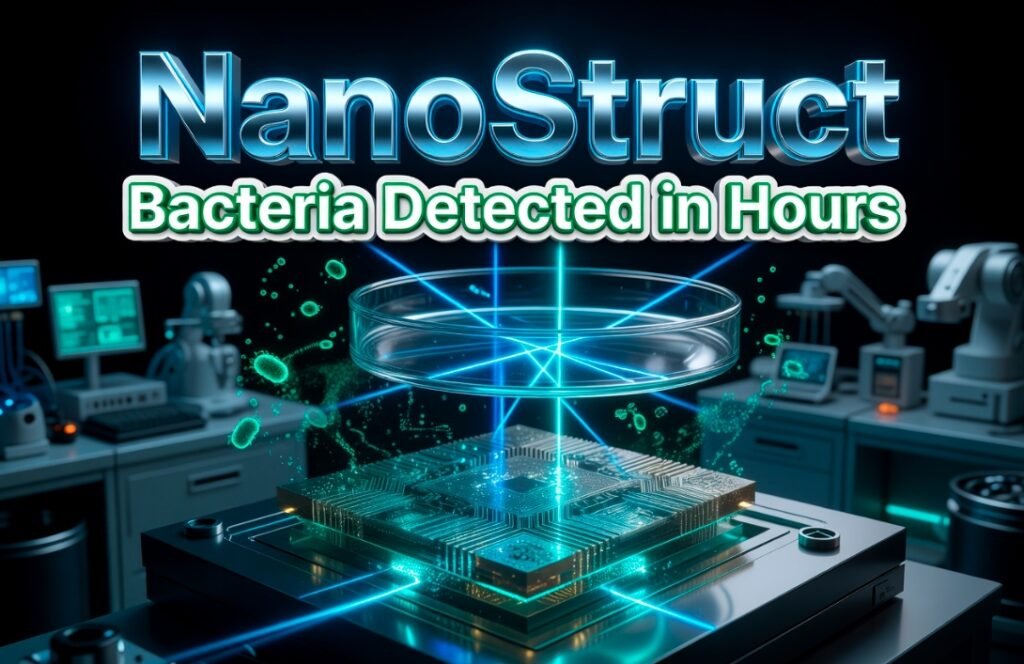
German deeptech startup rapid food bacteria detection nanosensor chip
The Science Behind the Breakthrough
The core of what NanoStruct has built is not just clever engineering. It is a rethinking of how microbial analysis works from the ground up. At the heart of the technology is a process where a laser irradiates a food sample. The molecules it contains, especially bacteria, begin to vibrate in a characteristic manner, and these movement patterns are specific to each pathogen and can be detected optically. The challenge, however, is that these signals are extremely faint. Such signals are weak and often noisy, and this is where specially developed nano-based amplifier sensors come into play, amplifying the signal billions of times until individual bacteria can be detected. NanoStruct integrates optical measurement techniques with advanced nanotechnology, biotechnology, and machine learning to offer rapid bacterial analytics, reducing detection time from days to mere hours. Here is what that means practically for food manufacturers:
- Same-day results instead of waiting several days
- Automated analysis reducing human error
- Fewer costly product recalls
- Significant reduction in food waste
- Faster, more confident release of products to market
The versatility of the method is considered its key strength, as the platform can be flexibly expanded with additional bacterial strains or substances such as PFAS. Initial proof of the system’s functionality has been provided in minced meat, and if bacteria can be successfully identified there, it opens up potential for other complex samples such as drinking water, blood, or urine.
Why the Food Industry Desperately Needs This
The size of the problem NanoStruct is solving is staggering. According to the World Health Organization, an estimated 1 in 10 people worldwide, equivalent to 600 million individuals, are projected to fall ill from consuming contaminated food, resulting in 420,000 deaths each year. The Centers for Disease Control and Prevention (CDC) estimates that 48 million Americans get sick annually from foodborne illnesses, with 128,000 hospitalized and 3,000 deaths. The financial opportunity is just as significant. The food pathogen detection technology market will grow from $6.42 billion in 2025 to an expected $9.37 billion by 2030, driven by rising food safety concerns. **The pressure on food manufacturers is intensifying on multiple fronts simultaneously.** Growth in the forecast period is attributed to increasing adoption of advanced food pathogen detection technologies for rapid testing and increasing stringency of food safety regulations. Traditional methods simply cannot keep pace. Traditional culture-based methods are often time-consuming, requiring several days to yield results, which can impede timely interventions in foodborne illness outbreaks. That delay is not just a business problem. It is a public health crisis waiting to happen. The technology is currently in the final development phase and is already being used in pilot projects with partners from the food industry, with food analysis laboratories and meat processors particularly interested.
What Investors and Founders Are Saying
The voices behind this funding round are confident, and for good reason. Dr. Henriette Maaß, CEO of NanoStruct, said: “With HTGF, Bayern Kapital, and AUXXO, we have found exactly the partners we need for this next step: experienced, well-networked, and convinced of our vision. Now we are bringing rapid bacterial analytics to the food industry.” The sentiment from the investor side is equally bullish. Dr. Stephan Ruck, Investment Analyst at HTGF, stated: “The technological breakthrough NanoStruct has achieved in sensor development is remarkable. In addition to the platform technology, we were convinced by the company’s strong network in the target market and, above all, by the team.” HTGF is a public-private venture capital investment firm based in Bonn, Germany, focused on high potential high-tech startups in industrial tech, deep tech, climate tech, digital tech, life sciences, and chemistry, and is among the most active venture capital investors in Europe. Their backing carries real weight in the European deeptech ecosystem. The approach has also been recognized with a nomination for an innovation award, an honor that came as a surprise even to NanoStruct themselves.
Beyond Food: A Platform With Much Bigger Ambitions
NanoStruct is not thinking small. While the food industry is the immediate target market, the underlying platform technology has a much wider reach. The scope of NanoStruct’s innovation is not limited to food safety alone. The technology shows promise in accelerating and simplifying processes in veterinary and human diagnostics, and in monitoring bacterial presence in sensitive production environments, indicating a broader potential far beyond the food industry. At NanoStruct, the team is a growing mix of physicists, engineers, biologists, software developers, and economists, supported by experienced entrepreneurs and researchers. That cross-disciplinary DNA is what makes the platform adaptable across sectors. Think about what rapid, laser-based, on-site bacterial detection could mean for hospital sterility monitoring, veterinary labs, or water treatment facilities. Contaminants and pathogenic bacteria accumulate in water and can cause health problems and environmental damage, and their precise rapid on-site identification can allow identification of the underlying source. The potential is enormous. And with this seed round now closed, the team has the runway to prove it. NanoStruct is arriving at exactly the right time. The global food industry is under more regulatory and consumer pressure than ever before, old testing methods are failing to meet modern demands, and investors are hungry for deeptech solutions that solve real-world problems at scale. A German startup born out of a university lab has just made a compelling case that the future of food safety fits in a chip and delivers results before the end of the working day. What happens next in their journey from pilot projects to full commercial rollout will be worth watching closely. What do you think about the future of food safety technology? Share your thoughts in the comments below.


Galaxy Ring’s FDA Sleep Apnea Clearance Faces a Familiar Wait

kausable’s €12 Million Seed Joins a Quiet Bet Against AI Scaling

Bitcoin ETFs Shed $225 Million as Treasury’s Biggest Buyers Retreat

telli Raises $15 Million Seed to Rival Billion-Dollar AI Giants

PageMind Raises €1.2 Million to Crack AI Shopping Search

Hackers Hijack Robinhood CEO’s X to Push Fake Memecoin

Apple’s Trade Secrets Suit Against OpenAI Is Europe’s Problem Too

Adobe’s Patch Leaves WhatsApp’s Own Security Gap Untouched

Reddit and Publishers Weigh Blocking Google Over AI Traffic Losses

CuspAI’s $2.6 Billion Bet Echoes AI Drug Discovery’s Playbook

CLARITY Act Final Text Expected This Weekend as 60-Vote Hurdle Looms

Fed Minutes Cite AI Demand as Inflation Risk, Put a 2026 Hike Back on the Map

Kalshi Loses Major NY Prediction Markets Ruling to Judge Torres

Marker AI Writing Startup Lands $13M Seed Led by Index Ventures

Dota 2 Esports World Cup 2026: Spirit Defends $2M Title In Paris

Meta’s Muse Spark 1.1 Beats Rivals on Price, Trails on Coding

CS2 Premier Season 5 Lands With Cache and a C4 Damage Rework

Trump Calls Iran ‘Islamic Republic of Japan’ as Ceasefire Ends

ARC Intelligence Closes €4M Seed Round in Roughly a Week

Finto Picks Munich Over Silicon Valley After YC, Raises $3.4M
-
 FINANCE2 months ago
Zcash Patched a Double-Spend Bug as ZEC Climbed 5%
-
 ENTERTAINMENT2 months ago
Steam Summer Sale 2026 Locks In June 25 to July 9 Dates
-
 NEWS2 months ago
Meta Adds AI Replies to Threads, But Users Can’t Block It
-
 FINANCE3 weeks ago
CLARITY Act Final Text Expected This Weekend as 60-Vote Hurdle Looms
-
 ENTERTAINMENT2 months ago
‘Widow’s Bay’ Review: Apple TV’s Sleeper Horror-Comedy Earns Its Fog
-
 NEWS7 months ago
FolderFresh Review: This Free Tool Automates Windows File Organizing
-
 NEWS4 months ago
U.S. Navy Deploys Solar-Powered Lightfish Drone to Patrol Oceans
-
 FINANCE3 weeks ago
Fed Minutes Cite AI Demand as Inflation Risk, Put a 2026 Hike Back on the Map