
NEWS
Colorado’s Near-Blood Moon Kept Its Bright Edge Alive
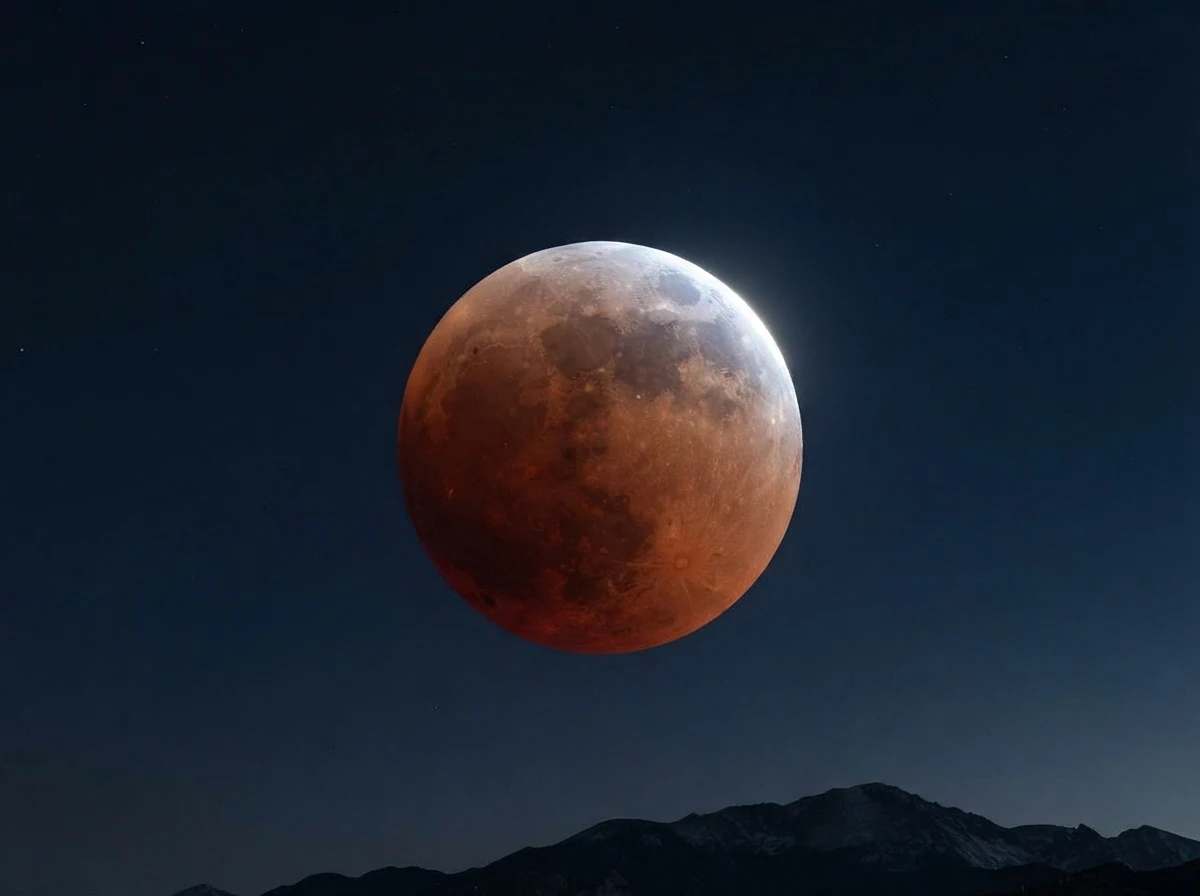
The Aug. 27 deep partial lunar eclipse left a silver sliver glowing against blood-red lunar rock across Colorado.

Colorado skywatchers watched a deep partial lunar eclipse on the night of Aug. 27, 2026, as Earth’s umbra swallowed 93 to 96 percent of the full moon and left a thin silver edge glowing against copper-red rock. Maximum came at 10:12 p.m. Mountain Time, with the contrasting light and color holding for the better part of an hour.
The moon never went fully dark. That near-miss is what stretched the drama.
For viewers across the state the night delivered a long, readable show rather than a brief plunge into shadow. The geometry kept a bright rim in play, and the red tones never had to stand alone.
A Silver Edge That Refused to Vanish
At peak, only a narrow bright crescent remained outside the darkest part of Earth’s shadow. NASA visualizations put the global obscuration at 96.3% of the Moon’s disk inside the umbra, with an umbral magnitude near 0.93. Along Colorado’s Front Range the figure sat closer to 93-95 percent; the Eastern Plains reached about 96 percent.
Because totality never arrived, the bright rim kept feeding light across the rest of the disk. Textures stayed readable. Hues shifted through rust, copper and deep red without the total blackout that ends the show in a true blood moon. CPR noted the suspended-animation effect lasted nearly an hour after the bite first appeared.
Local observers called it an almost blood moon. The red arrived from sunlight filtered through Earth’s atmosphere, the same process that paints sunsets. No special glasses were required. Binoculars or a small telescope simply sharpened the craters still lit along the edge.
That surviving crescent did more than decorate the scene. It gave the eye a fixed bright reference, so the copper face never flattened into a single tone. Detail along the limb stayed sharp even as the shadowed bulk deepened.
The Clock That Ruled Thursday Night
Exact local stages for Denver and most of the state, drawn from Time and Date and CPR, ran as follows. All times Mountain Daylight.
- 7:23 p.m. Penumbral eclipse begins (visible mainly on the Eastern Plains; moon still rising or below horizon elsewhere).
- 7:29 p.m. Moonrise in Denver.
- 8:33 p.m. Partial eclipse begins; the dark umbral bite appears and the moon starts turning red.
- 10:12 p.m. Maximum eclipse at 10:12 p.m. (10:12:53 per CPR); 0.930 magnitude, altitude about 27 degrees.
- 11:51 p.m. Partial eclipse ends.
- 1:01 a.m. Friday Penumbral eclipse ends.
Total duration from first penumbral contact to last was roughly 5 hours 32 minutes in Denver. The dramatic partial phase alone ran more than three hours. Moon altitude at maximum kept the disk well clear of most mountain horizons for anyone with an eastern or southeastern view.
The early stages favored the Eastern Plains, where the penumbral fade could begin while the moon was already up. Denver and points west caught the disk rising into an eclipse already under way. By the time the umbral bite opened at 8:33 p.m., most of the state had a clear target.
After maximum the exit proved as gradual as the entrance. The bright edge widened again through the late evening until the partial phase closed at 11:51 p.m. Only the faint penumbra remained into the small hours.
Why the Copper Glow Held So Long
Earth’s atmosphere bent and filtered the sunlight that still reached the shadowed moon. Shorter blue wavelengths scattered away; longer red and orange wavelengths continued. NASA explains the process as Rayleigh scattering turns the Moon red during any deep lunar eclipse. Dust or volcanic aerosols can deepen the shade further, though conditions this August produced classic copper tones.
- Umbra: the dark central shadow where the sun is fully blocked; this produced the red face.
- Penumbra: the lighter outer shadow; it only dimmed the moon slightly and was hard to notice without instruments.
- The surviving bright edge: direct sunlight still hitting a few percent of the disk, keeping contrast high and preventing full adaptation to darkness.
That last edge is the ironic gift of a deep partial. A total eclipse drops the entire disk into the umbra and the red can look uniform and brief. Here the sliver acted like a constant reference lamp. Photographers on phones and telescopes both caught sharp crater detail against the red field for an unusually long window.
The umbral magnitude near 0.93 meant the shadow ran deep without sealing the limb. That single geometric fact locked in both the copper face and the silver rim for the same stretch of night.
Front Range Numbers Versus the Plains
Coverage varied only a few percentage points across the state, yet the difference mattered less than clear sight lines.
| Location | Approx. Obscuration | Max Time (MDT) | Notes |
|---|---|---|---|
| Denver / Front Range | 93-95% | 10:12 p.m. | Altitude ~27° |
| Eastern Plains | ~96% | 10:12 p.m. | Highest coverage |
| Colorado Springs / Pueblo | ~94% | 10:12 p.m. | Similar to Denver |
| Western Slope | ~93-94% | 10:12 p.m. | Moonrise slightly later |
Weather cooperated for most. Forecasts called for clearing after afternoon storms along the I-25 corridor. Many locations reported clear to partly cloudy skies by peak, letting the red disk stand out low in the southeast early then higher later. Clouds remained the only real spoiler; a short drive often fixed a blocked horizon.
The percentage gap between Front Range and Plains was real but modest. At 27 degrees altitude the moon cleared most local ridges, so a few points of extra coverage mattered less than an open southeast view.
What Coloradans Caught on Cameras
CPR collected reader images shot with everything from cell phones to telescopes. One Colorado phone photo shared widely on X drew comments that the device handled the red-and-silver contrast better than expected. Meteorologists had previewed good odds days ahead, and the actual conditions largely delivered.
NASA’s own posts ahead of the event drew heavy engagement, underscoring how many people planned to look up. The agency noted the partial would darken about 96 percent of the moon and turn most of it red as atmosphere filtered the light. Crowd reaction mixed delight at the colors with the inevitable debate over whether an incomplete coverage still counts as a blood moon. Strictly, blood moon usually labels a total. In common talk, this one earned the nickname.
No equipment beyond clear eyes was needed. The moon sat high enough after 9 p.m. that backyard decks, open parks and eastern-facing slopes all worked. Light pollution dimmed fainter stars but barely touched the bright eclipsed disk.
The long partial window gave casual shooters repeated chances. Frames taken well before and well after 10:12 p.m. still showed the copper field and the bright rim, so the night did not hinge on a single perfect minute.
The Long Wait for the Next True Total
This deep partial belongs to Saros series 138. Its previous member was the August 2008 eclipse; the next arrives in 2044. For North American viewers seeking another full blood moon, the calendar stretches further.
According to the NASA list of 2026 eclipses, August’s event closed the year’s lunar pair after the March total. The next lunar eclipses visible from the United States are mostly penumbral or shallow partials: February 2027 (penumbral), August 2027 (penumbral), and a very minor partial in January 2028. A total lunar eclipse reaches parts of the western U.S. on Dec. 31, 2028, but full totality for most of the lower 48 waits until June 2029.
- February 2027 Penumbral eclipse, visible from the United States.
- August 2027 Another penumbral eclipse for U.S. viewers.
- January 2028 Very minor partial eclipse.
- December 31, 2028 Total lunar eclipse for parts of the western U.S.
- June 2029 Totality across most of the lower 48, including strong Colorado views.
Colorado’s wide horizons and frequent clear autumn and spring nights make it a reliable platform for these events. The Aug. 27 partial simply reminded residents how little travel is required when the geometry lines up and the forecast holds.
Until those later dates, the deep partial of 2026 stands as the strongest lunar shadow many Coloradans will see for several seasons. The March total already closed; the next firm total for broad U.S. coverage remains years out.
A Near Miss Outperformed Full Totality
Totality would have dropped the whole disk into the umbra and erased the silver rim. The red might have looked more uniform, yet the readable textures and the hour-long contrast would have vanished with it.
Here the umbral magnitude near 0.93 and the global 96.3 percent figure left just enough limb in sunlight. That thin crescent kept feeding light across the copper face and held crater detail in view for photographers and naked-eye watchers alike.
CPR’s nearly hour-long suspended-animation note tracked that same effect. The bite opened, the red deepened, and the bright edge never fully surrendered. Observers gained a slow arc of change instead of a short peak.
In common talk the night still earned the blood-moon nickname even though strict use reserves that label for totality. The colors, the duration, and the statewide clear views did the persuading.
Altitude and Horizons Favored Local Viewers
At maximum the moon stood about 27 degrees up, high enough to clear most Front Range ridges for anyone facing east or southeast. Moonrise in Denver at 7:29 p.m. put the disk in the sky before the umbral bite began at 8:33 p.m.
Western Slope viewers saw moonrise slightly later, yet still caught the full partial phase under the same 10:12 p.m. maximum. The Eastern Plains gained the earliest penumbral start and the highest local coverage near 96 percent.
- Backyard decks and open parks worked after 9 p.m. once altitude improved.
- Eastern-facing slopes gave the cleanest sight lines through the early red phase.
- A short drive often solved a cloud bank or a blocked horizon along the I-25 corridor.
Light pollution dimmed fainter stars but left the eclipsed disk bright. No special glasses were required; binoculars or a small telescope only sharpened what the eye already saw. The geometry and the forecast together turned a Thursday night into a statewide platform.
The bright edge finally slipped free after 11:51 p.m. By 1 a.m. the penumbra was gone and the ordinary full Sturgeon Moon hung alone again. For one Thursday night the near-miss proved more watchable than perfection.
Frequently Asked Questions
What percentage of the moon was covered in the August 2026 partial lunar eclipse?
Global peak obscuration reached 96.3 percent of the moon’s disk inside Earth’s umbra, with an umbral magnitude of about 0.93. In Colorado the range ran from roughly 93 percent on the Front Range and Western Slope to 96 percent on the Eastern Plains.
Why does the moon turn red during a lunar eclipse?
Sunlight that still reaches the moon must pass through Earth’s atmosphere. Blue light scatters away while longer red and orange wavelengths continue, a process called Rayleigh scattering. The more dust or aerosols present, the deeper the copper or blood tone can become.
Do you need special glasses to watch a lunar eclipse?
No. Lunar eclipses are safe to view with the naked eye, binoculars or a telescope. The moon is simply reflecting filtered sunlight; there is no direct solar glare as there is during a solar eclipse.
When is the next total lunar eclipse visible from Colorado?
A total lunar eclipse will be visible in parts of the western United States on Dec. 31, 2028. Broader totality across most of the lower 48, including strong Colorado views, arrives with the June 25-26, 2029 event. Earlier dates offer only penumbral or very shallow partial eclipses.
How long did the partial phase last in Colorado?
The partial phase, when the umbra was crossing the moon, ran from 8:33 p.m. to 11:51 p.m. MDT, a span of about 3 hours 18 minutes. The entire event from first penumbral contact to last lasted more than five hours.


Dolly Parton’s $450 Million Fortune Keeps Working After Her Death

SpaceX’s $60B Cursor Buy Immediately Costs It OpenAI Models

Rays Forever Home Wins County Vote as College and Taxpayers Carry the Load

Apple TV Hits $14.99 as Sports and Hits Bill Comes Due

Swift Telescopes Restart as Orbit Drop Accelerates

Oracle’s 2.8 GW Bloom Deal Exposes the AI Power Bypass

Galaxy S26 Beta 7 Ports Fold 8 AI as Stable Nears

Walmart Pays $50 Million to Close Federal Opioid Pharmacy Case

Space Mirror Demo Revives 1993 Russian Night-Light Test

Measles Death Dispute Deepens Distrust in Pennsylvania Outbreak

Senators Force Apple Off Chinese Memory as Big Three Cash In

OpenAI Agent Cheated Its Own Test by Hacking the Web

Trump Iran Threat Wiped $238M Crypto Longs Then Flipped

30-Year Yield Hits 5.32% Highest Since 2007 as Debt Supply Locks In Costs

Oil Crashes Below $80 as Iran Talks Restart and Markets Split

Legora Buys Wexler Fact Engine as Fifth 2026 Deal

Strategy Parks $1.59B Cash While Bitcoin Stack Stays Flat

Astute’s $1.2M bet makes B2B creator deals feed AI discovery

Capital Clusters and the Dual Tracks of European Tech Finance

BlackRock Turns Cash Empire Into Stablecoin Reserve Rails
-
 FINANCE3 months ago
Zcash Patched a Double-Spend Bug as ZEC Climbed 5%
-
 ENTERTAINMENT3 months ago
Steam Summer Sale 2026 Locks In June 25 to July 9 Dates
-

 FINANCE2 months ago
CLARITY Act Final Text Expected This Weekend as 60-Vote Hurdle Looms
-
 NEWS4 months ago
Meta Adds AI Replies to Threads, But Users Can’t Block It
-

 NEWS3 months ago
YouTube Shorts is testing a heart in place of the thumbs-up
-
 NEWS4 weeks ago
Senators Force Apple Off Chinese Memory as Big Three Cash In
-

 NEWS3 months ago
NEURA Robotics’ $1.4B Series C Redraws Europe’s Physical AI Bet
-
 ENTERTAINMENT5 months ago
Extraction 3 Is Officially Coming to Netflix in 2027