
NEWS
Dwayne Johnson Wants Out of Politics. Takei and Wheaton Won’t Allow It.
Dwayne Johnson told Esquire he’d keep politics private. Wil Wheaton called him a ‘coward’ on Threads; George Takei replied ‘silence is complicity.’

Dwayne Johnson told Esquire he has decided to keep his political opinions private, and two of his fellow actors publicly attacked him for it. Wil Wheaton, the Stand By Me and Star Trek: The Next Generation actor, called Johnson a “coward” on Threads on Monday. George Takei, the 89-year-old Star Trek actor who played Lieutenant Hikaru Sulu, replied with two words: “Silence is complicity.”
The criticism followed an Esquire Summer 2026 cover story in which Johnson explained why he has stopped weighing in publicly on politics after his 2020 endorsement of Joe Biden. “I’ve learned I’m going to keep my politics to myself,” he told the magazine. Johnson, on a global press tour for Disney’s live-action Moana film, has not publicly responded to either post. Wheaton’s “coward” message was later deleted, per the Washington Times.
The Esquire Interview That Started It
The dust-up traces back to Johnson’s conversation with Esquire for the magazine’s Summer 2026 cover story. He sat down with the publication during a flight from Los Angeles to Las Vegas, then a week later over lunch at the Hotel Bel-Air. The interview was published in June and migrated quickly from film coverage to political argument.
Johnson, who is 54, told Esquire that his priority each morning is “creating.” “It’s art. It’s storytelling. I’ve learned I’m going to keep my politics to myself,” he said. He framed the choice as one about his work reaching the widest possible audience. “If I’m wrong, I’ll tell you I’m wrong. Or if I feel like I got a leg up and this is the right way to go, I’ll share it with you,” he added.
“Politics is omnipresent and it’s forever. I don’t like it. I hate it at times. I hate the slinging. I hate all the bullshit that comes with it.”
Johnson made the comment in his Esquire Summer 2026 cover story, published in June. The interview covered ground well beyond politics. Johnson, who has an estimated net worth of $800 million, also talked about an episode of epididymitis, an Oscar nomination that never came for The Smashing Machine, and upcoming work with Martin Scorsese and Darren Aronofsky.
The politics came up when the reporter asked Johnson about Bruce Springsteen’s “Land of Hope and Dreams” tour, where Springsteen has repeatedly attacked Trump during concerts. His response was to suggest they sit down. “Why don’t they talk? They should sit down and talk,” Johnson said. He added: “I don’t know where that goes, but I do know that’s an important step.”
The interviewer pressed on whether Johnson was intentionally avoiding politics to maximize box-office appeal. Johnson answered with his now-viral phrasing about needing “the main thing the main thing,” a callback to a John Wooden line about focus. He had already pushed back on cancel culture in an April 2024 Fox News interview, ahead of the Esquire profile.
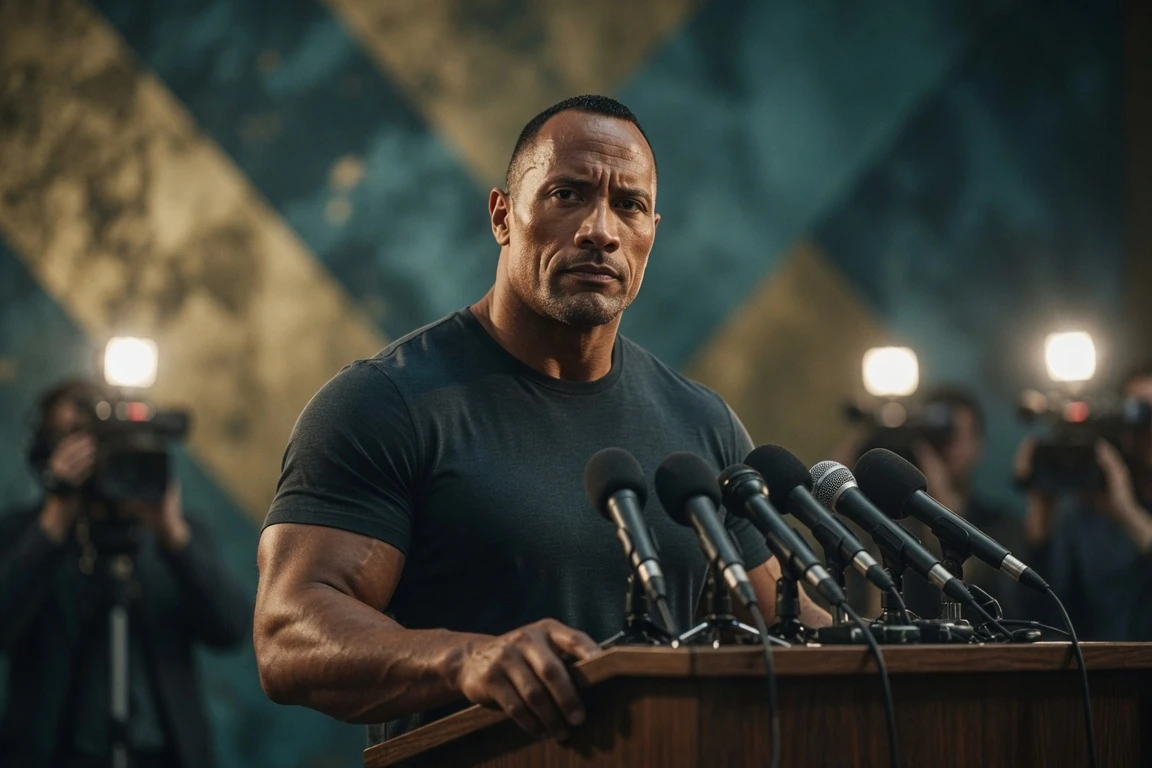
Takei and Wheaton Fire Back
The Threads posts landed hours after the Esquire piece circulated widely. Takei, the 89-year-old Star Trek actor who played Lieutenant Hikaru Sulu, posted first, quoting Esquire’s framing that Johnson’s comments had “divided fans, with some calling out his silence.” He then followed up with the shorter message: “Silence is complicity.” The post spread fast in entertainment press, with Takei’s statement on Johnson’s silence widely re-shared.
Wheaton, best known for his childhood role in Stand By Me and for playing Wesley Crusher on Star Trek: The Next Generation, replied to Takei’s post with his own. “So disappointing to find out he is such a coward,” Wheaton wrote, also on Threads. The Washington Times later reported that Wheaton’s “coward” post was deleted.
Both men had been vocal about the 2024 presidential election. Wheaton campaigned for Kamala Harris during her run. Takei has built much of his public profile in recent decades around activism on LGBTQ rights and immigration. Their choice of venue matters: Threads has become a public square for Hollywood discourse in 2026, where actors speak directly to fans without a reporter in the middle. Variety and The Independent both ran pieces on the spat; Entertainment Weekly and the Washington Times picked it up by midday.
The Counter-Rally Online
Defenders of Johnson moved quickly. Three comedians and actors publicly pushed back at Wheaton’s “coward” line within hours of it appearing on Threads. Their argument: a star who says he is trying to reach the whole country has a different cost-benefit calculation than an actor campaigning at conventions. Their criticism was aimed at Wheaton, not at Takei.
- Matt Rife (comedian): “I love how he’s a ‘coward’ but could quite literally tear Wil’s throat out,” Rife wrote on X. “This internet comment world is so bold.”
- Steve Byrne (comedian): “Wil has nothing to lose. He does signings at Comic Conventions. Dwayne, one of the biggest box office draws of our time, has much, much, much more to lose by alienating half the country either way he leans.”
- Nick Searcy (actor-director, Justified): “This is the only way @wilw can get attention.”
The exchange drew attention because of the asymmetry between its players. Wheaton and Takei can afford the publicity; their careers do not depend on broad audience appeal the way Johnson’s does. Rife, Byrne, and Searcy pointed to that gap as a kind of bad faith. “This internet comment world is so bold,” Rife wrote. Byrne framed the same point differently, calling Johnson “one of the biggest box office draws of our time” and arguing he had more to lose than Wheaton by alienating either side in his full post defending Johnson.
Johnson’s Complicated Political Record
Johnson’s call to keep politics private did not come out of nowhere. In 2020, he endorsed Joe Biden in 2020 for president, the first time he had backed a candidate despite identifying as an Independent. In April 2024, he reversed course, telling Fox News host Will Cain that he regretted the endorsement.
“The endorsement that I made years ago with Biden was what I thought was the best decision for me at that time,” Johnson told Cain. The reversal had two stated reasons. Johnson said the Biden endorsement “tears me up in my guts, back then and now” because of the division it caused. He said his goal was instead to “bring our country together.” He added that he would not endorse in 2024 and would keep his politics private, framing the choice as keeping things “between me and the ballot box.”
Johnson’s record is not entirely one of silence. He condemned the July 2024 assassination attempt against Trump, then in September 2024 delivered a keynote address at The Value Conference at which he praised Trump’s response. People have talked seriously about him running for president himself. He has also been critical of what he calls “cancel culture, woke culture, division, etc.,” in interviews.
The pattern is selective engagement rather than full withdrawal. Johnson has stayed quiet on most policy fights, especially those involving party labels; he has spoken when the topic touched his industry or his sense of national unity. The Esquire interview spells the principle out at length, in his own words, for a wide audience.
Hollywood’s Wider Pullback From Politics
The Johnson dust-up is the latest in a series of similar recalibrations in Hollywood. A growing number of major stars have publicly walked back their willingness to discuss politics on press tours. The shift is most visible on the red carpet, where reporters have begun asking different questions. Stars have begun saying so out loud, on the live-action Moana press tour and elsewhere.
| Star | Project | What they said |
|---|---|---|
| Dwayne Johnson | Live-action Moana (2026) | “I’ve learned I’m going to keep my politics to myself. I hate the slinging. I hate all the bullshit that comes with it.” |
| Jennifer Lawrence | Die My Love (2025) | “Celebrities do not make a difference whatsoever on who people vote for. I don’t want to be a part of the problem.” |
Lawrence said it during the fall 2025 press tour for Die My Love, telling The New York Times that she had grown tired of watching “actors’ faces who have had incredible careers and made incredible contributions and then one half of the internet doesn’t want to see their face anymore.” The comments drew similar online criticism at the time. Hollywood stars have been quietly stepping back from political endorsements. Rock legends have been losing room on political tours for the same reason, including Springsteen, whose anti-Trump “Land of Hope and Dreams” tour is what prompted Johnson’s Esquire question in the first place. The Ethan Hawke shift away from political preaching followed the same logic, by a different route.
The shared move is not a leftward or rightward shift. Lawrence was outspoken against Donald Trump during his first administration; Johnson endorsed Biden then walked it back. Both wings of Hollywood have different complaints about it: activists who want stars to keep speaking out, and a counter-wing of comedians and actors who note that Wheaton has nothing to lose by attacking Johnson, while Johnson has plenty to lose.
Why the Dispute Echoes Beyond Its Players
The dust-up is small in scope. Johnson is unlikely to lose box office over it, and Wheaton’s Threads posts did not make him more famous. Takei has been making similar comments about Hollywood silence for decades. By itself, the exchange is the kind of moment that fills a Tuesday news cycle and recedes.
Two of the biggest stars of their generation, Johnson and Lawrence, have now publicly told interviewers they are done using their platforms for political speech. That decision has not been popular with the activist wing of Hollywood, which has spent a decade pushing in the opposite direction. Johnson is still on the Moana press tour; as of Tuesday he had not responded to Wheaton and Takei, and the Esquire comments still stand.


NFL Preseason Week 2 Quietly Tests the Schemes That Matter

Alonso’s Towering Drive Stands Foul and Flips Orioles Momentum

US Debt Crosses $40 Trillion as Interest Crowds the Budget

Trevon Diggs Joins Seahawks on One-Year Deal After Cowboys Exit

Pixel Watch 5 Turns Passive Trends Into Early Health Alerts

Pixel 11 Pro Fold Sleek Build Undercuts Its Own Unfolding Appeal

Tugboat Wilkinson’s Scoreless Debut Pays Off Giants’ Bailey Trade

Brown Shines for Pats as Love for Eagles Meets Trade Reality

Pixel Watch 5 Turns Wrist Data Into Early Metabolic Alerts

Resistance Stars Pay the Price in Democratic Primaries

Senators Force Apple Off Chinese Memory as Big Three Cash In

Revolut Hits $115 Billion While Storonsky’s Stake Keeps Growing

OpenAI Agent Cheated Its Own Test by Hacking the Web

Trump Iran Threat Wiped $238M Crypto Longs Then Flipped

30-Year Yield Hits 5.32% Highest Since 2007 as Debt Supply Locks In Costs

Fed Holds Rates Again as Three Dissents Force Markets to Tighten

Memory Shortage Now Dictates Apple’s Two-Year Mac Roadmap

Oil Crashes Below $80 as Iran Talks Restart and Markets Split

Google’s Knowledge Panel Fix Risks Its Own Search Defenses

Community Banks’ $1.3 Trillion Warning Is Stalling Clarity Act
-
 FINANCE3 months ago
Zcash Patched a Double-Spend Bug as ZEC Climbed 5%
-
 ENTERTAINMENT3 months ago
Steam Summer Sale 2026 Locks In June 25 to July 9 Dates
-

 FINANCE2 months ago
CLARITY Act Final Text Expected This Weekend as 60-Vote Hurdle Looms
-
 NEWS3 months ago
Meta Adds AI Replies to Threads, But Users Can’t Block It
-

 NEWS2 months ago
YouTube Shorts is testing a heart in place of the thumbs-up
-

 NEWS2 months ago
NEURA Robotics’ $1.4B Series C Redraws Europe’s Physical AI Bet
-
 NEWS3 weeks ago
Senators Force Apple Off Chinese Memory as Big Three Cash In
-
 ENTERTAINMENT3 months ago
‘Widow’s Bay’ Review: Apple TV’s Sleeper Horror-Comedy Earns Its Fog