
NEWS
Google WeatherNext 3 Puts Turbine Winds Into Search
WeatherNext 3 now feeds Search and Maps, but its new 100-meter wind and solar fields are built for energy operators, not weekend plans.

Google DeepMind and Google Research began feeding WeatherNext 3 into Search, Maps, and Gemini on September 3, 2026. The model starts a new global run every hour from live satellite mosaics, and it writes 100-meter winds and solar radiation in the same pass.
Those energy fields are the part of the spec no commuter asked for. They sit next to the rain map because Google wants cleaner power to look easier to plan, including for its own load.
Hourly Weather Now Lives Inside Search and Maps
WeatherNext 3 is now the forecast engine behind weather in Google Search, the Gemini app, Google Maps, the Maps Platform Weather API, and Earth Engine. Developers can pull the same fields from BigQuery and Cloud Storage without training a model of their own.
Google DeepMind called it the first global weather model that writes a fresh forecast every hour of the day, and posted the launch the same afternoon.
https://x.com/GoogleDeepMind/status/2095528012791902536
Samier Merchant, a Google Research engineer on the paper, said the jump is that core fields now drive consumer products, not only research plots.
This is going to be the first time that some of the core variables feed and power a lot of the Google products.
Samier Merchant, Google Research engineer
The public pitch is packing for a weekend and catching a fast rain band. The company also opened the feed to enterprises on day one, which is where the extra variables earn their keep.
Why the Six-Hour Physics Cycle No Longer Sets the Clock
Most global physics models still wait on a six-hour data cycle because the supercomputers that solve the equations need that window. WeatherNext 2, released in June 2025, kept that rhythm on a 25-kilometer grid with 64 ensemble members.
WeatherNext 3 keeps the 64-member ensemble and the Functional Generative Network mesh, then adds a live geostationary satellite mosaic as a direct input. A new run can start every hour, 24 times a day, instead of four.
The hourly label needs a split. Full 15-day, 360-hour forecasts still start at 00, 06, 12, and 18 UTC. Interim hours produce 48-hour forecasts. Three-dimensional pressure-level fields also stay on those four synoptic starts, across 13 levels from 50 hPa to 1000 hPa.
WEATHERNEXT 2 VERSUS WEATHERNEXT 3
| Setting | WeatherNext 2 (June 2025) | WeatherNext 3 (August 2026) |
|---|---|---|
| Refresh | Every 6 hours | Every hour (24 starts a day) |
| Station temperature and dew point | 25 km (0.25°) | 5 km (0.05°) |
| Gridded surface, including 100 m wind | 25 km | 10 km (0.1°) |
| Upper-air pressure levels | 25 km | 25 km (0.25°), synoptic cycles only |
| Longest horizon | 15-day ensemble | 15 days on synoptic cycles; 48 hours on interim hours |
| Inputs | Analysis-based | Live satellite mosaics plus ECMWF HRES analysis |
Google’s blog says that stack is about five times sharper than WeatherNext 2’s 25-kilometer picture. Atmospheric wind on the 25-kilometer pressure grid did not get that shrink. Surface wind, including hub-height wind, lands on the 10-kilometer sheet.
Roger Pielke Sr., the atmospheric scientist, put a sharper point on the 5-kilometer claim after the launch post: the figure is horizontal grid spacing, a footprint, not proof the model resolves 5-kilometer weather. Google’s own docs already split the grid that way, with station heads at 0.05° and most surface fields at 0.1°.
100-Meter Winds Sit on the Spec Sheet for a Reason
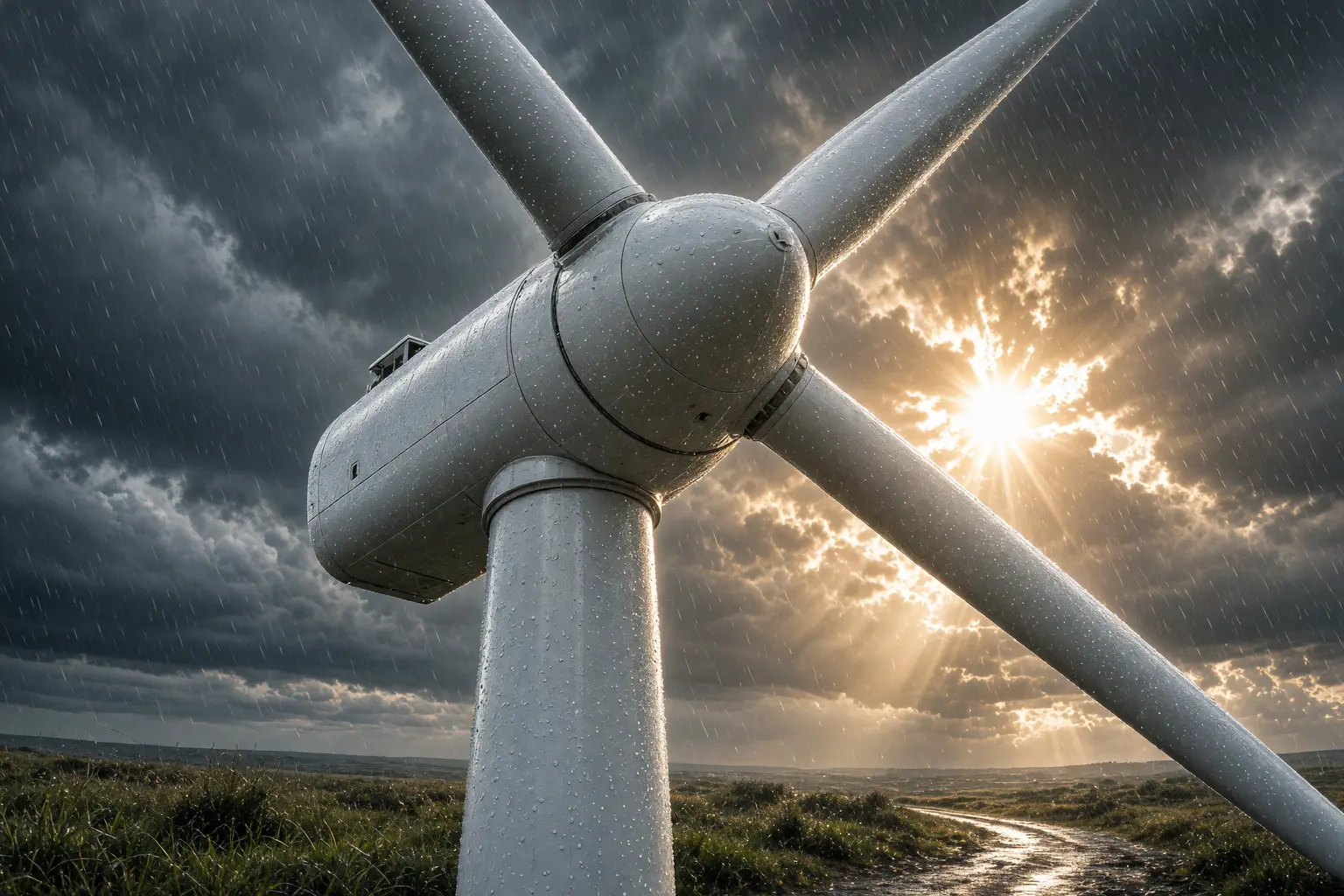
The blog does not hide the industrial extras. WeatherNext 3 writes 100-meter winds, roughly turbine hub height, plus high-resolution cloud cover and solar radiation so farms can estimate light on the ground. Ferran Alet, a Google DeepMind research scientist on the weather team, tied that work to rising power demand at Google and beyond, saying the company wants renewable generation to look like a more appealing option.
The developer sheet is blunter than the Search screenshots. It lists 100-metre wind speeds for turbine-height forecasting, full cloud-layer fields, and complete solar irradiance components, SSRD and FDIR, as clean-energy outputs.
CLEAN ENERGY FIELDS IN THE SAME PASS
- Hub-height wind: Scalar 100-meter speed plus eastward and northward components on the 10-kilometer surface grid.
- Solar on the ground: One-hour and six-hour downward radiation (SSRD / GHI) and total-sky direct beam (FDIR).
- Cloud layers: Total, high, medium, and low cover fractions, the inputs solar operators use when panels will drop out.
- Where they ship: BigQuery, Earth Engine, and Cloud Storage, not only the Maps rain icon.
A home battery that cannot ingest those Cloud tables will never see them. Grid desks and developers will. That is why the consumer launch and the energy launch are the same binary, shipped together.
The older WeatherNext line already had 100-meter wind in its variable list. Version 3 keeps those names, retitles them, and runs them hourly on a tighter surface grid, with satellite mosaics in the intake. For a company buying wind and solar to match data-center load hour by hour, a faster hub-height field is an operations tool.
Brightband Puts WeatherNext 3 Ahead of ECMWF and NOAA
Google’s claim that WeatherNext 3 is the most accurate global weather model rests on Brightband, a public-benefit firm that scores live AI and physics forecasts with Google Research’s WeatherBench-X toolkit. On the live Operational WeatherBench leaderboard, the latest fully verified 12Z cycle was 26 August 2026, about a week behind real time because each run has to verify.
Ranked on 850 hPa temperature RMSE for days 1 to 7, global, last 30 daily 12Z cycles, WeatherNext 3 led.
GLOBAL 850 HPA TEMPERATURE, LAST 30 CYCLES
| Rank | Model | RMSE | Cycles won |
|---|---|---|---|
| 1 | WeatherNext 3 (Google DeepMind) | 1.31 K | 19 of 30 |
| 2 | WeatherNext 2 (Google DeepMind) | 1.33 K | 10 of 30 |
| 3 | AIFS ensemble mean | 1.40 K | 1 of 30 |
| 4 | Aurora ensemble mean (Microsoft) | 1.45 K | 0 of 30 |
| 5 | IFS ensemble mean (ECMWF) | 1.52 K | 0 of 30 |
| 6 | Atlas ensemble mean (Nvidia) | 1.55 K | 0 of 30 |
| 7 | GraphCast (Google DeepMind) | 1.60 K | 0 of 30 |
| 8 | GEFS mean (NOAA) | 1.76 K | 0 of 30 |
| 9 | HRES (ECMWF deterministic) | 1.79 K | 0 of 30 |
| 10 | GFS (NOAA) | 2.07 K | 0 of 30 |
The regional slice is less sweep-like. WeatherNext 3 won 21 of 26 cycles in the tropics, 19 of 26 in the Northern Hemisphere, and 15 of 26 in the Southern Hemisphere. It won 9 of 26 in North America. In Europe, WeatherNext 2 still held the regional highlight, with 8 of 26 and a tie mark on the board.
Brightband’s method note also keeps a quiet dependency in view. Where a model has no analysis of its own, WeatherNext 2 and WeatherNext 3 are initialized from the ECMWF IFS analysis. Google’s developer sheet says the same in other words: live satellite mosaics plus ECMWF HRES analysis. The hourly satellite path does not replace Europe’s physics start. It rides on it.
Sparse Gauges Left a Hole the Satellites Now Fill
Global models have always struggled with rain because the clouds that make it are small and fast. Google trains WeatherNext 3 on three rain sources at once: ECMWF reanalysis, NASA’s IMERG satellite product, and Google’s own satellite-radar precipitation reanalysis.
Against those sets, the company reports a Continuous Ranked Probability Score gain of up to 60% versus IMERG, 30% versus MRMS, and 10% versus rain gauges at early lead times. On the product side, people planning a day or more ahead will see up to 50 percent more accurate rain forecasts, with the largest lift in places that have been poorly served. The developer page states the research comparison as up to a 50% cut in Brier score and CRPS versus numerical weather prediction baselines on IMERG.
RAIN SKILL GOOGLE PUBLISHED WITH THE LAUNCH
- IMERG CRPS: Up to 60% better than the baselines Google used for medium-range global rain.
- MRMS CRPS: 30% better on that radar-based set.
- Rain gauges: 10% better at early leads, the hardest ground check.
- In Search and Maps: Up to 50% more accurate precipitation when the plan is a day or more out.
The 5-kilometer layer is not a rain grid. It is a station head for 2-meter temperature and dew point, trained on sparse METAR, Mesonet from MADIS, and ICOADS observations going back to 2001. The paper, station heads beat unseen METAR sites on 2-meter temperature CRPS by up to 30% versus WeatherNext 2 and 40% versus ECMWF ENS, including stations held out of training. The head can be queried at any point because it uses station elevation and land-or-sea flags, then writes a 0.05° grid in production.
Google says that approach matters most in Latin America, Africa, and the Asia-Pacific, where regional physics models have been too expensive to run at this detail. Merchant described the shift as going past the analysis fields most global AI models train on, toward fresher observations. Alet has said the wider WeatherNext line trained on 50 years of historical weather and can run on a single TPU rather than a building-sized supercomputer.
Hurricane Melissa Already Tested This Model Family
The cyclone work predates this release. WeatherNext 2 was extended for operational tropical cyclone forecasting, and the National Hurricane Center already carries a Google DeepMind ensemble mean, GDMI, in its model suite.
In October 2025, Hurricane Melissa became the strongest hurricane on record to make landfall in Jamaica and tied for the strongest in the Atlantic. DeepMind says WeatherNext predicted a Category 5 landfall five days ahead with 80% confidence, then near 100% three days out. The NHC, for the first time, forecast a storm reaching Category 5 from Category 1 intensity.
MELISSA AND THE WEATHERNEXT LINE
- November 2023: WeatherNext 1 Graph (GraphCast) ships as a deterministic 0.25° model on a 6-hour step.
- December 2024: WeatherNext 1 Gen (GenCast) adds a 50-member probabilistic ensemble on a 12-hour step.
- June 2025: WeatherNext 2 runs a 64-member FGN ensemble at 0.25° every 6 hours and later supports operational cyclone work.
- October 2025: Melissa hits Jamaica; the DeepMind ensemble mean is in the NHC blend as the storm jumps from Category 1 toward Category 5.
- August 2026: WeatherNext 3 becomes the flagship, with hourly satellite starts and multi-resolution output, then begins powering Search, Maps, and Gemini on September 3, 2026.
WeatherNext 3 still writes discrete cyclone tracks from the same system that writes the surface grid. The Melissa episode is the family proof, not a WeatherNext 3 case. The new model inherits that tracker and adds hourly satellite intake around it.
Official Warnings Still Belong to National Weather Services
Google’s own terms put a hard fence around the launch. WeatherNext 3 is an automated experimental system. Outputs are as-is, for information and research, and do not count as official forecasts, watches, or warnings. Historical fields older than one hour move under CC BY 4.0; real-time and future fields stay under Google DeepMind’s experimental weather terms.
The blog ends on the same instruction the developer page repeats: for official forecasts, severe weather warnings, and public safety advisories, use the local meteorological agency or national weather service. Search and Maps can now refresh rain every hour. They are not the alarm that evacuates a coast.
The model still drinks ECMWF HRES analysis with the satellite mosaic. It still loses a European slice of Brightband to its own predecessor. It still withholds 15-day depth from the 20 interim hours. And the 100-meter winds that make the spec sheet distinctive remain a Cloud product first, even as the umbrella prompt in Search gets the better rain.
Grid operators who can read those hub-height fields now have a hourly global feed that physics centers do not publish in the same shape. Everyone else gets a sharper Maps tile, with the same caveat Google printed on the launch post.


The House Cancels September Votes and Strands the CLARITY Act

Ascentiz Recruits Developers Around Its Modular Exoskeleton at IFA

Saylor’s Bitcoin Speech Claim Needs a Statute

Zeit AI Raises €5 Million for the Mid-Market Data Layer

Onwards and Sideways Turns Five Good Years Into a Joke

The Galaxy Watch 9 Splits Samsung’s Watch Update Path

Rightcharge Raises £500,000 as Fleets Drift Onto Public Chargers

Early Payment Discounts Hand Buyers a 37 Percent Return

AI Score Raises $5.4 Million as Security Alumni Watch Agents

Sony’s PlayStation Settlement Pays Users in Store Credit

Walter’s TWG Insists No Fraud as Insurer Probes Force Cleanup

30-Year Yield Hits 5.32% Highest Since 2007 as Debt Supply Locks In Costs

PCE Stays at 3.7% as Gas and Tariffs Outrun Coming Revisions

Astute’s $1.2M bet makes B2B creator deals feed AI discovery

Strategy Parks $1.59B Cash While Bitcoin Stack Stays Flat

Evernorth S-4 Clears Path for Active XRP Treasury on Nasdaq

Amber’s €7M locks Mittelstand knowledge inside Europe

SpaceX Stock Rebound Tests Real Demand Before Huge Unlock

The 20% Savings Ideal Meets a 2.7% Reality Check

AI data centers win as RAM kits jump nearly 500 percent
-
 FINANCE3 months ago
Zcash Patched a Double-Spend Bug as ZEC Climbed 5%
-
 ENTERTAINMENT3 months ago
Steam Summer Sale 2026 Locks In June 25 to July 9 Dates
-

 FINANCE2 months ago
CLARITY Act Final Text Expected This Weekend as 60-Vote Hurdle Looms
-
 NEWS4 months ago
Meta Adds AI Replies to Threads, But Users Can’t Block It
-

 NEWS3 months ago
YouTube Shorts is testing a heart in place of the thumbs-up
-
 ENTERTAINMENT5 months ago
Extraction 3 Is Officially Coming to Netflix in 2027
-

 NEWS1 month ago
Senators Force Apple Off Chinese Memory as Big Three Cash In
-

 NEWS3 months ago
NEURA Robotics’ $1.4B Series C Redraws Europe’s Physical AI Bet