
NEWS
NVIDIA Locks Multi-Generation Ohio Capacity Behind OpenAI Lease
NVIDIA underwrites residual value on an 8-IT-GW PORTS-Pike campus for OpenAI, securing exclusive multi-generation AI factories while Ohio gains jobs and grid.

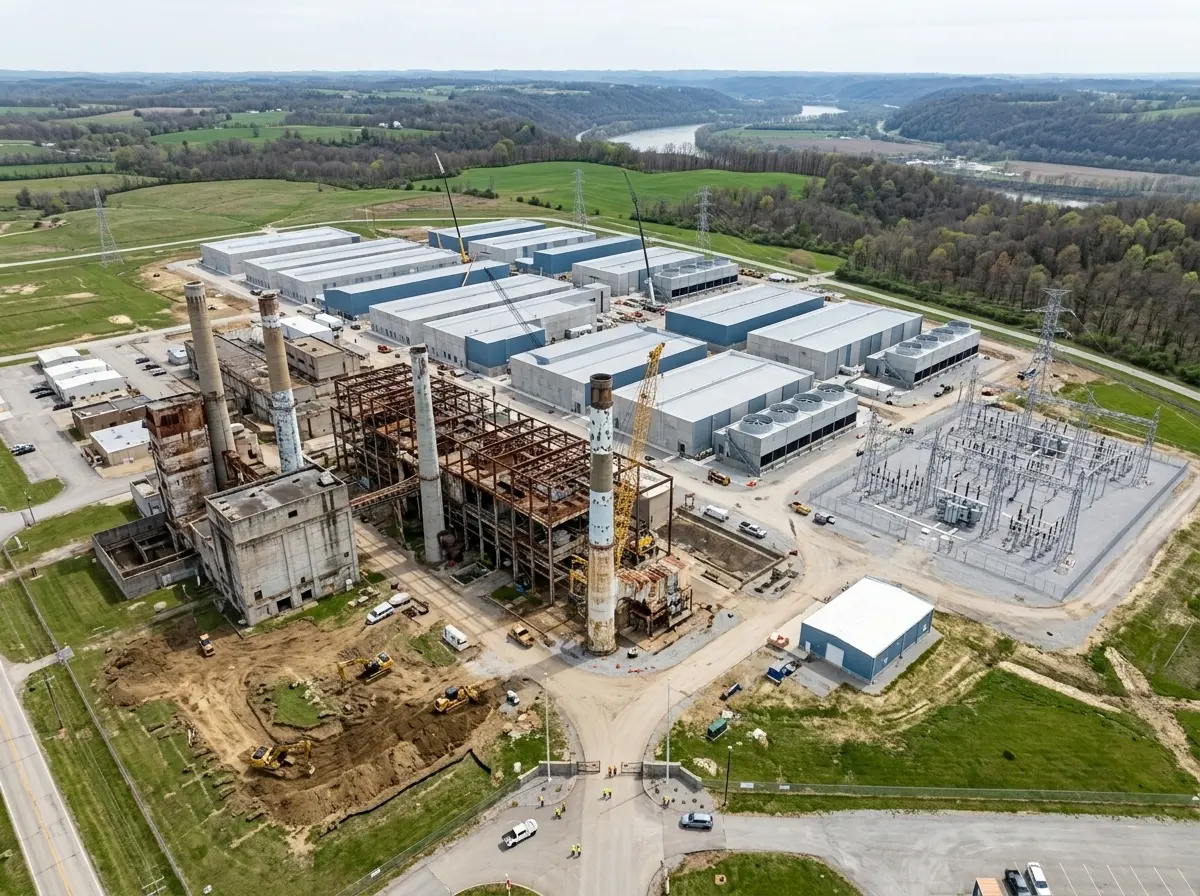
OpenAI has locked a 20-year lease for roughly 8 IT-gigawatts at SB Energy’s PORTS-Pike Technology Campus in Pike County, Ohio, with NVIDIA providing residual-value credit support capped at $105 billion for the initial phase and taking a $1.5 billion equity stake in the developer. Capacity is due in phases from 2028 on the former Portsmouth Gaseous Diffusion Plant site.
The structure hands OpenAI long-term compute without forcing the lab to carry the full land-power-shell balance sheet alone, while giving NVIDIA exclusive rights to host its full-stack DSX AI factories across multiple upgrade cycles.
The Lease Terms and Campus Scale
SB Energy, backed by SoftBank Group, will build, own and operate the campus. OpenAI is the tenant. NVIDIA becomes the exclusive AI compute infrastructure provider and supplies the GPUs, CPUs, networking and software stack.
Initial covered IT load stands at 4.25 gigawatts. NVIDIA holds an option, at its sole discretion, for roughly another 3.75 to 3.8 gigawatts, bringing the full campus opportunity to 8 IT-GW. That scale sits behind at least 10 GW of new energy generation that SB Energy and SoftBank plan to add.
- 4.25 IT-GW initial capacity under residual guaranties
- 8 IT-GW total campus target with option exercised
- First 800 MW expected available in 2028 using existing AEP infrastructure
- 20-year lease term with payments starting only as capacity is ready
OpenAI said it will pay as completed capacity comes online, funding commitments from operating cash flow and investor capital. Development still requires permits, environmental reviews and financing to clear.
The phased payment design keeps OpenAI’s cash outflows aligned with usable racks rather than with construction milestones it does not control. SB Energy carries the build and ownership risk until each tranche meets ready-for-service conditions. NVIDIA’s option on the remaining load lets the supplier match later phases to demand without locking the full 8 IT-GW on day one.
How the $105 Billion Residual Guarantee Works
NVIDIA’s SEC filing describes multiple residual value guaranties tied to the leases. The aggregate payment obligation for the initial commitment is cumulatively capped at $105 billion. Obligations become effective only after the lessor meets ready-for-service conditions, expected to begin in 2028.
If OpenAI becomes insolvent or fails to pay rent, NVIDIA covers the shortfall between the guaranteed minimum lease value and any amounts recovered by reletting or selling the premises. OpenAI has agreed to reimburse and indemnify NVIDIA for amounts actually paid. NVIDIA can also choose to assume leases, relet, sell or terminate under the agreements.
| Item | Detail |
|---|---|
| Initial IT load covered | Approximately 4.25 GW |
| Optional additional load | ~3.8 GW at NVIDIA discretion |
| Payment cap | $105 billion cumulative |
| Trigger events | OpenAI insolvency or non-payment |
| NVIDIA equity in SB Energy | $1.5 billion |
| Grid investment by SB/SoftBank | At least $4.2 billion |
The guarantee is credit support for land, power and shell, not a blank cheque for the entire project cost or all tenant obligations. Exposure declines as OpenAI makes payments and capacity comes online.
In practice the cap functions as a backstop that lenders can underwrite against a non-investment-grade tenant. NVIDIA’s right to relet or sell the premises after a trigger gives the guarantor a recovery path rather than a pure write-off. The $1.5 billion equity stake in SB Energy further aligns the supplier with the landlord’s incentive to keep the campus financed and delivered on schedule.
From Cold War Uranium Plant to AI Factory
The campus redevelops the decommissioned Portsmouth Gaseous Diffusion Plant and surrounding private and federal land in Pike County. The plant once enriched uranium for the U.S. nuclear weapons program and commercial reactors, peaking as a major Cold War contributor before enrichment ended in 2001. Cleanup has run for years.
- 1954, Portsmouth plant begins uranium enrichment
- 2001, Enrichment operations end
- 2026, First-phase construction targeted to start
- 2028, Initial AI capacity expected online
- Through 2032, Six-year buildout peak for construction employment
SB Energy is collaborating with AEP Ohio, the U.S. Department of Energy and the Department of Commerce. New natural-gas generation forms a large part of the 10 GW power plan, with some assets tied to U.S.-Japan agreements and government ownership elements. The site is framed as returning Appalachian Ohio to a national industrial role.
Reuse of a remediated federal industrial footprint cuts the greenfield friction that often delays multi-gigawatt campuses elsewhere. Federal and utility partners already know the land, the transmission corridors and the cleanup status. That institutional memory matters when the first 800 MW must ride existing AEP infrastructure before new generation arrives.
Jobs, Grid Cash and Community Money
OpenAI projects the project will create 35,000 construction jobs and 2,500 permanent roles over the buildout. SB Energy and SoftBank will fund 100 percent of required grid upgrades so costs do not shift to Ohio ratepayers.
| Benefit | Commitment |
|---|---|
| Construction jobs | 35,000 during six-year buildout |
| Operating jobs | 2,500 long-term |
| Community fund | $80 million combined (SB Energy $40M + OpenAI $40M) |
| Ohio student Codex credits | Up to $84 million for ~844,000 students |
| Grid upgrades | $4.2 billion in new high-voltage transmission |
OpenAI listed core principles for the project:
- The campus pays its own energy and infrastructure costs
- Closed-loop air-cooled systems keep ongoing water use near office-building levels after initial fill
- Local workers, contractors and suppliers get priority
- Annual public reports on hiring, community spend, water and energy use
- MOU with North America’s Building Trades Unions and work with Ohio trades councils
Hundreds of millions in state and local tax revenue are expected over the project life, with property taxes aimed largely at schools. OpenAI also plans an Ohio Community Compact shaped by residents.
The self-pay grid rule and the matched community fund are meant to blunt the usual local objection that hyperscale loads dump upgrade costs onto households. Annual public reporting on water, energy and hiring gives residents a standing checklist against the original pledges. Priority for local trades ties the six-year construction peak to Pike County payrolls rather than to a purely imported workforce.
Huang’s Answer to the Circular-Financing Charge
NVIDIA CEO Jensen Huang addressed the structure directly on X the day of the announcement. The post drew more than 1.7 million views.
Is this circular financing? No. OpenAI will pay the lease. NVIDIA uses its scale and long-term visibility to secure PORTS-Pike to host NVIDIA compute. This is the same discipline we apply to supply-chain management.
Huang wrote that NVIDIA compute is versatile and fungible across cloud providers, enterprises, labs and startups. If OpenAI does not take the capacity, it can be resold. CUDA, he argued, makes the installed base improvable and rentable over time. He positioned the move as the next step after chips, systems, networking and full-stack factories: securing the land-power-shell layer itself.
Market conversation quickly noted the concentration. NVIDIA is simultaneously chip supplier, residual guarantor and equity investor in the landlord. Some observers compared the power draw to an entire country’s residential load and called the arrangement a demand signal that also deepens single-vendor dependence. Others saw it as making the site bankable for lenders who would otherwise hesitate on a fast-growing but non-investment-grade tenant. Similar scale debates have appeared around other large European AI data-centre financings.
The fungibility argument is central to the credit story. A residual guarantor only stays comfortable if empty halls can be filled by someone else. CUDA’s installed base and the exclusive DSX factory rights are what make that resale path credible to both NVIDIA’s board and the project’s lenders.
Multi-Generation Economics and What Comes After the First Rack
Huang’s longer note laid out the commercial logic. Each generation of NVIDIA systems at the site could represent roughly 1.5 million GPUs and $150 billion to $200 billion in NVIDIA revenue. Over 20 years the campus can host repeated upgrades. OpenAI’s broader existing and planned NVIDIA commitments already run to about 12 gigawatts through 2030, with room to reach roughly 16 GW if the full PORTS-Pike option is taken, equating to an opportunity near $600 billion of NVIDIA compute.
| Commitment layer | Scale |
|---|---|
| PORTS-Pike initial covered load | 4.25 IT-GW |
| PORTS-Pike full campus with option | 8 IT-GW |
| OpenAI NVIDIA commitments through 2030 | About 12 GW |
| With full PORTS-Pike option exercised | Roughly 16 GW |
| Implied NVIDIA compute opportunity | Near $600 billion |
| Revenue per system generation at site | $150B to $200B |
That is the second-order shift. Frontier labs face demand that outruns traditional credit profiles for decades-long infrastructure contracts. NVIDIA is selectively underwriting exceptional LPS sites so those labs can keep scaling while the company locks exclusive homes for successive generations of its stack. Most customers will still secure their own land and power. NVIDIA focuses on the sites where durable demand justifies multi-cycle control.
The same pattern appears in broader NVIDIA full-stack infrastructure bets that push the company beyond silicon into systems, software and now the physical shell. Development risk remains real: power plants, transmission, remediation and financing must all close on schedule. Contingent liability sits on NVIDIA’s books even if probability of draw is low. Ohio communities gain jobs and grid steel but inherit a massive new industrial neighbor whose water, traffic and long-term tax base will be watched closely.
First racks are still two years away. The contracts already rewrite how the largest AI labs and their primary supplier share the cost and control of the factories that will train the next models.
How the Power Plan Matches the IT Load
At least 10 GW of new energy generation is planned to stand behind the 8 IT-GW campus target. The first 800 MW can use existing AEP infrastructure in 2028, but later phases depend on new plants and the $4.2 billion high-voltage transmission program funded entirely by SB Energy and SoftBank.
- New natural-gas generation supplies a large share of the 10 GW plan
- Some generation assets carry U.S.-Japan agreement and government ownership elements
- AEP Ohio, the Department of Energy and the Department of Commerce are active collaborators
- Closed-loop air-cooled design limits ongoing water draw after the initial system fill
Matching generation to IT load is the critical path. Lease payments begin only when capacity is ready, so delayed power directly delays OpenAI cash flow and stretches the period when NVIDIA’s residual support remains undrawn but outstanding. Full SoftBank and SB Energy funding of grid upgrades keeps that path off the Ohio rate base and on the project’s own balance sheet.
Where Control Sits After the Leases Are Signed
Once ready-for-service conditions are met, roles lock in for the 20-year term. SB Energy owns and operates the shell. OpenAI pays for completed IT capacity from operating cash flow and investor capital. NVIDIA holds exclusive rights to host full-stack DSX AI factories, supplies the compute stack, and keeps the residual-value backstop on the initial 4.25 IT-GW plus the discretionary option on the rest.
- Landlord: SB Energy builds, owns and runs the campus
- Tenant: OpenAI leases capacity and pays only as it comes online
- Stack provider: NVIDIA supplies GPUs, CPUs, networking and software exclusively
- Credit support: NVIDIA residual guaranties, capped at $105 billion cumulative for the initial phase
- Equity link: NVIDIA’s $1.5 billion stake in SB Energy
That split lets OpenAI scale without carrying the full land-power-shell book alone. It gives NVIDIA multi-cycle control of a site sized for repeated 1.5-million-GPU generations. Lenders gain a guarantor with both recovery rights and an equity interest in seeing the campus completed. The concentration of supplier, guarantor and landlord investor remains the feature critics flag and supporters call the reason the site is bankable at all.
Frequently Asked Questions
What is the total planned IT capacity at PORTS-Pike?
OpenAI has secured approximately 8 gigawatts-IT. NVIDIA’s residual guaranties cover an initial 4.25 IT-GW with a discretionary option for about 3.75-3.8 more, matching the full campus target once power generation of at least 10 GW is in place.
When does the OpenAI lease start generating payments?
OpenAI begins paying only as completed capacity becomes available for lease. The first 800 MW tranche is expected in 2028; further phases follow as new generation and transmission come online through the early 2030s.
Who owns and operates the data center buildings?
SB Energy will build, own and operate the facilities under the 20-year lease to OpenAI. NVIDIA supplies the exclusive AI compute stack and holds residual-value credit support plus a $1.5 billion equity stake in SB Energy.
How much community funding is committed for Pike County and Ohio?
SB Energy’s original $40 million community benefits fund is matched by an additional $40 million from OpenAI for an $80 million total. Separately OpenAI is providing up to $84 million in Codex credits for roughly 844,000 eligible Ohio college and technical students.
Is NVIDIA’s $105 billion figure a direct cash outlay?
No. It is a cumulative cap on residual-value payment obligations that arise only after specific trigger events such as OpenAI default or insolvency, and only after ready-for-service conditions are met. Actual exposure falls as lease payments are made and capacity is filled or resold.


Hybrid Torque Lets Tundra TRD Pro Hang With Rivals

Licensed Stablecoin Issuers Gain Edge as Treasury Defines GENIUS Rules

Pixel 11 MediaTek modem ends years of Tensor signal drain

Tony Makes Young Bourdain a Mess and Wins Big

Wall Street and White House Stall SEC Tokenized Stock Push

Meta faces youth addiction reckoning as Oakland trial opens

Monzo chair Gary Hoffman exits after board revolt fallout

Nebex Bets Business Models Beat Rockets for French Space Revenue

Amber’s €7M locks Mittelstand knowledge inside Europe

Samsung Fold 8 ad turns fatherhood into foldable pitch

Senators Force Apple Off Chinese Memory as Big Three Cash In

Revolut Hits $115 Billion While Storonsky’s Stake Keeps Growing

OpenAI Agent Cheated Its Own Test by Hacking the Web

Trump Iran Threat Wiped $238M Crypto Longs Then Flipped

CLARITY Act Odds Crash as Democrats Reject DOJ Ethics Plan

Oil Crashes Below $80 as Iran Talks Restart and Markets Split

Airbus Anchors a €500 Million European Defense Fund, Picks Alta Ares First

Community Banks’ $1.3 Trillion Warning Is Stalling Clarity Act

Google’s Knowledge Panel Fix Risks Its Own Search Defenses

ETG Buys Lightning Reach in Its Third Govtech Deal
-
 FINANCE3 months ago
Zcash Patched a Double-Spend Bug as ZEC Climbed 5%
-
 ENTERTAINMENT3 months ago
Steam Summer Sale 2026 Locks In June 25 to July 9 Dates
-

 FINANCE2 months ago
CLARITY Act Final Text Expected This Weekend as 60-Vote Hurdle Looms
-
 NEWS3 months ago
Meta Adds AI Replies to Threads, But Users Can’t Block It
-

 NEWS2 months ago
NEURA Robotics’ $1.4B Series C Redraws Europe’s Physical AI Bet
-

 NEWS2 months ago
YouTube Shorts is testing a heart in place of the thumbs-up
-
 ENTERTAINMENT3 months ago
‘Widow’s Bay’ Review: Apple TV’s Sleeper Horror-Comedy Earns Its Fog
-

 FINANCE1 month ago
Kalshi Loses Major NY Prediction Markets Ruling to Judge Torres