
NEWS
NVIDIA Puts RTX Spark Into Windows PCs This October
NVIDIA locked RTX Spark N1X specs and an October ship date, putting a Grace CPU and Blackwell GPU on one Windows chip that no longer needs Intel or AMD.

NVIDIA will put RTX Spark PCs on sale in October, the first Windows machines that carry its own CPU and GPU in one chip. At IFA 2026 on September 3 the company locked two N1X setups, one with 6,144 CUDA cores and 20 Grace CPU cores, the other with 5,120 CUDA cores and 18 Grace cores.
Both run Windows 11. Neither needs an Intel or AMD processor in the box. That is the break, not the calendar.
Two N1X Chips, Three Boxes
The public two N1X superchip spec sheets now list three products, not two. Laptops get both chips at 45-80 W. The compact desktop gets only the fat chip, at 140 W.
THE N1X LINE NVIDIA POSTED
| Box | GPU | CPU | Memory | Power |
|---|---|---|---|---|
| Laptop, full chip | 6,144-core Blackwell | 20-core Grace | Up to 128 GB LPDDR5X | 45-80 W |
| Laptop, cut chip | 5,120-core Blackwell | 18-core Grace | Up to 64 GB LPDDR5X | 45-80 W |
| Compact desktop | 6,144-core Blackwell | 20-core Grace | Up to 128 GB LPDDR5X | 140 W |
Shared memory is the product. CPU and GPU pull from one LPDDR5X pool, so a local model does not live in a 12 GB graphics card while the rest of the machine sits idle. The full chip also lists fourth-generation ray-tracing cores, fifth-generation Tensor cores, DLSS 5, Reflex 2, DirectX 12 Ultimate, and PCI Express Gen 5.
NVIDIA rates the top chip at up to 1 petaflop of FP4 AI work. Gaming support is on the sheet too, including HDMI 2.1b and DisplayPort 2.1b, plus one ninth-generation encoder and one sixth-generation decoder. The 5,120-core laptop keeps that feature list. It loses cores, and it loses half the memory ceiling.
Project DIGITS Returns as a Windows PC
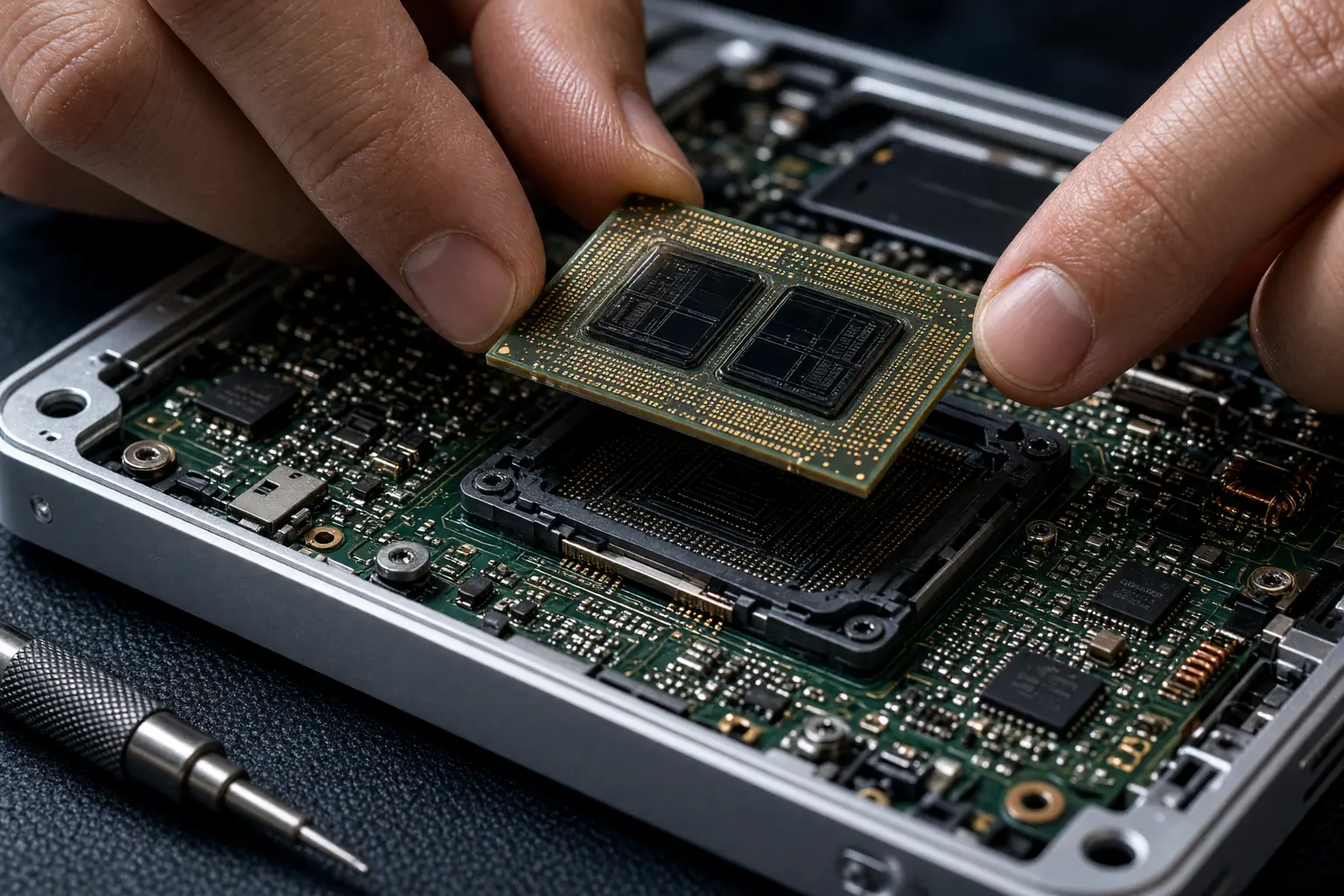
The silicon is not new in the way a GeForce launch is new. The same Grace-plus-Blackwell package already sits in NVIDIA’s DGX Spark, the small Linux box that started life as Project DIGITS. RTX Spark is that chip taught to boot Windows and sit in a 14 mm laptop.
HOW THE SUPERCHIP GOT TO A WINDOWS SKU
- January 2025: NVIDIA unveils Project DIGITS around the GB10 Grace Blackwell Superchip, a 20-core Arm CPU beside a Blackwell GPU, aimed at a desk-side Linux box.
- August 2025: At Hot Chips, the company walks through GB10 as two dies in a TSMC 3 nm 2.5D package, linked by NVLink-C2C, with up to 128 GB of LPDDR5X.
- June 1, 2026: At GTC Taipei during Computex, NVIDIA names the Windows version RTX Spark and says slim laptops and small desktops arrive in the fall.
- September 3, 2026: At IFA, the firm posts the two N1X cuts and says PCs go on sale in October.
DGX Spark still runs NVIDIA’s DGX OS, not Windows, and NVIDIA lists 128 GB of coherent unified memory at 273 GB/s on that box, with a 20-core Arm split of 10 Cortex-X925 cores and 10 Cortex-A725 cores. The Windows N1X flagship matches the core counts. The 18-core cut is the consumer trim DGX Spark never needed.
On June 1 the brand account posted the package itself and called it a new beginning for personal computers.
https://x.com/NVIDIARTXSpark/status/2061305494539469143
MediaTek Built the CPU NVIDIA Is Selling
The GPU die is NVIDIA’s. The CPU die is not a solo NVIDIA job. MediaTek co-designed the Grace side, and on June 1 it said it also did the memory controller for 128 GB of unified RAM, the power parts, and the radios. Vince Hu, corporate senior vice president for compute platforms, put the claim in one line.
With RTX Spark, MediaTek and NVIDIA bring unprecedented local AI supercomputing directly to consumer PCs. This launch underscores years of joint technology efforts between MediaTek and NVIDIA to deliver pioneering technology to the marketplace.
Vince Hu, Corporate Senior Vice President, MediaTek press release, June 1, 2026
That is MediaTek walking into the premium Windows market after years in phones and Chromebooks. Ben Bajarin, CEO of Creative Strategies, said the same day that the work is a push beyond Chromebooks into a segment where margins and brand perception sit higher.
WHAT MEDIATEK SAYS IT PUT IN THE PACKAGE
- CPU and cache: The general-purpose cores and cache that keep Windows and apps moving when the GPU is busy.
- Memory controller: A MediaTek-designed controller that talks to up to 128 GB of unified LPDDR5X.
- Power delivery: PMIC work MediaTek says it tuned so a thin laptop can hold a heavy load without dumping the battery in an hour.
- Radios: On-package wireless meant to keep a local agent in step with a cloud model when a job has to leave the machine.
The 20-core Grace package is also the consumer face of NVIDIA’s CPU push, the same campaign that now has Vera already in full production against x86. Spark is the first time that CPU shows up in a store laptop with a GeForce-class GPU glued beside it.
Lenovo, Acer, and the October OEM Wave
NVIDIA’s June 1 list named six brands for fall: ASUS, Dell, HP, Lenovo, Microsoft Surface, and MSI, with Acer and GIGABYTE to follow. The IFA post moves the calendar from “fall” to October and puts new hardware on a stand.
Lenovo showed the Yoga Pro 9n and the Yoga 9n 2-in-1. Acer showed a compact desktop. Those names join the machines already in the pipeline, including Dell’s XPS 16 Creator Edition, HP’s OmniBook line, ASUS ProArt notebooks, MSI’s Prestige, and Microsoft’s Surface Laptop Ultra. NVIDIA’s own blog now frames RTX Spark PCs arriving in October as the consumer half of a local-agent push that also includes PAIR, a tool that spreads inference across PCs on a home network.
THE FIRST MACHINES NVIDIA HAS NAMED
- Lenovo Yoga Pro 9n: A 16-inch class laptop on the full N1X chip, shown at IFA as a 128 GB local-AI machine.
- Lenovo Yoga 9n 2-in-1: A convertible on the same platform, shown as a creator machine rather than a 128 GB max box.
- Acer compact desktop: A small-form PC NVIDIA describes as a concept on the full chip, built to run agents all day on a desk.
- Surface Laptop Ultra: Microsoft’s own RTX Spark notebook, pitched by Brett Ostrum as a Surface for people who need serious speed in a portable shell.
Michael Dell said creators should not have to choose between portability and performance, and he tied that line to the XPS 16 Creator Edition. Yuanqing Yang, Lenovo’s chairman and CEO, called Spark a new level of AI device for creators, gamers, and developers. None of them posted a price.
That silence is the hole in the launch. AMD already sells Windows boxes with 128 GB of unified memory. Shoppers will compare Spark to those machines the minute a tag appears, and right now there is nothing to compare.
Why the 18-Core Laptop Stops at 64 GB
The cut chip is the tell. NVIDIA is not selling one AI PC. It is selling a 128 GB workstation class and a thinner laptop that stops at 64 GB, with the same 45-80 W lid on both notebooks.
The June 1 press kit says a full Spark machine can run 120-billion-parameter models locally with up to 1 million tokens of context, render 90 GB 3D scenes, edit 12K 4:2:2 video, and play AAA games at 1440p at over 100 frames per second. Those claims sit on the 128 GB product. A 64 GB laptop still has CUDA, Tensor cores, and DLSS 5. It does not have the same headroom for a fat local agent that wants to keep a long context in memory while you edit.
Unsloth, working with NVIDIA and Microsoft, has already said it can train models above 120 billion parameters on the 128 GB laptop. That line does not transfer to the 18-core SKU. The cheap machine is a CUDA laptop. The expensive machine is the one that can hold a frontier-class local model without spilling into the cloud.
Windows still has to translate a lot of old x86 software. NVIDIA and Microsoft are building agent plumbing on top of that, including OpenShell and new Windows security primitives, and Hermes Agent plus OpenClaw are in that work. Translation overhead will show up first on the 18-core, 64 GB lid, where there is less memory to hide a messy working set.
Adobe Rebuilds Photoshop for a 14 mm Laptop
NVIDIA’s June 1 pitch is a 14-to-16-inch aluminum laptop as slim as 14 mm and as light as three pounds, with tandem OLED panels and G-SYNC. The software story is bigger than the chassis. Adobe is rebuilding Photoshop and Premiere for Spark, and NVIDIA says Firefly tools, editing, color, and effects run up to 2x faster on the new chip. Substance 3D Painter and Stager are listed as native. Updates are due as the PCs land.
Blackmagic’s Grant Petty said light Spark laptops with long battery life will help customers shoot and cut on the road. ComfyUI’s Yannik Marek said the large unified memory makes Spark one of the stronger laptops for diffusion work. llama.cpp founder Georgi Gerganov said the chip multiplies context processing inside a portable box. Those are vendor lines, not benches. They do show who NVIDIA thinks will pay for 128 GB.
Games are on the same board. At Computex, KRAFTON, NetEase, Riot Games, and Xbox said they were bringing titles over. At Gamescom, Electronic Arts, Embark, and Ubisoft joined. NVIDIA also says more than 1,000 accelerated apps and games already run on RTX, and more than 100 Windows software vendors are on the Spark list. CyberLink’s PhotoDirector AI PC Mode is timed to the October launch, using TensorRT-RTX and FP8 on NVIDIA GPUs.
Jensen Huang framed the whole stack as a PC that you talk to instead of click through.
The PC is being reinvented. For forty years, you launched apps. Click. Type. With RTX Spark and Microsoft Windows, you ask, and the PC does the work. RTX Spark brings everything NVIDIA has built, CUDA, RTX, our AI platform, into a single superchip. Local agents. Frontier models. Creative workflows. RTX games. All on a laptop. This is the new PC. The personal AI computer.
Jensen Huang, founder and CEO, NVIDIA, GTC Taipei, June 1, 2026
Satya Nadella called it a breakthrough toward “unmetered intelligence” on every desk. That is the Microsoft half of the bet: Windows agents on a machine that can keep the model at home.
CUDA Now Ships Inside the Laptop Chip
Intel’s Panther Lake story is still an NPU TOPS pitch. Qualcomm’s Snapdragon X2 line is still a thin-and-light Arm pitch. AMD already has the closest hardware, a Windows PC with a fat unified-memory pool. Spark’s edge is not that pool. It is CUDA on the same die as the CPU, in a laptop that boots Windows 11, with the same tools a developer already uses on a GeForce card and a DGX box.
That is why the October machines matter even if they cost more than an AMD 128 GB mini PC. A model path that already runs on CUDA does not have to be rewritten for an NPU SDK. The 140 W desktop is the quiet product in the sheet: a Mac mini-sized box that can sit on all day, run agents overnight, and still play a game in the evening, without a separate graphics card.
The 18-core, 64 GB laptop is the compromise that lets OEMs hit a thinner price band. It also caps the local-model claim that NVIDIA used to sell the platform. Buyers who want the 120-billion-parameter pitch have to buy the 20-core, 128 GB machine, in a 14 mm notebook or a 140 W slab.
NVIDIA still has not posted a price. The first systems are due in October anyway.


The House Cancels September Votes and Strands the CLARITY Act

Ascentiz Recruits Developers Around Its Modular Exoskeleton at IFA

Saylor’s Bitcoin Speech Claim Needs a Statute

Zeit AI Raises €5 Million for the Mid-Market Data Layer

Onwards and Sideways Turns Five Good Years Into a Joke

The Galaxy Watch 9 Splits Samsung’s Watch Update Path

Rightcharge Raises £500,000 as Fleets Drift Onto Public Chargers

Early Payment Discounts Hand Buyers a 37 Percent Return

AI Score Raises $5.4 Million as Security Alumni Watch Agents

Sony’s PlayStation Settlement Pays Users in Store Credit

Walter’s TWG Insists No Fraud as Insurer Probes Force Cleanup

30-Year Yield Hits 5.32% Highest Since 2007 as Debt Supply Locks In Costs

PCE Stays at 3.7% as Gas and Tariffs Outrun Coming Revisions

Astute’s $1.2M bet makes B2B creator deals feed AI discovery

Strategy Parks $1.59B Cash While Bitcoin Stack Stays Flat

Evernorth S-4 Clears Path for Active XRP Treasury on Nasdaq

Amber’s €7M locks Mittelstand knowledge inside Europe

SpaceX Stock Rebound Tests Real Demand Before Huge Unlock

The 20% Savings Ideal Meets a 2.7% Reality Check

AI data centers win as RAM kits jump nearly 500 percent
-
 FINANCE3 months ago
Zcash Patched a Double-Spend Bug as ZEC Climbed 5%
-
 ENTERTAINMENT3 months ago
Steam Summer Sale 2026 Locks In June 25 to July 9 Dates
-

 FINANCE2 months ago
CLARITY Act Final Text Expected This Weekend as 60-Vote Hurdle Looms
-
 NEWS4 months ago
Meta Adds AI Replies to Threads, But Users Can’t Block It
-

 NEWS3 months ago
YouTube Shorts is testing a heart in place of the thumbs-up
-
 ENTERTAINMENT5 months ago
Extraction 3 Is Officially Coming to Netflix in 2027
-

 NEWS1 month ago
Senators Force Apple Off Chinese Memory as Big Three Cash In
-

 NEWS3 months ago
NEURA Robotics’ $1.4B Series C Redraws Europe’s Physical AI Bet