
NEWS
Pollen’s Swappable Battery Wants to Power Motorcycles, Then City Grids
Lisbon startup Pollen raised €3.2 million to build a universal battery-swap network that could keep electric motorcycles running and city grids stable.

More than 60 percent of new cars sold in the European Union last year were electrified, hybrid, plug-in hybrid or fully battery powered. Fewer than 6 percent of new motorcycles were. Pollen, a Lisbon startup, has raised €3.2 million (about $3.76 million) in seed funding to close that gap, and the plan does not involve building a new motorcycle.
Pollen’s premise is that the two-wheeler never needed a redesign. It needed a battery that could move between different bikes, get inspected every single day, and retire into the power grid instead of a landfill once it can no longer hold enough charge for a rider.
Batteries Cost More Than the Bike Can Bear
Rui Bento, Pollen’s co-founder and chief executive, has spent 12 years in urban mobility and logistics, including launching Uber in Portugal in 2014 and eventually running the company’s operations across Portugal and Spain. He says the electrification gap between cars and motorcycles comes down to math nobody has solved yet.
A car can spread its battery cost across a much larger vehicle while shedding a long list of mechanical parts. A motorcycle can’t do either. “In a car, you can spread that battery cost across a much larger vehicle while also eliminating many mechanical components. Motorcycles simply don’t have that advantage,” Bento said.
Charging is the second problem. Riders have to stop often, and a full recharge typically takes five to eight hours, a wait nobody wants from a machine already pricier than its petrol equivalent.
“For someone who uses a motorcycle professionally all day, it’s a complete deal-breaker,” Bento said. “That’s the real reason why there are still so few electric motorcycles on European roads today.”
The market backs him up. Electric two-wheeler registrations across Western Europe fell 7.1 percent to 89,000 units last year, even as Chinese brands NIU, Yadea and VMoto took over most of what sales did happen, according to the industry tracker MotorCyclesData.
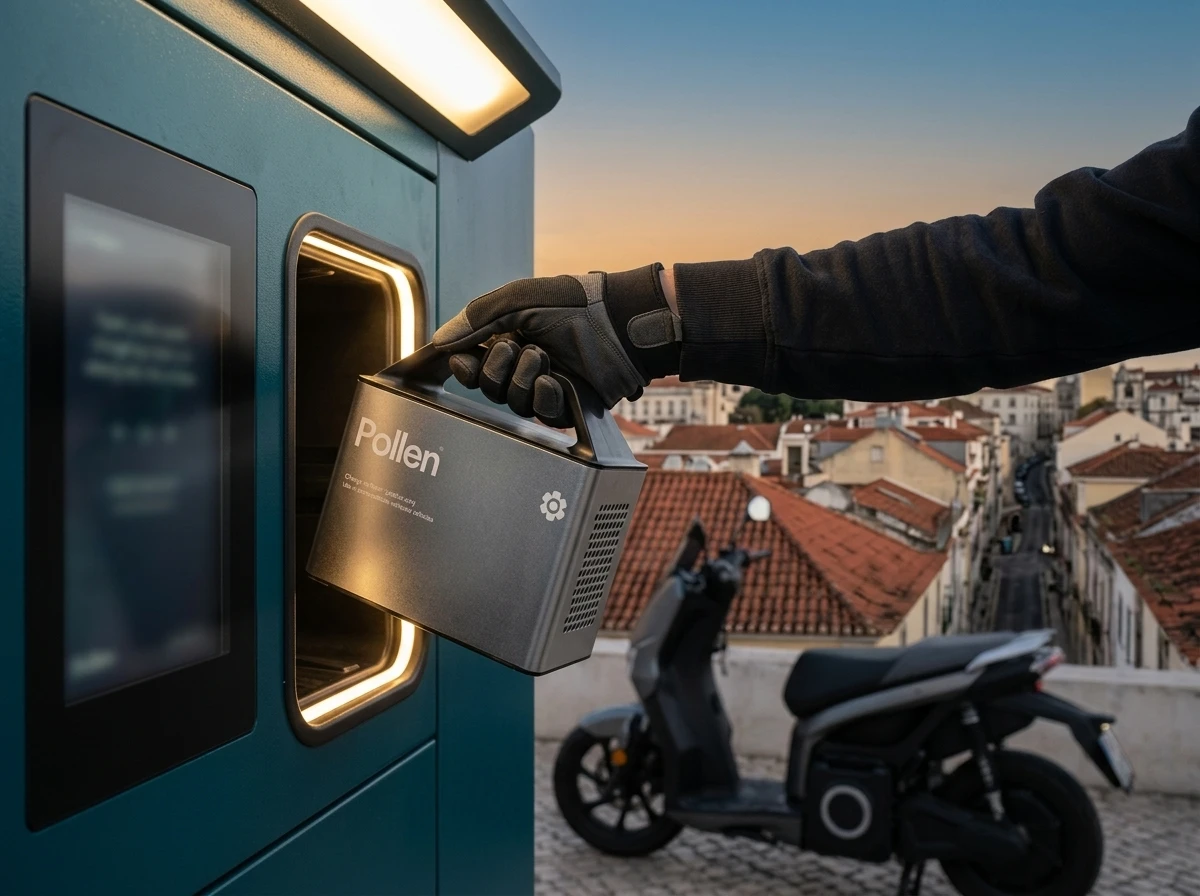
Pollen Built One Battery for Every Motorcycle
Bento founded Pollen in 2024 with Miguel Morgado, its co-founder and chief technology officer, after the two kept circling the same problem from different careers. Bento came from ride-hailing and food delivery. Morgado had built electric motorcycles of his own.
“We kept coming back to one problem: while vehicles in cities are electrifying at a much faster pace than most people realise, motorcycles are not,” Morgado said.
Every battery-swap network running today, whether it belongs to Gogoro, Honda or KYMCO Ionex, requires manufacturers to design their vehicles around one specific battery. That requirement is why swapping stalled outside a handful of Asian markets.
Pollen’s answer is Electronic Cell Switching (ECS), electronics that let a single battery pack safely power motorcycles and mopeds from different manufacturers with no loss of performance. A multi-protocol communications layer lets the battery talk to whichever bike it’s plugged into, and its form factor fits most two-wheelers already on the road. Manufacturers can adopt it without redesigning a single vehicle or introducing a new SKU.
Japan’s four biggest manufacturers tried something similar in 2022, when Honda, Yamaha, Suzuki and Kawasaki launched a joint swapping standard called Gachaco with the petroleum company Eneos. The group defaulted to Honda’s existing PCX battery instead of building something new, which kept the standard boxed inside Honda-compatible scooters.
How Pollen’s Model Differs From Gogoro and Honda
Line the networks up side by side and the difference sits in one place: whether compatibility lives inside the vehicle or inside the battery.
| Network | Vehicle Compatibility | Footprint |
|---|---|---|
| Gogoro | Own Smartscooter line plus partner brands like Yamaha and Hero, built to Gogoro’s spec | More than 2,000 stations and 370,000 riders in Taiwan as of 2021 |
| Gachaco (Honda, Yamaha, Suzuki, Kawasaki) | Common standard based on Honda’s existing PCX battery | Japan-only Battery-as-a-Service launch with Eneos, started 2022 |
| KYMCO Ionex | KYMCO-spec scooters, tied to a LiveWire partnership | Concentrated in Taiwan, limited expansion abroad |
| Pollen | Any manufacturer’s two-wheeler via ECS, no vehicle redesign needed | Three stations live in Lisbon, targeting 30 to 40 by year’s end |
Even the two Taiwanese pioneers of the format have never cracked full-size motorcycles this way. Their packs are sized for scooters, since the power packs are too heavy for a single person to move, Forbes reported in an analysis of the format’s limits.
Every Swap Doubles as a Diagnostic
Each Pollen station runs a full diagnostic the moment a battery comes back in. It checks everything that happened to the battery since it last left, then decides whether it’s healthy enough to go straight back out with the next rider.
That turns every swap into what amounts to a daily physical. Individual cell balance, temperature, pressure and data from the battery management system all get checked against operating thresholds. Fail any one of them, and the battery gets pulled for maintenance instead of handed to the next customer.
Bento says the company asks one question every time a battery comes back: is it in perfect condition to be issued to the next customer? “That’s one of the major advantages of battery swapping compared with battery ownership,” he said. “If you own your own battery, it may only be inspected once a year during routine servicing.”
Lisbon’s Hills Are Rewriting the Battery’s Chemistry
The stations don’t just check battery health. They log how people actually ride, data that Bento said “feeds back into the design of future generations.”
Flat cities barely tax a battery. No rapid acceleration, no high current draw. Lisbon is not flat. Riders there accelerate harder up its hills, creating repeated peaks in power demand and higher discharge currents than a rider in a flatter city would ever produce.
“Should we use exactly the same battery everywhere, or should we optimise batteries for different operating environments?” Bento said. “It even affects the type of cells we select. Do we prioritise long-term cell life, or do we choose cells that can better support repeated high-current discharge during steep climbs?”
What Happens to a Pollen Battery After 1,200 Cycles?
Pollen designs each battery for about 1,200 charge cycles, a threshold set by usage rather than age. Heavy use burns through those cycles faster but extracts more work per battery; light use just takes longer. Once a battery falls to around 70 percent of its original capacity, it leaves motorcycles for a second career storing electricity for the grid.
That second career is where the more consequential opportunity might sit. A battery too weak for a rider chasing maximum range is still strong enough for a stationary system that charges when solar generation is high and feeds power back to the grid when demand spikes.
Portugal and Spain suffered a major blackout last year after a grid failure knocked out power across the Iberian Peninsula. Traffic lights stopped working. Intersections turned chaotic. There was no local backup keeping basic infrastructure running.
That led us to ask a simple question: what if a second-life battery station were connected to a major intersection? A single battery could keep traffic lights operating for several hours, maintaining a critical piece of city infrastructure during a power outage.
Bento said that while describing why he thinks these retired batteries could create value well beyond transportation.
Gogoro has already shown a version of this at scale. When a magnitude 7.4 earthquake hit Taiwan in 2024, hundreds of its stations automatically powered down to ease strain on the grid, saving enough electricity to keep thousands of homes running until it stabilized, according to MIT Technology Review.
Bento sees the battery as a platform, not a product tied to two wheels. Use cases already on Pollen’s radar include:
- Commercial delivery vans that currently return to a depot once their single battery drains, which could finish an entire route on swapped batteries instead.
- Food trucks and recreational vehicles that currently run on propane or diesel generators.
- Electric boats, where marina charging can take hours and a swap could send a boat back out immediately.
“Anywhere reliable grid access is difficult, or where remaining off-grid is valuable, a swappable battery system could become an important part of the solution,” Bento said.
The Money Behind the Expansion
Pollen announced its €3.2 million raise last week. Pale Blue Dot, a seed-stage climate tech investor, and Mustard Seed Maze led the round, joined by Kfund, Bynd Venture Capital, 4P Capital, Masia and a group of mobility-focused angel investors. Among them: George Kalligeros, vice president of hardware at the mobility company Tier; Gui Telles, a former chief operating officer at Uber and Jump; and Bastian Cransac, Lime’s vice president for Europe and the Americas.
Pale Blue Dot said its confidence rests partly on Morgado’s own track record building the fastest electric motorcycle at Axiis before he co-founded Pollen, and on the team’s stated ambition to power 100 million trips a day without petrol.
The economics are shifting in Pollen’s favor too. “Anyone using a motorcycle professionally feels the impact of paying more than €2 per litre,” Bento said. “Once electricity becomes both the cheaper and more convenient option, the decision becomes much easier than it was even a year ago.”
- €3.2 million raised in seed funding, led by Pale Blue Dot and Mustard Seed Maze
- Fewer than 6% of new EU motorcycles sold last year were electric, against more than 60% of new cars
- 30 to 40 stations targeted across Lisbon by year’s end, up from three today
- 1,200 charge cycles is the design life of every swappable battery Pollen builds
Bento says the goal isn’t a map full of pins. He wants density in a handful of cities before Pollen spreads further, so a rider is never far from a station. “We believe that’s the best way to deliver a great customer experience while also building a sustainable business,” he said.
Frequently Asked Questions
Is Pollen’s Battery Swapping Available Outside Lisbon Yet?
Not yet for riders, though the expansion groundwork is already underway. Pollen is hiring a launch and operations manager based in Valencia to open its first market in Spain, part of a wider push into Southern Europe before the company looks further afield.
What Motorcycle Brands Work With Pollen’s Battery?
Pollen says its universal battery already fits most e-moped and motorcycle models from brands including Horwin, Niu, Vmoto, N-Moto, Honda, Yamaha and Askoll, without any hardware changes to the vehicle itself. That compatibility list is expected to grow as more manufacturers adopt the battery’s communications layer.
How Does Pollen Make Money From Battery Swapping?
Riders and fleet operators pay a fixed monthly subscription for access to the swap network rather than buying a battery outright. Fleet operators get predictable monthly costs instead of the higher upfront price of owning an electric motorcycle and its battery, which is what finally makes the economics work against petrol.


The House Cancels September Votes and Strands the CLARITY Act

Ascentiz Recruits Developers Around Its Modular Exoskeleton at IFA

Saylor’s Bitcoin Speech Claim Needs a Statute

Zeit AI Raises €5 Million for the Mid-Market Data Layer

Onwards and Sideways Turns Five Good Years Into a Joke

The Galaxy Watch 9 Splits Samsung’s Watch Update Path

Rightcharge Raises £500,000 as Fleets Drift Onto Public Chargers

Early Payment Discounts Hand Buyers a 37 Percent Return

AI Score Raises $5.4 Million as Security Alumni Watch Agents

Sony’s PlayStation Settlement Pays Users in Store Credit

Walter’s TWG Insists No Fraud as Insurer Probes Force Cleanup

30-Year Yield Hits 5.32% Highest Since 2007 as Debt Supply Locks In Costs

PCE Stays at 3.7% as Gas and Tariffs Outrun Coming Revisions

Evernorth S-4 Clears Path for Active XRP Treasury on Nasdaq

Astute’s $1.2M bet makes B2B creator deals feed AI discovery

Strategy Parks $1.59B Cash While Bitcoin Stack Stays Flat

Amber’s €7M locks Mittelstand knowledge inside Europe

SpaceX Stock Rebound Tests Real Demand Before Huge Unlock

The 20% Savings Ideal Meets a 2.7% Reality Check

CLARITY Act Cloture Opens a Door Ethics Still Blocks
-
 FINANCE3 months ago
Zcash Patched a Double-Spend Bug as ZEC Climbed 5%
-
 ENTERTAINMENT3 months ago
Steam Summer Sale 2026 Locks In June 25 to July 9 Dates
-

 FINANCE2 months ago
CLARITY Act Final Text Expected This Weekend as 60-Vote Hurdle Looms
-
 NEWS4 months ago
Meta Adds AI Replies to Threads, But Users Can’t Block It
-

 NEWS3 months ago
YouTube Shorts is testing a heart in place of the thumbs-up
-
 ENTERTAINMENT5 months ago
Extraction 3 Is Officially Coming to Netflix in 2027
-

 NEWS1 month ago
Senators Force Apple Off Chinese Memory as Big Three Cash In
-

 NEWS3 months ago
NEURA Robotics’ $1.4B Series C Redraws Europe’s Physical AI Bet