
NEWS
Twentyfour Industries Bets $11.8 Million on Simple Factory Drones
Twentyfour Industries raised $11.8 million for a 20-minute unarmed 10-inch quad, a small Munich factory hedge beside much larger strike-drone bets.

Twentyfour Industries came out of stealth on 19 January 2026 with $11.8 million already raised to mass-produce a 10-inch, non-kinetic quadcopter in Munich. The Q-X flies 20 minutes, hauls 2.5 kg, and does not carry a warhead. The same investors already sit on much larger European strike-drone bets.
That is the wager. Europe’s loud money in 2026 has gone to long-range one-way attack systems. This cheque is for a short-range workhorse, a factory line, and a plan to train the people who will fly it.
The Money Landed in August, Months Before the Reveal
Clemens Kürten, the chief executive and co-founder, wrote that the first hire arrived in January 2025 and that the company $11.8 million round with Lakestar, OTB Ventures and 468 Capital closed in August. The public story waited. On 19 January 2026 the firm came out of stealth with the round already closed, naming the Q-X and claiming several hundred airframes already in daily use.
Company articles were filed on 3 December 2024. Twentyfour Industries GmbH was entered in the Munich register on 1 January 2025 with €25,000 of share capital, and it is registered at Geretsrieder Strasse 10 in Munich. Kürten and Erik Linden, the chief commercial officer, are the managing directors. Martin Eichenhofer, the chief operating officer, previously co-founded 9T Labs in Switzerland. Constantin Jung is vice president of engineering. Kürten has said the four share a bet on European drone sovereignty, and that they stayed quiet in order to execute.
THE FOUNDING-TO-FUNDING CALENDAR
- 3 December 2024: Company articles are filed in Munich.
- 1 January 2025: Twentyfour Industries GmbH is registered (HRB 298664) with Kürten and Linden as managing directors.
- January 2025: Kürten says the first hire joins.
- August 2025: Funding is increased to $11.8 million from Lakestar, OTB Ventures and 468 Capital.
- 19 January 2026: The company exits stealth, names the Q-X, and says several hundred units are already flying.
- 17 July 2026: Lakestar lists Twentyfour Industries in the portfolio of its new dedicated defence fund.
Five months sat between the cheque and the announcement. Kürten’s stated aim was to design, build and deploy hundreds of drones, and to look like a supplier governments could take seriously, before anyone had to know the name.
20 Minutes, 2.5 kg, No Warhead
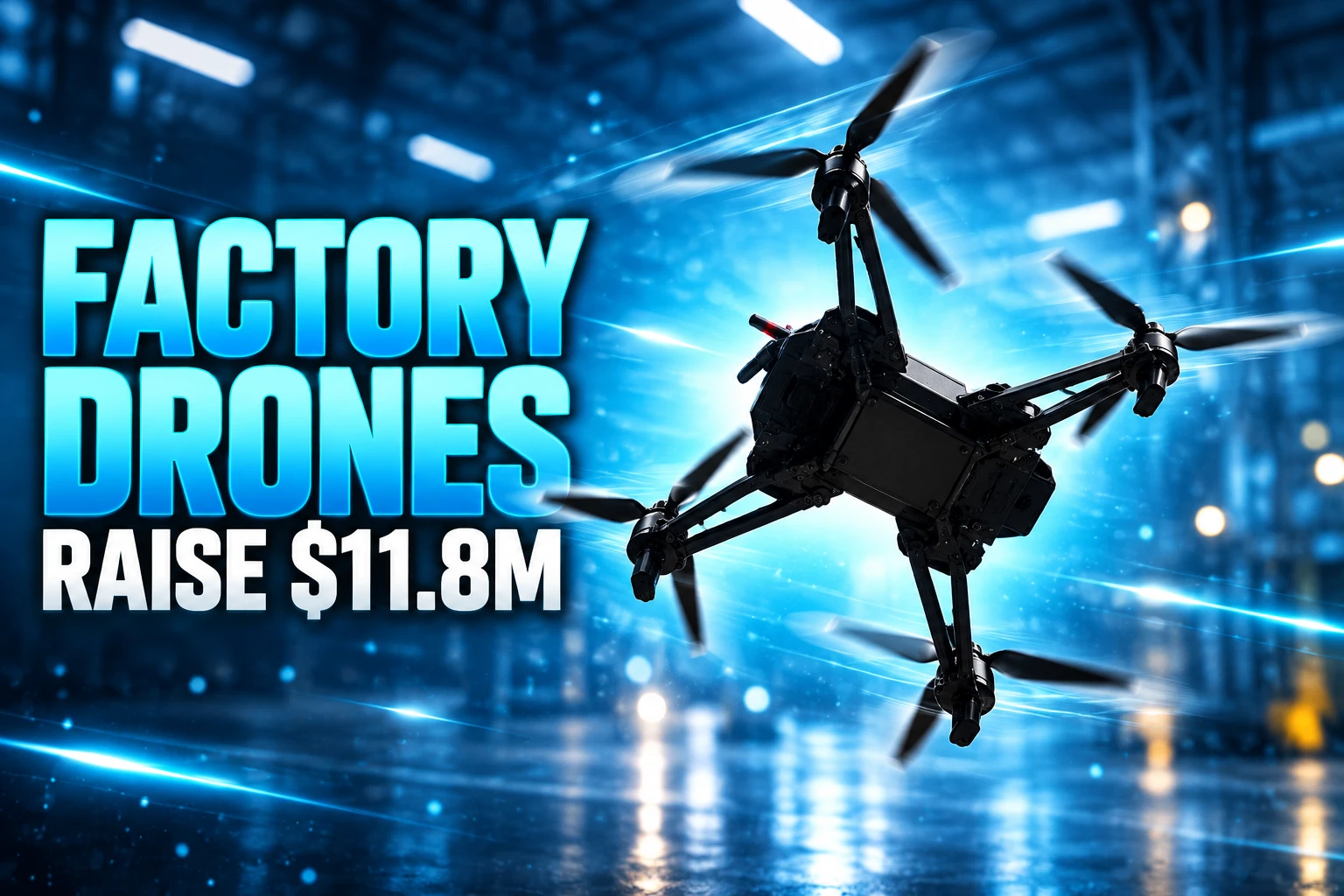
The Q-X is a 10-inch quadcopter for short jobs. Maximum flight time is 20 minutes. Maximum payload is 2.5 kg on a modular mount. Top speed is 140 km/h, and the working radius is 12 km. Kürten has stressed that Twentyfour Industries does not develop or supply kinetic payloads. Availability, the company says, is 98 percent.
Those numbers put the airframe in a different bin from the strike drones now being stood up a short drive away. On 10 September 2026, Auterion, a US-German software firm, and Ukrainian maker Airlogix began assembling more than 5,000 unmanned aircraft near Munich under a German-funded contract of about €300 million ($349 million). That order covers the Seth X medium-range swarm aircraft and the Anubis long-range strike drone, which Auterion says can fly 1,500 km with a 50 kg warhead.
THREE EUROPEAN LINES, THREE JOBS
| Platform | Builder | Reach | Load | Job |
|---|---|---|---|---|
| Q-X | Twentyfour Industries, Munich | 12 km, 20 minutes | 2.5 kg, modular | Unarmed multi-mission quad |
| French micro-quads | Harmattan AI, for the French armed forces | Short training and recon sorties | Electro-optical camera | 1,000 units at under €1,000 each |
| Anubis | Auterion and Airlogix, near Munich | Up to 1,500 km | 50 kg warhead | Long-range strike |
France has already taken a cheap-and-many route of its own. Under a 2024 aerial-drone pact, the French armed forces ordered 1,000 micro-drones at under €1,000 each from Harmattan AI, with the flight-control boards required to be made in Europe. The Q-X sits closer to that French order than to Anubis. It is a reusable, unarmed 10-inch machine for short sorties, not a one-way missile with wings.
Lakestar Already Backs Helsing, Auterion and Tytan
Lakestar and OTB Ventures are not new to this neighbourhood. Both have long defence lists that include Helsing and ICEYE. On 17 July 2026 Lakestar closed a $300 million Resilience I fund, which it called Europe’s largest dedicated dual-use and defence vehicle, and named Twentyfour Industries in the same portfolio sentence as Helsing, Auterion, Tytan, Frankenburg Technologies and UFORCE.
Klaus Hommels, Lakestar’s founder and chairman, used the close to argue that Europe needs sovereign technology capital as well as sovereign kit. The firm says it manages more than $6 billion. Founders across the defence book, it says, have raised over $5 billion in private capital, employ more than 5,000 people, and already sell into allied governments.
Freedom is not for free. Sovereignty and Europe’s capabilities in critical technologies are a core concern for all of us. Europe and its Western allies need sovereign technology capital in the defence and dual-use sectors.
Klaus Hommels, Founder and Chairman, Lakestar, Resilience I announcement
A $11.8 million early cheque inside that book is a sleeve, not the main bet. Helsing, Auterion and Tytan are the expensive autonomous and interceptor names. Twentyfour is the small, local production line. OTB did not put out a long note of its own. It left a short congratulations on Linden’s post. The interesting part is the mix: the same firms are financing both the high-end autonomy stack and a shop whose first product lasts 20 minutes and carries no warhead.
A Non-Kinetic Quad in a Strike-Drone City
Munich is where Germany’s new drone industry actually makes things. Helsing, Quantum Systems, ARX Robotics, Tytan and now Auterion’s Ukraine joint venture all sit in that Bavarian cluster. The political demand is for volume. Ukrainian output is described in the hundreds of thousands of drones a month. European armies are still trying to buy something they can train on, replace, and explain to a procurement officer.
Twentyfour’s own statement at launch was blunt about the hole it thinks it is filling. Modern warfare, it said, depends on unmanned systems at scale, and Europe still lacks sovereign production and trained operators, which leaves the continent on fragile supply chains and foreign know-how. That is a factory argument, not a software argument.
The Q-X’s limits are the point of the product. A 12 km radius and a 20-minute battery will not replace a 1,500 km strike drone, and the company is not pretending otherwise. What it can replace is a Chinese hobby airframe in a training shed, or a one-off quad that a unit cannot get spares for. Ministries that will not sign for a mystery kamikaze from a 12-person startup will sign for an unarmed trainer they can put in a soldier’s hands on a Tuesday.
The Quiet Product Is Operator Training
468 Capital, the Berlin firm in the round, had until this deal barely touched defence. Its 2022 fund was $400 million, spread across hundreds of early European and US bets. Its other recent defence name was Albacore, a US maritime drone company, in October 2025. What it says it bought in Munich is a system, not a single airframe.
WHAT 468 CAPITAL SAID STOOD OUT
- The airframe: A cost-efficient, mass-manufacturable, multi-mission 10-inch quadcopter.
- The line: A modular production system on local supply chains, aimed at ambitious unit counts.
- The school: A proprietary platform for training, with an ambition to make every soldier in Europe a drone operator.
- The team: Defence procurement, production and technical experience in one founding group.
That training line is the part of the pitch that does not show up in a spec sheet. Kürten has described three pillars from day one: the drone itself, sovereign production, and an organisation that can be a credible government supplier. Most firms, he said, pick one. Linden has said the company iterates with operators in the field and prefers delivery over complexity.
From day one, we set out to deliver three pillars: drone technology, sovereign production capacity, and an organization capable of being a credible supplier to governments. Most players focus on one of these. Very few combine all three in a way that scales.
Clemens Kürten, CEO and co-founder, Twentyfour Industries
Launch-week accounts said the quadcopter had already been used to train Bundeswehr soldiers. The company will not name customers or countries. If that training use holds, the Q-X is less a battlefield surprise than a school aircraft with a path onto daily tasking. A soldier who has already flown the trainer is a buyer for the next, heavier airframe. That is a slower business than a one-way strike contract, and it is also harder for a foreign hobby brand to displace once a ministry has written the syllabus.
Who Is Flying Twentyfour’s Quadcopters?
The firm says it has signed and delivered revenue-generating contracts in several countries, with both civilian and military operators using Q-X units every day. A spokesperson, asked which countries, would only confirm active European use. Pricing is undisclosed. So is the valuation. So are the customer names. Kürten has said customers and users already know the company, and that a wide public was not required for that first step.
WHAT WE KNOW
- The round: $11.8 million, closed in August 2025, announced on 19 January 2026, from Lakestar, OTB Ventures and 468 Capital.
- The hardware: Several hundred 10-inch Q-X quads, unarmed, 20 minutes, 2.5 kg, 140 km/h, 12 km radius.
- The legal home: Twentyfour Industries GmbH, Geretsrieder Strasse 10, 81379 Munich, HRB 298664.
- The 2026 plan: Expand the product list and scale modular, mobile production in Germany toward thousands of units a month, with more sites later in Europe.
WHAT IS UNCONFIRMED
- Customers: No ministry, unit or civilian operator has been named by the company.
- Price and valuation: Neither figure has been published.
- Current monthly output: Several hundred units are a lifetime count, not a rate, and the thousands-a-month figure is a target.
- Later capital: Company databases still show a single $11.8 million round.
Inside the German defence trade, the name was barely known when the round was disclosed, which is what stealth is for. The cost of that choice is that outsiders cannot test the “several hundred” claim, the 98 percent availability figure, or the daily-use line against a delivery schedule. The company is asking to be judged on hardware in the field while refusing to say whose field.
Thousands of Units a Month Is the Written Target
Kürten’s 2026 plan is specific enough to hold him to it. Expand the product portfolio. Scale modular, mobile manufacturing in Germany to thousands of units a month. Lay groundwork for more production elsewhere in Europe. Hire in engineering, operations and commercial roles. Dealroom’s write-up of the same plan matches that unit target. The public homepage is a coming-soon placeholder under the line “European drones at scale.”
THE 2026 PRODUCTION PLEDGE
- Output aim: Thousands of units a month from modular, mobile lines in Germany.
- Footprint: Extra European sites to be prepared after the German line.
- Catalogue: More products beyond the first 10-inch quad.
- People: Selective hiring in engineering, operations and commercial jobs.
A thousands-a-month unarmed quad is still a small number next to Ukrainian wartime output, and next to a 5,000-aircraft strike order being bolted together in the same metro area. It is a large number for a company that was incorporated in late 2024 and made its first hire in January 2025. The bet is that European armies will keep paying for a sovereign 10-inch trainer and tasking drone even while they also buy the expensive one-way systems from the neighbours on Lakestar’s letterhead.
Kürten said the early traction already shows that technology plus industrialisation plus institutional readiness is a value proposition in a crowded market. The next test is quieter than a launch: whether those several hundred airframes become several thousand a month, and whether the unnamed European operators keep flying them once the novelty of a new Munich drone shop has worn off.
Disclaimer: This article is news reporting on a private company’s funding and product claims, and it is for information only. It is not investment advice, a solicitation to buy or sell securities, or a recommendation to invest in Twentyfour Industries or any of the venture funds named. Readers who are considering an investment in defence-technology companies should consult a qualified financial adviser and, where relevant, a lawyer familiar with export-control and dual-use rules. Figures, customer claims and production targets reflect the company, investor and official statements available on 10 September 2026 and may change.

Triumph Bonneville 400 Puts Its Badge on a 349cc Tax Cut

Verstappen Takes First 2026 Pole at a Relocated Bahrain GP

Anthropic Warns a Pentagon Fight Can Hit Private Clients

FDA Closes Taylor Farms Lettuce Probe Without a Cause

Galaxy Z Fold 8 Ultra Gets a 5,298MB October Security Update

The Orchard Bug Forced Zcash to Open an Empty Pool

The $5.99 Game That Won Steam’s 2026 Summer Sale

Don Lee Joins Hemsworth as Extraction 3 Starts Shooting

YouTube Shorts Retires Dislikes and Swaps Likes for Hearts

NEURA Robotics Is Spending Its $1.4B on a Machine Stack
-
 NEWS4 months ago
The Orchard Bug Forced Zcash to Open an Empty Pool
-
 GAMING4 months ago
The $5.99 Game That Won Steam’s 2026 Summer Sale
-
 ENTERTAINMENT6 months ago
Don Lee Joins Hemsworth as Extraction 3 Starts Shooting
-
 NEWS4 months ago
YouTube Shorts Retires Dislikes and Swaps Likes for Hearts
-
 NEWS4 months ago
NEURA Robotics Is Spending Its $1.4B on a Machine Stack
-
 AUTO6 months ago
Kawasaki Bets the New Z1100 Against Its Own Supercharger
-

 BUSINESS5 months ago
Norway’s Export Bank Backs Nscale’s $790 Million Narvik Loan
-

 GAMING4 months ago
Game of Thrones Dragonfire Follows Boston’s Conquest Playbook