
NEWS
Sunray’s Cheap Beam Shifts Ukraine’s Drone War Math
Ukraine’s Sunray laser prices a drone kill at 50 cents, yet fog, dwell time, and a slipped summer shield still decide whether the nodes matter.

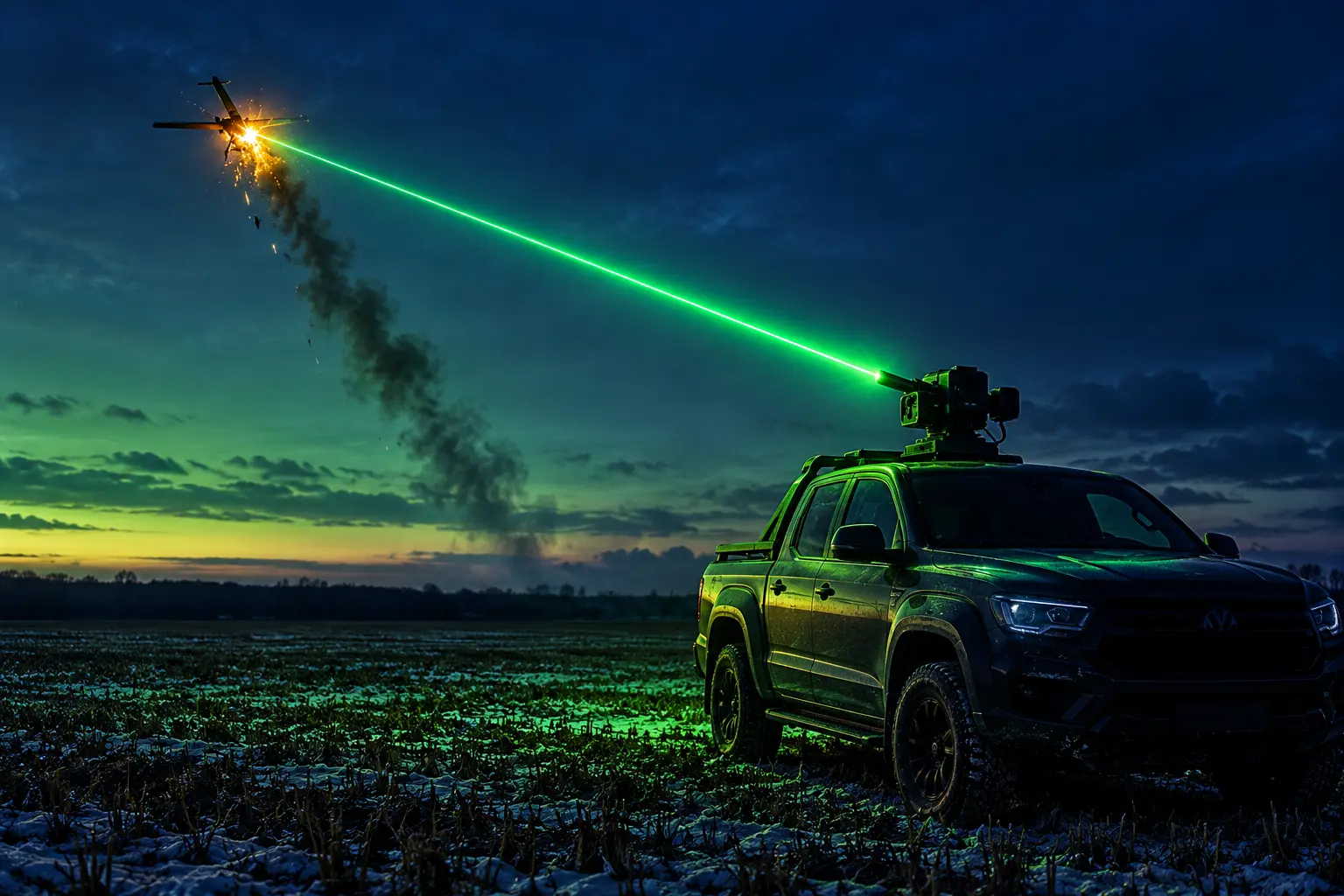
Ukraine’s Sunray laser burned a small drone in seconds from a pickup roof in February 2026, with no flash and no bang. The maker later priced a kill at 50 cents and a unit at $300,000.
The second fight is not the demo. It is whether enough silent nodes can sit on trucks, roofs, and boats, keep power and a clear line of sight, and stop cheap Russian airframes without firing the last expensive missile in the rack.
A Silent Beam Burned a Drone From a Pickup Roof
In an empty winter field, the crew set a tube that looked like a hobby telescope on the roof of a pickup, cameras fixed on both sides. A small drone flew a few hundred yards out and hung in a pale sky while the mount tracked it. The operator shouted “Fire!” and within seconds the airframe burned and fell in a fiery arc, as if something unseen had touched it.
The weapon made no sound and threw no visible beam, which is the whole point against a night of one-way attack drones. Creators who had spent about two years on the prototype said they built it for a few million dollars in the first telling, and a later company slideshow put the budget at $2 million. They designed it to ride in a car trunk and to sit on a light truck, not in a silo.
Pavlo Yelizarov, then the newly appointed commander of Ukraine’s air-defense forces and a deputy head of the Air Force, treated the price gap with Western programs as a war product. He had come out of television, then built the National Guard drone unit Lasar’s Group, before Kyiv handed him the job of stitching domestic guns, interceptors, and oddities like Sunray into one shield.
Sure, you can use a Bentley to haul potatoes. But it’s probably not the smartest way to do that job.
Pavlo Yelizarov, commander of Ukraine’s air-defense forces
That line is the doctrine. Shahed-class drones are cheap enough that a Patriot round is the wrong tool, and Ukraine has already spent scarce foreign missiles on targets that run on small engines. Sunray is the attempt to stop paying luxury prices for a farm chore.
LAZR Prices a Kill at 50 Cents
By May 2026 the company behind the tube had a name, LAZR, and a co-founder who would only go by Alex. He told a Brave1 industry day that Sunray was already in use on the Ukrainian battlefield as a set of autonomous nodes that detect, track, and burn drones at near-zero cost per shot. A company slideshow put the economics in hard figures: 50 cents per kill, $300,000 per unit, under 200 kilograms, built on a $2 million budget and battle-tested in less than 18 months.
Those per-shot cents are electricity and wear, not a new round in a crate. They sit beside a U.S. Navy path that started with a $150 million 2018 contract for HELIOS, the Lockheed Martin ship laser that the firm delivered an integrated laser to the Navy in 2022, four years after the award. Ukraine is trying to buy the same physics on a pickup budget.
WHAT A DRONE KILL COSTS
| Shooter | Stated cost | What the figure covers |
|---|---|---|
| Sunray laser | 50 cents per kill | LAZR slideshow, May 2026 |
| Sunray unit | $300,000 | One node, same slideshow |
| P1-Sun interceptor drone | A little more than $1,000 | Skyfall, February 2026 |
| HELIOS program | $150 million contract | Lockheed Martin, 2018 |
| Iron Dome battery | As much as $100 million | 2012 figure, CSIS |
Skyfall’s P1-Sun, a 3-D-printed interceptor with about 500 grams of C-4, had already been used against more than 1,000 targets by February 2026, including more than 700 Shaheds, according to the company. That kinetic layer still spends a thousand-dollar airframe to kill another airframe. The laser pitch is that the magazine is a generator, as long as the beam can hold.
The Winner Is a Network of Nodes
Alex’s argument was not a bigger cannon. Sunray, he said, can be thrown on a rooftop, a pickup, an unmanned ground vehicle, or an unmanned surface vessel, then run as a mesh that shares tracks. Weight under 200 kilograms is the feature that makes that mesh plausible. A trailer laser that needs a prepared pad cannot multiply across brigades the same way.
He said the Ukrainian Air Force was expected to buy the system for the anti-drone dome, and that LAZR aimed to deliver 500 units the following year and more than 20,000 by 2030. Those are maker targets, not a signed procurement notice. They still tell you the bet: many small burners, not one palace gun.
We’re going to build the laser shield for Ukraine. In my opinion, the winner in direct energy is not a bigger laser cannon, it’s a smarter network of nodes that can share targets.
Alex, co-founder of LAZR, at a Brave1 demonstration
The venue for that pitch was the state defense-tech cluster Brave1, which began as a grant shop for defense startups and now lists itself as the state’s main defense-innovation body, with more than 750 grants totaling 3.7 billion UAH. Lasers sit on the same national wish list as anti-Shahed kits and naval drones. Sunray is one private node in a cluster that is trying to turn workshop weapons into inventory.
Tryzub Hits Closer Than the Early Claims
Sunray is not Ukraine’s only beam. Celebra Tech’s Tryzub, a trailer-mounted system, was the first one Kyiv talked about in public. Vadym Sukharevskyi, then commander of the Unmanned Systems Forces, disclosed a working combat laser on December 16, 2024. First combat use against Geran drones was described on February 3, 2025, and in April 2025 the Unmanned Systems Forces showed the kit blinding a fiber-optic FPV camera, which is a kill if the pilot is flying on that feed.
Early military talk put Tryzub against strike drones and even cruise and ballistic missiles at up to 3 kilometers, with aircraft out to 5 kilometers. In May 2026 the maker’s own numbers were shorter. Celebra Tech said the trailer burns FPV drones at 800 to 900 meters and reconnaissance UAVs at about 1,500 meters, with work still aimed at Shahed-class shots toward 5 kilometers. About 15 people were on the project. The gap between the 2025 boasts and the 2026 test card is the sober version of this whole class.
UKRAINE’S LASER CALENDAR
- December 16, 2024: Sukharevskyi says Ukraine has a working combat laser, later identified as Tryzub.
- February 3, 2025: First described combat use against Geran drones.
- April 2025: Unmanned Systems Forces show Tryzub, including a camera-blind on a fiber-optic FPV.
- February 10, 2026: Sunray burns a small drone a few hundred yards from a pickup in a field demo.
- May 2026: LAZR puts 50 cents, $300,000, and battlefield use on a slideshow; Celebra Tech posts Tryzub’s 800 to 900 meter FPV card.
- July 22, 2026: Brig. Gen. Andrii Lebedenko says lasers that already down FPVs will reach units within two to three months.
Lebedenko, deputy commander-in-chief since February 2024 with the innovation brief, said private firms and army teams were already building the weapons, that they already downed FPV drones, and that they were already being tried against Shaheds. He did not name Sunray in that briefing. The calendar still puts both families in the same quarter Kyiv kept promising would be the laser quarter.
Fog and Dwell Time Still Own the Shot
A high-energy laser is a welder at a distance. The U.S. Government Accountability Office notes that these weapons can cost less per shot than missiles and can fire as long as they have power, and that a beam of at least 1 kilowatt, some 200,000 times a typical pointer, can melt steel. The same briefing is blunt about the catch: they generally reach less far than guns and missiles, and fog and storms can cut laser range and beam quality.
That is not a press-cycle quibble. The beam needs a line of sight. It must dwell on one aim point for several seconds while the airframe moves. Moisture, dust, smoke, and turbulence scatter and walk the spot. A swarm that arrives in rain, or behind a smoke screen, can force the operator back to guns and interceptors at the exact moment the magazine was supposed to be infinite. Soldiers who used four 50-kilowatt lasers to defend U.S. bases in Iraq in 2024 called the kit cumbersome and ineffective in a Center for a New American Security review, which is the field report the slideshow never prints.
THE PHYSICS THAT STILL LIMITS THE BEAM
- Line of sight: The turret cannot shoot over a hill, through a building, or around a weather front.
- Dwell time: Damage builds over seconds, so a fast or weaving target can walk off the spot before the skin fails.
- Weather: Fog, rain, smoke, and dust eat power before it reaches the drone.
- One target at a time: A narrow high-energy beam is a sniper, not a shotgun, until the next node joins the track.
- Power and cooling: The cheap shot still needs a generator, batteries, and a way to dump heat on a truck bed.
Britain has been walking the same path on land. Dstl laser fired from a British Army vehicle on a Wolfhound, a portable high-energy system meant to defeat drones at distances beyond 1 kilometer at Porton Down. That trial is useful context, not a Ukrainian inventory item. It shows what a funded ministry still treats as a demonstrator while Kyiv talks about putting beams on fire groups in a matter of months.
Frank Sauer, a defense expert at the University of the Bundeswehr in Munich, has said lasers are ready for real counter-drone work when the power is there, and that they are not a full replacement for air defense. The honest use is a layer: dazzle a camera, burn a small quadcopter, save the missile for the cruise weapon you cannot weld out of the sky.
Why Ukraine Will Not Spend a Bentley on Potatoes
President Volodymyr Zelensky wanted a new domestic air-defense shield up by summer 2026, a bootstrapped answer after the United States and Europe kept too many of their own missiles at home. Defense Minister Mykhailo Fedorov put the mood in one sentence in early 2026: “The anti-drone dome is not about the future. It’s about survival today.” Summer 2026 came and went without a public, nationwide laser belt. On July 22, Lebedenko was still talking in a two-to-three-month window, which runs from late September into late October 2026.
Yelizarov’s job, as described when he took it, was to sort the flood of domestic kits, put the useful ones under one command, and pick the cheapest effector that could kill the inbound track. That is software and doctrine as much as hardware. A silent laser on a pickup is wasted if the radar picture never reaches it, or if a mobile fire group still opens with a heavy machine gun because the generator is cold.
Israel spent years and a large budget to put Iron Beam beside Iron Dome. CSIS records that a single Iron Dome battery cost $100 million as far back as 2012, and Israel has roughly one-thirtieth of Ukraine’s land to cover. Kyiv is trying to buy a similar short-range idea with workshop lasers, interceptor drones, and wheeled guns, on a map that is much larger and under nightly Shahed waves. The Bentley line is the procurement rule. It does not by itself keep a beam on a wet, fast target at 2 a.m.
In southern cities such as Nikopol, people have long run errands in the rain because small attack drones hunt in fair weather. That folk habit is also a laser forecast. Clear air helps the burner. Bad air is when the city still needs something that does not care about droplets in the beam path.
500 Units Would Still Leave Gaps
LAZR’s May 2026 slide deck is the closest thing to a production plan in public. 500 units in 2027 is a lot of pickup turrets if they arrive, work, and stay supplied with power and spare optics. It is a thin coat if Russia keeps launching mixed waves of FPV, fiber-optic, and Shahed-class aircraft against cities, substations, and roads at once. More than 20,000 nodes by 2030 is a country-scale mesh. It is also a date four years out, in a war that bills by the night.
LAZR’S BUILD TARGETS
- Unit mass: Under 200 kilograms, light enough for a roof, a truck, a robot, or a boat.
- Unit price: $300,000 on the May 2026 slideshow.
- Near-term volume: 500 units in 2027, as the company told that industry day.
- Long bet: More than 20,000 units by 2030 for a national laser shield.
Company talk in May that Sunray was already burning drones in combat is the strongest field claim on the record, and it is still the company’s claim. Lebedenko’s July briefing, which pointed at lasers that already kill FPVs and are working on Shaheds, did not certify a count, a range, or a brigade list. The February demo proved a small airframe can catch fire in seconds in a clear field. The months since have added a price list, a rival trailer with shorter honest ranges, and a fielding promise that slid from summer into autumn.
If the nodes show up on trucks this autumn and hold a beam through the first dirty weather, Ukraine will have bought a magazine that costs cents. If they stay in the same two-to-three-month bucket that followed the missed summer date, the Bentley will keep hauling potatoes a little longer.

UPI MDR Delay Hands Traders the Calendar After Paytm Falls

Google Messages Builds Nine In-Chat Games After Samsung’s Exit

Anthropic’s $100 Million Academy Trains the Firms That Bill Both Sides

iPhone Air 2 Tries to Fix Thinness by Going Thinner

Toyota’s Electric C-HR Leaves the Cheap Twin to Subaru

The Orchard Bug Forced Zcash to Open an Empty Pool

The $5.99 Game That Won Steam’s 2026 Summer Sale

Atlantic City Turned WWE’s Return Into a Civic Night

Don Lee Joins Hemsworth as Extraction 3 Starts Shooting

YouTube Shorts Retires Dislikes and Swaps Likes for Hearts
-
 NEWS6 months ago
The Orchard Bug Forced Zcash to Open an Empty Pool
-
 GAMING6 months ago
The $5.99 Game That Won Steam’s 2026 Summer Sale
-
 NEWS6 months ago
Atlantic City Turned WWE’s Return Into a Civic Night
-
 ENTERTAINMENT7 months ago
Don Lee Joins Hemsworth as Extraction 3 Starts Shooting
-
 NEWS5 months ago
YouTube Shorts Retires Dislikes and Swaps Likes for Hearts
-

 NEWS5 months ago
NEURA Robotics Is Spending Its $1.4B on a Machine Stack
-

 BUSINESS6 months ago
Norway’s Export Bank Backs Nscale’s $790 Million Narvik Loan
-

 GAMING6 months ago
Game of Thrones Dragonfire Follows Boston’s Conquest Playbook