
AUTO
Mazda’s CX-5 Touchscreen Lands as Knobs Come Back
The 2026 Mazda CX-5 replaces the commander knob with a 12.9-inch Google screen just as Europe starts scoring physical climate and volume controls.

The 2026 Mazda CX-5 replaces the commander knob with a 12.9-inch Google touchscreen, and the flagship stretches that glass to 15.6 inches. Mazda lists a starting MSRP of $29,990 for the 2.5 S, before a $1,595 destination fee that took effect on August 11, 2026. The rotary dial that defined Mazda Connect for more than a decade is gone on every U.S. trim.
Climate shortcuts and the old console volume knob now live on that display. Europe’s 2026 crash-test protocol, in force since January, awards points for physical buttons on those same jobs.
A Decade of the Commander Knob
Mazda Connect arrived in November 2013 on the then-new Mazda3, pairing a small center screen with a rotary commander in the console. The idea was simple enough to say aloud: keep the display high, keep your hand low, and stop stabbing at glass while the car is moving.
Second-generation Mazda Connect, which landed on the 2019 Mazda3, doubled down. The screen grew into a wide, shallow slab, and native menus lost touch input. Apple CarPlay and Android Auto, both built for fingers, had to be driven with a dial that was never designed for them. Later crossovers added a fudge, a setting that allowed touch on phone projection, sometimes only when parked, and never as the native path.
The 2024 CX-90 and CX-70 still live in that split world, with the commander doing the real work while some high trims accept touch. The new CX-5 does not. It has traded its scroll wheel for a touchscreen on every U.S. car, and the rest of the dash follows that bet.
THE COMMANDER YEARS
- November 2013: Mazda Connect and the commander control debut on the Mazda3.
- 2019: Second-generation Mazda Connect drops native touch on the Mazda3 and keeps the dial as the main input.
- Early 2020s: CX-50 and some CX-90 trims add limited touch, mostly for phone projection.
- 2026: The redesigned CX-5 launches Mazda Connect with Google built-in and no commander.
Loyal owners learned the click-and-nudge grammar. Shoppers who came from a phone never did, and that gap is the one Mazda just closed with glass.
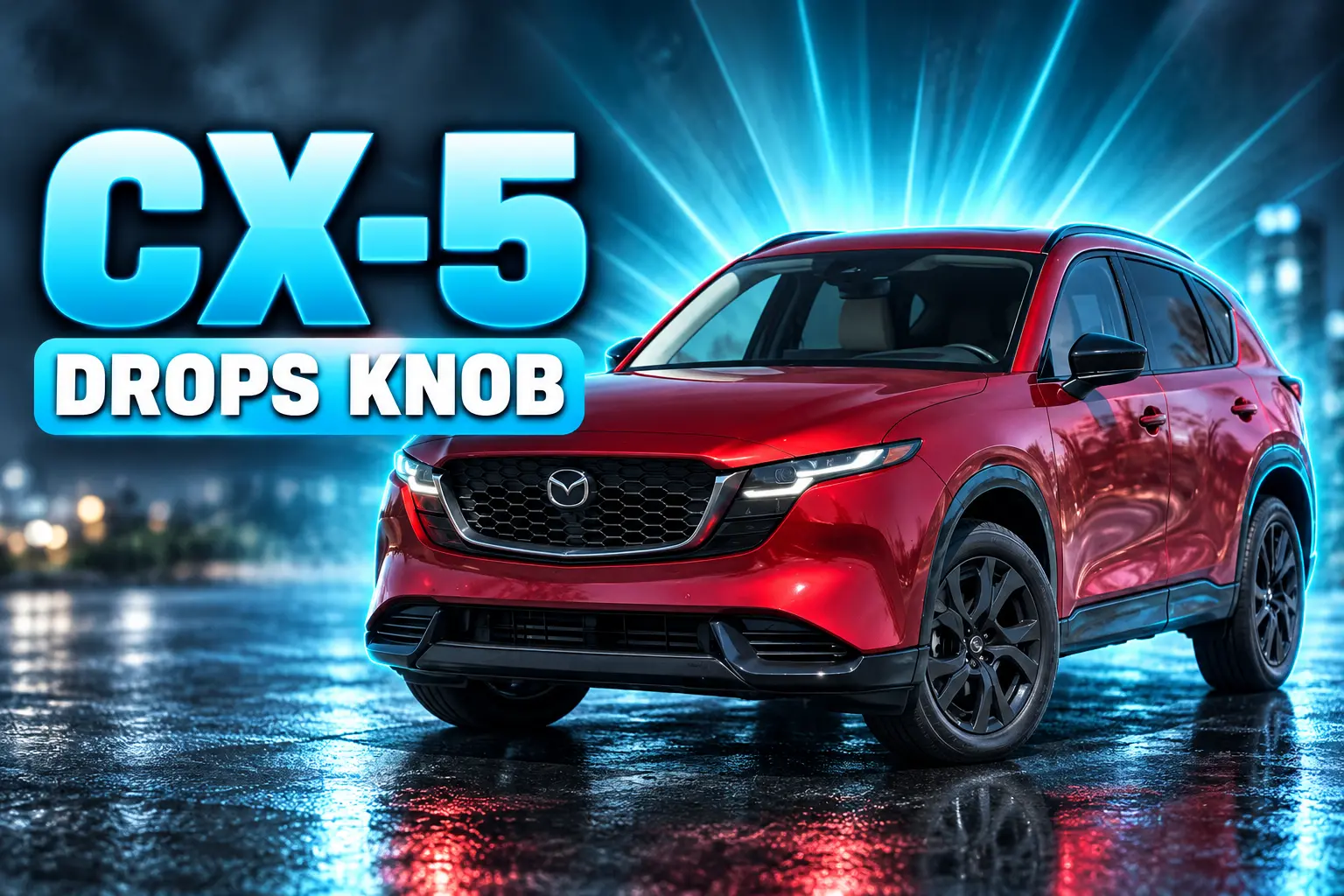
12.9 Inches Is Standard, 15.6 on Premium Plus
Mazda’s U.S. site now advertises a standard 12.9-inch center touchscreen, with the 15.6-inch panel reserved for the 2.5 S Premium Plus. Both sizes are true touchscreens. They take tap, swipe, and pinch, and they fold climate, cameras, and vehicle settings into the same stack that runs maps and media.
Google built-in is standard on every trim, with vehicle connectivity free for one year. Google Maps, Google Assistant, and Google Play run on the car, so navigation no longer depends on a phone cable. Apple CarPlay and Android Auto remain. The base 2.5 S gets them wired; wireless projection and a wireless charger start on Select.
Mazda representatives said the display sits right of center to keep it in the driver’s glance path. Both screen sizes share a left-side anchor, so the 15.6-inch unit does not sit dead in the middle of the dash. It grows toward the passenger. Cabin purists who wanted the old left-right symmetry notice that before they notice Google. It is a tooling choice, not a software skin.
High-use audio skips and volume still sit on the steering wheel, Mazda says, and a shortcut for the exterior cameras lives there too. Drive-mode switching moved to the wheel as well. The transmission stays a real shifter on the console, not a row of buttons. The hardware Mazda was willing to keep is the hardware you can find without looking.
Why Mazda Dropped the Dial
Matthew Valbuena, Mazda’s project manager of in-vehicle technologies and human machine interfaces, has been the public voice for the switch. He argues the brief never changed, only the input.
Mazda’s driving philosophy remains the same. We are focused on minimizing driver distraction.
Matthew Valbuena, Mazda project manager of in-vehicle technologies and HMI
The practical reason is app count. Google built-in opens a store of in-car software, and Valbuena put that catalog at more than 350 titles. A single commander, he said, cannot herd that many programs. He compared the old stack to an iPod Classic and the new one to an iPod Touch: same job, more ways in.
Trying to control that great variety of apps with a singular command knob would be very difficult.
Matthew Valbuena, Mazda project manager of in-vehicle technologies and HMI
He also wanted a system adults already know from a phone, without a thick owner’s manual. Mazda is rolling the Google stack out on its best-selling nameplate first. Valbuena would not map the calendar for the rest of the lineup, and he said shoppers will see the older Mazda Connect and this Google version side by side for quite a while.
Mazda’s own explainer leans on the same talking points: larger type, higher contrast, HVAC pinned to the bottom of the display, and voice as a third hand. Assistant is in the car now. Mazda lists Gemini as a later upgrade, which matches Google’s own path of offering Gemini as an upgrade from Assistant on cars that already have Google built-in. As of May 2026, Google said that stack was in more than 100 models from 16 brands. The CX-5 is joining a crowded field, not inventing it.
Testers Still Hunt for a Volume Knob
The screen is large and sharp. The complaint is what got smaller, or moved a tap away. Independent testers at Consumer Reports, after living with the redesigned car, called the control layout a step backward in day-to-day use. Temperature stays on the bottom of the display. Fan speed, heated seats, and steering-wheel heat sit behind extra menus. On a cold start, seat heat can wait until the system finishes booting, then ask for more tapping.
The console volume knob is gone. Volume is an on-screen slider you have to wake, plus those thumb buttons on the wheel. Mazda’s old dedicated i-stop switch, the one that killed auto stop-start in a single press, is now a submenu. Instrument brightness lives in another on-screen path that testers found clumsy after dark. The steering-wheel pads themselves went from distinct buttons to flat, tilting surfaces that are hard to hit without a glance.
MISSING HARDWARE ON THE 2026 CX-5
- Console volume: The rotary knob is gone, replaced by an on-screen slider plus wheel buttons.
- Seat and wheel heat: Status icons are small, and full adjustment sits in a submenu.
- Auto stop-start: i-stop no longer has a dedicated hard key.
- Cluster brightness: Nighttime dimming is buried in an on-screen menu.
- Window switches: The rockers look normal, yet only the outer tip of each paddle moves.
That last quirk is easy to miss in photos. The switches look like every other Mazda window cluster until a fingertip finds that only the end of the paddle actually rocks, so opening a window takes a more precise poke than the old full-length rocker.
WHERE TESTERS AND MAZDA DISAGREE
- Mazda’s brief: Larger screens, docked HVAC, wheel buttons, and Google voice cut glance time and copy a phone.
- Tester logs: Extra taps for fan, heat, and stop-start pull eyes off the road more than the old knobs did.
- Shared ground: Turn signals, wipers, lights, mirrors, and the gear lever are still real stalks and a shifter.
Some long-time CX-5 shoppers already treat a missing console knob as a deal-breaker, the same way they once treated the commander as non-negotiable. U.S. dealers were posting reboot tutorials for the new display in September 2026, a small sign that this stack already has the same frozen-screen rituals as every other modern car computer. Mazda UK, answering owners, also confirmed tyre pressures now appear on the infotainment screen rather than in a separate trip computer dance.
Euro NCAP’s New Points for Real Buttons
The timing is awkward in Europe, where the CX-5 also goes on sale with 12.9- and 15.6-inch Google screens. Euro NCAP’s 2026 protocol, which took effect in January, added a human-machine score inside Safe Driving. The agency’s own press note says the new tests look at placement, clarity, and physical buttons for commonly used functions.
The Driver Engagement protocol is blunt about what counts. Direct physical input means a control you can find by feel, with a mechanical movement and haptic feedback, and with little or no gaze off the road. Menu-based touch, especially more than two steps deep, is the low end of that scale.
EURO NCAP COMFORT CONTROLS
- Driving controls slice: General Vehicle Controls are worth 5 points inside Driver Engagement.
- Comfort share: Comfort and Infotainment take 2.5 of those 5 points.
- Climate: Climate controls are scored at 0.5 point.
- Audio: Audio entertainment is scored at 0.5 point.
Mazda still has the easy wins on that sheet. Indicators, wipers, the horn, and the shifter are conventional. The points it left on the table sit in climate and audio, the two daily jobs testers keep tripping over. Other carmakers have started putting those switches back on plastic you can grab without a menu. The CX-5 went the other way in the first model year the score exists.
That does not mean the U.S. car fails a test it will never take. It means Mazda spent ten years making the safety case for knobs, then adopted the industry habit those tests were written to punish, on the nameplate it sells hardest.
Which CX-5 Trim Buys Wireless CarPlay?
The Google screen is standard. The useful phone setup is not. If the point of the new system is to use it like a phone, the 2.5 S Select is the first trim that actually does, because wireless projection and a wireless charger arrive together there.
2026 CX-5 SCREENS AND CONNECTIVITY BY TRIM
| Trim | Screen | Phone link | Audio | MSRP |
|---|---|---|---|---|
| 2.5 S | 12.9-inch | Wired CarPlay / Android Auto | 8 speakers | $29,990 |
| 2.5 S Select | 12.9-inch | Wireless | 8 speakers | $31,990 |
| 2.5 S Preferred | 12.9-inch | Wireless | 8 speakers | $34,250 |
| 2.5 S Premium | 12.9-inch | Wireless | Bose 12-speaker | $36,900 |
| 2.5 S Premium Plus | 15.6-inch | Wireless | Bose 12-speaker | $38,990 |
Destination is $1,595 in the 48 states and $1,640 in Alaska. Select also adds leatherette with a cloth insert, auto-folding heated mirrors, a wireless charger, and rear air vents. The jump from Select to Premium is $4,910 before destination, and that money buys the Bose 12-speaker set, a head-up display, leather, ventilated front seats, and a panoramic roof, not a larger screen. The 15.6-inch glass is a Premium Plus exclusive in the United States.
A 10.25-inch digital cluster is standard across the range. That smaller display still carries track info when you change sources from the wheel, which is one reason Mazda keeps arguing the cabin is not touch-only. It is touch-first. The cluster and the wheel are the backup, and they only cover a slice of what the commander used to do.
Over-the-Air Updates Stop at the Glass
Mazda says the new Connect stack can take over-the-air updates, and that is the honest upside of putting so much on a Google panel. Icon size, gray-on-gray heat status, the extra tap for fan speed, and the buried i-stop toggle are software. If Valbuena’s team wants those controls bigger or pinned permanently, they can ship a patch without a new dashboard.
Gemini can arrive the same way, as an Assistant replacement, once Mazda opens the update. Google has already framed that swap as a free-form voice layer that can read an owner’s manual and poke vehicle settings. None of that puts a knob back on the console.
The commander, the old volume wheel beside it, and the dedicated i-stop key are tooling. They return only if a later CX-5 refresh puts them on the parts list. Until then, the car that finally made CarPlay feel native is also the car that asks you to tap through climate on a cold morning, in a year when crash testers started handing points to brands that did not.
Frequently Asked Questions
Do Other Mazdas Still Use the Commander Knob?
Yes. The CX-90 and CX-70 still revolve around the commander, and several smaller Mazdas have not moved to Google built-in. Valbuena said customers will see the older Mazda Connect and the new Google version together for quite a while, because the company will not discuss a full-lineage cutover date.
Is Google Built-In the Same as Android Auto?
No. Google built-in runs Maps, Assistant, and Play on the car itself, even if your phone stays in a pocket. Android Auto and Apple CarPlay still mirror a phone, and Mazda kept both paths. On the 2.5 S that mirror link is wired; from Select up it is wireless.
Does the Base 2026 CX-5 Include Wireless Apple CarPlay?
It does not. The 2.5 S is wired only, and it also skips the wireless charger. Select is the first trim that matches the way most people actually use a phone in a car, which is why it is the rational step up if the new screen is the reason you are shopping.
Will the 2026 Mazda CX-5 Get a Hybrid?
Not at launch. The U.S. range opens with the familiar 2.5-liter four-cylinder and a six-speed automatic, with all-wheel drive standard. Mazda has already said a hybrid arrives in 2027, so the Google cabin and the electrified powertrain are on staggered calendars.
Mazda can keep redrawing icons until the heat status is obvious from the driver’s seat. The commander only comes back if a future CX-5 spends the money to mold it.

Triumph Bonneville 400 Puts Its Badge on a 349cc Tax Cut

Verstappen Takes First 2026 Pole at a Relocated Bahrain GP

Anthropic Warns a Pentagon Fight Can Hit Private Clients

FDA Closes Taylor Farms Lettuce Probe Without a Cause

Galaxy Z Fold 8 Ultra Gets a 5,298MB October Security Update

The Orchard Bug Forced Zcash to Open an Empty Pool

The $5.99 Game That Won Steam’s 2026 Summer Sale

Don Lee Joins Hemsworth as Extraction 3 Starts Shooting

YouTube Shorts Retires Dislikes and Swaps Likes for Hearts

NEURA Robotics Is Spending Its $1.4B on a Machine Stack
-
 NEWS4 months ago
The Orchard Bug Forced Zcash to Open an Empty Pool
-
 GAMING4 months ago
The $5.99 Game That Won Steam’s 2026 Summer Sale
-
 ENTERTAINMENT6 months ago
Don Lee Joins Hemsworth as Extraction 3 Starts Shooting
-
 NEWS4 months ago
YouTube Shorts Retires Dislikes and Swaps Likes for Hearts
-
 NEWS4 months ago
NEURA Robotics Is Spending Its $1.4B on a Machine Stack
-
 AUTO6 months ago
Kawasaki Bets the New Z1100 Against Its Own Supercharger
-

 BUSINESS5 months ago
Norway’s Export Bank Backs Nscale’s $790 Million Narvik Loan
-

 GAMING4 months ago
Game of Thrones Dragonfire Follows Boston’s Conquest Playbook