
FINANCE
CLARITY Act Odds Rise to 57% as Bessent Presses Congress

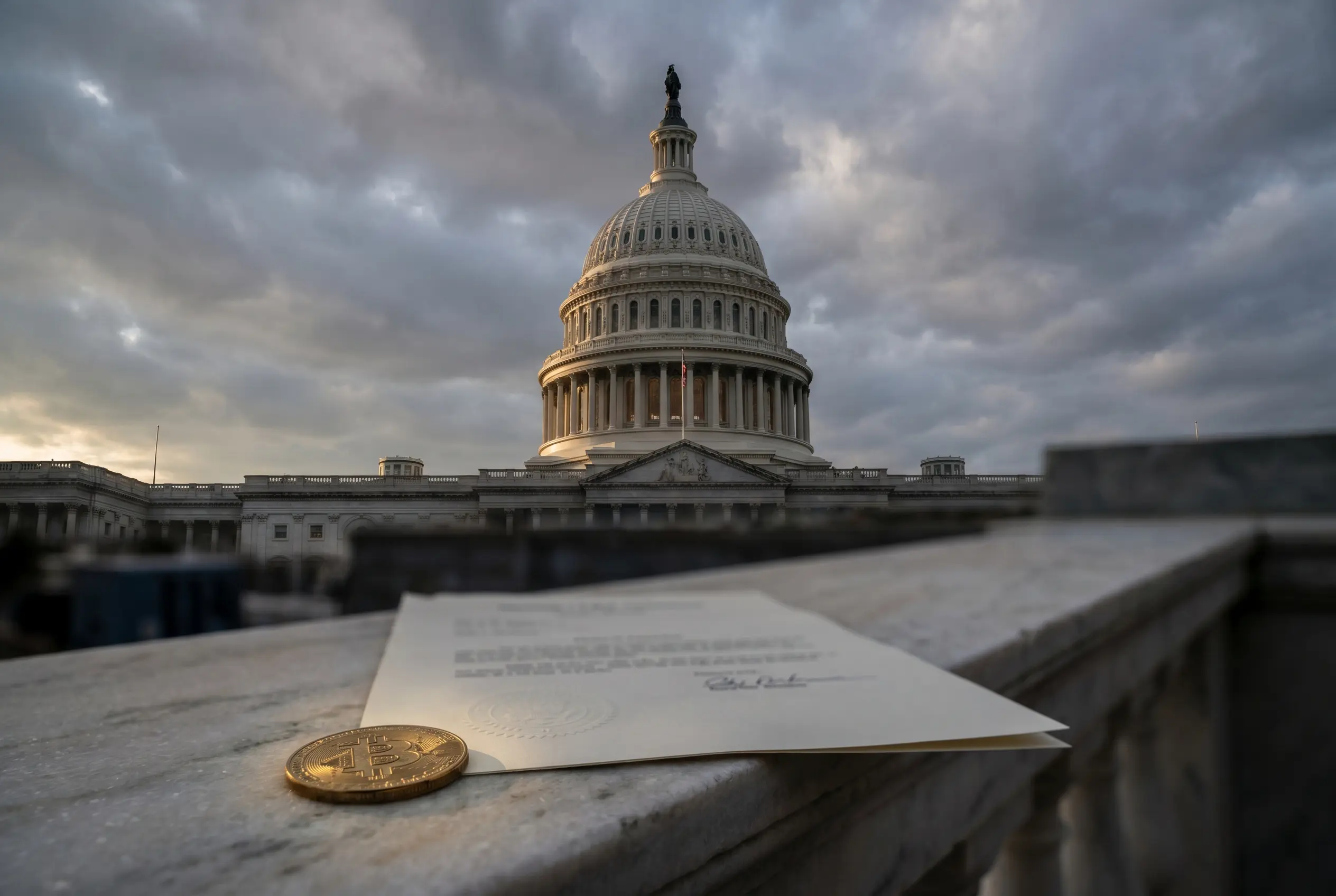
The CLARITY Act, formally the Digital Asset Market Clarity Act, now carries a 57% chance of becoming law in 2026 on the prediction market Polymarket, after Treasury Secretary Scott Bessent used a White House briefing on May 28 to press the Senate and House to pass it. The bill would hand most crypto oversight to U.S. regulators and draw a firm line between two federal agencies.
That percentage has whipsawed all month, sliding from 75% to 49% during the Senate recess before climbing back. What decides the bill’s fate sits somewhere a betting line cannot reach: whether seven Senate Democrats supply the votes to break a filibuster while a fight over Trump-family crypto profits stays unresolved.
Bessent Takes the Crypto Bill to the White House Podium
Speaking from the White House briefing room, the Treasury secretary made the administration’s case in plain terms. The country needs to define what a digital asset is, he argued, and put crypto activity under the watch of American regulators rather than leaving it to chance abroad.
He drew a hard boundary on one point. The administration wants “no central bank digital currency,” Bessent said, calling a government-issued CBDC (central bank digital currency, a digital dollar controlled by the Federal Reserve) “the first step toward tracking.” With the House already behind bipartisan stablecoin rules, he said the next job is the market-structure bill: “And the CLARITY Act is now up on the Hill. I think it has bipartisan support.”
His sharpest line aimed at the offshore venues where much of the industry’s trouble has played out. “When you look at digital assets, all the nonsense that happens, all the things you read about, that’s because it’s the wild, wild west offshore,” he said, adding, “So we got to bring it on shore.” The pitch ties consumer harm to a lack of domestic rules, the same argument the bill’s sponsors have leaned on for a year.
Why the 57% Headline Hides the Senate Math
A betting market reacts to headlines within minutes. The Senate floor does not. The same week traders priced passage in the high 50s, the bill cleared the Senate Banking Committee’s 15-9 vote on May 14, with every Republican joined by Democrats Ruben Gallego of Arizona and Angela Alsobrooks of Maryland.
Committee passage is the easy gate. The floor is the hard one. A market-structure bill of this size needs 60 votes to overcome a filibuster, and the chamber holds 53 Republicans. That leaves a seven-vote gap that only Democrats can close, and the two who voted yes in committee have not committed to do the same on the floor.
The volatility tells its own story. Earlier this month the odds tumbled after a presidential broadside at industry critics, a swing covered in our report on the odds slide below 50% following a Trump crypto post. Each headline moves the number; none of them move the vote count.
Here is the arithmetic the percentage glosses over:
- 60 votes required on the Senate floor to break a filibuster
- 53 Republicans in the chamber, leaving a seven-seat shortfall
- 15-9 the committee margin that sent the bill to the floor
- 75% to 49% the Polymarket swing during the Senate recess
The Ethics Fight Over Trump-Family Crypto Gains
The wall standing between committee passage and a floor vote is not a technical dispute over token definitions. It is about who in government gets to profit from the assets the bill would legitimize.
The Van Hollen Amendment
Democrats have pushed an ethics amendment, authored by Senator Chris Van Hollen of Maryland, that would bar senior government officials from holding certain crypto business interests. The backdrop is impossible to separate from the policy. President Trump and his family have booked at least $1.4 billion in gains from crypto-related ventures since he took office, including a memecoin launch and family-run platforms, while officials across the executive branch hold stakes in the very industry the bill would regulate.
That conflict has hardened Democratic demands for what several senators call real, enforceable guardrails. A parallel fight over financial access, detailed in our coverage of a move to block Ripple from Federal Reserve access, shows how amendments could reshape the bill before any final tally.
Gallego’s Floor-Vote Threat
Gallego, one of the two committee crossovers, has made his price explicit. Negotiators are close on ethics language, he said, but not done, and he is willing to walk if it falls apart.
We have come close, but not finished, an agreement on ethics guardrails for elected officials, all elected officials. If this is not resolved by the time of the floor vote, like I have in the past, I am not afraid to vote no.
That is the swing vote talking, and it puts the bill’s seven-Democrat math on a knife edge. A betting market reading 57% cannot price a single senator’s threshold for walking away.
What the CLARITY Act Would Rewrite for Crypto
Stripped of the politics, the bill is a jurisdiction map. It splits authority between the SEC (Securities and Exchange Commission, the markets regulator) and the CFTC (Commodity Futures Trading Commission, the derivatives regulator), ending years of turf disputes that pushed firms to register through enforcement actions instead of clear rules. You can read the full language in the House text of the Digital Asset Market Clarity Act.
For holders, the headline change is classification. The bill would permanently treat Bitcoin and Ethereum as commodities rather than securities, defining decentralization at the protocol level so that genuinely distributed networks fall outside the SEC’s reach.
What the bill sets out to do:
- Assign clear oversight of spot crypto markets to the CFTC, with the SEC keeping authority over investment contracts
- Classify Bitcoin and Ethereum as non-securities, removing the threat of retroactive enforcement
- Set consumer-protection rules covering custody and disclosures
- Codify anti-money-laundering obligations for registered platforms
Wyoming Senator Cynthia Lummis, the bill’s most vocal Republican backer, frames it as protection for two groups. “Without the CLARITY Act, if a digital asset exchange goes bankrupt, customers have no guaranteed right to their own assets,” she wrote, warning that holders would face long fights with creditors. She also cautioned that coders are exposed, a point we examined in our piece on warnings that software developers could be prosecuted for publishing code.
The Analyst Odds Diverge From the Trading Floor
Professional forecasters are more bullish than the crowd, and they disagree among themselves. Galaxy Research head Alex Thorn lifted his estimate of 2026 passage to 75% after the committee vote, sketching a calendar that runs through Senate floor consideration by mid-June, final passage before the end of the month, House reconciliation through July, and a possible Trump signature in the week of August 3.
Others see a tighter window. Solana Policy Institute President Kristin Smith pegged the odds nearer 60%, citing the squeeze before the August recess, while Polymarket traders have ranged from the high 40s to the upper 60s across the month, depending on the news cycle. We tracked one such jump in our report on the bill reaching 68% passage odds after a stablecoin-yield deal.
| Source | 2026 passage odds | Basis |
|---|---|---|
| Polymarket traders | 57% (press time) | Live crypto-legislation betting market |
| Galaxy Research (Alex Thorn) | 75% | Post-committee call, August 3 signing path |
| Solana Policy Institute (Kristin Smith) | 60% | Narrow pre-recess legislative window |
If the Senate clears a floor vote before the August recess, Thorn’s signing timeline holds and the betting lines drift up toward the analyst camp. If the ethics language stalls and Gallego walks, the same 57% that looks like momentum today gets repriced toward the lows it touched two weeks ago.
Frequently Asked Questions
What is the CLARITY Act?
The CLARITY Act, formally the Digital Asset Market Clarity Act (H.R. 3633), is a U.S. market-structure bill that sets federal rules for crypto. It splits oversight between the SEC and the CFTC, defines what counts as a digital asset, and aims to replace regulation-by-enforcement with a written framework.
When will the Senate vote on the CLARITY Act?
A Senate floor vote is targeted for June 2026, with backers racing to clear the chamber before the August recess. The Senate Banking Committee advanced the bill on May 14 in a 15-9 vote, but a full floor schedule depends on resolving ethics and amendment disputes first.
How many votes does the CLARITY Act need to pass the Senate?
It needs 60 votes to overcome a filibuster. With 53 Republicans in the chamber, that requires at least seven Democratic crossovers, which is why the unresolved ethics provision and individual senators such as Ruben Gallego carry outsized weight.
Does the CLARITY Act create a U.S. central bank digital currency?
No. Treasury Secretary Scott Bessent explicitly rejected a CBDC, calling it a step toward tracking. The bill focuses on private digital assets and exchange rules, not a government-issued digital dollar.
Would the CLARITY Act classify Bitcoin and Ethereum as securities?
No. The bill would treat Bitcoin and Ethereum as non-securities, placing spot-market oversight largely with the CFTC and removing the threat of retroactive enforcement tied to securities law.
Disclaimer: This article is for informational purposes only and does not constitute investment, legal, or financial advice. Cryptocurrency and legislation tied to it carry significant risk, and outcomes in Congress remain uncertain. Consult a qualified professional before making decisions. Figures and odds are accurate as of publication.


Dolly Parton’s $450 Million Fortune Keeps Working After Her Death

SpaceX’s $60B Cursor Buy Immediately Costs It OpenAI Models

Rays Forever Home Wins County Vote as College and Taxpayers Carry the Load

Apple TV Hits $14.99 as Sports and Hits Bill Comes Due

Swift Telescopes Restart as Orbit Drop Accelerates

Oracle’s 2.8 GW Bloom Deal Exposes the AI Power Bypass

Galaxy S26 Beta 7 Ports Fold 8 AI as Stable Nears

Walmart Pays $50 Million to Close Federal Opioid Pharmacy Case

Space Mirror Demo Revives 1993 Russian Night-Light Test

Measles Death Dispute Deepens Distrust in Pennsylvania Outbreak

Trump Iran Threat Wiped $238M Crypto Longs Then Flipped

30-Year Yield Hits 5.32% Highest Since 2007 as Debt Supply Locks In Costs

Oil Crashes Below $80 as Iran Talks Restart and Markets Split

Strategy Parks $1.59B Cash While Bitcoin Stack Stays Flat

Astute’s $1.2M bet makes B2B creator deals feed AI discovery

SpaceX Stock Rebound Tests Real Demand Before Huge Unlock

BlackRock Turns Cash Empire Into Stablecoin Reserve Rails

The 20% Savings Ideal Meets a 2.7% Reality Check

Walter’s TWG Insists No Fraud as Insurer Probes Force Cleanup

Amber’s €7M locks Mittelstand knowledge inside Europe
-
 FINANCE3 months ago
Zcash Patched a Double-Spend Bug as ZEC Climbed 5%
-
 ENTERTAINMENT3 months ago
Steam Summer Sale 2026 Locks In June 25 to July 9 Dates
-

 FINANCE2 months ago
CLARITY Act Final Text Expected This Weekend as 60-Vote Hurdle Looms
-
 NEWS4 months ago
Meta Adds AI Replies to Threads, But Users Can’t Block It
-

 NEWS3 months ago
YouTube Shorts is testing a heart in place of the thumbs-up
-

 NEWS1 month ago
Senators Force Apple Off Chinese Memory as Big Three Cash In
-

 NEWS3 months ago
NEURA Robotics’ $1.4B Series C Redraws Europe’s Physical AI Bet
-
 ENTERTAINMENT5 months ago
Extraction 3 Is Officially Coming to Netflix in 2027