
NEWS
Apple’s Foldable iPhone Ultra Reportedly Packs a Smaller Battery Than the Pro Max
A new leak pegs Apple’s foldable iPhone Ultra battery at 4,883mAh, hundreds of milliamp-hours short of the rumored iPhone 18 Pro Max’s cell.

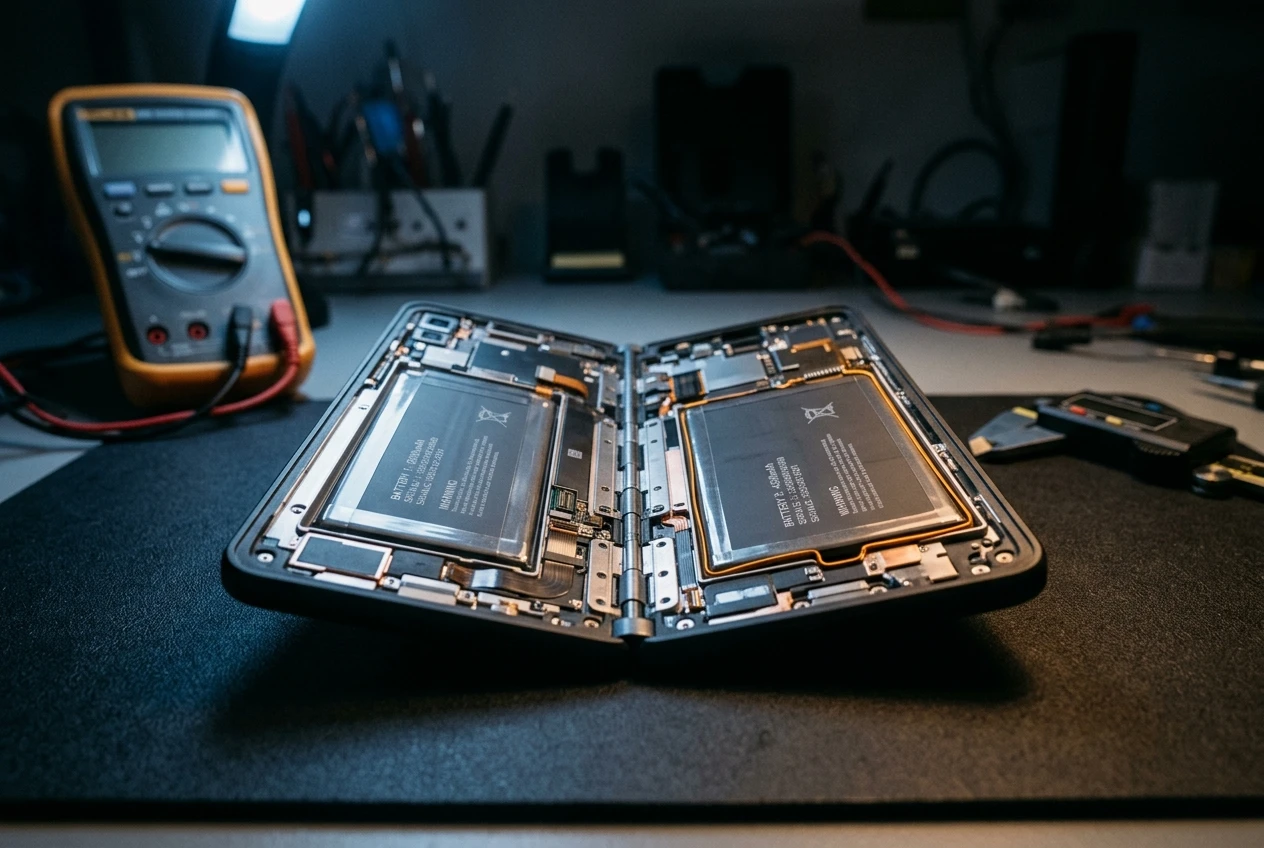
Apple’s first foldable iPhone will reportedly carry a 4,883mAh battery, smaller than the iPhone 18 Pro Max rumored to launch right alongside it in September. The figure comes from Digital Chat Station, a Weibo leaker with a strong track record on Apple’s supply chain, who says the company’s battery supplier just registered two cells, a 1,921mAh unit and a 2,962mAh unit, for the device widely expected to carry the iPhone Ultra name.
That math hands Apple’s most expensive iPhone yet a smaller cell than the model sitting one rung below it, on a device built to run two screens instead of one.
The Math Behind 4,883mAh
Digital Chat Station’s post, which surfaced July 10, says Apple’s battery supplier filed regulatory paperwork for two cells split across the foldable’s two hinged halves. That is standard practice for book-style foldables, since a single cell would leave one side heavier or thicker than the other.
Add the numbers and the total lands at 4,883mAh. Digital Chat Station added that the wider supply chain still expects a total somewhere between 4,800mAh and 5,000mAh, pending confirmation of the exact cell sizes.
That range lines up with the reported figure, but it lands well short of an earlier rumor that pegged Apple’s foldable at 5,400mAh to 5,800mAh during engineering testing. Apple has not confirmed any of it. The company is expected to unveil its first foldable smartphone in September alongside the iPhone 18 Pro and iPhone 18 Pro Max.
| Device | Battery Configuration | Total Capacity |
|---|---|---|
| iPhone Ultra (foldable) | Dual cell, 1,921mAh plus 2,962mAh | 4,883mAh (rumored) |
| iPhone 18 Pro Max | Single cell | 5,391mAh to 5,567mAh (rumored) |
| iPhone 18 Pro | Single cell | 4,056mAh to 4,288mAh (rumored) |
| Samsung Galaxy Z Fold7 | Dual cell | 4,400mAh (official) |
| Google Pixel 10 Pro Fold | Dual cell | 5,015mAh (official) |
The eSIM and physical SIM split explains the ranges for the Pro lineup. Apple typically sells eSIM-only models in the US and keeps a SIM tray for China and most other markets, which usually adds a little extra room, and weight, for a bigger cell.
An Ultra Nameplate, a Smaller Battery
Apple reserves the Ultra name for its most capable hardware. The Watch Ultra and the M-series Ultra chips sit at the top of their respective lineups, built to outperform everything below them on paper.
The foldable due this fall breaks that pattern on one number that matters to nearly every buyer. At 4,883mAh combined, it trails the iPhone 18 Pro Max’s rumored cell by roughly 508mAh to 684mAh, depending on whether Apple ships the eSIM-only version sold in the US or the physical SIM version sold in China, Europe and most markets outside it.
That range comes from new filings in China’s 3C database, which pushed the Pro Max estimate higher than an earlier rumor of 5,235mAh to 5,425mAh. Either way, the phone marketed as Apple’s most capable iPhone folds around a smaller battery than the one sitting in a regular slab-shaped iPhone box on the same shelf.
Why Does a Foldable Need More Battery, Not Less?
A foldable phone runs two displays instead of one: a small outer screen for quick glances and a larger inner panel that can stretch past a tablet-sized 7.8 inches when unfolded. Powering both, plus the extra sensors and hinge electronics a folding chassis needs, typically demands more battery, not less, which is why the 4,883mAh figure raised eyebrows among Apple watchers this week.
Apple’s own foldable is rumored to pair a 5.5-inch outer display with that 7.8-inch inner one, roughly the footprint of an iPad mini when unfolded. Samsung solves the same problem with 4,400mAh split across the Galaxy Z Fold7’s hinge. Google uses 5,015mAh in the Pixel 10 Pro Fold. Apple’s reported total sits almost exactly between the two.
Samsung plans to answer with its own new hardware first. The company has set a Galaxy Unpacked event for July 22, where a new Galaxy Z Fold 8 with passport-style dimensions is expected to debut, weeks before Apple’s foldable reaches a stage of its own.
None of that guarantees Apple’s real-world battery life falls short. Raw capacity is only one variable, and Apple has leaned hard on efficiency gains in past launches to make smaller cells outlast what the spec sheet suggests.
Betting the Gap on a 2nm Chip
Apple’s counterargument, unstated but implied by every rumor around this launch, rests on silicon. The foldable is expected to run a new A20 Pro chip built on a 2nm manufacturing process, which should draw less power per task than the chips inside current iPhones.
The company has pulled this off before. The iPhone 17 Pro Max, built around a 4,823mAh cell, managed roughly 28 hours of continuous web browsing in third-party testing, a result that outran what its raw capacity alone would predict.
Apple’s engineering playbook already leans this way elsewhere in the current lineup. The vapor chamber cooling added to the iPhone 17 Pro Max squeezed more sustained performance from the same battery budget rather than simply growing the cell, and similar logic could carry into a foldable chassis with even less room to spare.
Rivals are taking a blunter route to the same underlying problem. Huawei’s newest flagship tackles heat with a fan built into its chassis rather than chasing efficiency gains in silicon, a sign of how differently manufacturers are solving the same power and heat squeeze as phones get thinner.
Whether a 2nm chip can close a battery gap of several hundred milliamp-hours remains unproven. Apple has not published any battery life estimates, and none are likely to arrive before the September event.
A Premium Price Meets a Supply Squeeze
Price rumors have settled into a tight band. Analysts including Ming-Chi Kuo, a supply chain analyst who closely tracks Apple’s manufacturing partners, expect the foldable to start between $2,000 and $2,500, with top storage configurations reportedly reaching close to $3,000. Research firm IDC has pegged the average selling price at around $2,500.
Supply looks tight before a single unit ships. Kuo’s most recent survey puts third-quarter shipments at roughly 500,000 to 1 million units, about 10% of the total foldables Apple expects to build in the second half of 2026. Separately, Nikkei Asia has reported that Apple told suppliers to prepare for about 10 million foldable iPhones this year, up from a prior forecast of 7 to 8 million.
Scarce initial supply, a highly recognizable design, and an innovative user experience should all support a short-term resale premium.
Kuo wrote that in a research note covered widely across Apple coverage this month. He added that resale prices could run 50 to 100 percent above the official price in the weeks right after launch, before supply catches up with demand toward the end of the year.
Beyond the battery, the leaks around Apple’s foldable have converged on a consistent set of details:
- Display – a 5.5-inch outer screen paired with a 7.8-inch inner display, close to iPad mini size when unfolded
- Chip – a new A20 Pro built on a 2nm process, with Apple’s C2 modem in some markets
- Biometrics – Touch ID built into the power button instead of Face ID, since there is no room for a TrueDepth camera system
- Cameras – two rear lenses, wide and ultra-wide, with no telephoto option
- Hinge – a still-undecided choice between liquid metal and 3D-printed titanium alloy, expected to be locked in during testing this summer
Every one of those details traces back to supply chain leaks and analyst notes rather than an Apple announcement.
The Resale Math Nobody Advertises
A folding phone priced above $2,000 carries a second risk that has nothing to do with chemistry: how much of that money comes back at resale.
A study by resale platform SellCell, covering flagship devices from Apple, Samsung, Google, Motorola and OnePlus, found that foldable phones lose an average of 64.6 percent of their value within 12 months. Conventional smartphones lose 55.3 percent over the same period. In dollar terms, foldable owners lose close to $1,000 on average, compared with roughly $605 for owners of standard flagship phones.
Apple has historically bucked that trend. The same SellCell analysis found the iPhone 16 family retained 51.5 percent of its original value after a year, well above the industry average for any device type. Whether that loyalty premium extends to a first-generation foldable with a smaller battery than the flagship beside it is untested.
The Countdown to September
The next two months carry more weight than usual for a phone that still does not officially exist. Here is what is left to resolve before Apple’s stage event:
- July to early August 2026: Apple’s production validation testing window, when suppliers expect a final call between a liquid metal and titanium alloy hinge.
- Late August 2026: Mass production would need to ramp through this month to hit a September stage debut, per supply chain reporting.
- September 2026: Apple’s rumored event date, expected to introduce the iPhone 18 Pro, iPhone 18 Pro Max and the foldable together.
- Weeks after the event: Pre-orders and retail sales for the foldable could trail the Pro lineup by four to six weeks or longer, echoing the staggered rollout Apple used for the iPhone X in 2017.
- Fourth quarter 2026: Kuo expects production to climb toward 7 to 8 million units, with clearer signals on whether demand holds up at full volume.
Samsung’s OLED supplier has reportedly been cleared to build panels for around 3 million foldable units to start, a ceiling that alone signals a controlled rollout rather than a mass-market push from day one. Apple has not disputed the delay chatter, but it has not confirmed a date either.
Frequently Asked Questions
How Much Smaller Is the iPhone Ultra’s Battery Than the Pro Max?
Based on current leaks, the iPhone Ultra’s rumored 4,883mAh total trails the iPhone 18 Pro Max by roughly 508mAh to 684mAh, depending on whether Apple ships the eSIM-only variant sold in the US or the physical SIM version sold elsewhere.
Has Apple Confirmed the iPhone Ultra Name?
No. Every detail, including the name, comes from supply chain leakers and analysts rather than Apple itself. Multiple leakers have converged on iPhone Ultra as the likely branding, following the naming pattern Apple already uses for the Watch Ultra.
Will the iPhone Ultra Launch on the Same Day as the iPhone 18 Pro Max?
Probably not for retail sales. Apple is expected to announce all three phones together in September, but the foldable’s pre-orders and shipping could lag the Pro lineup by four to six weeks or more, similar to how the iPhone X arrived weeks after the iPhone 8 in 2017.
How Much Will the iPhone Ultra Cost?
Estimates cluster between $2,000 and $2,500 for the starting configuration, with higher storage tiers potentially reaching close to $3,000. Research firm IDC has predicted an average selling price around $2,500 once all configurations are counted.
Does the iPhone Ultra Have Face ID?
No. Leaks point to Touch ID built into the power button instead, since Apple reportedly could not fit a TrueDepth camera system into the folding chassis. The device is also expected to skip a telephoto lens, using only wide and ultra-wide rear cameras.
How Many iPhone Ultra Units Will Apple Make This Year?
Reports point to roughly 500,000 to 1 million units in the third quarter of 2026, climbing toward 7 to 8 million by year end. Separate reporting says Apple asked suppliers to prepare for as many as 10 million units total, up from an earlier forecast of 7 to 8 million.


TECNO’s 0mm Bezelless Phone Still Needs a Rim

Ripple’s 700 Million XRP Re-Lock Repeats a Yearlong Pattern

Chainlink Puts Official US Inflation and GDP Onchain

Google Pushes Gemini Daily Brief off the Chat Screen

Crypto Stocks Fall on a Hike Scare That Pays Them

Top CD Rates Rise, but Inflation Still Takes the Gain

Nick Shirley Brings Minnesota Medicaid Fraud Into the Senate

Google Messages Leaks Old Texts on New Phone Transfers

iPhone 18 Pro Colors Walk Back Last Year’s Black Cut

Olivia Rodrigo’s Festival Left Thousands Walking Home at Night

Trump Iran Threat Wiped $238M Crypto Longs Then Flipped

30-Year Yield Hits 5.32% Highest Since 2007 as Debt Supply Locks In Costs

Oil Crashes Below $80 as Iran Talks Restart and Markets Split

Walter’s TWG Insists No Fraud as Insurer Probes Force Cleanup

Astute’s $1.2M bet makes B2B creator deals feed AI discovery

Strategy Parks $1.59B Cash While Bitcoin Stack Stays Flat

BlackRock Turns Cash Empire Into Stablecoin Reserve Rails

The 20% Savings Ideal Meets a 2.7% Reality Check

SpaceX Stock Rebound Tests Real Demand Before Huge Unlock

Amber’s €7M locks Mittelstand knowledge inside Europe
-
 FINANCE3 months ago
Zcash Patched a Double-Spend Bug as ZEC Climbed 5%
-
 ENTERTAINMENT3 months ago
Steam Summer Sale 2026 Locks In June 25 to July 9 Dates
-

 FINANCE2 months ago
CLARITY Act Final Text Expected This Weekend as 60-Vote Hurdle Looms
-
 NEWS4 months ago
Meta Adds AI Replies to Threads, But Users Can’t Block It
-

 NEWS3 months ago
YouTube Shorts is testing a heart in place of the thumbs-up
-

 NEWS1 month ago
Senators Force Apple Off Chinese Memory as Big Three Cash In
-

 NEWS3 months ago
NEURA Robotics’ $1.4B Series C Redraws Europe’s Physical AI Bet
-
 ENTERTAINMENT5 months ago
Extraction 3 Is Officially Coming to Netflix in 2027