
HEALTH
HTG Medical Clears EU’s Toughest Device Rule, Raises €450,000
Czech medtech startup HTG Medical has cleared EU MDR certification for its automated ICU urine monitor and raised €450,000 for global expansion.

Czech medtech startup HTG Medical has raised €450,000, roughly $486,000, and cleared European Union certification for its automated intensive care unit (ICU) monitor. The device, called the HTG Urogram, replaces a nurse’s hourly walk to a patient’s bedside with a continuous digital readout piped straight into hospital records.
A working prototype inside one ICU is common enough in medtech circles. Clearing Europe’s Medical Device Regulation in fifteen months, the same rulebook that has pushed slower manufacturers out of business entirely, is the harder trick HTG Medical just pulled off.
A Screen Replaces the Hourly Bedside Walk
Every hour, in ICUs across Europe, a nurse walks to a patient’s bedside, reads the fluid level in a drainage bag, and writes the number down by hand. It is one of the oldest, most repetitive tasks in critical care.
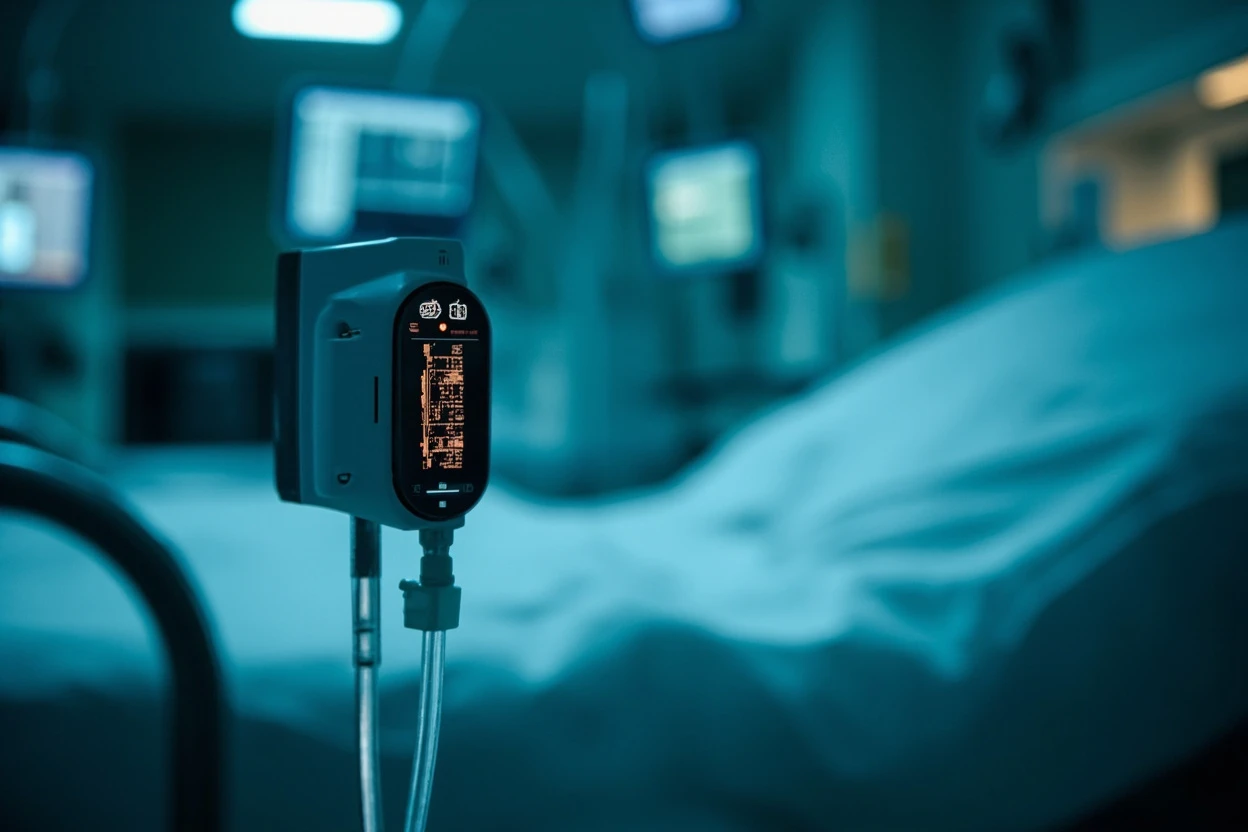
The HTG Urogram reads fluid output directly from the drainage line, shows the running total on an integrated bedside screen, and transmits fluid data straight into hospital records. No clipboard changes hands. No number gets copied twice.
| Monitoring Method | Reading Frequency | Nurse Time Required | Where the Data Lands |
|---|---|---|---|
| Manual bedside check | Roughly once an hour | Several minutes per round, every round | Paper chart or manual entry, often delayed |
| HTG Urogram | Continuous, updated every five minutes | None, capture is automatic | Hospital Information Systems (HIS), in real time |
HTG Medical says the swap returns up to an hour of net time to each nurse every shift, time the company argues belongs at the patient’s side rather than on paperwork.
Fifteen Months Through a Rule That Sinks Rivals
The EU’s Medical Device Regulation (MDR) has a reputation in the industry for burying small manufacturers. Meeting it means years of engineering documentation, quality audits and clinical evidence, expensive enough that some legacy device makers have simply pulled products from the market rather than pay for it.
HTG Medical went from working prototype to full CE certification in fifteen months. Co-founder and chief technology officer Max Klimeš says the fast track hid a mountain of unglamorous work.
Getting a prototype into the ICU with real patients is one thing. Transitioning it into a certified medical device means perfecting countless details hidden beneath the surface.
Klimeš pointed to measurement accuracy, engineering reliability, secure hospital data integration, a quality management system and a full testing lifecycle as the work packed into those months. The company credits localised European manufacturing and complete component traceability for keeping the timeline short.
Chief executive and co-founder Tobiáš Vybíral frames the certification as proof of process. “Securing the CE mark is validation that we built this product the right way,” he said, adding that the team started with the “real needs of ICU nurses and doctors” before engineering documentation that meets “the world’s strictest regulatory requirements.” The company, he said, is “now ready to deploy the HTG Urogram where it can truly help and start saving time.”
Krištof Šaman, chief operating officer and co-founder, steered the certification sprint itself. “More than a year of intense regulatory work taught us how to build institutional processes that can withstand any high-stakes international market,” he said. “ISO 13485 and CE marking under MDR aren’t just rubber stamps. They are the core foundations upon which we are building a highly scalable company.”
The Hidden Cost of an Hourly Round
HTG Medical points to outside research showing manual fluid tracking in ICUs can carry error rates as high as 26%. That claim lines up with a growing body of peer-reviewed literature on the same problem.
A clinical evaluation in the Netherlands Heart Journal found manual charting errors ranging from 8.5% to 33.3% across low, medium and high fluid output patient groups. A separate Critical Care study found nurses overestimated hourly output by 19.9 millilitres compared with dedicated study staff.
- Up to 26%: the error rate HTG Medical cites for manual fluid logging in ICUs, drawn from outside research
- 8.5% to 33.3%: the range of charting errors the Netherlands Heart Journal evaluation found across output levels
- 19.9 millilitres: the average hourly overestimation nurses made versus dedicated study staff
- 1 hour: the daily time HTG Medical says its device hands back to each ICU nurse
None of this is really about carelessness. Bedside math done in dim light, mid shift, under time pressure, is where the errors creep in, and both studies point to timing as much as arithmetic.
From a Hackathon Runner-Up to a Hospital Fixture
HTG Medical’s story starts in 2019, at a medtech hackathon hosted by IKEM, a major Prague hospital and research institute. The founders were challenged to digitise urine output tracking. They narrowly missed first place.
The idea outlasted the scoreboard. What began as a hackathon entry became a pilot device tested inside real ICUs, then a company chasing certification, then a product now active in patient care.
Money followed the same slow build. HTG Medical’s first close brought in a €600,000 pre-seed round backed by four investors, topped up by a further €160,000 grant from CzechInvest’s Technological Incubation programme.
The pattern is not unique to one Czech drainage bag. European medtech has been placing similar bets on unglamorous hospital problems, including a bionic eye implant’s own funding round. HTG Medical’s version just happens to be small enough to clip onto a catheter line.
The Money Behind the Next Stretch
The new €450,000 is structured as the second tranche of HTG Medical’s pre-seed round. A wire notice distributed by the Czech News Agency confirmed JIC Ventures’ stake in the round, alongside the other backers.
The round’s full lineup:
- Garage Angels, an angel investment network whose Investment Director, Aleš Filipenský, gave this round’s most detailed public comment
- Electron Capital Partners, a venture capital firm joining this round for the first time
- JIC Ventures, a Czech venture capital firm named in the Czech News Agency notice above
- Jinej fond, returning from HTG Medical’s first pre-seed close
- Dendis Capital, also returning from that earlier round
Filipenský said healthcare is a sector where innovation usually scales slowly. “The HTG Medical team blew us away by taking the Urogram from a rough hackathon concept to a certified product already active in patient care,” he said, citing “a stellar founding team, clear MDR clearance, and a highly attractive recurring-revenue business model” as the deciding factors. The raise pushes HTG Medical’s total funding past €1 million, according to the company.
How Far Can One CE Mark Travel?
A single MDR certification covers the entire European Union and European Economic Area at once, which is why HTG Medical is already lining up distribution beyond Czechia. The company’s own distributor page lists expansion plans reaching Austria, Spain, France and the Netherlands.
Further out, the same certificate becomes a shortcut outside Europe entirely. HTG Medical expects the MDR clearance to fast-track registrations in Australia, Singapore, Malaysia and Saudi Arabia, markets where local regulators often accept CE-marked devices as a head start on their own approval process.
That kind of cross-border confidence echoes a broader argument European health-tech founders have been making lately, including one CEO’s case that US rivals cannot compete here on regulatory home turf. For HTG Medical, the test now shifts from Prague hospital corridors to regulators thousands of kilometres away.
Frequently Asked Questions
What Does the HTG Urogram Actually Attach To?
The sensor connects to a patient’s existing catheter and drainage bag rather than replacing that hardware, so ICUs do not need to change how patients are catheterised to use it. It simply takes over the reading and logging step a nurse used to do by hand.
What Is the EU’s Medical Device Regulation, and Why Is It Hard to Clear?
The Medical Device Regulation (MDR) is the European Union’s framework for approving medical devices, and one certification under it is valid across every EU and European Economic Area member state at once. It replaced an older, looser directive, and the higher bar it set for engineering documentation and clinical evidence has pushed some legacy manufacturers to discontinue products rather than pay for recertification.
How Did HTG Medical Certify a Device in Just Fifteen Months?
The company says the device logged more than 4,000 hours of hospital operational testing, including pilot use inside IKEM and other Czech hospitals, before certification came through. Localised European manufacturing and full component traceability let engineers document the supply chain fast enough to keep pace with that testing schedule.
How Much Charting Delay Does Manual Urine Tracking Really Cause?
Beyond the accuracy problem, timing is its own issue. A peer-reviewed study in Scientific Reports found manual charting ran an average of 47 minutes late, which matters when a sudden drop in output is often the earliest sign of kidney trouble in a critically ill patient.
Does the MDR Certification Also Cover the United States?
No. MDR clearance applies to the European Union and European Economic Area, and separately supports fast-tracked registration in select outside markets that recognise CE-marked devices. HTG Medical’s stated targets outside Europe are Australia, Singapore, Malaysia and Saudi Arabia; entering the United States would require separate clearance from the Food and Drug Administration (FDA), which the company has not announced.


Evernorth S-4 Clears Path for Active XRP Treasury on Nasdaq

Pixel 11 App Crashes Echo Past Play Services Glitches

Comics Unleashed Rerun Edges Jelly Roll Kimmel in Key Demo

Anthropic’s $30 Trillion Pitch Meets Gates’ AI Job Warning

Galaxy S27 Pro Leak Puts a Compact Ultra in Reach

Google Messages Themes Restore What Samsung Switchers Lost

China Door Handle Recall Forces Global EV Redesign Beyond Tesla

Schwab Puts Solana Avalanche and Chainlink in 40 Million Accounts

Xbox Disc-to-Digital Locks Physical Libraries for Next Console Era

Meta’s $18 Billion Teen Deal Bets Rivals Must Match Limits

Senators Force Apple Off Chinese Memory as Big Three Cash In

OpenAI Agent Cheated Its Own Test by Hacking the Web

Trump Iran Threat Wiped $238M Crypto Longs Then Flipped

Fed Holds Rates Again as Three Dissents Force Markets to Tighten

30-Year Yield Hits 5.32% Highest Since 2007 as Debt Supply Locks In Costs

Oil Crashes Below $80 as Iran Talks Restart and Markets Split

Legora Buys Wexler Fact Engine as Fifth 2026 Deal

Agon Raises $30M to Build Europe’s AI Weapon Training Arenas

Tillis Ethics Push Gives Clarity Act One Last Shot Before Recess

Strategy Parks $1.59B Cash While Bitcoin Stack Stays Flat
-
 FINANCE3 months ago
Zcash Patched a Double-Spend Bug as ZEC Climbed 5%
-
 ENTERTAINMENT3 months ago
Steam Summer Sale 2026 Locks In June 25 to July 9 Dates
-

 FINANCE2 months ago
CLARITY Act Final Text Expected This Weekend as 60-Vote Hurdle Looms
-
 NEWS4 months ago
Meta Adds AI Replies to Threads, But Users Can’t Block It
-

 NEWS3 months ago
YouTube Shorts is testing a heart in place of the thumbs-up
-
 NEWS4 weeks ago
Senators Force Apple Off Chinese Memory as Big Three Cash In
-

 NEWS3 months ago
NEURA Robotics’ $1.4B Series C Redraws Europe’s Physical AI Bet
-
 ENTERTAINMENT5 months ago
Extraction 3 Is Officially Coming to Netflix in 2027