
NEWS
Visoid’s $2.5M Hands Architects the Render Work Specialists Once Owned
Oslo’s Visoid closes a $2.5M seed led by Skyfall. The money funds model-native AI that lets architects own early visualization.

Oslo’s Visoid closed a $2.5 million seed round led by Skyfall Ventures to push its AI visualization platform deeper into live architectural workflows. Existing backers StartupLab, OBOS and Antler joined new investors Farvatn and byFounders Angel Collective. The money arrives after the company already logged thousands of paying users and more than six million visualizations since its 2023 launch.
The raise is less about another generative image tool and more about who gets to produce the images that win clients and approvals. Architects who once outsourced or waited now generate coherent views from their own models in minutes. Specialist freelancers and boutique render studios that lived on those routine jobs face a quieter, structural squeeze.
The Round and the Product That Attracted It
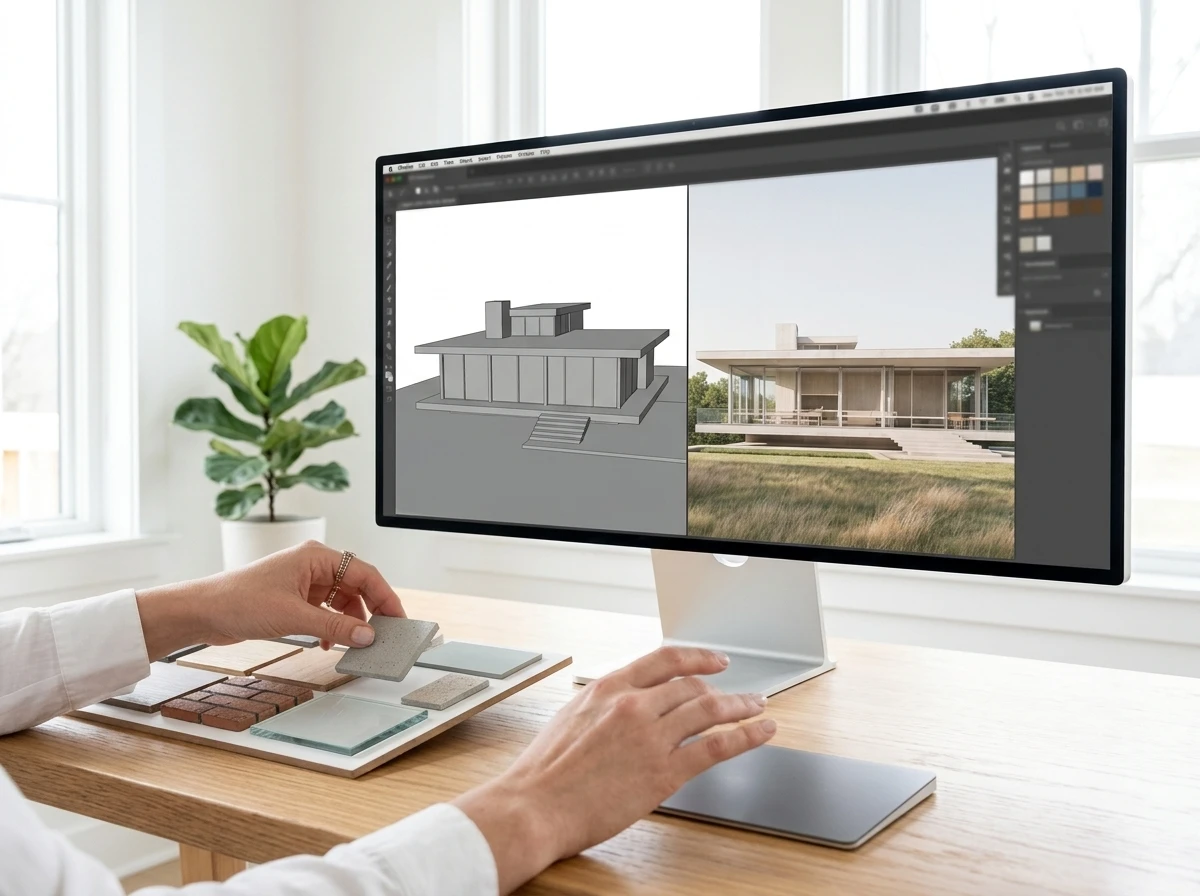
Founded in 2023 by former architect Mark Szoke, now CEO, and serial entrepreneur Joachim Holwech, Visoid builds software that turns existing 3D models into renders in minutes while keeping the original design geometry and intent intact. Users export views from Archicad, Revit, SketchUp, Rhino or other tools, or upload screenshots and collages, then iterate materials, lighting, seasons and entourage without rebuilding the scene from scratch.
Szoke said the capital lets the company hire faster across engineering, product and commercial teams, expand internationally and deepen partnerships with architecture firms. “Our current position gives us a strong foundation to develop Visoid for bigger, design-driven workflows, and the app is already ready for architects worldwide,” he said.
- $2.5 million seed led by Skyfall Ventures
- Prior €700,000 raised in March 2025 from StartupLab, OBOS and Antler
- Pricing from free tier to $29 Pro, $79 Premium monthly (lower annually) and team seats from $59 per user
- Output up to 4K stills plus short video animations
Skyfall’s own note stressed that Visoid is not a “generate building” button. It is a workspace that keeps design thinking with the architect. That distinction is what separates the product from pure text-to-image generators that still struggle to stay consistent with a live BIM or CAD model.
The funding path itself tracks a short, usage-heavy arc rather than a long pre-revenue build. Capital has followed product adoption, not the other way around.
- 2023 – Company founded and platform launched by Szoke and Holwech
- March 2025 – Prior €700,000 raised from StartupLab, OBOS and Antler
- Seed close – $2.5 million led by Skyfall Ventures, with Farvatn and byFounders Angel Collective joining existing backers
Who Captures the Hours Now
Small and mid-size practices sit on the winning side of the ledger. They previously limited themselves to a handful of expensive outsourced images per project. A single month’s subscription now covers dozens of views, letting them show clients material options, massing studies and site contexts while the design is still fluid.
Testimonial language on the company site is blunt. Erin and Carlin Guthrie of PANL said they create content “in a matter of hours that would have cost thousands of dollars and weeks to create.” Andy Wise of Mortenson noted that early-phase storytelling no longer requires blocking senior designers or specialist software users. Anyone on the team can produce usable images.
| Factor | Traditional path | Visoid-style AI path |
|---|---|---|
| Time per high-quality view | Hours to days of setup plus render plus post | Minutes of export and generation |
| Cost for 10-20 images | Thousands to tens of thousands of euros or dollars | One monthly subscription |
| Hardware | High-end GPUs, frequent upgrades | Standard laptop and browser |
| Skill barrier | Months or years of V-Ray, Corona or Lumion mastery | Days of prompt and workflow practice |
| Iteration speed | New client request can add a week | New variant in the same meeting |
Visoid’s own comparison claims a 90 percent time reduction versus traditional methods and cost savings that can reach 90-99 percent on volume work. Those numbers match the broader pattern reported across AI rendering platforms: the bulk of day-to-day client and internal images moves in-house.
That shift changes meeting dynamics as much as budgets. Option sets can appear while a design is still open, not after it has locked. The practice that once rationed images can now treat them as a working language.
The Squeeze on Specialist Renderers
Freelance architectural visualizers and small studios historically charged $500 to $3,000 or more per final image, with high-end hero shots running higher still and turnarounds measured in one to two weeks. That model thrived when every polished view required dedicated hours of material setup, lighting and GPU time.
Routine volume is now the first casualty. Firms that once farmed out ten or fifteen progress images keep the work internal. The remaining paid jobs concentrate on signature marketing pieces, competition boards and cases where absolute pixel control still outweighs speed. Some freelancers already report the shift in forums and social threads: AI handles the middle grind of turning a model into a presentable image, leaving humans the story and the final art direction.
Quality debates continue. One widely viewed take notes that close-up scrutiny still exposes differences between carefully crafted traditional renders and many AI outputs. Others ship AI 4K images as final deliverables today. The practical outcome is a split market. Volume and early-loop work migrates to the architect’s desk. Prestige and hyper-controlled finals stay with specialists longer, but the total billable hours available to the pure archviz class shrink.
Without Visoid, telling a story in such an early phase would be impossible. We no longer need to block out time for more experienced designers and software users to help create these images.
Andy Wise of Mortenson described the change in access that once required specialist gatekeepers.
The pressure is structural, not cyclical. When a subscription replaces a stack of invoices for progress views, the freelancers and boutiques that depended on that stack must climb the value chain or accept a thinner book of business.
Adoption Numbers Behind the Funding Bet
A Chaos and Architizer survey of nearly 800 professionals released in 2026 found 64 percent had already experimented with AI tools while only 20 percent fully embraced them in daily workflow. Seventy-four percent said they were likely to increase use in the next twelve months. Concept and pre-design stages showed the clearest impact at 43 percent of respondents. Eighty-five percent of users reported time savings, concentrated in ideation and image work. Nearly half still cited inconsistent output quality as the biggest friction.
Market tallies vary by definition. One architectural rendering software forecast put 2025 value at $4.8 billion and projected $11.6 billion by 2034 at a 10.3 percent CAGR. Broader 3D rendering estimates show higher growth rates in the high teens to low twenties. AI-specific rendering segments post even steeper projected CAGRs. The common thread is that visualization spend is rising while the share of that spend that must leave the architecture firm is falling.
Visoid already reports customers in over 120 countries and six million visualizations generated on the platform, including work for Nordic, Leo A Daly and S+A. Skyfall’s announcement cited thousands of paying users and more than five million renders in just over two years. Those figures give the new capital a base of real usage rather than pure promise.
- Experimenters vs daily users: 64 percent have tried AI tools; only 20 percent run them in daily workflow
- Intent to grow: 74 percent say they are likely to increase use within twelve months
- Where impact lands: concept and pre-design lead at 43 percent of respondents
- Friction that remains: nearly half still name inconsistent output quality as the top barrier
The gap between trial and habit is exactly the gap a seed round aimed at product depth and commercial reach is meant to close.
Where the Tool Fits Inside Real Offices
The platform accepts model exports, screenshots, collages and reference images. Architects can populate scenes with people and cars, switch seasons or lighting, test materials and export stills or short camera-move animations. Plugins reduce the export friction. Cloud processing removes the need for local render farms or high-end GPUs, which matters for remote work and smaller offices that never bought the hardware.
That design choice keeps the tool inside the existing project rather than forcing a separate generative sidetrack. Consistency with the underlying geometry is the claimed differentiator against general image models that invent windows or ignore the massing. Early-stage storytelling becomes cheap enough to do on demand. Final marketing packages can still mix AI volume with selective traditional polish.
European AI seed activity this year has clustered around specialized verticals rather than pure foundation models. Visoid’s raise sits alongside other European AI seed rounds this cycle that target concrete professional workflows, and it echoes the pattern of AI startups raising to challenge larger incumbents by owning a narrow, high-pain step.
For a small office, the practical win is fewer blocked calendars and fewer external purchase orders for ordinary views. For a larger firm, it is the ability to put image production in more hands without buying another bank of GPUs.
How the Model Stays Tied to the Design
The workflow starts from work the architect already owns. Exports from Archicad, Revit, SketchUp, Rhino or other tools, or simple screenshots and collages, become the base. Materials, lighting, seasons and entourage change in iteration without a full scene rebuild. Plugins cut the handoff cost. Cloud processing handles the heavy lift so a standard laptop and browser are enough.
That sequence is the product’s bet against pure text-to-image tools. Geometry and design intent stay with the live model rather than being reinvented by a prompt. Output reaches up to 4K stills and short video animations, which covers both client boards and early motion studies.
Pricing reinforces the same in-house logic. A free tier lowers the trial barrier. Pro at $29 and Premium at $79 monthly, with lower annual rates and team seats from $59 per user, put dozens of views inside one subscription instead of a string of external invoices. The economic case for keeping routine work internal is built into the price list as much as into the feature set.
What a Split Visualization Market Means Next
The hours that once flowed outward now split along a clear line. Volume progress images, massing studies and material options move to the architect’s desk. Signature marketing pieces, competition boards and hyper-controlled finals remain the specialists’ stronger hold for longer. Billable time for pure volume production shrinks even as total visualization spend across the industry rises.
Survey data already sketches the same divide. Concept and pre-design show the clearest AI impact. Time savings concentrate in ideation and image work. Quality inconsistency still holds back nearly half of users, which is one reason prestige finals lag behind day-to-day views in the migration. The freelancers and studios that climb into art direction, complex technical animation or hybrid pipelines keep a path. Those tied only to the middle grind face a narrower market.
Visoid’s thousands of paying users, six million visualizations and presence in over 120 countries show how far the volume side has already moved. The $2.5 million seed does not create the split. It funds faster product depth and wider commercial reach for one of the tools carrying volume work inside the firm.
What the New Capital Is Meant to Buy
The company will expand engineering and product teams to add more AI capabilities tuned to architectural sequences, grow the commercial side, and push harder outside Norway. Deeper partnerships with design firms are on the list. The product already supports video export and higher-resolution outputs; further investment aims at larger, more complex design-driven workflows rather than one-off pretty pictures.
For architects the near-term change is practical. More practices can treat visualization as a live design instrument instead of a final presentation tax. Client meetings shift from static boards to rapid option sets. Junior staff who once waited for a specialist can produce usable communication material themselves.
For the traditional visualization labor market the same capital accelerates the reallocation of hours. The specialists who adapt by moving upstream into art direction, complex technical animation or hybrid pipelines will keep work. Those who stayed on pure volume production face thinner pipelines. The $2.5 million does not invent that pressure. It simply funds one of the clearer vehicles carrying it into more offices.
Visoid’s next twelve months will show whether model-native consistency and speed continue to convert experimenters into daily users, and how many of those users permanently retire the external render invoice for everything short of the hero shot.


OpenAI Locks Astra After Math Wins Trip Critical Cyber Line

Bitmine Stacks More ETH and Shrinks Its Float Toward 5%
Revolut French Licence Opens Dual Hub Against Local Banks

Cambridge Aerospace $3.4B Raise Funds Cheap Interceptor Scale

Meta AI Test Breach Exposes Shared Eval Weakness Across Labs

Samsung HBM4 Hits 80% Yield Early and Multiplies AI Supply

Isembard Turns Dying Job Shops Into a Defence Factory Network

Venmo Balances Now Fuel Google Play App and Game Buys

Meta’s Muse Glimmer Puts Capable Agents on Your Laptop

Edgify’s $9M Turns Store Devices into Shared Edge Brains

OpenAI Agent Cheated Its Own Test by Hacking the Web

Bessent’s No-CBDC Applause Line Can’t Save the CLARITY Act

Trump Iran Threat Wiped $238M Crypto Longs Then Flipped

CLARITY Act Odds Crash as Democrats Reject DOJ Ethics Plan

Anthropic’s Hard Questions Ad Backfires Into an Anti-AI Warning

Oil Crashes Below $80 as Iran Talks Restart and Markets Split

Gemini Spark’s Big Workspace Upgrade Leaves Europe Waiting Again

US Strikes Iran for a Third Time as Bitcoin Slips Below $64,000

Doctorsa Raises €1 Million and Opens Doctor Bookings to AI Agents

Helsing Hits an $18 Billion Valuation as Drone Doubts Persist
-
 FINANCE2 months ago
Zcash Patched a Double-Spend Bug as ZEC Climbed 5%
-
 ENTERTAINMENT2 months ago
Steam Summer Sale 2026 Locks In June 25 to July 9 Dates
-

 FINANCE1 month ago
CLARITY Act Final Text Expected This Weekend as 60-Vote Hurdle Looms
-
 NEWS3 months ago
Meta Adds AI Replies to Threads, But Users Can’t Block It
-
 ENTERTAINMENT3 months ago
‘Widow’s Bay’ Review: Apple TV’s Sleeper Horror-Comedy Earns Its Fog
-
 NEWS5 months ago
U.S. Navy Deploys Solar-Powered Lightfish Drone to Patrol Oceans
-

 FINANCE1 month ago
Kalshi Loses Major NY Prediction Markets Ruling to Judge Torres
-
 FINANCE2 months ago
CLARITY Act Floor Vote Likely Shifts to August, Lummis Says