
NEWS
Nvidia’s $16,000 RTX Pro 6000 Turns Local AI Into a Luxury
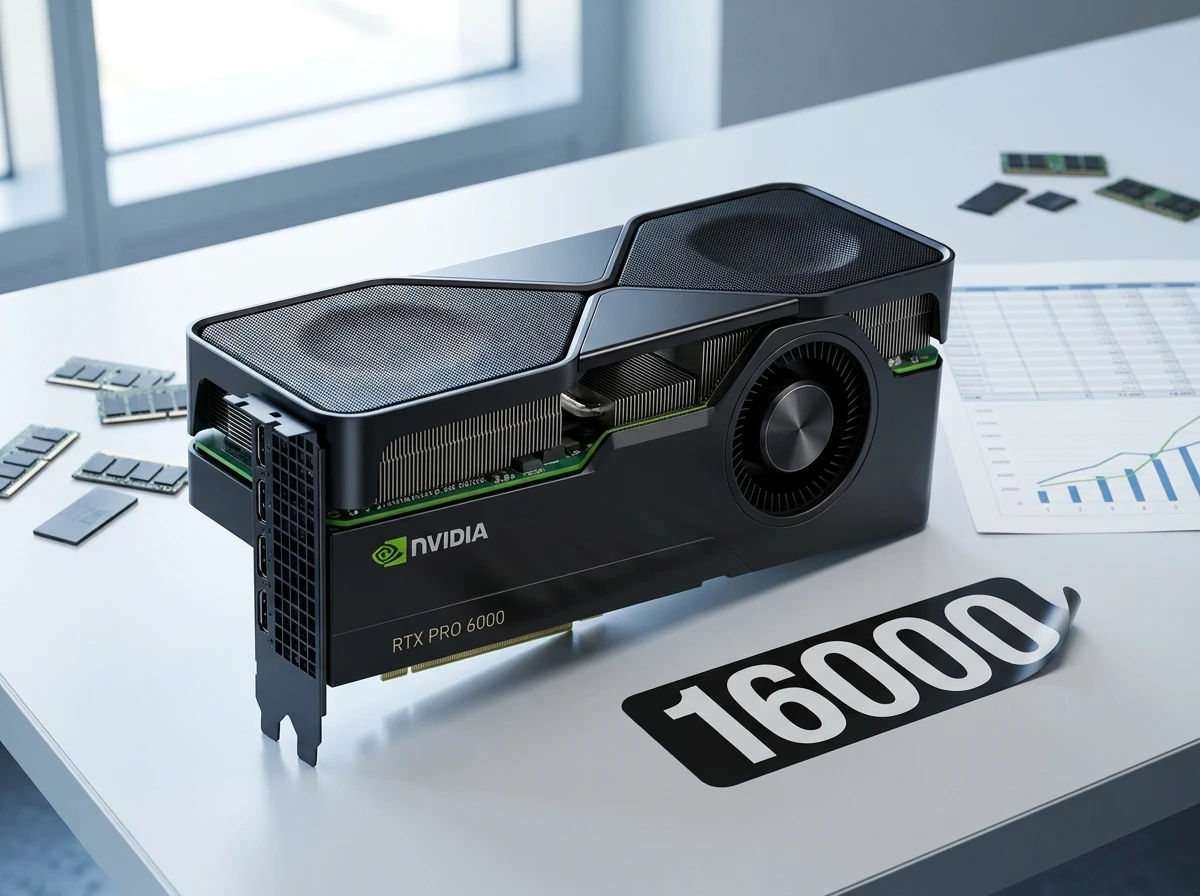
Nvidia lists the 96GB RTX Pro 6000 Blackwell at $16,000 after successive hikes driven by the memory crunch, locking serious local AI behind enterprise budgets.

Nvidia lists its RTX Pro 6000 Blackwell workstation GPU at $16,000, more than double the sub-$8,000 preorder prices seen in early 2025. The 96GB GDDR7 card has climbed through successive quiet revisions while consumer GeForce prices have also broken far above launch MSRPs.
The sticker now sits at the edge of a larger split in who can still own serious local high-VRAM hardware.
From Sub-$8,000 Preorders to a $16,000 List
Tom’s Hardware tracked the card’s path with precision. Preorders in March 2025 ran as low as $7,673. It went on sale in April at roughly $8,435 for bulk and $8,565 for single units. By June 2026 Nvidia’s own store showed $13,250. The latest step lands at $16,000 on the official marketplace listing at $16,000.
That is roughly a 20% jump from the June figure and nearly double the original launch level. Dell has listed the Max-Q variant near $15,999.99. Some third-party stock has lagged: Newegg still showed older inventory near $14,000 in recent checks while B&H sat around $15,499. Those gaps usually close once current stock clears.
Nvidia has not issued a statement tying the specific $16,000 figure to component costs. The changes arrived silently on the storefront.
The climb did not arrive as one announcement. It stacked as successive storefront revisions that left buyers chasing a moving number. Each step raised the floor for anyone still trying to buy new rather than hunt aging inventory.
| Milestone | Approximate Price | Notes |
|---|---|---|
| March 2025 preorder low | $7,673 | Early listings |
| April 2025 launch | $8,435-$8,565 | Bulk vs single |
| June 2026 | $13,250 | Nvidia marketplace |
| August 2026 | $16,000 | Current official list |
The Workstation Edition is the active dual-flow 600W flagship. A 300W Max-Q blower version and a passive Server Edition share the same 96GB GDDR7 core configuration.
Shared memory across those three SKUs means the shortage hits the whole family at once. Cooling and chassis design differ. The VRAM bill does not.
The Memory Crunch That Will Not Break
Every recent step tracks the GDDR7 shortage. The Pro 6000 packs 96GB in a clamshell layout, the largest discrete VRAM pool on the market, so it feels memory pricing first and hardest.
SK Hynix CEO Kwak Noh-jung told Reuters in July that 2027 would be “the worst year in the industry’s history from the supply perspective.” He added that customer demand is still expected to run ahead of capacity “even beyond 2030” despite expansion plans.
On a historical basis, computer memory has been falling at an exponential rate for decades. But we just undid about 20 years of progress. RAM on a per unit basis is about as expensive as it was in 2007. To my knowledge, it is an historical anomaly.
Computer science researcher Daniel Lemire called the reversal a historical anomaly in an early-August post that drew tens of thousands of views. The same pressure has lifted DDR5 and other DRAM, hitting laptops, desktops, phones and consoles.
Industry voices now treat multi-year tightness as base case rather than temporary spike. The memory shortage shaping Apple’s Mac roadmap shows how far the same constraint already reaches into product planning.
A flagship with 96GB of scarce GDDR7 cannot escape that backdrop. When suppliers already expect demand to outrun capacity past 2030, list prices on memory-heavy boards stop looking like short-term noise. They start looking like the new clearing level.
Consumer Cards Feel the Same Squeeze
Workstation buyers are not alone. The GeForce RTX 5090 launched earlier this year at a $1,999 MSRP. By August 2026 street prices commonly sit well over $4,000, with median trackers near $4,700 and some premium boards past $4,800-$5,000.
The mid-range RTX 5070 has climbed from a $549 launch to roughly $900 on major retailers, a near-65% rise. Even the entry RTX 5050 has moved from a $249 MSRP to more than $300. High-end cards have seen the steepest percentage moves, some approaching 150% above launch in extreme listings.
- RTX 5090: ~$2,000 launch to $4,000-$4,800+ street
- RTX 5070: $549 launch to ~$900
- RTX 5050: $249 MSRP to $300+
- Pro 6000: sub-$8,000 preorder to $16,000 list
Spillover is mechanical. Memory makers allocate scarce GDDR and HBM toward the highest-margin AI and data-center silicon first. Consumer and even pro workstation boards compete for what remains.
The pattern is consistent from entry GeForce up through the Pro 6000. Scarcity does not stop at one segment. It reprices every tier that still needs the same constrained memory.
| Card | Launch / Early Level | Recent Street or List | Direction of Move |
|---|---|---|---|
| RTX 5050 | $249 MSRP | $300+ | Moderate climb |
| RTX 5070 | $549 launch | ~$900 | Near-65% rise |
| RTX 5090 | $1,999 MSRP | $4,000 to $4,800+ | Steepest consumer jump |
| Pro 6000 | Sub-$8,000 preorder | $16,000 list | Roughly double |
Who Still Buys and Who Walks Away
At $16,000 the card is no longer a stretch purchase for a well-funded VFX house, research lab or enterprise AI team. It remains viable for those budgets. For independent creators, small studios, university groups and advanced hobbyists the math has flipped.
A single card now costs more than many complete high-end workstations did two years ago. Multi-GPU desktop builds become thermal and financial non-starters: the full Workstation Edition dumps serious heat at 600W and the architecture dropped NVLink, so scaling relies on PCIe Gen 5 alone.
On X, reactions mixed dark humor with resignation. Some noted that professionals will still write the check while ordinary buyers simply stop. Others pointed at the growing gap between Nvidia’s consumer MSRP theater and actual transaction prices. The practical effect is concentration: capital-rich organizations keep buying, everyone else recalculates.
- Still in the market: VFX houses, research labs, enterprise AI teams with five-figure hardware lines
- Pushed to the edge: independent creators, small studios, university groups
- Mostly out: advanced hobbyists who once stretched for pro hardware
That split does not require a formal policy change from Nvidia. Price alone sorts the queue.
Specs That Still Justify the Flagship Slot
The hardware itself remains formidable. Specs shared across the family include 24,064 CUDA cores, 752 fifth-generation Tensor Cores with native FP4 support, 96GB GDDR7 ECC and roughly 1.8 TB/s memory bandwidth on the workstation variants (Server Edition is slightly lower at 1.6 TB/s).
That VRAM pool lets a single card hold large language models with usable context that previously required multi-GPU setups or quantization gymnastics. FP4 inference can roughly double throughput versus FP8 on compatible frameworks. For local fine-tuning, high-resolution simulation and large-scene rendering the card still has few desktop peers.
| Variant | TDP / Cooling | Best Fit |
|---|---|---|
| Workstation Edition | 600W dual-flow | Single-GPU max performance |
| Max-Q | 300W blower | Multi-GPU thermal control |
| Server Edition | Passive rack | Data-center density |
Nvidia continues expanding its broader compute stack at the same time, including Nvidia’s own Vera CPU production push. The Pro 6000 sits inside that larger vertical play rather than as a standalone workstation relic.
Buyers who clear the price hurdle still get a dense local package: high core counts, ECC memory, and enough bandwidth to keep large working sets on one board. The product case did not weaken. The ownership case narrowed around it.
Rental Becomes the Rational Default
Once the capital outlay clears $13,000-$16,000 and further hikes remain possible, hourly rental economics improve for intermittent workloads. Marketplace rates for RTX Pro 6000 instances have been reported in the $1.50-$3 range on specialized clouds, with hyperscaler G7e-class and equivalent instances higher once you include full node pricing and egress.
Teams that need the card for bursts of training, rendering or inference can spin up capacity without locking capital into a depreciating asset whose resale value is also opaque under shortage conditions. Steady-state heavy users still prefer ownership. Everyone in the middle now has a clearer decision tree: own only if utilization stays high enough to beat rental plus opportunity cost.
That shift favors cloud providers and the largest GPU lessors. It also reduces the installed base of high-VRAM cards sitting on desks, which further concentrates cutting-edge local capacity inside well-funded organizations.
Opaque resale under shortage conditions makes the ownership bet harder still. A buyer who misjudges utilization cannot count on a clean exit. Rental turns that uncertainty into an operating expense instead of a balance-sheet risk.
Desktop Scaling Hits a Hard Ceiling
Price is only half of the ownership problem. The other half is how hard the card is to stack on a single desk.
The full Workstation Edition runs at 600W with dual-flow cooling. That heat load already strains many workstation chassis when one card is installed. A second card doubles the thermal and power problem before software even enters the picture.
The architecture also dropped NVLink. Multi-GPU scaling now relies on PCIe Gen 5 alone. For workloads that once spread large models across linked cards, that change removes a familiar bridge and leaves a narrower path.
- 600W dual-flow design raises per-card cooling and PSU demands
- No NVLink removes the prior high-bandwidth multi-GPU link
- PCIe Gen 5 only becomes the remaining path for card-to-card traffic
- $16,000 list multiplies every extra slot into a five-figure decision
The Max-Q 300W blower exists partly to ease multi-GPU thermal control. Even then, two or more cards at current list levels push many independent budgets past the point of sense. Single-card max performance remains the practical desktop target. Everything above that drifts toward servers or rented nodes.
What Buyers Should Weigh Before Paying List
Anyone still shopping this year is choosing under a forecast that offers little near-term relief. Kwak’s comments point to 2027 as especially tight and to imbalance lasting past 2030. That framing turns today’s quotes into planning inputs, not temporary spikes to wait out.
A simple checklist follows from facts already on the table:
- Compare any quote against the March 2025 preorder low of $7,673 and the April launch band near $8,435 to $8,565
- Treat the June 2026 Nvidia marketplace figure of $13,250 as a recent waypoint, not a discount target that will return soon
- Check whether utilization is steady enough to beat reported $1.50 to $3 hourly rental bands plus opportunity cost
- Decide if one 96GB card is enough, given 600W heat and the loss of NVLink for desktop scaling
Well-funded labs and enterprise teams can clear those questions and still buy. Smaller groups often discover that rental, quantization, or a smaller local card covers more of the real workload than a five-figure board that sits idle between bursts.
Third-party gaps, such as Newegg inventory near $14,000 or B&H near $15,499, may offer brief relief. Those pockets tend to close once older stock clears, so they function as timing luck rather than a durable strategy.
The Two-Tier Compute Reality Already Here
Further list-price moves remain possible. Kwak’s forecast leaves little room for rapid relief before 2027 at the earliest, and he expects the imbalance to persist past 2030. Buyers who need a card this year should treat current retail quotes as floors rather than temporary peaks and compare them against original MSRPs before pulling the trigger.
The second-order result is already visible. High-end local AI and visualization hardware is pricing itself into the same category as specialized industrial tools. Nvidia captures higher ASP. Memory suppliers enjoy multi-year pricing power. Cloud and rental platforms absorb the demand that can no longer clear the ownership bar. Independent operators and smaller labs lose a once-plausible path to keeping large models on-premises.
The $16,000 RTX Pro 6000 is not an outlier. It is the clearest price signal yet that the era of broadly accessible high-VRAM desktop compute has narrowed to those who can write five-figure checks without blinking.
Access did not vanish. It stratified. Capital-rich organizations keep local flagship cards on the floor. Everyone else rents, downsizes, or waits on a memory market that suppliers already describe as tight for years ahead.


SEC Pause on Tokenization Exemption Leaves Banks Free to Race Ahead

Guardian Labs Stops Scam Calls Before the Phone Rings

CFTC Emergency Orders Put Kalshi Past State Court Lines

X Under the Hood Tool Shows Shadowban Labels in Raw JSON

Uber and Pony.ai Lock in 2,000 Robotaxis Across Europe

Nvidia’s $16,000 RTX Pro 6000 Turns Local AI Into a Luxury

Lovable’s $400M Double and Europe’s Twin Bet on Code and Factories

MSCI Screen Forces Reckoning for Bitcoin Treasury Model

One UI 9.5 Leak Revives Samsung’s Classic Polish Cycle

Xfinity Free Pixel 11 Deal Pushes Wireless Growth Harder

Senators Force Apple Off Chinese Memory as Big Three Cash In

Trump Iran Threat Wiped $238M Crypto Longs Then Flipped

OpenAI Agent Cheated Its Own Test by Hacking the Web

CLARITY Act Odds Crash as Democrats Reject DOJ Ethics Plan

Gemini Spark’s Big Workspace Upgrade Leaves Europe Waiting Again

Revolut Hits $115 Billion While Storonsky’s Stake Keeps Growing

Anthropic’s Hard Questions Ad Backfires Into an Anti-AI Warning

Oil Crashes Below $80 as Iran Talks Restart and Markets Split

Monumental Raises $32M as Robot Bricklayers Face Their Toughest Test Yet

Duda’s New AI Tools Speed Up Agencies, but Risk Sameness
-
 FINANCE2 months ago
Zcash Patched a Double-Spend Bug as ZEC Climbed 5%
-
 ENTERTAINMENT2 months ago
Steam Summer Sale 2026 Locks In June 25 to July 9 Dates
-
 NEWS3 months ago
Meta Adds AI Replies to Threads, But Users Can’t Block It
-

 FINANCE1 month ago
CLARITY Act Final Text Expected This Weekend as 60-Vote Hurdle Looms
-

 NEWS2 months ago
YouTube Shorts is testing a heart in place of the thumbs-up
-

 NEWS2 months ago
NEURA Robotics’ $1.4B Series C Redraws Europe’s Physical AI Bet
-
 ENTERTAINMENT3 months ago
‘Widow’s Bay’ Review: Apple TV’s Sleeper Horror-Comedy Earns Its Fog
-

 FINANCE1 month ago
Kalshi Loses Major NY Prediction Markets Ruling to Judge Torres